What Is Sales Intelligence? A Guide to Winning More Deals

Imagine trying to navigate a new city with an old, paper map. You’d probably find your way eventually, but you'd be completely blind to the brand-new bypass, the unexpected road closures, and the real-time traffic jams. That’s what selling without modern tools feels like.
Sales intelligence is your real-time GPS. It doesn't just show you the map; it guides you to the right prospects with the right message at the perfect moment.
What Is Sales Intelligence and Why Does It Matter Now
At its heart, sales intelligence is the whole process of gathering, analysing, and then actually using data to make your sales process smarter. But let's be clear: this is so much more than a glorified contact list. It’s a complete shift in strategy that turns messy, raw data into a clear roadmap for closing deals.
This shift isn't just a "nice-to-have" anymore. It's essential. Today’s buyers are incredibly well-informed and their expectations are sky-high. They’ve done their research. They don't want a generic pitch; they expect you to walk into the very first conversation already understanding their unique challenges and business context.
The Evolution from Pitching to Connecting
Not too long ago, sales was a pure numbers game. Success was measured by how many calls you made or how many emails you blasted out. The top performers today, however, focus on building genuine connections. And that requires a level of understanding that goes way beyond basic details like company size or industry.
Sales intelligence changes your entire mindset. You stop asking, "Who can I sell this to?" and start asking, "How can I genuinely help this specific person?" It’s the difference between shouting a message from a megaphone and starting a real conversation.
This is where the power of modern sales intelligence really clicks. It gives you the context you need to build that bridge. For example, knowing a prospect's company just landed a new round of funding or hired a new VP of Engineering gives you a timely, relevant reason to reach out that immediately sets you apart. To really get how this fits into the bigger picture, it helps in understanding sales operations and how every piece of the revenue engine works together.
The New Competitive Advantage
The most powerful form of sales intelligence today adds a critical layer that most people miss: the human element. It's no longer enough to know what a prospect's company does. To win, you need to understand how that prospect thinks, communicates, and makes decisions.
This is the new frontier.
Modern tools can now help you see the personality traits and communication styles that traditional data completely overlooks. Think about what you could do with that kind of insight:
- Pinpoint decision-makers who respond best to data-driven, logical arguments versus those who prefer hearing relatable stories.
- Recognise prospects who value a collaborative, relationship-first approach from the get-go.
- Tweak your messaging on the fly to match their specific communication patterns, making your pitch resonate on a much deeper level.
This kind of insight allows for truly empathetic and informed outreach. Your interactions stop feeling like a sales pitch and start feeling like a helpful consultation. By starting from this place of deep understanding, you lay the groundwork for stronger relationships, shorter sales cycles, and more closed deals. You can see just how impactful this is by exploring how AI-powered sales intelligence is completely reshaping what effective selling looks like.
The Core Components of a Modern Sales Intelligence Engine
To really get what makes sales intelligence work, you need to look under the bonnet. It’s not just one piece of tech; it’s a dynamic system with three critical parts working in sync: robust data sources, intelligent analytics, and genuinely actionable insights. Each part builds on the last, turning a sea of raw information into a clear path to closing a deal.
This whole process changes how sellers see their market. The concept map below shows this shift from a traditional, reactive way of selling to a modern, insight-driven strategy.

As you can see, sales intelligence acts like a GPS. It gives you the context and direction that old-school methods always lacked, paving the way for data-driven growth.
Diverse Data Sources: The Fuel
It all starts with data—the more varied and high-quality, the better. A modern sales intelligence platform pulls information from a huge range of sources to paint a rich, multidimensional picture of your prospects and their companies. Forget basic contact lists; this is about deep context.
Key data types include:
- Firmographic Data: This is the bedrock, covering company size, industry, location, and revenue. It helps you zero in on your ideal company profile.
- Technographic Data: This reveals the tech stack a company is using. Knowing they use a competitor’s product or a complementary tool is the perfect conversation starter.
- Buying Signals & Intent Data: This is where the magic really happens. This data tracks online behaviour—like content downloads, topic searches, or website visits—that signals a company is actively researching solutions just like yours.
This data collection is constant and automated, making sure the information you get is fresh and relevant. That gives you a massive timing advantage.
Intelligent Analytics: The Engine
Raw data on its own is just noise. The second component, analytics, is the engine that processes all that information to find meaningful patterns. This is where artificial intelligence comes in, sifting through millions of data points to connect dots that no human could ever spot on their own.
For example, an AI might notice that companies that recently hired a new Chief Marketing Officer and downloaded a whitepaper on customer retention are 85% more likely to buy a new analytics tool within the next quarter. That’s not a guess; it's a data-backed prediction.
An effective sales intelligence engine doesn't just show you data; it interprets it for you. It answers the "so what?" by turning disconnected facts into a cohesive story about a prospect's needs and readiness to buy.
This analytical power is especially potent in regions with high data volume. Take Singapore, for example. Sales intelligence adoption there is surging, with its market share projected to top 70% by 2035. This growth is driven by the need for advanced analytics to make sense of the massive datasets available.
Actionable Insights: The GPS Navigation
The final, and most important, piece of the puzzle is turning all that analysed data into actionable insights—specific, practical steps a sales professional can take right away. This is the difference between knowing a fact and knowing what to do with it.
To see what this means in practice, let’s compare the old way with the new.
Traditional Data vs Sales Intelligence Insights
This table shows the leap from basic contact information to the deep, actionable insights that modern sales intelligence provides.
| Data Point | Traditional Approach (Standard CRM Data) | Sales Intelligence Approach (Enriched Insights) |
|---|---|---|
| Contact Info | John Doe, VP of Marketing at Acme Inc. | John Doe recently spoke at a conference on customer retention and is active in three marketing subreddits. |
| Company Info | Acme Inc., 500 employees, technology sector. | Acme Inc. just secured Series B funding, posted 5 new roles in its marketing team, and its web traffic shows high interest in "customer journey mapping." |
| Sales Trigger | Quarterly follow-up scheduled in CRM. | Alert: Acme Inc.’s intent score for "analytics software" just spiked. AI suggests reaching out with a case study on ROI for similar-sized tech firms. |
| Meeting Prep | Review past emails and company website. | AI-generated talking points based on John’s communication style. Key insights: he’s data-driven and focused on efficiency. Mention their recent funding round. |
The difference is night and day. One gives you a name and number; the other gives you a strategy.
Instead of just telling you a prospect’s job title, an advanced platform provides AI-generated talking points tailored to that person’s likely communication style. It helps you prepare for a call in seconds, not hours. For a deeper dive, check out our guide on how effective customer profiling works to see how these insights are built.
These insights are the final output of the sales intelligence engine, delivered right into your workflow to help you build rapport, handle objections, and ultimately, win more deals.
How Top Performers Use Sales Intelligence
Alright, let's move from theory to what actually works on the ground. Sales intelligence isn't just a spreadsheet of data points; it's a strategic weapon that the best in the business wield to completely change their outcomes. Top performers don't just have information—they use very specific insights to drive precise actions.
They understand the human element hiding behind the numbers. This allows them to tailor every single interaction to resonate deeply with their prospect, whether they're a C-suite executive, a sharp-eyed investor, or a high-net-worth client. It’s this laser-focused approach that separates average results from the truly exceptional wins.
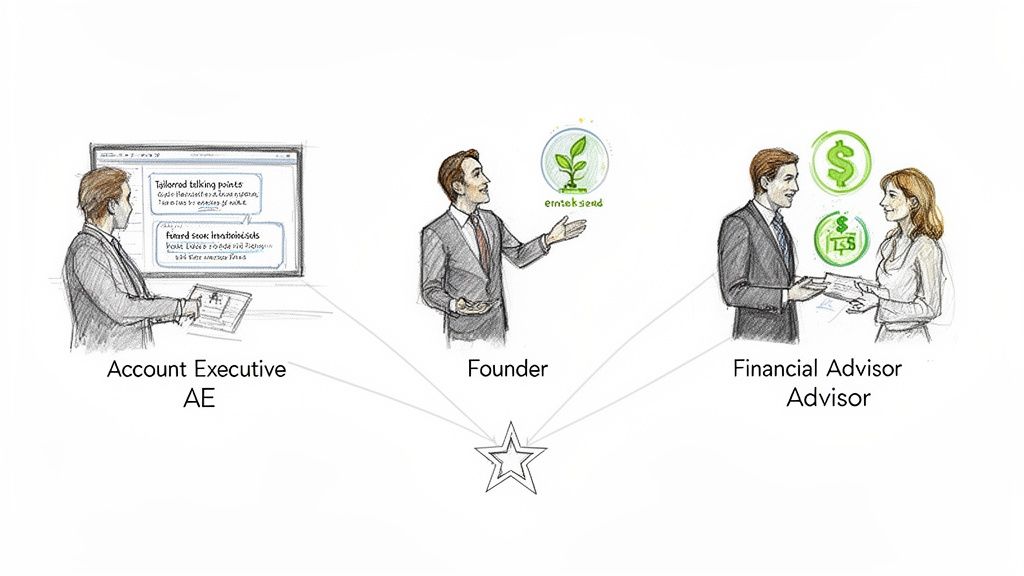
Let's walk through a few real-world scenarios. We'll see how different professionals use these insights to turn tricky conversations into closed deals.
The Account Executive Securing a High-Stakes Demo
Picture this: Sarah, an Account Executive (AE), is prepping for a critical demo with a notoriously sceptical Chief Technology Officer. Her standard sales intelligence tool gave her the usual stuff—company size, revenue, tech stack. It was handy, but it didn't give her a real edge.
But then, a more advanced platform revealed something crucial about the CTO's communication style. He was a classic "Wizard" archetype—analytical, data-driven, and allergic to marketing fluff. The intelligence brief told her to skip the grand, visionary opening and lead with hard numbers and a crystal-clear ROI breakdown.
Armed with this, Sarah ripped up her old presentation. Instead of a flashy intro, she opened with, "Based on your current stack, our platform can reduce your data processing costs by 18% in the first six months. Let me show you the exact three steps to get there."
The CTO, who was bracing for another generic pitch, immediately leaned in. By speaking his language, Sarah earned his trust and respect in the first two minutes. The rest of the demo felt less like a sales pitch and more like a collaborative problem-solving session. The result? A signed contract just two weeks later.
This is the real power of modern sales intelligence. It’s not about finding a contact; it's about finding the right way to connect with that contact. It shifts the dynamic from a persuasive push to a consultative pull.
This focused approach is absolutely vital in competitive markets. In Singapore, for instance, the sales intelligence scene is exploding as part of the region's AI boom. The Asia Pacific market is poised for massive growth, fuelled by AI startups and heavy investment in sales tech that makes this kind of deep personalisation possible. You can read the full research on the APAC market to see just how big this trend is becoming.
The Founder Winning Over a Key Investor
Now, let's look at Ben, a startup founder chasing seed funding. He landed a meeting with a well-known venture capitalist famous for being tough to impress. Ben's gut instinct was to just overwhelm her with technical details about his product's architecture.
His sales intelligence tool, however, flagged the investor as an "Explorer" archetype. This personality type is moved by vision, big-picture impact, and powerful stories of disruption. The platform suggested Ben pivot away from the technical weeds and instead focus on the human story behind his company and its long-term potential.
So, during the pitch, Ben changed his entire approach. He opened with the story of the customer problem that sparked his idea, painting a vivid picture of the future market he was creating.
He used phrases like, "Imagine a world where..." and zeroed in on the transformative impact his startup would have. This narrative-driven pitch captivated the investor, who was far more interested in the "why" than the "how." Ben secured the funding—not because of his code, but because he connected with her visionary mindset.
The Advisor Building Instant Trust with a New Client
Finally, there’s Maria, a financial advisor meeting a potential high-net-worth client for the first time. In her world, trust is everything, and it can often take months, even years, to build.
Sales intelligence gave Maria the usual background info, but more importantly, it identified her prospect as a "Healer" archetype. This is someone who values security, stability, and genuine, long-term relationships. The AI recommended she steer clear of aggressive investment talk and instead focus on building rapport and showing she was committed to his family's financial well-being.
Maria opened the meeting by discussing shared community interests she’d uncovered, rather than jumping straight into portfolio performance. She listened intently, asked about his legacy goals, and framed her services as a way to create a secure future for his children.
This empathetic, relationship-first approach was exactly what the client needed to feel at ease. He signed on with her that same week, telling her that her genuine interest in his personal goals was the deciding factor. Maria’s success shows how intelligence can dramatically speed up the trust-building process, a cornerstone of the art of high-ticket closing.
Adding the Human Element to Your Data
Standard sales intelligence gives you the blueprint of a company—its size, revenue, and the tech it uses. This tells you what the business does. But what if you could go deeper? The next generation of intelligence reveals how the people inside that business think, communicate, and ultimately, make decisions. This is the crucial human element.
Without this layer, you’re flying blind. You might have the right company on your list, but you’ll almost certainly use the wrong approach to connect with them. It’s the difference between knowing a building’s address and having the key to get in the front door.
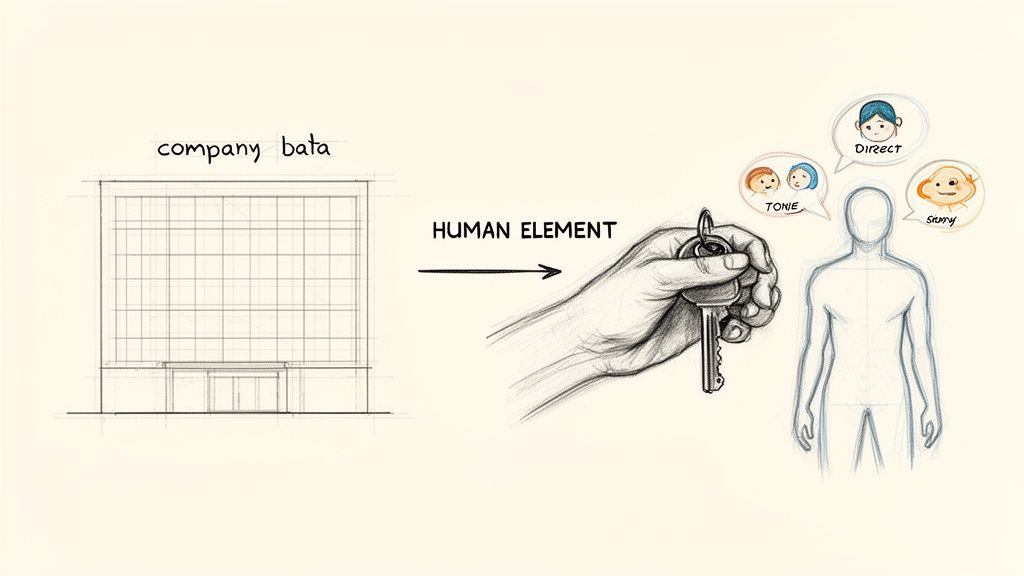
This human-centric approach doesn’t replace your sales skills; it makes them surgically precise. It’s about building genuine rapport faster, navigating objections with empathy, and creating real connections that a generic email blast could never hope to achieve.
Decoding Communication Styles and Personalities
The most advanced sales intelligence platforms have moved beyond company stats. They now analyse digital footprints and communication patterns to identify practical personality archetypes that you can actually use in a sales conversation. This isn't some vague personality quiz; it's a framework built for the real world.
Imagine knowing, before you even type an email, whether your prospect is a:
- Knight: Direct and decisive. They value efficiency and want to see the bottom-line results, no fluff.
- Explorer: A big-picture visionary. They’re motivated by compelling stories and transformative potential, not minor details.
- Healer: Relationship-driven and security-focused. They prioritise trust, stability, and understanding the human impact of a decision.
- Wizard: Analytical and data-obsessed. This person needs to see the logic, the evidence, and a step-by-step breakdown before even considering a proposal.
Knowing this changes everything. You stop guessing and start adapting your strategy from the very first interaction.
From Data Points to Dialogue
This deeper level of insight translates raw data into a conversational playbook. It turns abstract information into tangible actions that directly influence your outcomes. To truly empower your sales team, adding the human element means mastering actionable data that drives smarter conversations.
Suddenly, you can prep for a meeting in minutes, not hours. The right platform can even generate talking points tailored specifically to your prospect’s archetype.
Instead of a one-size-fits-all pitch, you enter every conversation with a clear advantage. You know exactly what motivates your buyer, what they value, and how they prefer to be spoken to.
This level of preparation elevates you from a simple vendor to a trusted advisor. It shows you’ve done your homework and that you respect their time and communication preferences—the fastest way to build the trust needed to close high-value deals.
Practical Application: The Mindreader Advantage
So, what does this look like in the real world? Consider these scenarios where human-centric sales intelligence provides a clear winning edge:
Scenario 1: The Direct Approach
- The Data: Your prospect is a classic "Knight" archetype.
- Your Action: You skip the lengthy small talk and lead with a bold subject line like, "3 Ways to Increase Your Team's Output by 15%." Your email has three bullet points and a clear call to action.
- The Result: Your directness earns their respect and a quick reply.
Scenario 2: The Visionary Pitch
- The Data: Your prospect is an "Explorer" who gets excited by big ideas.
- Your Action: In your demo, you spend less time on feature walkthroughs and more time painting a picture of how your solution will redefine their industry in five years.
- The Result: You capture their imagination and get buy-in on the long-term vision, not just the short-term features.
This is exactly where Mindreader excels. It doesn’t just dump data on you; it gives you clear direction. By profiling prospects into these practical archetypes, it provides the specific messaging, pacing, and meeting tactics you need to connect on their terms. It closes the massive gap between knowing who to talk to and knowing how to talk to them.
Integrating Sales Intelligence Into Your Workflow
Bringing a new tool into your daily operations can feel like a huge mission, but integrating sales intelligence doesn't have to be a painful process. The trick is to stop seeing it as another task to manage and start seeing it as a layer of insight that makes every sales activity you’re already doing more effective.
The goal is to weave these insights seamlessly into the natural flow of your team's day—prospecting, outreach, meeting prep, and follow-ups. When you get it right, it acts as an invisible amplifier, sharpening your team’s instincts and improving their results without adding friction. A smooth, practical rollout that delivers value from day one is what we're aiming for.
1. Define Your Primary Goal
Before you even glance at a demo, ask yourself one question: "What is the single biggest problem we need to solve?" Trying to fix everything at once is a surefire way to get nowhere. Instead, zero in on a specific, measurable outcome.
Maybe your cold email reply rates are abysmal, or perhaps too many deals are hitting a wall right after the first call. By pinpointing a single, critical pain point, you give your integration a clear sense of purpose.
- Example Goal 1: Increase our meeting-to-opportunity conversion rate by 20% in the next quarter.
- Example Goal 2: Cut the average sales cycle for enterprise deals from 90 days down to 75.
- Example Goal 3: Help each rep book 15% more qualified first meetings every month.
This sharp focus makes it worlds easier to pick the right platform and actually measure its impact.
2. Choose Tools That Connect Seamlessly
Your sales intelligence platform should make your team’s life easier, not harder. The most important technical detail? It has to play nicely with your existing Customer Relationship Management (CRM) system. If the insights can’t flow directly into the workspace where your reps spend their entire day, they just won't get used.
Look for tools that offer a simple browser extension or a native CRM integration. This lets reps pull up powerful insights without constantly switching tabs or manually copying and pasting information. A frictionless workflow isn't a "nice-to-have"; it's non-negotiable for getting your team on board.
3. Train Your Team to Interpret Insights
Having powerful data is one thing; knowing how to turn it into a compelling conversation is another. Training shouldn't be a dry, technical walkthrough of the software. It has to be about the real-world application of the insights.
The real art of sales intelligence is turning a data point into a dialogue. It’s about teaching reps how to use an insight about a prospect's communication style to build genuine rapport in the first 30 seconds of a call.
Set up role-playing sessions where reps can practise using personality insights to nail their opening lines, handle objections, and frame their value proposition. This hands-on practice builds the confidence they need to move from just knowing the data to using it fluidly when the pressure is on.
4. Measure Outcomes, Not Just Activity
Finally, a successful integration means you have to measure what actually matters. While it’s easy to track activity metrics like calls made or emails sent, those numbers don't tell you if your strategy is actually working. Instead, you need to focus on the outcome-based Key Performance Indicators (KPIs) you set back in step one.
Keep a close eye on metrics that directly reflect sales effectiveness:
- Deal Velocity: Are deals moving through the pipeline any faster?
- Win Rates: Is the percentage of closed-won opportunities climbing?
- Average Deal Size: Are reps getting better at upselling or landing bigger contracts?
When you measure these outcomes, the return on investment becomes crystal clear. This hard data is your best asset for getting team-wide buy-in and making a solid case for expanding the use of sales intelligence across the whole organisation.
Got Questions About Sales Intelligence?
As you start looking into sales intelligence, a few questions always pop up. It's natural. Getting your head around what this tech actually does—and how it fits into what you’re already doing without blowing everything up—is the first step. Let's clear the air and tackle the most common ones.
The goal here is to move past the buzzwords and get a real feel for how these tools actually help you close more deals.
How Is Sales Intelligence Different from a CRM?
This is the big one. A lot of people wonder if a sales intelligence tool is just a fancier, more expensive version of their CRM. The short answer is no—they’re two completely different tools that work brilliantly together.
Your CRM is your system of record. Think of it as your meticulously organised library, storing everything you already know about your customers and prospects. It tracks your history of calls, emails, deals, and contacts.
Sales intelligence, on the other hand, is your system of insight. It's a dynamic, forward-looking tool that tells you what you should know about your market. It finds new opportunities and adds timely context to the data you already have.
Imagine your CRM is a detailed map of your current territory. Sales intelligence is the live traffic updates, the weather forecast, and the best route suggestions for every single journey you take. One stores your history; the other guides your next move.
Is It Only for Big Enterprise Teams?
There's a common myth that sales intelligence is a luxury item, something reserved for massive enterprise teams with bottomless budgets. While big companies were definitely the early adopters, that’s not the reality anymore. Modern platforms have made these powerful insights accessible to businesses of every shape and size.
For small to medium-sized businesses (SMBs) and startups, it’s a game-changer. It lets smaller, nimbler teams punch well above their weight, competing on the quality of their insights rather than the size of their headcount. You can hyper-personalise your outreach and win deals against much larger competitors who are often too slow to adapt.
How Should I Get Started?
Jumping in can feel overwhelming, so the best way to start is to keep it simple. Focus on your single biggest sales headache right now. Is it the depressingly low reply rate to your cold emails? Or maybe deals keep stalling right after the first discovery call?
Pinpoint that one specific pain point. Then, find a tool designed to solve that problem. Run a small pilot programme with a couple of your reps and measure the impact on that single metric. This focused approach makes it dead simple to prove the ROI and builds a solid, data-backed case for rolling it out to the rest of the team.
Ready to stop guessing and start connecting? Mindreader provides the human-centric sales intelligence you need to understand how your prospects think and what they want to hear. Learn how to close more deals by adapting to your client's communication style.