AI Powered Sales Intelligence The Definitive Guide
Picture this: you have a digital co-pilot who has already met every single prospect, knows their personality inside and out, and can tell you exactly how to approach them. That's the real power of AI powered sales intelligence. It goes way beyond just storing data; it interprets behaviour to give you advice you can actually use.
It’s about turning static information into a dynamic playbook for building real, human connections.
What Is AI Powered Sales Intelligence
Let's be clear: traditional sales tools like CRMs are fantastic. They are your library for customer data—names, titles, deal histories, contact logs. All the essential facts. But they don't tell you why a deal is moving forward or how you could communicate better.
AI powered sales intelligence is the expert librarian for that data. It doesn't just stack the books; it reads them, connects the dots, and reveals the human story behind the data points. This technology shifts your focus from knowing what a prospect does to truly understanding who they are.
To see just how big this shift is, it's worth understanding AI's role in fueling a franchise boom and lead surge, which perfectly sets the stage for its wider impact on sales.
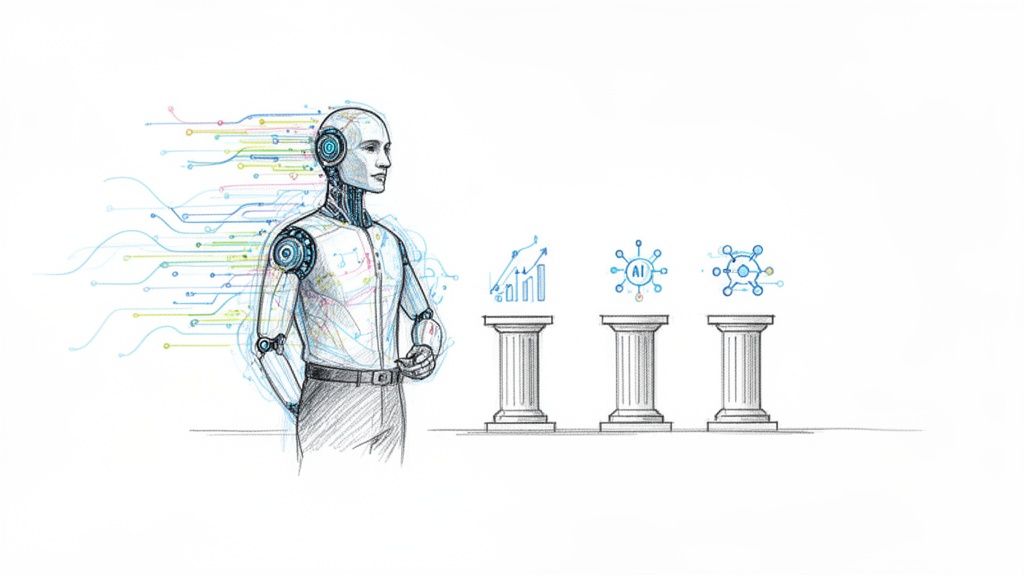
The Three Pillars Of Sales AI
At its heart, this whole approach rests on three core pillars. Think of them as a simple, three-step process that turns raw information into insights that drive revenue.
- Pillar 1: Data Synthesis: It all starts with gathering information from everywhere. We're talking public data from social media and company websites, plus all the internal gold sitting in your CRM and past emails.
- Pillar 2: AI Analysis: This is where the magic happens. Smart algorithms, powered by machine learning and natural language processing, sift through all that combined data. They're looking for patterns—in communication styles, personality traits, and buying habits.
- Pillar 3: Actionable Insights: Finally, the system translates its complex analysis into simple, practical advice for you. It spits out concrete recommendations on how to write that email, what tone to use in a meeting, or which talking points will actually land with this specific person.
The goal isn't just to dump more data on your plate; it's to deliver clarity. AI sales intelligence cuts through the noise to give you a predictive roadmap to a prospect's personality, their likely objections, and the decision-making triggers that actually matter.
This structured process doesn't replace a salesperson's intuition. It supercharges it with data-driven guidance, making every single interaction more personal and far more effective.
For a deeper dive, you can explore how generative AI enhances sales intelligence and opens up even more ways to understand your customers. At the end of the day, it's about giving sales professionals the tools to build rapport faster and close deals with a whole lot more confidence.
Traditional Sales Tools vs AI Powered Sales Intelligence
It’s easy to get these tools confused, but their functions are worlds apart. Traditional tools are about recording what happened; AI intelligence is about predicting what will happen next and guiding you on how to make it happen.
Here’s a simple breakdown of the key differences:
| Capability | Traditional Tools (CRM, Data Enrichment) | AI Powered Sales Intelligence |
|---|---|---|
| Primary Function | Data storage and organisation | Data interpretation and recommendation |
| Data Type | Static and historical (contacts, activities) | Dynamic and predictive (personality, intent) |
| Core Output | A record of past interactions | A playbook for future interactions |
| User Focus | "What happened?" | "What should I do next?" |
| Key Benefit | Centralised information | Personalised sales guidance |
While CRMs are the system of record, AI powered sales intelligence is the system of action. The two are most powerful when they work together, turning your historical data into a forward-looking strategy for every deal in your pipeline.
How AI Gets You Inside Your Prospect's Head
AI-powered sales intelligence does more than just gather data; its real magic is in the interpretation. Think of it as a digital anthropologist, observing a prospect's public behaviour to understand not just what they do, but who they are. This process turns a messy collection of digital footprints into a clear picture of someone’s communication style and what makes them tick.
It’s like putting together a puzzle. A single piece—like a LinkedIn post or a curt email reply—gives you a hint, but you can’t see the full picture. The AI gathers thousands of these public data points and fits them together, revealing a complete and actionable profile of your prospect.
Instead of guessing, you get a predictive roadmap to their personality. This lets you anticipate their needs, predict their objections, and know exactly which emotional triggers to pull—all before you’ve even said hello.
From Digital Signals to Human Insights
It all starts with analysing a massive amount of publicly available data signals. These are the digital breadcrumbs people leave behind as they go about their professional lives. The AI doesn’t just read the words; it digs into the context, tone, and structure to find the real meaning.
Some of the key signals include:
- Textual Cues: The system looks at the language used in emails, social media posts, and professional bios. It searches for patterns—do they use data-driven arguments, emotional language, or short, direct sentences?
- Digital Body Language: This is all about behaviour. How often do they engage with content? What kind of articles do they share? Are they active in professional groups? These actions reveal their priorities and what they care about.
- Professional Footprint: The AI examines a person's career history, company info, and industry. This builds a picture of their professional world and the specific challenges they’re probably facing.
By pulling all these signals together, the AI model starts to build a hypothesis about the person’s go-to communication style and personality archetype.
Turning Raw Data into Actionable Archetypes
Let’s be honest, raw data is useless. The real value comes when the AI model transforms these scattered signals into a practical profile you can actually use. It organises complex human behaviour into easy-to-understand communication style archetypes.
Instead of staring at a spreadsheet, you get a clear summary of your prospect's personality. This profile is your guide, telling you the best way to approach them to build real rapport and trust.
For example, the system might flag a prospect as a "data-driven decision-maker" who needs logic and evidence to be convinced. This insight is pure gold. It tells a salesperson to skip the fluffy, visionary pitches and lead with hard numbers, case studies, and a clear ROI breakdown. This is the heart of effective customer profiling, where technology helps you get on your audience’s wavelength. You can learn more about this in our guide on advanced customer profiling techniques.
A Real-World Example of AI in Action
Let's make this concrete. Imagine you need to sell new software to "Sarah," a CTO at a fast-growing tech firm.
Data Signal Collection: The AI scans Sarah's public info. It sees her LinkedIn is packed with technical articles and data charts. Her posts on industry forums are blunt, concise, and she loves to challenge claims that aren't backed by evidence. In company press releases, her quotes always focus on efficiency metrics and performance gains.
AI Synthesis and Profiling: The model pieces it all together. The obsession with data, direct language, and measurable results all point to one thing: she's analytical, sceptical, and values proof over promises. The platform profiles her as a "Wizard" archetype—logical, innovative, and focused on outcomes.
Actionable Insights Delivered: Now the system gives the sales rep a game plan.
- Email Outreach: "Write a short, direct email. Open with a killer stat on performance improvement and link to a technical whitepaper, not a marketing brochure."
- Meeting Preparation: "Your demo needs to focus on the backend architecture and security features. Get ready for very specific, technical questions."
- Objection Handling: "She’s going to ask about integration complexity and data validation. Have specific, data-backed answers ready to go."
Just like that, the sales rep isn't walking in blind. They have a data-driven strategy tailored specifically to Sarah's personality. This kind of smart preparation dramatically boosts the odds of building genuine rapport and pushing the deal forward, showing the real power of AI powered sales intelligence.
Putting AI Sales Intelligence Into Action
Knowing how AI-powered sales intelligence works is one thing, but watching it actually deliver results? That's the real test. Any new tech in sales has to prove its worth by sharpening your workflows, shrinking sales cycles, and helping you close more deals. This is where the theory becomes a practical, money-making playbook you can use at every step of the sales process.
Forget about generic templates and educated guesses. AI hands you a specific strategy for every single interaction. Let's break down exactly how you can use these insights at three crucial moments: before you ever reach out, during the meeting itself, and in that all-important follow-up.
This simple flow shows how the AI turns a mess of raw data points into a clear, actionable profile you can run with.
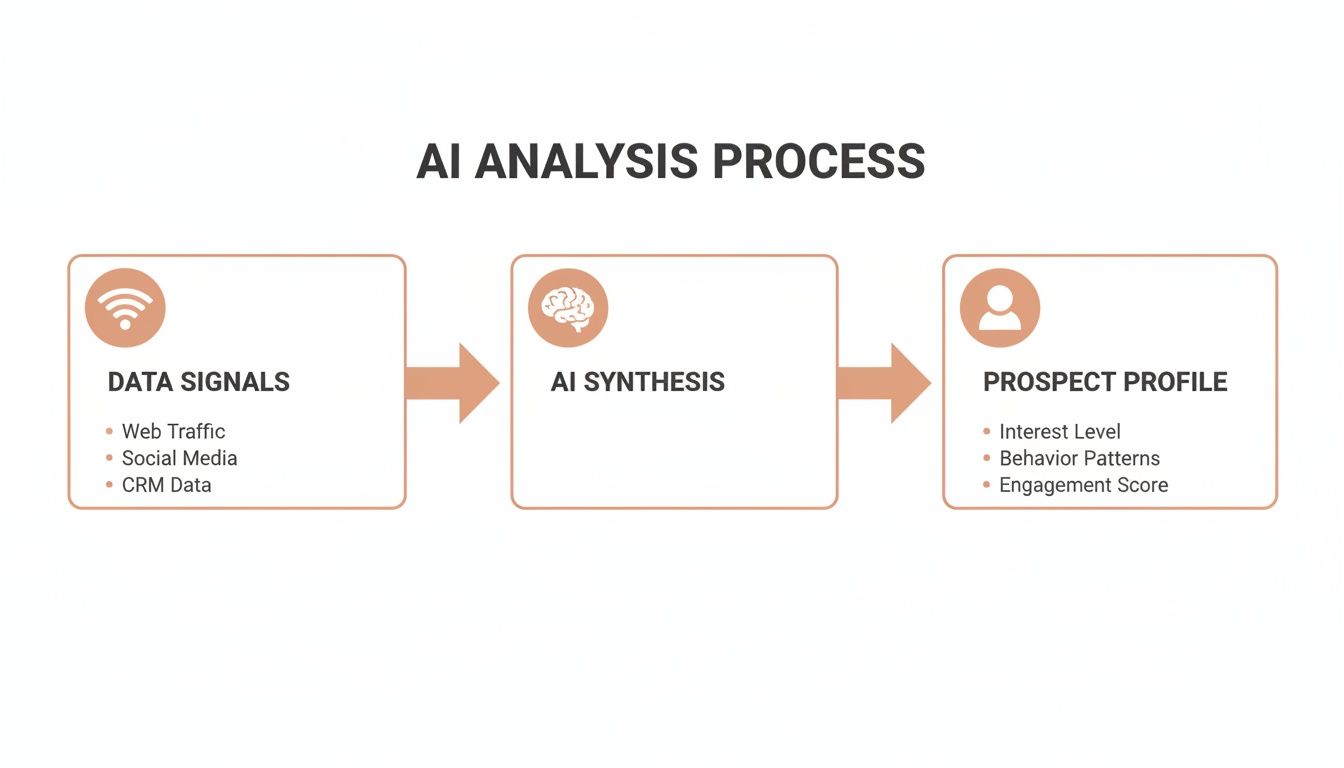
This is the core idea in action: turning scattered digital breadcrumbs into a coherent game plan for genuine connection.
Crafting Hyper-Personalised Pre-Outreach Emails
That first email is your one shot. A generic, copy-paste message lands in the trash folder within seconds. An AI-powered sales intelligence tool, however, gives you the intel to write an email that speaks directly to a prospect’s unique personality, which can seriously boost your reply rates.
Let's say the AI profiles your prospect as an "Explorer"—a visionary, relationship-driven person who gets excited by big-picture ideas. The system would nudge you to:
- Open with a shared vision: Forget the cold, hard stats. Start with an inspiring line about the future of their industry.
- Use collaborative language: Frame your pitch as a partnership, something you can build together to help them hit their ambitious goals.
- Focus on the "why": Talk about the long-term impact and potential of what you’re offering, not just a dry list of features.
This goes so much deeper than just dropping their name or company into a template. It’s about fundamentally shifting your tone, structure, and message to match how they think and communicate.
Anticipating Objections During Live Meetings
Walking into a meeting with AI insights is like having the other team’s playbook in your hands. During a live call, these platforms can feed you real-time cues and talking points based on the prospect's profile. This helps you guide the conversation and handle objections before they even fully surface.
For instance, if you're about to meet a "Wizard" archetype—someone analytical and driven by data—the AI would get you ready to:
- Lead with proof: Have your case studies, ROI calculators, and tech specs queued up and ready to go.
- Expect detailed questions: This person will want to get into the weeds of implementation, security, and how you validate your data.
- Keep it direct and logical: Ditch the emotional appeals. Stick to the facts and figures that prove your worth.
By understanding the "how" and "why" behind a prospect's likely worries, you can address them head-on with the right kind of proof. This doesn’t just answer a question; it builds your credibility and shows you’ve done your homework, turning a potential point of conflict into a moment of trust.
The global AI in sales market is exploding for a reason—teams are seeing immense value. It was valued at USD 29.20 billion in 2025 and is expected to hit USD 145.12 billion by 2033. Singapore is a major player in this growth, especially as part of the Asia Pacific AI market. Here, sales teams in finance and real estate are using AI to personalise their outreach and are seeing huge lifts in conversion.
Writing Post-Call Follow-Ups That Prevent Ghosting
The time right after a call is where deals are won or lost. A weak follow-up lets all that good momentum fizzle out. AI helps you write a summary that reinforces your key points in a way that truly connects with your prospect’s personality, keeping them engaged and moving things forward.
Let's say your prospect is a "Healer" type—someone who is empathetic, avoids risk, and cares deeply about their team. An AI-guided follow-up would look like this:
- Reiterate security and support: Kick things off by reassuring them about your solution's reliability and the hands-on support you provide.
- Highlight team benefits: Frame the value around how it will make their team's work easier, more collaborative, and less stressful.
- Offer social proof: Weave in testimonials or case studies from similar clients who had a smooth and successful rollout.
This isn’t just a recap of your conversation. It’s a strategic piece of communication designed to hit on their core emotional drivers. To really put AI sales intelligence into action, businesses can also explore the power of a virtual sales assistant AI to drive revenue. For more on this, check out our guide on how AI for sales teams can unlock efficiency. When you integrate these tactics, every touchpoint becomes another opportunity to build a stronger, more lasting relationship.
Why AI Delivers More Than CRMs or Personality Tests
Many sales teams treat their Customer Relationship Management (CRM) platform as the absolute source of truth. And while CRMs are indispensable, they’re essentially a well-organised library of facts—a static record of past calls, emails, contacts, and deal stages. It tells you what happened.
AI-powered sales intelligence is on a totally different level. It’s not just the library; it’s the expert librarian who has read every book, understands the context, and tells you exactly which page to turn to next and why. AI takes all that historical data and spins it into forward-looking, actionable advice for your very next conversation.
This is the fundamental shift from a system of record (your CRM) to a system of insight (AI intelligence). One stores information; the other interprets it to guide your next move. That’s a massive competitive edge.
Moving Beyond the CRM Data Graveyard
Your CRM is sitting on a goldmine of information, but without someone to interpret it, it's just a data graveyard. It can tell you a prospect opened three of your emails, but it has no clue why or what you should do about it. It logs that a deal went cold, but it can’t tell you about the personality clash that caused the friction.
This is where AI sales intelligence breathes life into static data. It connects the dots between a prospect’s public digital footprint and your internal CRM history, building a living, breathing profile of the person you're talking to. The distinction couldn't be clearer:
- CRMs are retrospective. They look backwards, documenting things that have already happened.
- AI intelligence is prospective. It looks forward, predicting what a prospect needs to hear to move the deal along.
Think of it this way: A CRM is a map of where you've been. AI-powered sales intelligence is the real-time GPS guiding you where to go next, complete with turn-by-turn directions on exactly how to communicate.
In today's sales world, you can't afford to rely only on historical data. The real money is in understanding the human being on the other side of the deal.
From Vague Personality Labels to Actionable Sales Tactics
This is also where AI completely outperforms generic personality frameworks like Myers-Briggs or DISC. These tests can be fun for a bit of self-discovery, but they often fall flat in a high-stakes sales meeting. Knowing your prospect is an "introvert" or a "Type C" is just too broad to be useful.
What does that label actually tell you about how to close a deal with them? Not much. It’s a blunt instrument when you need surgical precision.
AI sales intelligence, on the other hand, gives you context-specific guidance. It doesn’t just stick a label on someone; it explains how their core personality traits directly shape their buying process.
Let's break down the difference:
| Aspect | Generic Personality Test | AI-Powered Sales Intelligence |
|---|---|---|
| Output | A broad personality type (e.g., ‘Advocate’) | A sales-specific archetype (e.g., ‘Data-driven Sceptic’) |
| Guidance | Vague behavioural descriptions | Concrete meeting tactics and messaging advice |
| Application | General self-awareness | Actionable steps to build trust and handle objections |
| Context | Not specific to a sales scenario | Directly tied to the buying journey and communication style |
While a personality test might tell you a prospect is detail-oriented, an AI tool will tell you to send a technical whitepaper instead of a slick marketing brochure and to come prepared with answers on integration timelines.
That’s the difference between a trivia fact and a winning strategy. It gives you a playbook tailored to the individual, not just a label, making sure every single interaction builds trust and pushes the conversation forward.
How to Integrate and Measure Success with AI
So, you're ready to bring a new tool into your sales workflow. Just like any other addition to your tech stack, rolling out AI-powered sales intelligence needs a solid plan. It’s not just about flipping a switch; a successful launch means knitting the platform into your existing systems and, just as importantly, getting your team excited and skilled enough to use it.
The technical part usually starts with your CRM. Modern AI intelligence platforms are built to play nice with the rest of your sales tools, plugging directly into your stack. This enriches all that contact and account data you already have with dynamic personality insights, saving your reps from juggling multiple systems and keeping everything in one place.
But the tech is only half the story. The human side is where the real magic happens. Proper onboarding and ongoing training are what turn AI insights from interesting data points into actual sales tactics that close deals.
Building a Strong Business Case for AI
To get the green light and prove this investment is worth it, you need a business case that speaks in outcomes, not just features. The best way to start is by zeroing in on the exact problems you’re trying to solve. Are your sales cycles dragging on forever? Are your cold emails getting ignored? Does your team freeze up when faced with tough objections?
Once you’ve identified these pain points, you can draw a straight line from the problem to the AI solution. Think of it like this:
- Problem: Abysmal reply rates from generic, templated emails.
- AI Solution: Hyper-personalised outreach ideas based on a prospect's unique communication style.
- Expected Outcome: A clear, measurable lift in positive replies.
Framing it this way turns the conversation from a cost-centre discussion into a strategic investment. You’re not just buying software; you’re buying a solution to a core business challenge. It gives stakeholders a clear story of how this technology will directly impact the bottom line.
Key Metrics to Track for Demonstrating ROI
Once you're up and running, you have to measure the impact. Success isn’t just a gut feeling; it’s something you can prove with the right Key Performance Indicators (KPIs). Tracking the right numbers will help you quantify the return on investment (ROI) and fine-tune your approach as you go.
The real goal here is to connect every feature of your AI sales tool to a tangible improvement in revenue-generating activities. This data-backed approach proves its value and justifies keeping it in your toolkit.
Here are the most critical KPIs to keep an eye on:
- Lead Conversion Rate: Are you turning more of your qualified leads into real opportunities? This is the first sign that personalised outreach is hitting the mark.
- Sales Cycle Length: Is AI helping your team build rapport faster and shrink the time from first contact to a closed deal?
- Deal Win Rate: This is the ultimate metric. If this number is climbing, it’s a strong signal that the insights are helping your team close deals more effectively.
- Average Deal Size: By getting a better read on a client's core needs, your team might be spotting more opportunities to upsell or cross-sell.
Singapore's AI scene is creating a boom in sales intelligence, with the nation ranking second globally in AI readiness. For sales teams on the ground, this translates into real-time insights on prospect archetypes, which helps cut down on ghosting and makes objection handling far less painful. This readiness means these tools can be deployed at scale, helping sales leaders see higher reply rates as AI deciphers communication styles and, ultimately, drives more conversions in high-stakes deals. You can discover more about Singapore's AI data centre market and how it’s shaping the future of sales.
Navigating the Ethical Use of Sales AI
In sales, trust isn't just a nice-to-have; it's the most valuable asset you can build. As AI-powered sales intelligence becomes more common, using it responsibly is non-negotiable. What separates the top performers from the rest is their ability to use these powerful tools to build confidence, not erode it. The goal is always to serve clients better, not to find clever ways to manipulate them.
This means putting ethics at the very centre of your sales strategy. When used correctly, AI actually enables more human, relevant, and respectful interactions that lead to stronger, longer-lasting business relationships.

Upholding Transparency and Data Privacy
The entire foundation of ethical AI rests on transparency. You absolutely have to be clear about how data is sourced and used. Modern sales intelligence tools rely on publicly available information—think social media profiles, company press releases, and professional articles—to piece together their insights. This ensures the process respects personal boundaries and privacy from the get-go.
Sticking to data privacy regulations isn't just a legal hoop to jump through; it’s a commitment you make to your prospects. Following standards like the General Data Protection Regulation (GDPR) and similar local laws builds a framework of trust. This boils down to:
- Consent: Ensuring data is collected and used with proper consent where it's required.
- Security: Storing all information securely to protect it from breaches.
- Transparency: Being open about how you use data to personalise your approach.
A prospect who feels respected is far more likely to become a customer. Ethical practice isn't a barrier to sales; it’s a competitive advantage that proves you value the relationship over the transaction.
Best Practices for Responsible AI Application
Bringing AI into your sales process ethically requires clear guidelines. It’s all about framing the technology as a tool to enhance understanding, not as a shortcut to bypass genuine connection. Here are three best practices to guide your team.
- Use Insights for Empathy, Not Manipulation: The goal is to understand a prospect's communication style so you can speak their language. Use the insights to build rapport and address their needs more effectively, not to exploit psychological triggers for a quick win.
- Verify and Contextualise AI Suggestions: AI provides a powerful starting point, but your human oversight is still essential. Always cross-reference AI-driven insights with your own knowledge of the prospect and their industry. This makes sure your approach is both accurate and appropriate.
- Maintain the Human Element: Never let the technology overshadow the person. AI should support your conversations by removing the guesswork, which frees you up to focus on what really matters: listening, building trust, and solving real problems for your clients.
By embedding these principles into your workflow, you ensure your use of AI-powered sales intelligence strengthens relationships and drives sustainable growth.
Got Questions? We've Got Answers
As sales teams start exploring AI-powered sales intelligence, a few common questions always seem to pop up. Getting to grips with the specifics of this technology is the key to really unlocking what it can do and seeing how it differs from the other tools already in your sales stack.
Let's break down some of the most frequent queries to get you the clarity you need. These usually focus on the practical differences between this new breed of tool and what you're already using, its real-world use across different markets, and, of course, the all-important human side of getting your team on board.
How Is This Different from Data Enrichment Tools?
This is a really important distinction. Data enrichment tools are fantastic at what they do: giving you static, factual information. They’ll tell you a company's size, its funding history, or the tech it uses. Think of this as the "what"—a snapshot of objective data points about an organisation.
AI-powered sales intelligence, on the other hand, gives you dynamic, behavioural insights. It goes a crucial step further to tell you how to use those facts to connect. It looks at a person’s public digital footprint to figure out their communication style, helping you build genuine rapport on a human level.
So, while enrichment gives you the map, AI intelligence gives you the turn-by-turn directions for the conversation.
Can These AI Tools Be Used in Any Industry?
Absolutely. The core principles of effective human communication don't change just because you switch industries. The need to build trust, handle objections, and frame solutions in a way that resonates is fundamental to any high-stakes conversation. That makes these insights valuable no matter what you're selling.
Whether your sales team is in:
- B2B Technology: Where you need to persuade highly analytical decision-makers.
- Financial Services: Where trust and credibility are everything.
- Real Estate: Where a strong emotional connection often drives the biggest decisions.
- Consulting: Where deeply understanding a client’s core challenges is the whole game.
The communication tactics can be adapted to fit any sector. The underlying AI models are focused on personality and communication archetypes, which are consistent across all professional environments.
Is It Difficult to Get a Sales Team to Adopt a New AI Tool?
Let's be honest, adoption is always a hurdle with new tech. But it gets a whole lot easier when the value is immediate and obvious. The key to a smooth rollout isn't about forcing compliance; it's about showing clear benefits from day one. Reps are far more likely to embrace something that helps them hit their targets faster.
Successful adoption hinges on proving that the tool makes a salesperson's job easier and more effective. When reps see a direct line between using the tool and closing more deals, they become its biggest advocates.
A winning implementation strategy is all about showing that instant value. That means providing excellent, hands-on onboarding and maybe starting with a small pilot group. This group can rack up some early wins and become internal champions, demonstrating the tool's power to the rest of the organisation and creating genuine excitement for the change.
Ready to see how Mindreader can help your team close more deals by adapting to how your clients think? Our Human Intelligence System provides the actionable insights you need for every high-stakes conversation. Start connecting smarter today.