Crafting the Ultimate Persona Profile for Precision Sales
A persona profile is essentially a semi-fictional deep dive into your ideal customer. It’s not just about demographics, but about what truly drives them—their motivations, their biggest challenges, and how they prefer to communicate. Think of it as a tool that helps you move past who your buyer is to understand how they think and make decisions. This is the key to creating sales outreach that actually feels personal.
Moving Beyond Basic Demographics
Let's be honest: the traditional buyer personas we’ve been taught to use are failing modern sales teams. For years, the advice has been to build profiles based on job titles, company size, and industry. But knowing your prospect is a "CFO at a mid-sized tech firm" just isn't enough to cut through the noise anymore.
This kind of surface-level data only leads to generic outreach, templated emails, and a ton of missed opportunities. It makes the dangerous assumption that everyone with the same job title thinks, acts, and buys in the exact same way. Anyone with real-world sales experience knows that’s just not true. Relying on these old methods is like trying to navigate a city with a map that only shows the main highways—you miss all the crucial side streets where real connections are made.
The Shift to Psychographics and Communication Style
The most powerful persona profiles go deeper, focusing on psychographics—the psychological drivers that actually influence behaviour. This means getting a handle on a person’s core motivations, their natural communication style, and what they truly value in a business relationship.
Imagine knowing not just what your buyer’s role is, but how they actually prefer to be sold to. This is the crucial mindset shift. This deeper level of insight is a core part of effective customer profiling, allowing you to tailor your entire sales approach from the ground up.
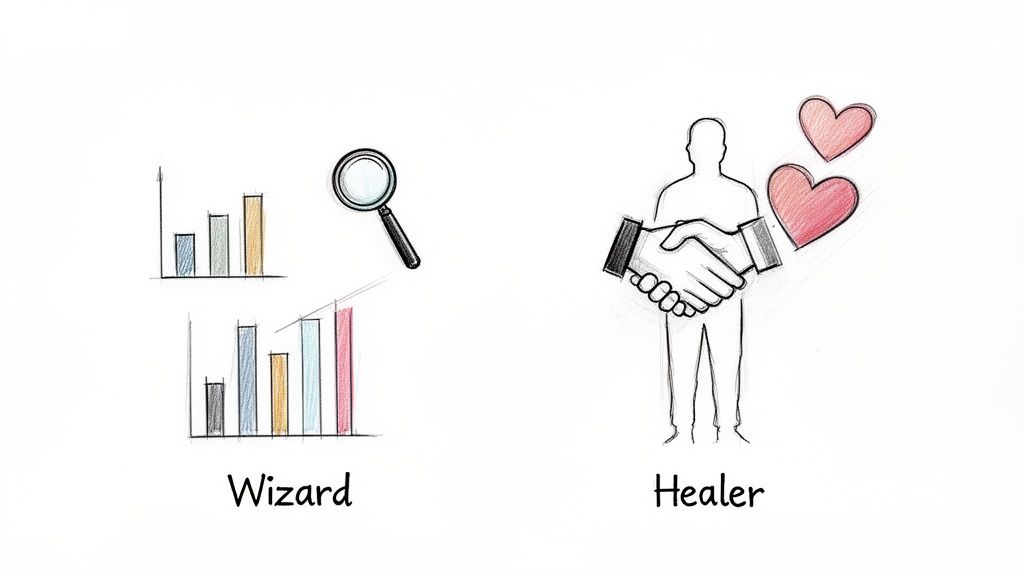
To make this tangible, let's look at two prospects with the exact same title: Director of Operations.
- Prospect A, The 'Wizard' Archetype: This person lives and breathes data. They’re analytical, sceptical of broad claims, and need to see hard evidence—think ROI projections, detailed case studies, and performance charts. Their main focus is on efficiency and measurable outcomes.
- Prospect B, The 'Healer' Archetype: This director is all about relationships. They value trust, collaboration, and partnership. Their motivation comes from ensuring team harmony and finding solutions that support their people and reduce friction.
A generic email blasting "industry-leading features" will fall flat with both of them. The Wizard needs a data sheet, while the Healer wants to hear a compelling customer success story.
A persona profile built on psychographics doesn't just tell you who to call; it tells you how to start the conversation, what questions to ask, and how to frame your value in a way that resonates on a deeply personal level.
Why This Deeper Approach Drives Results
When you adopt this more nuanced strategy, you gain a massive advantage. Sales professionals who can read and adapt to a prospect's underlying communication style in real-time see tangible benefits that go straight to the bottom line.
A sales strategy guided by a psychographic persona helps you:
- Increase Engagement Rates: Your outreach suddenly feels relevant and personal, cutting through the endless noise of generic sales pitches. You’re speaking their language from the very first touchpoint.
- Build Trust Faster: When you show that you understand their unique priorities and communication needs, you build credibility and rapport much more quickly than your competitors.
- Handle Objections Proactively: Knowing a Wizard will demand data means you can have those ROI calculations ready. Understanding a Healer values consensus helps you frame discussions around team-wide benefits.
- Shorten the Sales Cycle: With less friction and more targeted conversations, you navigate the decision-making process more efficiently. This leads directly to faster commitments and closed deals.
Moving away from basic demographics isn't just another sales tactic; it's a fundamental change in how we view our profession. It’s about finally recognising the human on the other side of the deal and engaging with them in a way that respects their individual mindset. Building this type of persona is the first step toward making every sales interaction more meaningful—and ultimately, more successful.
Gathering Actionable Intelligence for Your Persona Profile
A persona profile that actually works is built on solid intelligence, not just intuition. If you want to move past basic demographics and really understand the psychographics we’ve been talking about, you need to think like a detective. The mission is to find the clues that reveal the ‘how’ and the ‘why’ behind every single purchase decision.
This isn’t about sending out another soulless survey. It’s a multi-pronged attack that blends qualitative insights, hard quantitative data, and the smart use of modern tech to paint a complete picture of your ideal customer.
Let's break down the key pillars of this intelligence-gathering operation.
Uncovering Motivations Through Interviews
The most direct way to get inside your prospect's head is simply to talk to them. But not just any chat will do. You have to ask open-ended questions that get them telling stories, not just giving one-word answers. These conversations are your ticket to uncovering their hidden challenges and true motivations.
Ditch the generic questions and try these instead:
- "Walk me through a recent project where you hit a major wall. What made it so tough?" This question gets right to their pain points and shows you how they approach problems.
- "When you picture success in your role a year from now, what does that look like?" This helps you tap into their goals and professional aspirations.
- "Describe the best partnership you've ever had with a vendor. What did they do right?" This is a clever way to find out their communication style and what they genuinely value.
These prompts are designed to get people talking about real experiences, frustrations, and wins. The answers you get are the raw, human material you need to build a persona that feels real because it is real.
Mining Your CRM for Hidden Patterns
While interviews give you the stories, your Customer Relationship Management (CRM) system gives you the cold, hard facts. Your CRM is an absolute goldmine of behavioural patterns, holding the history of your biggest wins and most painful losses. It’s where you can stress-test the assumptions you made during your interviews.
Start by pulling a list of your best customers—the ones with the highest lifetime value, smoothest sales cycles, or biggest growth potential. Then, start digging. Look for the common threads that tie them all together.
When you analyse your CRM, you’re not just looking at contact info. You’re looking for the digital breadcrumbs that lead to a signed contract. This is where you can spot trends in communication cadence, common objections, and which pieces of content actually moved the needle.
For instance, you might find that 80% of your enterprise deals involved you sharing a specific case study within the first two weeks. That’s a powerful piece of intelligence you can build right into your sales process for similar personas. If you're looking for a structured way to start, our detailed guide on implementing data-driven sales insights is a great place to begin.
Leveraging Digital Signals and AI Analysis
In this day and age, your prospects are leaving digital footprints everywhere—from their LinkedIn activity to the exact words they use in emails. These signals are incredibly valuable for getting a feel for their personality and communication style before you even hop on a call.
This is where AI tools like Mindreader really shine. By analysing publicly available text, like a LinkedIn profile or an article they wrote, these platforms can reveal crucial personality traits in seconds. You can get an instant read on whether you're dealing with a direct, data-loving 'Wizard' or a collaborative, relationship-focused 'Healer'. It gives you a massive head start.
This AI analysis adds a critical layer to your persona, turning abstract traits into concrete sales tactics. It tells you whether to lead with an ROI calculator or a customer story, making sure your very first interaction is calibrated to their specific mindset. When you combine human interviews, CRM data, and AI analysis, you get a robust, three-dimensional view of your customer that goes way beyond a simple job title.
How to Build Your Persona Profile with the Mindreader Framework
Alright, you've done the digging and gathered all that raw intelligence. Now what? The real magic happens when you turn that mountain of data into a sharp, actionable sales tool. A killer persona profile isn't something you create once and file away; it's a living guide that sharpens your every move. This is where we get our hands dirty and build a profile using Mindreader's four core archetypes.
The mission is to move from abstract data points—CRM entries, interview notes, online behaviour—to a vivid, three-dimensional picture of the human you're trying to connect with. By mapping what you’ve learned to these archetypes, you can start to genuinely understand how a prospect thinks, what they care about, and, crucially, how they prefer to be sold to.
Think of it like this: you're blending different streams of information to get a complete picture.
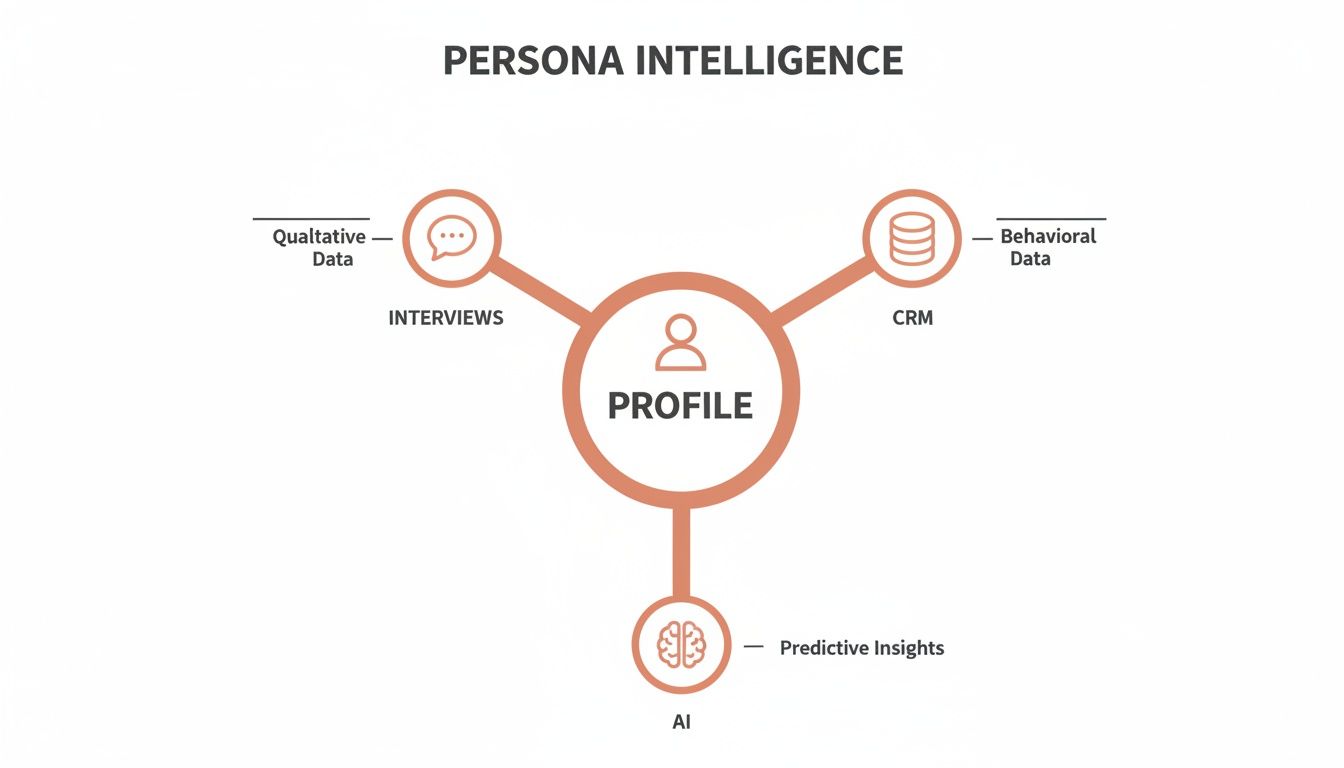
Here's the key takeaway: no single source of intelligence tells the whole story. The most robust personas are built by blending qualitative human insights from interviews with hard quantitative data and AI-driven analysis.
Mapping Research to the Four Archetypes
The Mindreader framework is designed to cut through the noise, simplifying complex personalities into four practical sales archetypes. Each one operates with a distinct set of motivations, communication styles, and decision-making triggers. Your job is to sift through the intelligence you've gathered and find the best fit.
Let’s meet the crew:
- The Knight: Decisive, goal-oriented, and all about the results. They're often leaders who want to cut the fluff and get straight to the bottom-line impact of your solution.
- The Explorer: Innovative, open-minded, and a sucker for big ideas. They get fired up by what's possible and are drawn to creative solutions that paint a picture of the future.
- The Healer: Collaborative, relationship-focused, and they value trust above all else. Their main drive is supporting their team and making sure new solutions benefit everyone involved.
- The Wizard: Analytical, data-driven, and deeply sceptical of broad claims. They need proof, hard numbers, and a logical, step-by-step case before they'll even consider your offering.
Now, pull out your interview notes and look at the patterns in your CRM. Does your prospect constantly bring up "the bottom line" and "efficiency gains"? You're probably talking to a Knight or a Wizard. Do they keep circling back to "team harmony" and "making everyone's life easier"? That’s classic Healer behaviour. For a wider view on this, exploring the fundamentals of a Buyers Persona B2B can show how these principles apply in different sales contexts.
To make this even easier, here’s a quick-glance guide to the archetypes.
Mindreader Archetype Quick Reference Guide
| Archetype | Core Motivation | Communication Preference | Winning Sales Tactic |
|---|---|---|---|
| Knight | Value & Reliability | Direct, practical, no-nonsense | Focus on proven results and ROI. |
| Explorer | Experience & Novelty | Enthusiastic, visionary, inspiring | Highlight innovation and immediate benefits. |
| Healer | Purpose & Harmony | Authentic, supportive, patient | Build trust and align with their values. |
| Wizard | Efficiency & Logic | Factual, analytical, data-rich | Present a clear, evidence-based business case. |
This table serves as a simple cheat sheet, but the real power comes when you build out a full profile.
Constructing a Detailed Persona Card
Once you’ve zeroed in on an archetype, it's time to build out a "persona card." This is a one-page summary that your entire sales team can pull up for a quick refresher before any call or email. It needs to be concise, visual, and jam-packed with practical advice.
Here's what every good persona card should have:
- Archetype & Photo: Give them their primary Mindreader archetype (e.g., Wizard) and find a stock photo that feels representative.
- Key Identifiers: List their job title, industry, and—this is important—a short, punchy quote from your interviews that perfectly captures their mindset.
- Core Motivations: What actually gets them out of bed in the morning? For a Wizard, this would be things like "Achieving measurable ROI," "Eliminating inefficiencies," and "Making data-backed decisions."
- Primary Challenges: What keeps them up at night? A Wizard might be wrestling with "Inaccurate forecasting," "Lack of clear data," or "Justifying budget spend without solid proof."
- Communication Playbook: This is the most critical part. It details exactly how to engage them.
A persona profile without a communication playbook is just a collection of interesting facts. The playbook is what turns intelligence into revenue, telling your team precisely what to say, how to say it, and what to avoid at all costs.
For our Wizard, the playbook would look something like this:
- Do: Lead with data. Provide detailed case studies. Use precise, unambiguous language. Present a clear, logical business case.
- Don't: Use vague or emotional language. Make unsubstantiated claims. Rush them into a decision without giving them all the evidence they need.
If you're looking to really dig in, our guide on AI-powered sales intelligence shows how technology can help automate parts of this discovery process.
A Real-World Persona Profile Example
Let's pull it all together. Say we've identified Sarah, the CFO of a growing logistics company, as a 'Wizard' archetype after a few discovery calls and some research.
Example Persona Card: Sarah the Wizard
- Quote: "If you can't measure it, you can't manage it. Show me the numbers."
- Motivations: She cares deeply about financial predictability, mitigating risk, and maximising return on investment. She operates on logic, not emotion.
- Challenges: She’s frustrated by supply chain inefficiencies that inflate her costs and struggles to get accurate data for her quarterly forecasts.
- Sales Tactics:
- Outreach: Your first email absolutely must include a specific, compelling statistic. Something like, "Our platform reduces shipping costs by an average of 18% for companies like yours."
- First Meeting: Forget the long, fluffy introductions. Open with a data-rich dashboard and walk her through an ROI calculator tailored to the logistics industry.
- Handling Objections: Her biggest objection will likely be about implementation costs. Be ready with a detailed financial model showing a break-even point within six months.
- Follow-Up: Send a summary email with bullet points of key data points, an attached case study, and a direct link to your security and compliance documents.
This level of detail moves your sales approach from a guessing game to a precise, targeted strategy. You're no longer just selling to a "CFO"—you're communicating with Sarah the Wizard in the exact language she understands, building trust and momentum with every single interaction.
Adapting Your Strategy for Cultural Nuances
A persona profile is more than just a psychological sketch. To make it truly powerful, you have to add layers of real-world context. This is especially true in a dynamic, multicultural hub like Singapore, where a one-size-fits-all approach is doomed to fail. Cultural intelligence isn’t just a nice-to-have; it’s what makes your outreach feel genuine and respectful.
Think about it. You need to understand how local business etiquette, communication norms, and even generational attitudes shape a prospect's decisions. Ignoring these nuances is like trying to sell to someone without speaking their language. You might have the perfect solution, but if the message doesn't connect culturally, it gets lost in translation.
Going Beyond the Archetype
Your Mindreader archetype gives you the foundational 'how'—the person's core communication style and motivation. The cultural layer adds the 'why' behind their behaviour. It’s what helps you navigate the subtle social dynamics that can make or break a deal.
Let's take a 'Healer' archetype, for example. You know they prioritise group consensus and team harmony. But how they achieve this is heavily influenced by their cultural background. A 'Healer' from a more collectivistic culture might seek consensus through indirect communication and subtle cues, valuing group alignment far more than a quick decision.
This distinction is everything. If you push for a direct, immediate "yes," you could come across as aggressive and disrespectful, destroying the very trust you're trying to build. Recognising this allows you to adapt your pacing and meeting style to fit their world, not just yours.
The Singaporean Context
Singapore’s multi-ethnic fabric creates a fascinating, complex marketplace. Cultural background and communication preferences have a huge impact on how people buy and make decisions. As of June 2024, ethnic Chinese residents make up about 76.2% of the citizen population, with Malays at 15.0% and Indians at 7.4%. This internal diversity means a single persona profile can’t possibly represent everyone. You can learn more about the unique demographics of Singapore's people and nationalities to get a clearer picture.
Building a culturally aware persona profile isn't about stereotyping. It's about developing a sophisticated understanding of general cultural tendencies so you can listen more effectively and ask better, more respectful questions.
Practical Steps for Cultural Adaptation
So, how do you weave this cultural intelligence into your personas? It’s not about grand gestures but a mindful, observant approach. You’re looking for specific, nuanced details to guide your interactions.
Here are a few actionable ways to sharpen your profiles:
- Observe Communication Norms: Pay attention to the language. Is it formal or casual? Do they prefer direct, explicit communication, or is it more high-context, where meaning is implied? This tells you how to frame your own messages.
- Understand Decision Hierarchies: Look into typical business structures. Are decisions made from the top down, or is there a strong emphasis on getting the group on board first? Knowing this tells you who to influence and when.
- Recognise Generational Shifts: Younger professionals in Singapore often have different communication habits and business values compared to more senior leaders. Acknowledging these potential differences helps you tailor your approach to the right generation.
By layering this cultural context onto your core archetype, you create a much sharper, more effective persona. This added dimension moves you beyond just selling a product and into building a genuine, respectful business relationship—giving you an edge your competitors probably don't have.
Putting Your Persona Profiles Into Action
A beautifully crafted persona profile is completely useless if it just gathers digital dust in a forgotten folder. Its real value is unlocked only when your sales team actively and consistently uses it, transforming their daily workflows and sharpening every single customer interaction. The goal is to embed these insights so deeply into your process that they become second nature.
This isn't about adding another layer of complexity to your team's plate. It’s about making your sales efforts smarter and far more effective. By putting your persona profiles to work, you turn abstract insights into a concrete roadmap for engaging prospects at every stage of the sales cycle. This transforms your profiles from static documents into living, breathing assets that evolve with your market.
Integrating Personas Into Your CRM and Sales Tools
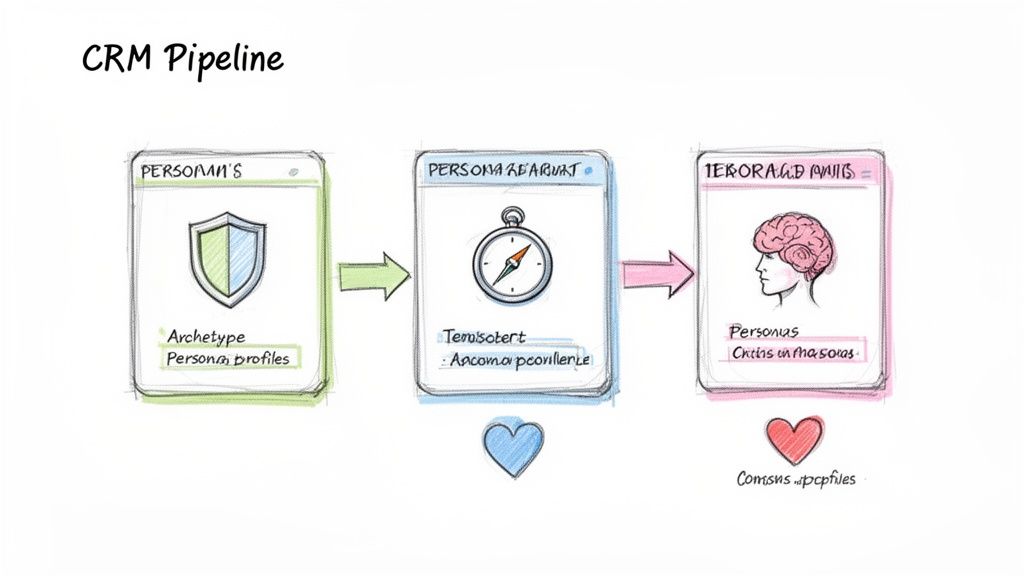
Your CRM should be the central hub of your sales operation, and your persona profiles need to be a core part of it. The simplest way to get started is by creating a custom field or tag for the Mindreader archetype (Knight, Explorer, Healer, Wizard). This small change allows for incredibly powerful segmentation and targeted outreach.
Imagine filtering your entire pipeline to see all the 'Wizards' you need to follow up with this week. This simple action lets you build highly specific campaigns. You can even create email templates tailored to each archetype.
- For Wizards: Lead with a subject line that features a hard data point, like "18% cost reduction". Keep the body concise, logical, and link directly to a detailed case study or an ROI calculator.
- For Healers: Use a warmer, more collaborative tone. The subject line might focus on a shared value, like "A new approach to team efficiency". The content should tell a story about how your solution supports people and reduces friction.
This level of customisation can seriously boost engagement because you're speaking the prospect's language from the very first touchpoint.
Powering Pre-Call Planning and Discovery
A persona profile is your ultimate cheat sheet for pre-call planning. Before any meeting, your sales reps should review the prospect's persona card. This quick five-minute exercise focuses their preparation on what truly matters to that specific individual, moving them beyond just generic company research.
The most successful sales calls are not monologues; they are well-guided conversations. A persona profile gives you the talking points and, more importantly, the right questions to ask to steer that conversation effectively.
For instance, when prepping to speak with a 'Knight', a rep knows to have their bottom-line results and a clear implementation timeline ready to go. For an 'Explorer', they should prepare to discuss future possibilities and innovative applications of the product. Understanding specific roles can also sharpen this focus; for example, knowing the function of an ISA in real estate highlights how specialised lead qualification relies heavily on accurate persona-based targeting.
Creating a Validation and Refinement Loop
Your personas should never be set in stone. The most effective teams treat them as dynamic assets that are constantly tested and refined with real-world feedback. Setting up a validation loop is key to ensuring they stay accurate and drive measurable results.
Start by tracking key sales metrics, but segment them by persona archetype. This will quickly reveal which profiles are performing best and where you need to make adjustments.
Key Metrics to Track per Persona:
- Meeting Conversion Rate: What percentage of outreach to each archetype results in a booked meeting?
- Sales Cycle Velocity: How long does it take to move each persona from first contact to a closed deal? A shorter cycle for 'Knights' might prove your direct approach is working.
- Win Rate: Which archetypes are you most successful at closing? A low win rate with 'Healers' might signal a need to refine your trust-building tactics.
By analysing this data every quarter, you can spot patterns. If your meeting conversion rate for 'Wizards' is low, maybe your data-led emails aren't compelling enough. This feedback loop allows you to continuously improve your persona profiles and the sales tactics tied to them, proving their ROI and creating a culture of data-informed selling.
Your Persona Questions, Answered
Even with the best game plan, questions always come up when you start putting theory into practice. That's a good thing. Building a powerful persona profile isn't a one-and-done task; it's a living process of learning and tweaking.
Let’s tackle some of the most common questions sales pros ask when they first bring this strategy into their workflow.
How Many Persona Profiles Should I Actually Create?
It’s tempting to want a persona for every single customer type you meet. Don't do it. That path usually leads to a messy, confusing pile of profiles that nobody uses. The real goal is to laser-focus on your most common and valuable customers first.
For most businesses, three to five core persona profiles is the sweet spot. That’s enough to cover the main decision-makers you talk to every day without making your team’s heads spin. A great way to start is by looking at your best accounts—who were the key people who helped get those deals over the line? Build your first profiles around them.
Remember to focus on depth over breadth. One deeply researched, genuinely useful persona is worth a dozen shallow ones. Quality beats quantity every single time.
How Often Should I Update My Personas?
Think of your persona profiles as living documents, not dusty binders on a shelf. Markets change, customer problems evolve, and your own products get updated. Using an old persona is almost as bad as having no persona at all.
As a general rule, schedule a formal review of your profiles at least once a year. But honestly, you should always be in a state of “soft review.” The moment your sales team mentions that their conversations aren't matching up with a persona's predicted behaviour, it's time for a quick check-in.
Jump on some call recordings or grab fresh feedback from the team in the trenches. Making small, ongoing adjustments is the key to keeping your personas sharp and effective.
Can a Persona Profile Represent an Entire Demographic?
This is a really important point, so let's be clear: a persona is not a stereotype. You should never use a profile as a blunt tool to represent an entire demographic group. The whole point is to dig into psychographic and behavioural patterns, not to make broad assumptions.
Take Singapore’s shifting demographics, for example. As of June 2025, citizens aged 65 and up make up 20.7% of the population, a big jump from 13.1% in 2015. You can see the full breakdown in the Population in Brief 2025 report.
It would be a huge mistake to lump this entire group into a single "senior" persona. Within that demographic, you’ll find action-oriented Knights, analytical Wizards, relationship-driven Healers, and experience-seeking Explorers—all with completely different motivations. A persona helps you see the individual within the demographic, not the other way around. Use demographic data for context, but build the profile around individual behaviours. That nuance is what makes this strategy work.
Ready to stop guessing and start connecting with prospects on a level that actually works? Mindreader translates complex human behaviour into actionable sales tactics, giving you the communication playbook you need to close more deals. See how our AI-powered insights can transform your sales process at https://www.themindreader.ai.