Data-Driven Sales Insights: Boost Your Close Rate
Ever heard the phrase "work smarter, not harder"? That's the entire philosophy behind data-driven sales insights. It’s about taking all the scattered bits of information a prospect leaves behind and turning them into a clear roadmap for how to connect with them.
Forget just knowing a prospect's job title or company size. We're talking about digging deeper to understand their behaviour, their real needs, and even how they prefer to communicate.
What Are Data-Driven Sales Insights, Really?
Think of it like this: an old-school pilot might have a map and a compass. They can probably find their destination, eventually. But a modern pilot has a full dashboard of instruments—GPS, weather radar, altitude gauges. They can fly with precision, adapt to turbulence instantly, and get to their destination efficiently.
That’s the difference between traditional selling and using data-driven sales insights. It’s the shift from educated guesswork to a predictable, almost scientific approach. It’s about decoding the subtle signals your prospects are constantly sending through their digital interactions.
Decoding the 'Why' Behind the 'What'
True insight isn't just knowing what a prospect did; it's understanding why they did it. Every click, every download, every email reply is another piece of the puzzle.
For example, getting a notification that a prospect viewed your LinkedIn profile is just data. But knowing they viewed your profile right after you sent over the pricing proposal? That’s an insight. It tells you they're doing their due diligence, weighing the investment, and probably trying to gauge your credibility.
Data-driven selling doesn't replace the human touch in sales—it sharpens it. It gives you the intelligence to make every single conversation more relevant, empathetic, and ultimately, more effective.
This deeper level of understanding helps you tackle some of the most common headaches in sales:
- Deals Gone Cold: You can spot hidden objections or shifting priorities by looking at their digital footprint. Did they suddenly start downloading content about a competitor? That's a red flag.
- Abysmal Reply Rates: Stop sending generic emails. Instead, craft hyper-personalised messages that speak directly to what their actions tell you they care about right now.
- One-Size-Fits-All Pitches: The data lets you adapt your value proposition on the fly. If they’ve been all over your case studies on ROI, you lead with that, not product features.
To show just how much things have changed, let’s compare the old way of doing things with the new, insight-led approach.
Old School Selling vs New School Insights
This table gives a quick look at the shift from gut-feel tactics to strategies that are backed by real, measurable data.
| Aspect | Traditional Selling | Data-Driven Selling |
|---|---|---|
| Strategy | Relies on intuition, scripts, and past experience. | Based on prospect behaviour, engagement data, and predictive analytics. |
| Outreach | Generic, high-volume cold calls and emails. | Highly personalised messages based on observed interests and needs. |
| Focus | "What can I sell them?" | "What problem are they trying to solve?" |
| Adaptability | Slow to react to changing buyer needs. | Agile; adjusts messaging and tactics in real-time based on new data. |
| Predictability | Inconsistent results, "feast or famine" cycles. | Creates a repeatable, predictable pipeline from contact to close. |
The takeaway is clear: while traditional methods might still get you there, a data-driven approach gives you a much clearer, more reliable path to success.
Ultimately, using these insights gives you a repeatable playbook for moving from that first "hello" to a signed contract. By understanding the 'why,' you can anticipate what your prospect needs next, build genuine rapport, and steer the conversation with confidence. This modern way of selling is a core part of what we now call sales intelligence, and it’s become an essential toolkit for any team that wants to win.
Decoding Your Prospect's Digital Language
To really get a grip on data-driven sales insights, you first have to learn how to read the constant stream of signals your prospects leave behind. Think of yourself as a detective piecing together clues. Every digital interaction isn't just random noise; it's a piece of evidence that reveals what they care about, what keeps them up at night, and how ready they are to make a move.
It sounds complicated, but it's not. We can break these signals down into three main pillars, and each one gives you a unique window into your prospect's mind.
Reading Between the Lines with Textual Signals
The words your prospects use are loaded with meaning. Digging into their email tone, the specific keywords they use, and even the questions they ask can tell you what really matters to them. This is about going way beyond just what's written on the surface.
Let's look at two different emails from a prospect:
- Email 1: "Could you provide more details on the implementation timeline and what support your team offers during onboarding?"
- Email 2: "Our main goal is to reduce operational overhead. Can you show me a case study demonstrating a clear ROI within the first six months?"
The first email is all about logistics and security. This person is likely detail-oriented and doesn't like taking risks. The second one, though? It screams urgency and a focus on the bottom line. They need to see a financial win, and they need it fast. Catching that difference lets you tailor your response to their specific priority, not just your generic sales pitch.
Following the Footprints of Behavioural Signals
A prospect's digital footprint tells the story of their journey. What they click on, the content they download, and how they move through your website are all powerful clues about their intentions.
A prospect's actions often speak louder than their words. A download of a technical whitepaper is a far stronger buying signal than a polite "looks interesting" on a discovery call.
These actions are like a trail of breadcrumbs leading you straight to their biggest challenges.
- Downloading a pricing guide: This is a classic late-stage buying signal. It means they're actively weighing up their options.
- Attending a webinar on a specific feature: This shows a very targeted interest and a need to solve a specific problem that feature addresses.
- Repeatedly visiting your case study page: This person is looking for proof and validation from others before they commit.
This framework below shows how all these different data points and signals come together to create real insights that drive your sales actions.
As you can see, it's a clear cycle: raw data gets interpreted as signals, which are then turned into insights that tell you exactly what to do next.
Capturing Unspoken Non-Verbal Cues
In the age of endless video calls, non-verbal communication has become an incredibly rich source of data. Facial expressions, posture, and even tiny gestures can reveal agreement, scepticism, or confusion—often long before a prospect says a single word.
A slight nod when you're discussing pricing could signal they're on board, while a furrowed brow might mean there's a concern you need to address right away. These cues give you real-time feedback, letting you pivot your pitch on the spot.
This is where modern platforms like Mindreader come in. They're designed to pull all three types of signals—textual, behavioural, and non-verbal—into a single, coherent profile you can actually use. This makes what used to be a complex, abstract theory into a practical tool for any sales professional looking to close more deals.
Turning Raw Data Into Actionable Intelligence
Collecting data is one thing; turning it into a genuine sales advantage is another game entirely. It’s easy to get buried in digital signals from your prospects, but without a clear way to connect the dots, that information can be more confusing than helpful. This is where deals stall out and revenue gets left on the table.
This isn't just a theoretical problem. In Singapore, business leaders are feeling the sting. While 54% say their organisations are data-driven, a massive 63% of data and analytics leaders admit they struggle to link that data back to actual business priorities. For sales teams, this gap is critical. 59% confess they often draw the wrong conclusions from information that lacks context, killing their efforts at meaningful personalisation.
To bridge this gap, you first need a solid foundation. That means implementing smart data integration best practices to get all your information singing from the same hymn sheet.
Bridging the Gap From Data to Deals
This is exactly where a Human Intelligence System (HIS) steps in to act as the crucial bridge. An HIS is built to take all those scattered data points—keywords in an email, clicks on your website, even expressions on a video call—and translate them into a concrete, sales-specific playbook. It’s the difference between just knowing about your prospect and understanding exactly how to engage them.
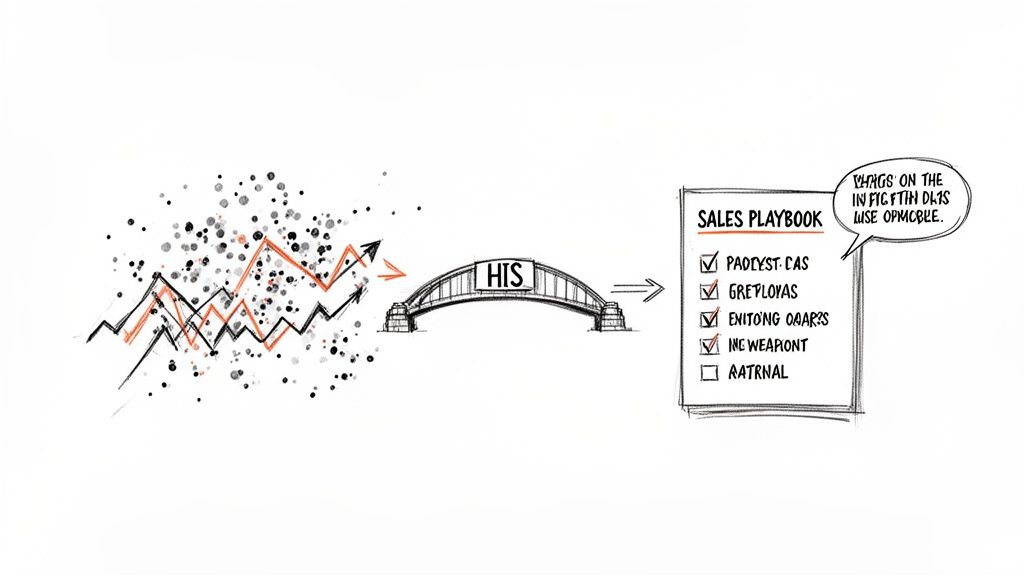
This process isn't just about slapping a personality label on someone. It’s about getting an instant script that tells you how to approach them, what objections they’re likely to raise, and how to pace the conversation for maximum impact.
The goal of data-driven sales insights is to turn complexity into clarity. It’s not about giving you more dashboards to stare at; it's about providing clear, practical steps you can take in your very next conversation.
From Archetype to Action Plan
Think of it like the difference between a raw weather report and a pilot's flight plan. The report gives you the data—wind speed, cloud cover, and so on. But the flight plan gives you the optimal route and altitude to ensure a smooth journey. An HIS provides that action plan for your sales calls.
For example, knowing a prospect fits the 'Explorer' archetype is a good start. But a true insight-driven system gives you specific actions:
- Pacing: Kick off the meeting with big-picture ideas before you get into the nitty-gritty details.
- Objection Handling: Be ready for "what if" questions with forward-thinking examples and possibilities.
- Messaging: Use visionary language that focuses on innovation, not just trimming costs.
This is the kind of guidance that separates simple data gathering from real intelligence. By putting these deeper insights to work, you can build genuine momentum and create far more meaningful engagements with every single interaction. We explore more on this in our guide on how AI-powered sales intelligence is making this a reality for sales teams.
Weaving Insights into Your Daily Sales Workflow
Knowing all this theory is one thing, but the real magic happens when you start weaving data-driven sales insights into your daily habits. It’s about making intelligence a natural, baked-in part of every conversation you have, not just another dashboard you check once a week. This is how you turn your routine into a structured, repeatable system for actually closing more deals.
To make this happen, you've got to understand what CRM integration is and why it's no longer a nice-to-have. When your tools talk to each other seamlessly, the data you need is always right there, exactly when you need it. This isn't just for convenience; it's a must-have for staying in the game.
This shift towards smarter, digital tools is already paying off big time. In Singapore, 82% of SMEs are using at least one digital solution. The payoff? Many have reported average cost savings of 50% between 2018-2023, which feeds directly back into a more efficient sales engine. With customers expecting ever-more personalised interactions, you simply can't afford to fall behind. You can read more on Singapore's robust digital economy to get a sense of where the market is headed.
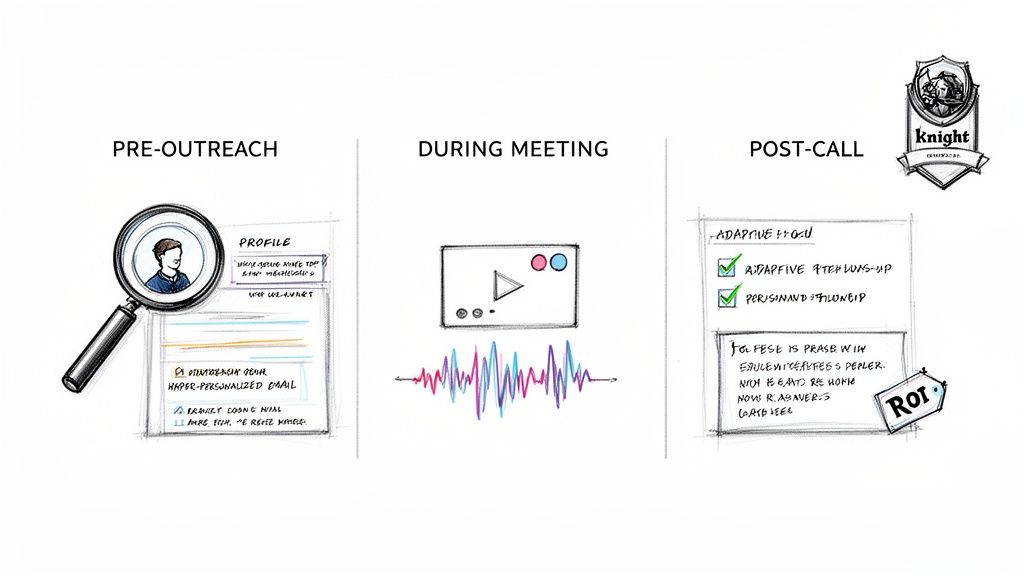
Before the Outreach
That first touchpoint is your golden opportunity. Instead of blasting out a generic template, you can use digital footprint analysis to craft a hyper-personalised message that actually lands.
- Step 1: Analyse the Signals. Take a look at your prospect's latest LinkedIn activity. What posts are they liking? Has their company been in the news?
- Step 2: Pinpoint Their Archetype. Use an intelligence tool to figure out their communication style. Are they a direct, get-to-the-point 'Knight'?
- Step 3: Craft a Sharp Message. Write a short, ROI-focused email. Cut the fluff. Lead with a clear value proposition that you can tie directly to something you found in your research, like a recent company announcement.
A well-researched, five-sentence email that speaks directly to a prospect's known priorities will outperform a hundred generic cold emails. Every. Single. Time.
During the Meeting
This is where the top reps really shine—adapting in real-time. Data-driven insights give you a secret weapon for reading the room (even a virtual one) and adjusting your pitch on the fly.
Let's say you've identified your prospect as an 'Explorer' who gets excited about big-picture ideas. You can kick off the meeting by talking about industry trends and what's possible in the future, instead of jumping straight into product features. If you see them physically lean in when you mention innovation, you know to double down on that theme. It's active listening, but supercharged with data.
After the Call
The follow-up is where so many deals either come together or fall apart. Ditch the lazy "Thanks for your time" email. Instead, use what you learned from the conversation to tackle potential hurdles before they even become roadblocks.
Here’s a simple but powerful post-call workflow:
- Review the Conversation. Did they keep bringing up "budget" or "integration"? Those are your key follow-up points.
- Get Ahead of Objections. If budget was a recurring theme, don't just send a meeting summary. Include a case study that shows undeniable ROI or mention a more flexible payment plan.
- Reinforce the "Why". Frame your recap around the specific problems they told you they have. This shows you didn't just hear them—you actually understood.
By embedding these small, insight-driven actions into every stage of your sales cycle, you build a powerful flywheel of momentum that keeps deals moving forward, consistently.
Measuring The Real Impact Of Your Sales Insights
Having powerful data-driven sales insights is one thing, but if you can't prove their value, they're just interesting facts. The real test isn't just knowing more about your prospects; it's seeing a tangible lift in the Key Performance Indicators (KPIs) that actually drive revenue.
When your team starts using these insights to tailor their outreach and get ahead of customer needs, you should see a clear, measurable impact. It's all about drawing a straight line from better data to better results.
KPIs That Reveal True Performance
To see what's really working, you need to zero in on a few core metrics. These are the numbers that tell the true story of how well your team is turning leads into happy customers.
- Reply Rate: This is your first and most honest piece of feedback. A higher reply rate is a direct signal that your personalised messages are hitting the mark. It proves your insights are resonating.
- Meeting Conversion Rate: Are more of your initial chats turning into qualified meetings? This tells you that your data is helping you spot and engage prospects with a genuine, urgent need for what you're selling.
- Sales Cycle Length: When you use insights to handle objections before they even come up and align your pitch with a prospect's core drivers, you smooth out the entire sales process. The natural result is a shorter, more efficient sales cycle.
The ultimate goal is to connect every insight to a specific sales action, and every action to a measurable outcome. This creates a powerful feedback loop where data continually sharpens your strategy, leading to predictable growth.
A Case Study In Data-Driven Growth
This principle of using data to cut out the guesswork isn’t just for sales outreach; it's a proven business strategy. Just look at Singapore's competitive market, where Ice Cube Marketing pulled off a staggering 300% revenue growth over 36 months by going all-in on a data-driven approach.
Their success story is a perfect parallel for how sales teams can stop wasting time on the wrong leads. It’s especially powerful when you consider that 41% of digital ad spend—about US$6.15 billion—often goes to ineffective campaigns. This just goes to show how rigorous analysis delivers a real, measurable ROI. You can read more about how they tripled their growth on straitstimes.com.
By focusing on these core KPIs, you can finally move past assumptions and start quantifying the precise return on your data-driven sales efforts. You'll have the concrete proof you need to show that working smarter isn't just a catchy phrase—it's a direct path to closing more deals.
Using Data Ethically To Build Customer Trust
As we start collecting and analysing more customer information, the conversation around ethics isn't just important—it's essential. The whole point of using data-driven sales insights isn't to manipulate people. It’s about communicating with them more effectively and building genuine trust.
When you do it right, this approach is all about service, not surveillance.
The key is to focus on information that’s either publicly available or given consensually. Think about what a prospect has already chosen to share: their LinkedIn profile, company press releases, or a whitepaper they downloaded from your website. It’s really just about listening to what they’re already telling you and using that to serve them better.
From Insight To Rapport
Here's the most important rule of thumb: never, ever make your AI-driven assumptions explicit. Telling someone you’ve analysed their personality or communication style can feel incredibly invasive and will shatter trust in an instant.
The real art is in using these insights to subtly adapt your own behaviour. This builds natural rapport and shows you are attuned to their needs, making the conversation more relevant and valuable for them.
So, instead of saying, "My analysis suggests you prefer direct communication," just get straight to the point in your email. Rather than announcing, "You seem like a big-picture thinker," kick off your meeting with a visionary overview. The insights should guide your actions, not become the topic of conversation.
Best Practices for Ethical Data Use
To make sure you’re always building trust and never crossing a line, stick to these core principles:
- Be Transparent: If asked, be clear about why you’re collecting data. Frame it around how it helps you provide a better, more personalised experience.
- Provide Value: The data you use should directly translate into a more helpful interaction for the prospect. Use it to solve their problems, not just to hit your quota.
- Stay Human-Centred: Remember that behind every single data point is a real person. Your goal is to foster a better human connection, using technology as a quiet guide to improve your own empathy and understanding.
By following these guidelines, you can use powerful data insights to create stronger, more authentic relationships. This ethical approach turns data into a tool for building lasting trust—and that’s the ultimate foundation for any successful sale.
You can explore more on how Mindreader approaches this topic in our article on addressing potential biases in AI systems.
Still Have Questions About Data-Driven Sales?
We hear these a lot. Here are some quick answers to the most common questions that come up when teams are considering this approach.
Do I Need to Be a Data Scientist to Use These Insights?
Absolutely not. That’s a common misconception. Modern tools are designed to do all the heavy lifting for you. They take in complex signals and spit out simple, actionable playbooks.
Your job isn't to become a data analyst; it's to use these insights to amplify the sales skills you already have. Think of it as having a secret research assistant who preps you before every single call.
How Does This Integrate With My Existing CRM?
This is a crucial point. Nobody wants yet another tool to juggle. Most modern sales intelligence platforms are built to plug straight into your CRM.
Insights pop up right where you already work, enriching your contact records and offering guidance without you ever having to switch screens. This lets you keep your head in the game and your focus squarely on the conversation.
Is This Approach Only For Large Enterprise Teams?
Not at all. This way of selling is incredibly scalable, offering huge advantages to organisations of all sizes.
For founders and small teams, it's about making every minute count and maximising your impact. For larger enterprises, it’s about creating a consistent, high-quality standard for every client interaction across the entire sales force.
Ready to stop guessing and start building predictable revenue? Mindreader delivers the actionable playbooks you need to connect with every prospect on their own terms. See how our Human Intelligence System can elevate your sales conversations—explore Mindreader today.