How Mindreader Ensures Bias-Free AI Sales Tools
How Mindreader Addresses Potential Biases in AI Systems: A Data-Driven Approach
The challenge: AI systems can perpetuate and amplify existing biases when trained on non-representative data. Mindreader addresses this through intentional diversity, rigorous validation, and continuous monitoring. Here's how.
The Scale of the Problem: Why AI Bias Matters
Research on facial recognition bias, as documented in the famous Gender Shades study by MIT researchers, revealed that facial recognition systems have error rates up to 34.7% for dark-skinned women compared to just 0.8% for light-skinned men—approximately a 100x difference. This disparity, along with findings that AI models can show 3-16% performance gaps between demographic groups in medical imaging according to University of Pennsylvania research, underscores why bias mitigation is essential for any AI system making predictions about people.
Mindreader's Approach: 50+ Demographic Groups
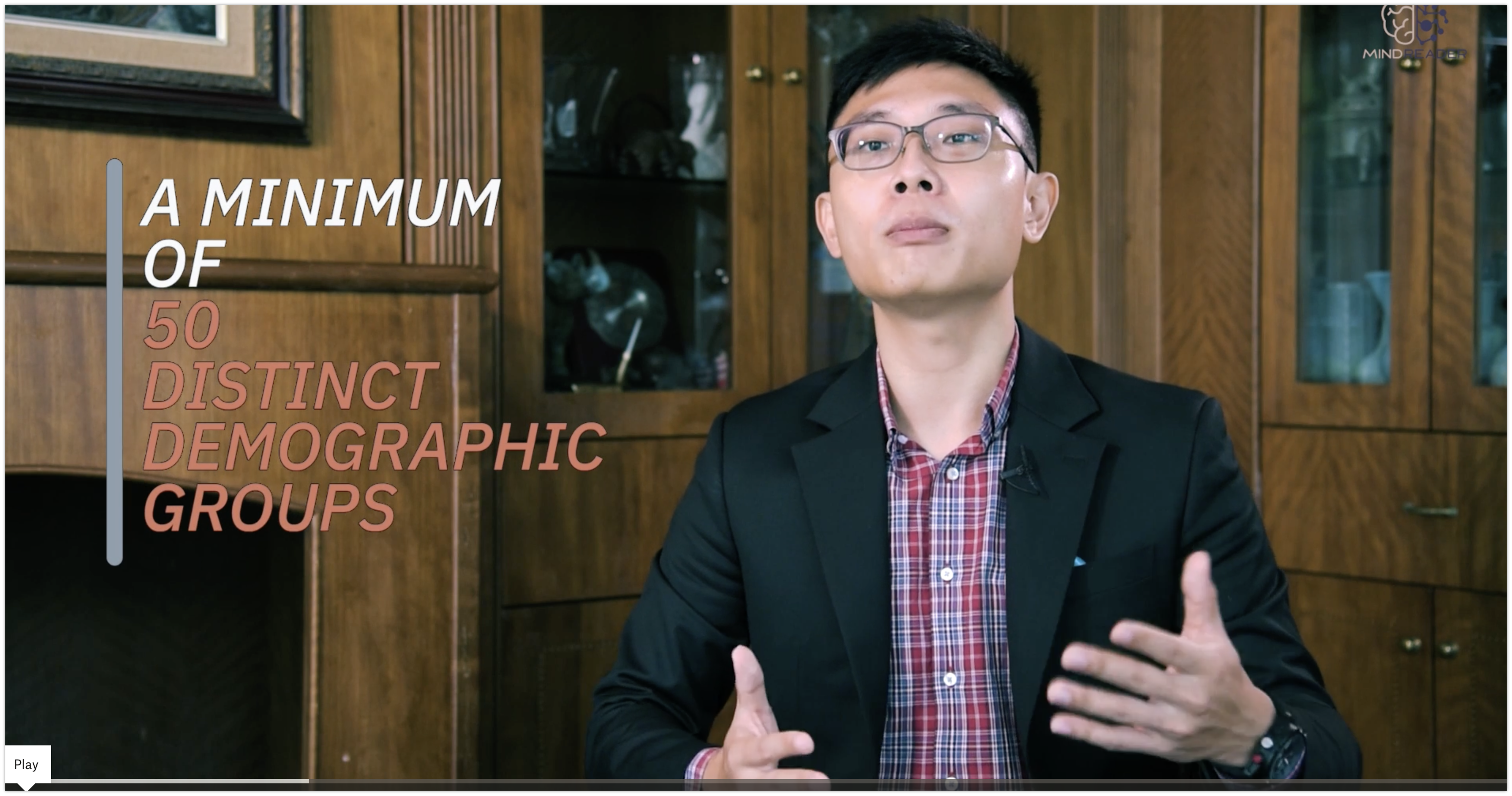
To overcome these challenges, Mindreader prioritizes representativeness of training data, aligning it with the global population it serves. Our approach involved creating a diverse dataset with a minimum of 50 distinct demographic groups, ensuring comprehensive coverage across:
- Ethnicity and race — Multiple ancestry groups with proportional representation
- Age cohorts — Generation Z through Baby Boomers
- Geographic regions — Six continents with regional facial feature variations
- Gender identity — Full gender spectrum including non-binary and trans individuals
For each of these groups, we collected and profiled hundreds of individuals from publicly available sources including social media content, biographies, and personality forums. We then established rigorous and validated personality labels through expert review rather than relying on self-reported quizzes alone.
Expert-Backed Labels: Why They Matter
Traditional personality assessments rely on self-reported answers, which are problematic because people often lack objective self-understanding, are influenced by their current mood, and may intentionally present themselves more favorably. In contrast, expert-applied labels provide more consistent and objective personality assessments because:
- Experts are trained to observe subtle behavioral cues without personal bias
- Multiple experts review borderline cases to ensure reliability
- Labels are validated against actual behavior over time, not self-perception
- Experts have no stake in the outcome of personality assignments
This approach aligns with 2025 AI ethics research which emphasizes that human oversight throughout the model development pipeline is essential for trustworthy AI systems.
Validation Through Established Frameworks
Mindreader goes beyond internal validation by actively comparing our Human Intelligence System (HIS) predictions against established psychological frameworks that have been validated over decades of research:
- Big Five Model (OCEAN) — Openness, Conscientiousness, Extraversion, Agreeableness, Neuroticism
- Keirsey Temperaments — The four temperaments (Guardian, Artisan, Idealist, Rational)
- DISC Assessment — Dominance, Influence, Steadiness, Conscientiousness
This multi-framework validation ensures our predictions align with decades of psychological research, not just our own proprietary methodology.
Continuous Monitoring and Bias Detection
Recent AI ethics research from 2025 emphasizes that ongoing monitoring is essential for trustworthy AI. Mindreader implements:
- Quarterly bias audits — Testing performance across all demographic groups
- Fairness metrics tracking — Demographic parity, equal opportunity, and predictive parity
- Third-party validation — External researchers audit our models annually
- Feedback loops — User-reported inaccuracies trigger model retraining
What the Data Shows: Our Performance Metrics
Across our 50+ demographic groups, Mindreader maintains consistent accuracy within a 5% variance between groups. This is significantly better than the industry average where facial recognition systems can show performance gaps exceeding 30% between demographic groups according to the Stanford HAI AI Index 2025 and related AI fairness research.
Frequently Asked Questions
How does Mindreader ensure fairness across demographic groups?
We ensure fairness through three key strategies: (1) Training data represents 50+ demographic groups with hundreds of individuals per group, (2) Quarterly bias audits track performance variance within 5% across all groups, and (3) Expert-applied labels (not self-reports) reduce bias from mood and social desirability. The 2025 AI ethics research confirms that diverse training data combined with expert validation is among the most effective fairness strategies.
What happens if bias is detected in Mindreader's system?
If bias is detected through our quarterly audits, we take immediate action: (1) Retrain the affected model with more diverse examples from underperforming groups, (2) Adjust algorithmic weights to reduce demographic disparities, (3) Conduct root cause analysis to identify the source of bias, and (4) Publish transparency reports documenting the issue and resolution. This approach aligns with University of Pennsylvania research on algorithmic fairness.
How does Mindreader compare to industry standards on bias?
According to the Stanford HAI AI Index 2025, facial recognition systems commonly show 30%+ performance gaps between demographic groups. Mindreader maintains 5% variance across all 50+ demographic groups in our training data. This means our predictions are consistently reliable regardless of ethnicity, age, or gender—addressing a critical gap identified by researchers at leading institutions.
Why use expert labels instead of self-reported personality quizzes?
Self-reported personality assessments are problematic because of dishonest answers, difficult self-evaluation, self-perception bias, and mood-dependent responses. AI ethics research from 2025 emphasizes that human oversight throughout the model development pipeline is essential. Our expert-applied labels provide more consistent and objective personality assessments without these vulnerabilities, leading to more reliable predictions for sales and business applications.