The Ultimate MBTI Compatibility Chart for Sales Success
An MBTI compatibility chart is a fantastic quick-reference tool, showing you how different personality types are likely to interact. When we talk about compatibility in a sales context, we're not talking about personal chemistry or romance. Instead, it’s all about decoding communication styles to build rapport quickly and effectively. Think of it as a visual matrix that helps you instantly size up the potential dynamic with any prospect, giving you a head start on your strategy.
A Quick Reference MBTI Compatibility Chart for Sales
In a high-stakes sales conversation, understanding how your prospect prefers to communicate is a massive advantage. An MBTI compatibility chart acts as your starting point, giving you a snapshot of how different personalities might connect—or clash—based on their core cognitive functions. The goal isn't to put people in a box; it's about developing the flexibility to adapt your approach on the fly.
For example, two types who share a preference for Sensing (S) or Intuition (N) will often find it much easier to get on the same wavelength. If you want to dive deeper into this, we've got a great guide on the differences between Sensing vs Intuitive communication styles. On the flip side, clashing preferences can create real friction if you don't know how to handle them with a bit of finesse.
Understanding the Communication Dynamics
I find it helpful to think of compatibility in three simple buckets:
- Good Match: These pairings usually share key cognitive functions, which makes for smoother, more intuitive conversations. Communication just feels more natural, and building that crucial rapport often happens without much effort.
- Neutral: Here, you've got a mix of similar and different preferences. These interactions require a bit more conscious effort to bridge any communication gaps, but they can lead to really balanced and productive relationships once you do.
- Challenging: These types have fundamentally different ways of seeing the world, processing information, and making decisions. And while that sounds tough, these pairings offer the biggest opportunity for growth if you can learn to genuinely appreciate and adapt to their perspective.
This infographic breaks down what that looks like in terms of effectiveness.
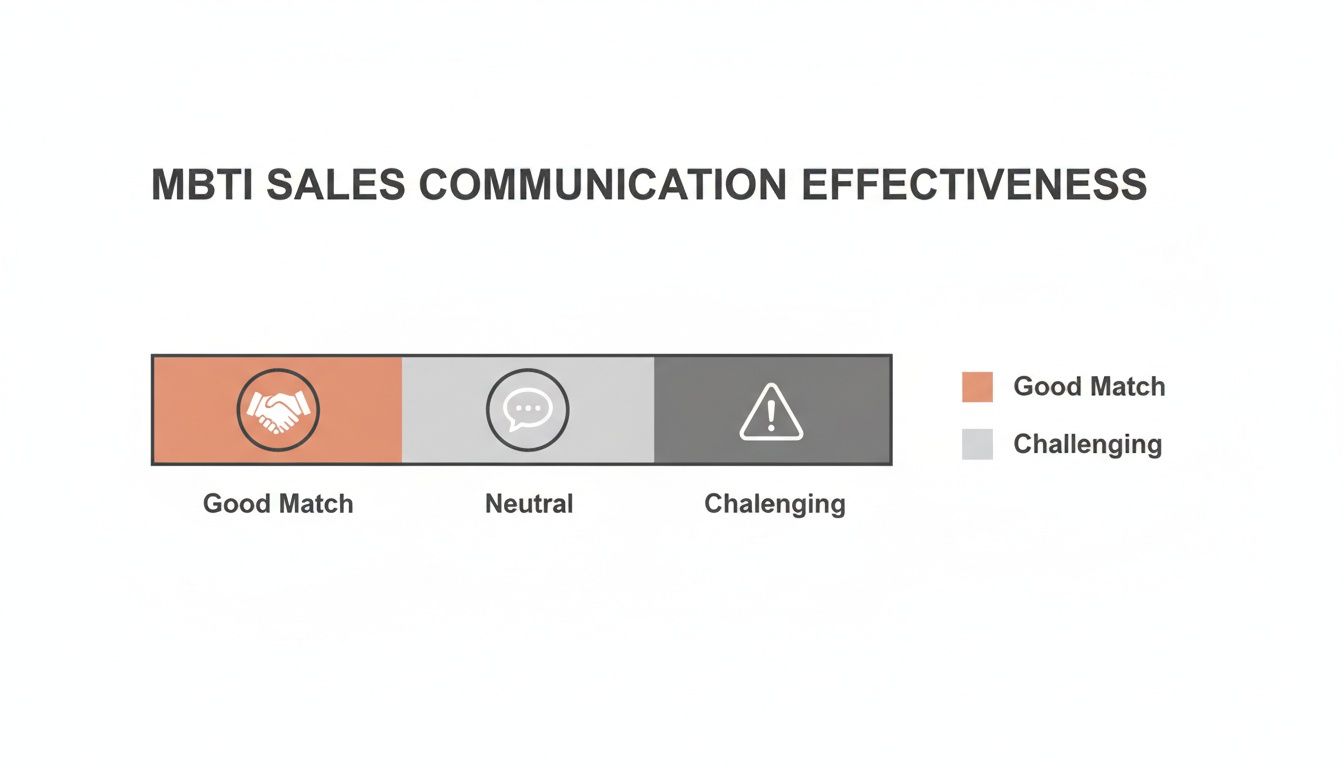
As you can see, while the "good matches" give you the easiest path to rapport, a huge chunk of your conversations will fall into the neutral or challenging zones. This is exactly why having adaptive sales strategies is so critical for success.
Ultimately, this chart isn't a rigid set of rules you must follow. It's a guide to help you anticipate a prospect's mindset. It’s about encouraging you to move beyond a one-size-fits-all pitch and start tailoring your message for maximum impact.
The Four Dimensions Driving Every Sales Conversation
To turn the mbti compatibility chart from a static diagram into a practical sales tool, you first have to get familiar with its building blocks. The 16 personality types are all built from four core dimensions, or dichotomies. Don't think of these as rigid labels. Instead, see them as the underlying preferences that guide how your client takes in information, makes decisions, and organises their world.
When you master these four dimensions, you'll start spotting communication patterns in real-time. This lets you adapt your approach on the fly, long before you’ve even pinned down a specific personality type. Each one is a critical clue to building genuine rapport.
Extraversion (E) vs Introversion (I): How Clients Recharge
This first dimension is all about where a client directs their energy. It's not about being shy versus being loud; it’s about what recharges their decision-making battery.
- Extraverts (E) get their energy from the outside world. They often think out loud, love a good collaborative brainstorm, and get fired up by fast-paced discussions. During a sales call, they’re the ones jumping in with questions and wanting to workshop ideas right there with you.
- Introverts (I) get their energy from internal reflection. They’d much rather process information privately before they speak and often need pauses or a bit of silence to think. They really appreciate it when you send materials in advance so they can review them on their own time.
Just spotting this one preference helps you pace the conversation perfectly. Do you need to keep the energy high and interactive, or should you slow down and give them the space to think things through?
Sensing (S) vs Intuition (N): How Clients See the World
This pair describes how people prefer to take in information. It’s a game-changer. Are they focused on concrete facts, or are they more interested in abstract possibilities? Getting this right is often the most critical part of structuring your pitch.
Sensing types are grounded in the tangible reality of what is. They want to see the proven case studies, the hard data, and a step-by-step demo of how your solution actually works. They trust what they can see, touch, and measure, which makes them pretty sceptical of purely theoretical benefits.
Intuitive types, on the other hand, are all about the big-picture possibilities of what could be. They get excited by visionary concepts, innovative ideas, and the long-term strategic impact. They connect the dots quickly and can get bored if you bog them down with too many details. You can learn more about how to engage both by understanding the Sensing vs Intuitive dynamic in sales.
In a sales pitch, a Sensing client asks, "Show me exactly how this has worked for a company like mine before." An Intuitive client asks, "How will this change the way my industry operates in five years?"
Thinking (T) vs Feeling (F): How Clients Decide
Once a client has the information, this dimension shows you how they prefer to make decisions. Is their primary filter logical consistency, or is it human impact?
- Thinking (T) types make decisions based on objective logic and impersonal analysis. They prioritise facts, principles, and quantifiable outcomes like ROI. The bottom line for them is whether the decision is fair, effective, and makes logical sense.
- Feeling (F) types make decisions based on personal values and the impact on people. They prioritise team harmony, company culture, and customer relationships. They need to know if the decision feels right and supports their core mission.
This doesn't mean Thinkers are heartless or that Feelers are illogical. It just points to their default decision-making software. Frame your value proposition to match—lead with hard ROI for a Thinker, but open with team benefits or powerful testimonials for a Feeler.
Judging (J) vs Perceiving (P): How Clients Organise Their Life
Finally, this dimension clues you in on a client’s preferred approach to the outer world. Do they favour structure and closure, or do they thrive on flexibility and spontaneity?
Judging types like a planned, organised life. In a sales context, they absolutely appreciate clear agendas, firm deadlines, and decisive next steps. They want the meeting to have a clear purpose and end with a conclusion.
Perceiving types, however, prefer a flexible, adaptable approach. They stay open to new information, enjoy exploring different options, and may resist being pushed into a final decision too quickly. They thrive in exploratory meetings where they can ask questions and pivot as new ideas pop up.
Turning MBTI Theory into Actionable Sales Archetypes
While a detailed MBTI compatibility chart is fascinating, let's be realistic—memorising 16 different personality types and how they all interact isn't practical when you're trying to hit your targets. The real challenge is bridging the gap between interesting psychological theory and what you actually do on a sales call.
That's where sales archetypes come in. We can distill those 16 complex personalities into four simple, actionable groups. This approach lets you quickly size up a prospect and switch up your strategy on the fly, without getting bogged down in the finer details of an INTJ versus an ENTJ. Think of it as a powerful shortcut.
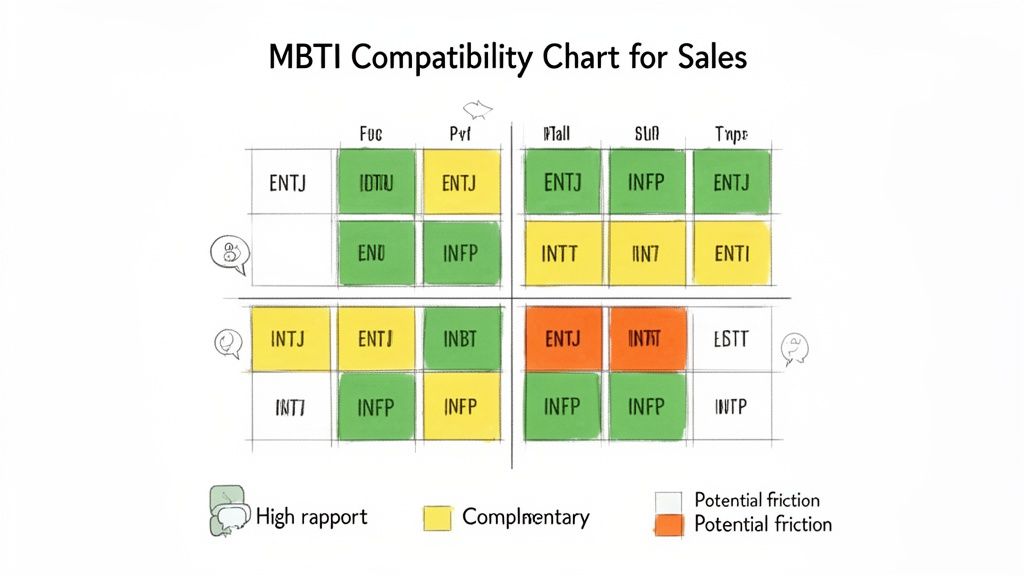
These archetypes are grouped by shared communication styles and what ultimately triggers their decision to buy. This streamlined system helps you move faster and act with far more confidence.
Meet the Four Core Sales Archetypes
Each archetype represents a fundamentally different way of thinking, communicating, and ultimately, buying. Getting to know these core groups is your first step in turning abstract personality data into a real-world sales advantage.
Here are the four archetypes you’ll meet in the field:
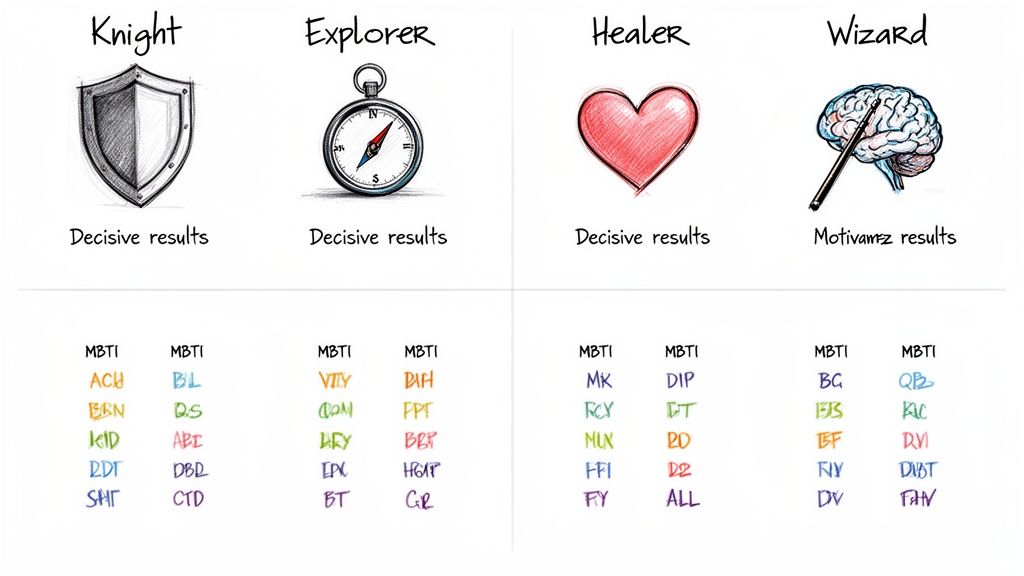
- The Knight: Straight to the point, decisive, and all about the goal. Knights value efficiency and clear, logical results. They just want the bottom line and are driven by hitting objectives and getting a competitive edge.
- The Explorer: Spontaneous, hands-on, and ready for action. Explorers get energised by new experiences and things they can see and touch. They love a good live demo and respond to excitement and immediate, practical benefits.
- The Healer: Empathetic, relationship-driven, and guided by their values. Healers need to build genuine trust and are motivated by solutions that help people. They want to know the human impact behind any decision.
- The Wizard: Deeply analytical, strategic, and always seeking knowledge. Wizards are meticulous thinkers who respect data, expertise, and a well-thought-out system. You’ll persuade them with in-depth information and a clear, logical framework.
By slotting the 16 MBTI types into these four buckets, you dramatically simplify how you prepare for a meeting. Instead of a generic script, you can quickly identify a prospect's core motivation and tailor your message to what really drives them.
MBTI to Sales Archetype Conversion Guide
This table is your quick-reference guide for mapping each of the 16 MBTI personality types to its corresponding sales archetype. It's designed to translate the complex MBTI compatibility chart into a practical tool you can use in your daily sales interactions.
| Sales Archetype | Corresponding MBTI Types | Core Sales Motivation |
|---|---|---|
| Knight | ENTJ, ESTJ, INTJ, ISTJ | Efficiency and Results |
| Explorer | ESTP, ESFP, ISTP, ISFP | Action and Experience |
| Healer | ENFJ, ESFJ, INFJ, ISFJ | Harmony and Connection |
| Wizard | ENTP, ENFP, INTP, INFP | Logic and Innovation |
With this simple conversion in mind, you're ready to move beyond just understanding personality and start using it to build stronger connections and close more deals.
How to Sell to Every Personality Archetype
That MBTI compatibility chart isn't just a theory—it's a practical sales playbook once you understand the four core archetypes. Forget guessing how to connect. This is about adapting your strategy to a prospect's fundamental motivations. Let's break down how to engage each archetype, build real rapport, and actually drive decisions.
This is where you move from theory to application. Getting this right is a genuine competitive edge, because each archetype needs a completely different approach to communication, pacing, and how you present value.
Selling to the Knight (ESTJ, ENTJ, ISTJ, INTJ)
Knights are all about results and efficiency. They see the world through a lens of goals and objectives, which means they have zero patience for fluff, pointless small talk, or presentations that meander. To win them over, you have to be direct, confident, and armed with data.
Actionable Tactics:
- Lead with the Bottom Line: Start with your conclusion or the main outcome. Don’t build up to it; they’ll get impatient.
- Use Concrete Data: Show them the numbers. Clear metrics, ROI projections, and efficiency gains speak their language. In fact, over 70% of their decisions are rooted in logic and hard proof.
- Respect Their Time: Keep meetings short, structured, and on-point. An agenda isn't just nice to have; it's essential.
A common mistake is trying to get too personal or emotional. Knights are making a business decision, not trying to make a new friend. Your job is to radiate competence and credibility. For example, skip "I think you'll love this," and go straight to, "This will cut your overheads by 15% in the first quarter."
Selling to the Explorer (ESTP, ESFP, ISTP, ISFP)
Explorers live for immediate impact and hands-on experience. They're focused on the here-and-now, getting energised by action, excitement, and things they can see and touch. A long, abstract presentation will make their eyes glaze over in seconds.
Actionable Tactics:
- Show, Don't Just Tell: A live demo beats a slide deck every single time. If they can interact with the product, even better.
- Focus on Immediate Benefits: Talk about what they gain right now, not five years down the road.
- Keep the Energy High: You need to be dynamic and engaging. Use visuals, movement, and a conversational, energetic tone.
Avoid getting bogged down in tiny technical details or long-term strategic plans. The Explorer just wants to know how your solution fixes their problem today. A great line to use is, "Let me quickly show you how this feature solves that exact bottleneck you just mentioned."
Selling to the Healer (INFJ, INFP, ENFJ, ISFJ)
Healers are all about relationships and values. For them, trust is the only currency that matters. They have to believe in you and your solution’s positive impact before they’ll even consider buying. Building a genuine connection isn't optional; it's the entire game.
Actionable Tactics:
- Build Rapport First: Take the time to get to know them and their team's challenges on a human level.
- Demonstrate Empathy: Show you truly understand their mission and how your solution aligns with their values. Use phrases like, "It sounds like a major priority is ensuring your team feels supported."
- Use Testimonials and Case Studies: Stories about how you’ve helped others are incredibly powerful. Social proof is everything to them.
The fastest way to lose a Healer is to rush the sale or use high-pressure tactics. They’ll shut down immediately if they feel pushed. For a closer look at these nuanced approaches, check out our guide on how to read client personalities for sales success.
Key Insight: For Healers, the "who" and "why" often matter more than the "what." They buy from people they trust, who represent solutions they believe in.
Selling to the Wizard (INTJ, INTP, ENTP, ENFP)
Wizards are deep, analytical thinkers motivated by logic, innovation, and expertise. They need to understand the system behind your solution and see a clear, well-reasoned argument for it. They respect knowledge and will absolutely test the limits of yours.
Actionable Tactics:
- Present a Logical Framework: Clearly explain the "how" behind your solution. Connect every feature to a benefit with a clear, logical step.
- Be Prepared for In-Depth Questions: Don't dread their questions; welcome them as a sign of genuine engagement. Just make sure you can provide detailed, accurate answers.
- Offer Comprehensive Information: Give them the white papers, technical specs, and detailed data. They want to do their own research, so let them.
The biggest pitfall here is giving superficial answers or showing up unprepared. Wizards lose respect fast if they sense you don't have a firm grasp of your own product. Frame your pitch as a collaborative exploration of a complex problem—one you can solve together.
Tailoring Your Sales Presentation for Each Archetype
How you present your solution is just as critical as the words you choose. A brilliant message delivered in the wrong format will fall flat, which is why adapting your presentation structure to each archetype is a non-negotiable step in strategic selling. A good mbti compatibility chart is only useful when you translate its insights into tangible actions—right down to the format of your pitch.
When you move beyond generic slide decks, you start connecting with a prospect’s core cognitive preferences. This is the difference between your message being heard and it being truly understood and valued.
Crafting Presentations for Knights and Wizards
When you're dealing with the logical and results-focused archetypes, your presentation has to be a model of clarity and efficiency. They process information systematically and have very little patience for anything that feels disorganised or purely emotional.
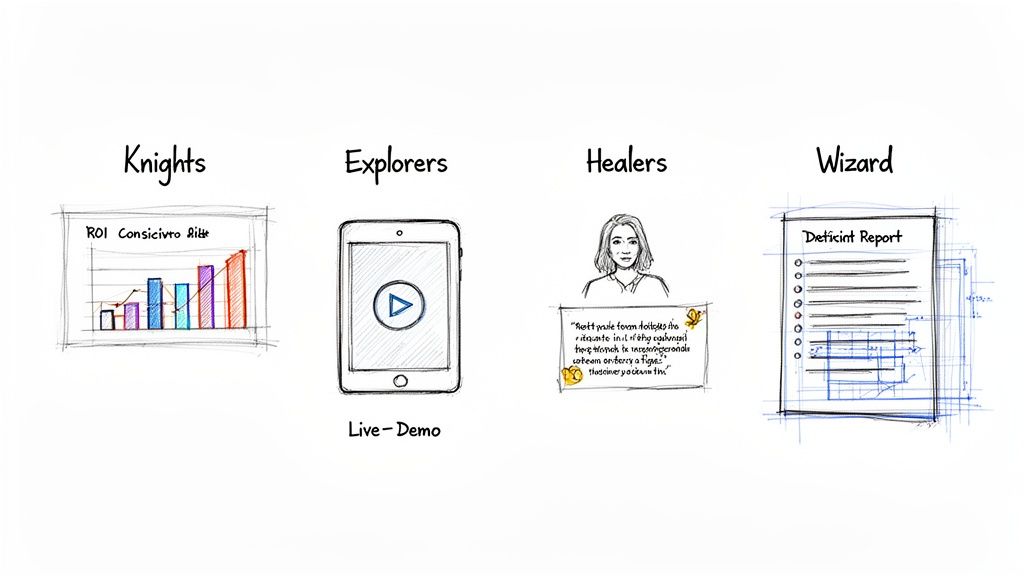
Knights (ENTJ, ESTJ, INTJ, ISTJ): These types need a concise executive summary right at the start. Use clear ROI charts, bolded key metrics, and a logical flow that drives straight to the bottom line. Their main question is always, "What result will this get me?"
Wizards (INTP, ENTP, INFP, ENFP): Wizards demand depth and expertise. Don't be afraid to get technical. Provide them with a detailed report, white papers, or comprehensive data sheets. They want to understand the system underneath it all and will appreciate a presentation that respects their intelligence by not oversimplifying complex ideas.
For both Knights and Wizards, a polished, professional format is absolutely crucial. Their confidence in you is directly tied to the competence you project through your materials. If you want to refine this approach, you can learn more about how personality AI improves sales script writing and presentation structure.
Engaging Explorers and Healers Visually
Explorers and Healers are moved by experience and human connection. This makes visual and story-driven presentations far more effective than dry data dumps. They need to see and feel the impact of your solution.
Recent data from Malaysia confirms a universal truth for sales professionals in the Singapore region: visual preference is dominant across the board. In a study on digital engagement, picture-based content was preferred by nearly 100% of surveyed profiles, followed closely by videos and then text. This just goes to show that adapting your communication medium is as vital as the message itself. You can discover more insights about these engagement patterns and what they mean for sales.
With that in mind, here’s how to structure your presentations for these archetypes:
Explorers (ESTP, ESFP, ISTP, ISFP): Forget static slides. Explorers respond best to live demos, interactive elements, and high-energy videos that show the product in action. The more hands-on and immediate it feels, the more engaged they will be.
Healers (INFJ, ISFJ, ENFJ, ESFJ): These types are persuaded by authentic human stories. Feature genuine video testimonials, detailed case studies focusing on client success, and visuals that highlight the positive impact on people or teams. For Healers, building trust is your primary goal.
How Personality Insights Drive Real-World Sales: A Singapore Case Study
Theory is great, but let's talk about what this looks like on the ground. This case study zooms in on the Singaporean market—a fiercely competitive space where subtle cultural and personality nuances can make or break a deal. Moving from a generic pitch to one guided by personality insights isn’t just a small tweak; it can completely change your results.
Picture a tech sales team in Singapore. They came in hot, using the same high-energy, feature-dumping pitch that had served them well in Western markets. The result? Polite nods and firm rejections. They were struggling to get any real traction.
Shifting Gears with Local Insights
The team's breakthrough moment came when they started digging into regional personality data. The professional landscape in Singapore is unique, with research showing it's one of Asia's most introverted countries—a solid +4.7% more introverted than the global average.
When you cross-reference that with studies on Southeast Asian populations, you see higher concentrations of ISFJ types, who fall neatly into our Healer archetype. Suddenly, the team realised that nearly 1 in 10 of their prospects could be Healers. This insight was a game-changer. You can dive deeper into how personality data shapes regional communication styles to see just how powerful this can be.
This wasn't just a fun fact; it completely reframed their strategy. Instead of leading with aggressive tactics, they knew they had to shift their focus to building trust and demonstrating long-term value—two things that resonate deeply with the Healer archetype.
From Aggressive Pitch to Trusted Advisor
Armed with this new perspective, the team walked into a meeting with a key prospect who was a classic Healer: relationship-focused, cautious about risk, and deeply concerned with team harmony.
Here’s how they flipped the script:
- Initial Outreach: The direct, feature-heavy emails were out. In their place came a softer opening that acknowledged the prospect’s company mission and highlighted shared values.
- The Meeting: They didn't open with ROI. They started with a story about how their solution had supported another client’s team, focusing on community benefits and reduced employee stress.
- Follow-Up: The push for an immediate decision was gone. Instead, they sent a detailed summary and offered patient, thoughtful follow-ups, even suggesting they speak with other team members to make sure everyone was comfortable.
This Healer-centric approach transformed the entire dynamic. The prospect, who had ghosted their generic pitch, became an engaged partner. By leading with trust, community, and patient guidance, the sales team didn't just close a deal; they built a relationship.
Key Takeaway: The sales team's success in Singapore wasn't about finding a magic script. It was about recognising the prevalent personality archetypes in their market and adapting their communication to build genuine rapport. They turned a potential clash into a strong, lasting business partnership.
Common Mistakes to Avoid in Personality-Based Selling
Using an mbti compatibility chart or sales archetypes can give you a massive edge, but it's easy to stumble. Misusing these tools can torpedo rapport and kill trust faster than a bad pitch. Remember, the goal is to connect more authentically, not cram prospects into neat little boxes.
The biggest mistake? Stereotyping. When you treat an archetype as a rigid script instead of a flexible guide, you lose sight of the person right in front of you. Someone is always more than their four-letter code, and what you observe in the moment should always trump any preliminary assessment.
Over-Reliance on a Single Data Point
Leaning entirely on a chart or your first guess without being ready to adapt is a surefire way to fail. A prospect might come across as a direct, results-driven Knight, but have deep-seated Healer motivations about their team’s well-being. If your data-heavy pitch isn't connecting, you have to be nimble enough to switch gears.
Think of a personality framework as a compass, not a map. It points you in a direction, but you still have to navigate the actual terrain of the conversation.
Being flexible is far more valuable than being perfectly accurate right out of the gate. The real power here isn't in flawlessly pegging a prospect's type from the start; it's in having a ready-made toolkit of communication styles to pull from when your first approach falls flat.
Misinterpreting Regional Nuances
Another classic blunder is applying a one-size-fits-all standard without considering local communication styles. For instance, research on personality traits across Southeast Asia reveals that people in places like Thailand and Vietnam tend to score higher on Agreeableness and lower on Extraversion than their Western peers. These findings suggest that 55-60% of prospects in the wider ASEAN market will likely respond better to relationship-building than a purely transactional pitch. You can read the full research about these regional traits to get a better handle on these dynamics.
Forgetting the Human Element
At the end of the day, the worst mistake is letting these frameworks replace genuine curiosity. Never stop asking good questions and actually listening to the answers. The insights from a personality tool should add to your natural empathy and sales instincts, not stand in for them.
So, what are the key tripwires to watch out for?
- Stereotyping: Boiling a complex person down to a simple label.
- Rigidity: Sticking to one approach even when it’s obviously not working.
- Ignoring Live Cues: Trusting your initial guess over what the prospect is telling you, with their words and body language.
- Forgetting Context: Overlooking cultural or regional communication norms.
By sidestepping these common blunders, you can make sure personality-based selling remains a powerful and ethical way to build stronger, more successful business relationships.
Your Adaptive Sales Workflow
Turning what you know from an mbti compatibility chart into actual results isn't about memorising theory. It’s about building a repeatable workflow that makes adapting to your client second nature. When you weave these personality insights into your daily routine, you stop guessing and start selling with a deliberate, effective strategy.
Think of this adaptive workflow in three distinct stages, each building on the last. It starts long before the first handshake and keeps going well after the meeting ends. The goal? Make sure every single interaction is flexible, relevant, and builds real trust.
Pre-Call Preparation: Anticipating Their Style
The first step is all about preparing with intent. Before you even think about picking up the phone or writing that first email, take a minute to anticipate your prospect’s likely communication style. A quick look at their LinkedIn profile, their role in the company, or even industry norms can give you a working hypothesis.
Are they a finance exec in a data-heavy industry? It's a safe bet to prepare a Knight-like approach, focusing on hard numbers, ROI, and efficiency. Or is their role all about team culture and HR? A Healer-oriented playbook that talks about collaboration and employee impact will probably land much better.
This prep phase comes down to a few key things:
- Make an Archetype Hypothesis: Based on their role and industry, make an educated guess. Are they a Knight, Explorer, Healer, or Wizard?
- Tailor Your Opener: Sketch out your initial questions and talking points to connect with that archetype’s core drivers.
- Get Your Materials Ready: Gather the right kind of proof. For a Knight or Wizard, have hard data and case studies ready. For a Healer or Explorer, compelling team testimonials will be far more powerful.
In-Meeting Adaptation: Adjusting in Real Time
Let's be honest: no plan ever survives first contact. The real magic happens during the conversation itself, where you have to listen for cues and adjust your approach on the fly. You're not trying to slap a label on them; you're just responding to the behaviours they're showing you in the moment.
Listen closely to the words they use. Are they saying things like “efficiency,” “results,” and “deadline”? That’s your signal for a direct, structured conversation. But if you hear words like “team,” “culture,” and “support,” it’s a clear cue to slow down, lean in, and build a more personal connection.
The heart of adaptability is perceptive listening. Every question a prospect asks is a clue to how they make decisions. Your ability to shift your language in response is what makes them feel truly heard.
Stay flexible during the meeting. If you came in with a Knight-focused game plan but it isn’t landing, be ready to pivot. Maybe they keep talking about the long-term vision—that’s classic Explorer territory. So, you shift from ROI figures to a more inspiring, big-picture story. This real-time adjustment is what turns a sales pitch into a genuine dialogue and builds solid rapport.
Post-Call Follow-Up: Cementing the Connection
The final stage is all about reinforcing the connection you just built. Your follow-up can't be a generic template. It has to be tailored to the decision-making style you observed during the call. A great follow-up proves you were listening and that you respect their time.
For example, a follow-up email to a logical Wizard or Knight should be a sharp summary with bullet points, crystal-clear next steps, and any data sheets attached. On the other hand, a follow-up to a relationship-driven Healer might start by referencing a personal point from your chat before outlining how your solution benefits their team. By personalising this final touchpoint, you make it incredibly easy for them to become your champion internally.
Have Questions About MBTI Sales Strategies? We’ve Got Answers.
When you start digging into personality-based selling, a few practical questions always pop up. It’s one thing to look at an MBTI compatibility chart, but it's another to apply it in the real world. Let's tackle some of the most common ones to help you turn these insights into actual results.
How Much Can I Really Trust an MBTI Chart to Predict a Sale?
It’s tempting to view an MBTI compatibility chart as a crystal ball, but that’s not really its purpose. Think of it less as a predictor of a closed deal and more as a strategic communication map. Its real power is in giving you a framework to adapt your approach, build rapport much faster, and sidestep those awkward misunderstandings before they even start.
So, the chart's "accuracy" isn't about guaranteeing a sale. It’s about dramatically improving your connection rate. When you can speak a prospect's language from the get-go, you're building the foundation for every successful sale that follows.
What Happens If I Get a Prospect’s Archetype Wrong?
Don't sweat it—it happens to everyone. Getting the archetype wrong at first is completely normal, especially when you're just starting out. The key isn't to be a perfect profiler but to be observant and ready to adapt on the fly.
Let's say you've been hitting your prospect with direct, data-heavy tactics fit for a "Knight," but you're getting nowhere. If you notice they seem disengaged, that’s your cue to pivot. Try shifting to a more relationship-focused "Healer" approach and see how the energy changes.
The goal is never perfect labelling. It's about developing the flexibility to adjust your communication based on real-time feedback. The archetypes are simply a ready-made toolkit of strategies to pull from when your initial approach isn’t landing.
Can I Use This for More Than Just Selling to Clients?
Absolutely! While we've focused on client interactions, this framework is incredibly powerful for understanding the dynamics within your own sales team.
Here are a few ways to apply it internally:
- Assigning Leads: Got a tough, analytical client? Maybe send your best "Wizard" rep. A lead who needs more nurturing? That's a job for a "Healer." You can match reps to clients based on likely personality alignment.
- Structuring Presentations: Let team members lean into their natural strengths. Have your "Wizard" handle the deep-dive technical data, while your "Explorer" brings the energy and presents the live demo.
- Resolving Conflict: This framework helps team members appreciate different working styles and perspectives, which goes a long way in smoothing out internal communication and disagreements.
It’s a versatile tool for both boosting external sales and building a stronger, more cohesive internal team. And while this article covers the specifics of MBTI sales strategies, you can find answers to general business FAQs over on their dedicated page.
Ready to stop guessing and start connecting on a deeper level? Mindreader translates these personality insights into actionable sales tactics in seconds. Discover how our AI can help you prepare smarter, build trust faster, and close more deals. Visit https://www.themindreader.ai to see it in action.