Sensing vs Intuitive: How to Read and Persuade Prospects
The real difference between Sensing vs Intuitive people boils down to how they process the world around them. Think of it this way: Sensing types trust what is real, concrete, and verifiable, focusing on the practical reality of 'what is'. In contrast, Intuitive types are drawn to patterns, future possibilities, and the big-picture context of 'what could be'.
Getting this distinction right is the key to building genuine rapport and sidestepping the kind of miscommunications that can kill a high-stakes conversation before it even gets started.
Understanding the Sensing and Intuitive Divide
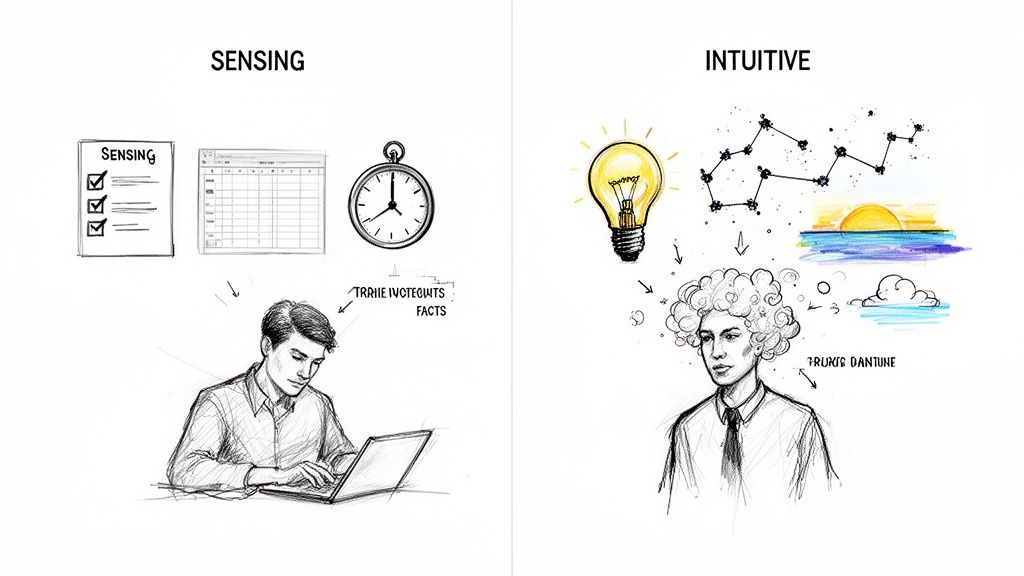
At its heart, this isn't about boxing people into rigid labels. It’s about their preferred way of perceiving things. Everyone uses both sensing and intuition to get through the day, but we all have a default setting we fall back on, especially under pressure. It's like being right-handed or left-handed—sure, you can use your non-dominant hand, but it’s clumsy and takes a lot more conscious effort.
This preference dramatically shapes how a prospect listens to your pitch, the kind of questions they’ll ask, and what they truly value in a solution.
Sensing (S) types are grounded in the here and now. They build their understanding of the world through their five senses—what they can actually see, hear, and touch. For them, personal experience and hard data are king.
Intuitive (N) types live in the world of the abstract. They're far more interested in theories, symbols, and how different ideas connect. They trust their "gut feelings" and get energised by exploring innovative concepts.
This is more than just a theoretical exercise. In Singapore's fast-paced business scene, for instance, a surprising 56 percent of consumers admit they rely on emotions and intuition over hard data when making big decisions. This single insight from a Frontier Enterprise study shows how a purely data-driven, Sensing-focused sales approach could fall flat with more than half the market.
These preferences are also a cornerstone of many personality frameworks. You can get a better sense of how they fit into the bigger picture by exploring Keirsey's Temperament Model.
Key Differences Between Sensing and Intuitive Prospects
To help you start tuning your ear to the subtle cues in your next sales conversation, here’s a quick reference guide. It breaks down the fundamental differences between how Sensing and Intuitive prospects think and what they look for.
| Attribute | Sensing Preference (Focus on 'What Is') | Intuitive Preference (Focus on 'What Could Be') |
|---|---|---|
| Information Focus | Relies on concrete facts, data, and past experiences. | Looks for patterns, connections, and future possibilities. |
| Communication Style | Prefers linear, sequential, and literal language. | Uses metaphors, analogies, and conceptual language. |
| Decision-Making | Values practicality, evidence, and proven results. | Values innovation, vision, and strategic potential. |
| Pace & Detail | Appreciates a deliberate pace with a focus on specifics. | Enjoys a faster pace with a focus on the big picture. |
| Core Question | "How does this work, and can you prove it?" | "What does this mean for our future and the overall vision?" |
Use this table as your starting point. The more you listen for these differences, the more naturally you’ll be able to adapt your style and build stronger connections with every type of prospect.
Spotting Sensing and Intuitive Cues in Conversation
Okay, let's move past the theory. How do you actually spot the difference between a Sensing and an Intuitive prospect in a real conversation? It all boils down to active listening. You need to tune your ear to the subtle but consistent patterns in how they talk, what they ask, and the general flow of their communication. These cues are your roadmap to making your message land.
Sensing prospects talk about what’s tangible and proven. They build their understanding of your solution piece by piece, like a contractor following a detailed blueprint. They need to see the foundation before they can even think about the penthouse view.
On the other hand, Intuitive prospects start with the big picture and only drill down to the details when they absolutely have to. They're far more interested in the architect's vision than the specific grade of concrete being poured. Their language is often peppered with metaphors, analogies, and future-focused ideas.
The Language of the Sensing Prospect
When you're talking to a Sensing type, you'll notice their conversation is firmly planted in reality. They use precise, literal language and expect the same from you. If you get too vague or speak in broad generalisations, you'll quickly lose their attention—or worse, their trust.
Listen for these specific verbal patterns:
Specific, Data-Oriented Questions: They’ll ask for numbers, timelines, and hard evidence. Expect questions like, "What was the exact ROI for that client?" or "Can you walk me through the implementation process step-by-step?"
Focus on Past Experience: They lean heavily on what has worked before. You'll hear them reference past projects, their own experiences, or established industry standards as they size up your proposal.
Literal Interpretations: Metaphors can just be confusing or even frustrating for them. If you say your software is "like a Swiss Army knife," they might start mentally cataloguing every single tool and wondering if you're exaggerating. Stick to clear, direct descriptions.
This preference for facts over feelings is becoming more common in many business settings. At Singapore's Outsmart Local event, for instance, HR leaders were quite vocal about moving away from gut-based hiring. One rewards professional put it bluntly: "I don’t work with feelings—I work with facts." This signals a clear shift toward sensing-based analytics over intuitive judgment in workforce strategy. You can explore more on this data-driven trend from Visier's event recap.
Key Takeaway: A Sensing prospect’s core need is proof. They want to minimise risk by understanding the practical, verifiable details. Every claim you make should be backed by a tangible piece of evidence.
The Language of the Intuitive Prospect
Spotting an Intuitive prospect means listening for connections, possibilities, and the "why" behind your solution. They are less concerned with the nitty-gritty of the "how" and more energised by the strategic implications of "what if."
Their communication style is often more abstract and conceptual. They have a knack for connecting ideas that might seem totally unrelated to a Sensing type, creating a rich tapestry of thought.
Look out for these common cues:
Big-Picture and Strategic Questions: They want to get a handle on the long-term vision. Be ready for questions like, "How does this fit into the future of our industry?" or "What new possibilities could this unlock for us in two years?"
Use of Metaphors and Analogies: They not only use figurative language frequently but also appreciate it when you do. Saying your solution is "the central nervous system for their operations" will likely resonate deeply.
Future-Focused Language: Their vocabulary is full of words like "vision," "potential," "innovation," and "transformation." They get much more excited about creating a new future than perfecting the present.
These verbal cues give you a strong foundation, but mastering the art of observation is a skill you constantly refine. For a deeper dive into decoding prospect behaviour, check out our guide on how to read client personalities for sales success. By recognising these distinct communication patterns, you can start tailoring your approach, ensuring your message not only gets heard but truly connects.
Tailoring Your Pitch to Resonate With Each Style
Once you’ve learned how to spot the differences between Sensing and Intuitive communication styles, the real work begins. Identifying a prospect's preference is only half the battle; adapting your pitch to how they actually think is where deals are won or lost. This isn’t about changing what your product does, but reframing its value to speak their language.
A pitch that’s abstract and visionary will energise an Intuitive prospect but can sound like unsubstantiated fluff to a Sensing one. On the other hand, a detailed, step-by-step breakdown builds immediate trust with a Sensing type but could easily bore an Intuitive who just wants to get the big picture.
The following graphic gives a great high-level summary of the core differences to keep in your back pocket.
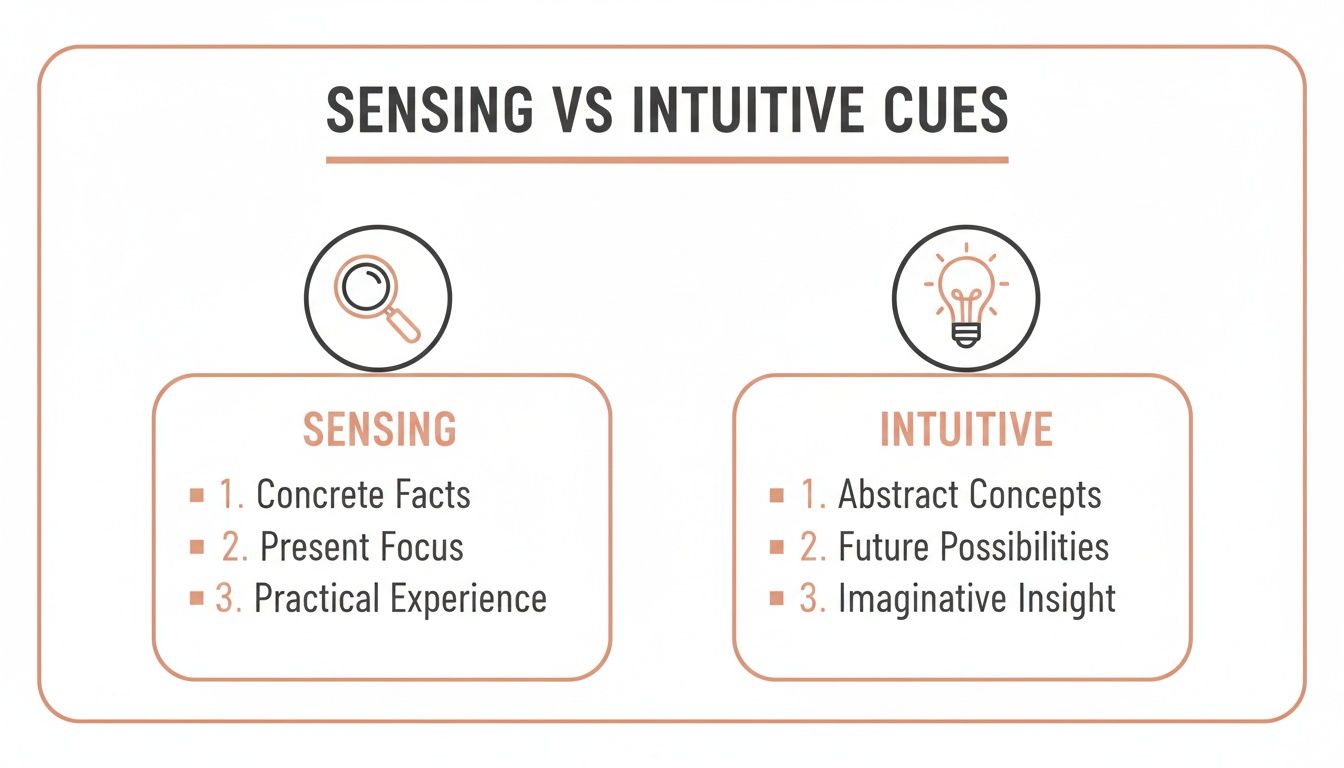
This visual contrast really drives the point home: Sensing types are grounded by a magnifying glass (details, facts), while Intuitives are driven by a lightbulb (ideas, possibilities).
Crafting a Pitch for the Sensing Prospect
When you're in front of a Sensing individual, your number one goal is to build credibility with concrete, verifiable proof. They are naturally risk-averse and need to feel confident that your solution is a practical, safe, and logical choice. Vague promises will just raise red flags.
Your messaging needs to be grounded in reality. Use specific, literal language and steer clear of corporate jargon or overly ambitious metaphors. Their trust is earned through clarity and evidence.
Here are a few practical tactics:
Lead with Hard Data: Start with quantifiable results. Don't say your solution "improves efficiency." Instead, say it "reduced processing time by 34% for Client X."
Show, Don't Just Tell: Lean on detailed case studies, live product demos that follow a clear sequence, and step-by-step implementation roadmaps. They need to see exactly how it works in the real world.
Focus on the 'How': Clearly explain the entire process. Break down the onboarding, the support structure, and what the day-to-day user experience looks like. Answer the question, "How will this practically fit into our current workflow?"
A Sensing prospect needs to connect the dots between your solution and a tangible outcome. Your job is to give them a clear, well-documented path from A to B, backed by evidence at every single step.
This shift toward data-driven decisions is happening everywhere. In Singapore, many SMEs have moved from intuition-based inventory management to strategies based on sensing data. For example, e-commerce platform Kearea saw its business grow by 50 percent in under nine months just by analysing sales data instead of relying on gut feelings. This is a perfect example of how speaking the language of Sensing types—prioritising specifics and proof—can open doors. Find out more about how local SMEs are using data analytics to grow.
Crafting a Pitch for the Intuitive Prospect
Engaging an Intuitive prospect demands a completely different playbook. These people are motivated by vision, innovation, and potential. Drowning them in technical details too early will make them tune out; they need to buy into the strategic 'why' before they’ll ever care about the 'how'.
Your messaging should be conceptual and future-focused. Use storytelling, analogies, and powerful visuals to paint a picture of what's possible with your solution. Help them see how you can transform their business or even their industry.
Try these strategies:
Start with the Vision: Kick things off by discussing industry trends, future challenges, and the big strategic opportunity your solution addresses. Connect your product to their larger business goals right away.
Leverage Storytelling: Frame your solution inside a compelling narrative. Talk about the transformation a similar company experienced, focusing on the strategic shift, not just the ROI percentage.
Focus on Possibilities: Instead of dwelling on current features, explore what new capabilities your solution could unlock for them down the road. Use phrases like "Imagine if you could..." or "What would it mean for your team if..."
To make these differences crystal clear, the table below breaks down exactly how your messaging should adapt for each buyer type.
Messaging Playbook for Sensing vs Intuitive Buyers
| Communication Tactic | Effective for Sensing Prospects | Effective for Intuitive Prospects |
|---|---|---|
| Opening Hook | Start with a key statistic or proven result. | Begin with a big-picture vision or a compelling story. |
| Keywords to Use | "Proven," "step-by-step," "reliable," "data," "guarantee." | "Imagine," "transform," "opportunity," "future," "potential." |
| Evidence | Detailed case studies, live demos, testimonials with hard numbers. | High-level success stories, strategic partnerships, industry trends. |
| Content Format | Checklists, detailed proposals, technical documentation, ROI calculators. | Vision boards, conceptual diagrams, short videos, executive summaries. |
| Meeting Agenda | A structured, linear agenda with clear action items. | A flexible, collaborative discussion focused on strategic goals. |
The core difference in the Sensing vs. Intuitive debate really comes down to this: Sensors buy proven solutions, while Intuitives buy exciting futures. By tailoring your pitch to resonate with their natural way of processing information, you dramatically increase the odds that your message will not only be heard but truly embraced. This adaptability is the hallmark of a truly effective communicator.
Structuring Meetings and Presentations for Success
Great communication is about more than just what you say. It’s baked into the very structure and flow of your interactions. When you design a meeting or presentation that clicks with a prospect's natural way of thinking, you create momentum. Get it wrong, and the whole conversation can fall flat. The architecture of your meeting is just as important as the message itself.
For Sensing buyers, predictability and clarity are everything. They need to follow a logical, straight line from A to B. On the flip side, Intuitive buyers get their energy from exploring big ideas and connecting concepts freely, without being boxed in by a rigid structure. If you force one into the other's preferred format, you’re just creating friction.
Designing Meetings for the Sensing Prospect
When you’re meeting with a Sensing prospect, your main goal is to create an environment of order and reliability. They see meticulous preparation as a sign of professionalism. A casual, unstructured approach or last-minute surprises can come across as you not taking them or their business seriously.
Start by sending a detailed agenda well ahead of time. This isn't just a box-ticking exercise; it’s a crucial first step in building trust. Your agenda should clearly lay out the topics, how much time is dedicated to each, and what you both hope to achieve.
When you get to the presentation, stick to a clear, step-by-step flow.
Linear Product Demos: Don't jump around between different features. Start from the beginning and walk them through a logical process that reflects how they would actually use it. Every step needs to build on the one before it.
Data-Rich Slides: Ground your presentation in solid facts. Every claim you make should be backed up by charts, graphs, and specific numbers. A slide that says "Improves Efficiency" is forgettable. A slide showing a graph of a 32% reduction in processing time is compelling.
Pause for Factual Questions: Deliberately build in time for them to ask for clarification. Sensing types will dig into the details to make sure they understand the mechanics. Answering these questions with patience and precision is absolutely critical.
For a Sensing buyer, a well-structured meeting is a sign of respect. It shows you value their time and have come prepared with a practical, evidence-based case for them to consider. You earn their trust through clarity and proof.
Creating Space for the Intuitive Prospect
Meeting an Intuitive prospect requires a completely different playbook. It should feel less like a formal presentation and more like a collaborative workshop. They get excited by brainstorming and exploring what’s possible, so a rigid, by-the-numbers pitch will just make them tune out.
Your job is to spark their imagination and connect your solution to their biggest strategic goals. The meeting itself should be a space where you can co-create a vision for their future.
Here’s how to set the stage for success:
Start with the 'Why': Ditch the detailed agenda. Open with a big, thought-provoking question or a powerful story about where their industry is headed. You want to get them thinking conceptually right from the start.
Use Compelling Visuals: Intuitives think in concepts and pictures. Lean on diagrams, whiteboards, and high-level visuals that show relationships and future possibilities. Avoid dense, text-heavy slides packed with granular data.
Allow for Tangents: Be ready to go off-script. If an Intuitive prospect wants to explore a "what if" scenario or chase a new idea, go with them. These detours are often where the real magic happens and the most valuable insights are found.
Interpreting and Handling Objections
How you navigate objections also needs to be tailored. The sensing vs intuitive difference is never more obvious than when a prospect starts pushing back.
A Sensor's objection is almost always a request for more information. When they say, "I'm not sure about this," they’re usually thinking, "You haven't given me enough concrete data to feel comfortable." The answer is to provide more proof: a detailed case study, a technical spec sheet, or a more in-depth demo.
An Intuitive's objection, however, is usually about the strategic fit. When they express doubt, they’re really questioning how your solution fits into their long-term vision. The right response isn’t more data, but a better story. Bring the conversation back to their overarching goals and paint an even clearer picture of the future you can help them build.
Using AI to Turn Insights into Actionable Sales Plays
Knowing the theory behind Sensing vs Intuitive preferences is a great start. But trying to apply it on the fly, under the pressure of a live sales call? That’s a whole different ball game.
This is where modern AI platforms come in. They’re the bridge between knowing and doing, transforming abstract personality data into concrete, actionable guidance you can use in the moment.
Human Intelligence Systems (HIS) like Mindreader aren’t just another personality test. They dig through huge amounts of public data and communication signals to profile your prospects, taking the guesswork out of your prep work. You can walk into every single conversation with a clear, data-backed strategy built for your prospect’s unique cognitive style.
From Data Points to Practical Archetypes
Instead of just dumping a list of traits on you, these systems synthesise what they find into practical archetypes. It makes the insights immediately useful.
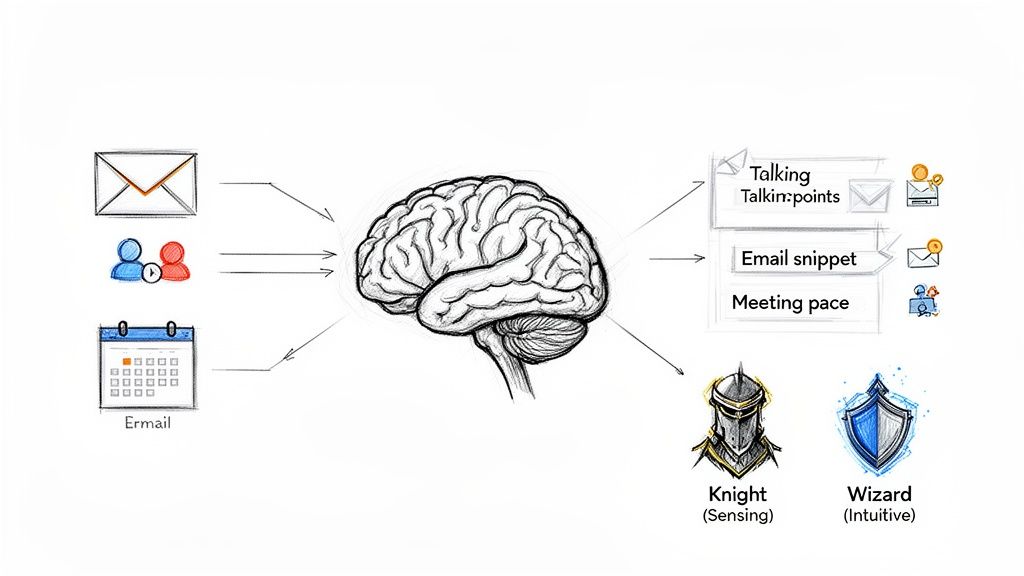
For example, a prospect who consistently shows Sensing preferences—focusing on facts, past performance, and step-by-step logic—might be flagged as a ‘Knight’ archetype. This is someone who values reliability, structure, and proven results above anything else.
On the flip side, a prospect with strong Intuitive tendencies—someone who speaks in metaphors, asks big-picture questions, and gets excited about future possibilities—could be profiled as a ‘Wizard’. This person is driven by innovation, vision, and strategic potential. Having these clear archetypes gives you a practical framework for your entire sales approach.
A key advantage of using AI is speed and accuracy. An advanced system can analyse a prospect's digital footprint and communication style in seconds, providing a detailed playbook that would take hours to assemble manually.
This frees you up to prepare smarter, not harder. You can focus your energy on building genuine rapport instead of getting bogged down in basic research. For a closer look at how these platforms work, you might be interested in our guide on AI tools for analysing client communication styles.
Generating Concrete Sales Recommendations
The real magic of these platforms is their ability to generate specific, in-the-moment recommendations. It’s not just about labelling a prospect a ‘Knight’ or ‘Wizard’; it’s about getting clear guidance on what to do with that information.
This moves you from a reactive posture, where you're trying to decode cues during a call, to a proactive one. You’re fully prepared to speak your prospect’s language from the very first hello.
These AI-driven recommendations often include:
Tailored Talking Points: For a Sensing ‘Knight’, the AI might suggest leading with a hard stat, like, “Our solution helped a similar company in your sector reduce overheads by 18% in the first year.” For an Intuitive ‘Wizard’, it might recommend opening with a vision: “Imagine a future where your team can anticipate market shifts before they happen.”
Email and Message Snippets: The platform can draft sentences or entire paragraphs optimised for each archetype. This ensures your written outreach hits the right note, improving reply rates and making it far less likely you’ll be ghosted.
Ideal Meeting Pace and Structure: For a ‘Knight’, the AI will suggest a structured agenda, a linear presentation, and a deliberate pace. For a ‘Wizard’, it will recommend a more flexible, brainstorming-style session that prioritises strategic discussion over granular details.
Building Authentic Rapport at Scale
At the end of the day, technology’s role here isn't to replace the human element of sales—it’s to amplify it. By handling the heavy lifting of analysis and prep, AI frees you to focus on what really matters: building genuine, authentic connections.
When you communicate with prospects in a way that matches their natural thinking patterns, you reduce cognitive friction. The conversation just flows. Trust is built faster, and your message lands with far greater impact. You’re no longer just a salesperson pitching a product; you become a trusted advisor who truly gets their world.
This intelligent preparation helps you adapt like water to any conversation. By translating the complex sensing vs intuitive dynamic into actionable playbooks, technology empowers you to build stronger relationships and, ultimately, close more deals with confidence and precision.
Answering Your Questions About Sales Communication Styles
Putting the sensing vs. intuitive framework into practice always brings up a few questions. It’s one thing to understand the theory, but it's another to apply it during a complex, real-world sales conversation. Let’s tackle some of the most common queries to help you start adapting your communication with more confidence.
Can a Prospect Be Both Sensing and Intuitive?
Yes, and it’s a great question. It’s crucial to remember that we’re talking about preferences here, not rigid, unchangeable labels. Everyone uses both ways of thinking every single day, but one style usually takes the lead, especially when the stakes are high or a big decision is on the table.
Think of it this way: a prospect might use their Sensing side to meticulously comb through the fine print of a contract. But then, they’ll switch to their Intuition to decide if your company feels like the right long-term cultural fit. The goal is never to put people in a box.
Instead, your job is to recognise which mode they're operating in at that moment and adjust your approach. More advanced tools can even help you track these subtle shifts as you move through the sales cycle, giving you dynamic guidance when you need it.
Is One Preference Better for Certain Industries?
You’ll definitely see patterns, but relying on stereotypes is a massive mistake. Sure, you'll find that fields like finance and engineering often attract detail-oriented Sensing types, while roles in marketing and strategy might have more big-picture Intuitives.
However, I guarantee you’ll meet innovative, visionary CFOs and methodical, detail-obsessed creative directors. Your focus must always be on the individual in front of you, not on assumptions you've made based on their job title or industry.
The best salespeople can articulate their value to a data-hungry engineer and a forward-thinking CEO in the same meeting. They pull this off by fluidly shifting their communication style to connect with how each person thinks.
How Can I Practice Identifying These Traits Manually?
Active listening is your best friend here. It’s a skill that takes real, conscious practice to build.
On your next sales call, make a deliberate effort to tune into your prospect’s language.
Are they asking for hard data, specific details, and past examples? That’s a strong sign of a Sensing preference.
Are they talking about future potential, new ideas, and abstract concepts? This points directly towards an Intuitive preference.
Another great exercise is to go back and review email chains with clients you already have a good relationship with. Look for these same patterns in how they write. This kind of manual practice sharpens your observational skills, making you more attuned to the subtle cues that reveal how a prospect processes information. It also makes you appreciate the efficiency that AI-powered analysis brings to the table, turning hours of review into seconds of actionable insight.
Intuition isn't about magically knowing an answer. It's more about instinctively understanding what information is unimportant and can be discarded. This is what allows Intuitives to see the big picture quickly, while Sensors are busy verifying every single detail along the way.
By getting a handle on these nuances, you can navigate the sensing vs intuitive dynamic much more effectively, building stronger rapport and moving deals forward.
Ready to stop guessing and start connecting with prospects on their terms? Mindreader translates these insights into actionable sales plays, giving you the talking points, messaging, and meeting strategies you need to close more deals. Discover how it works at https://www.themindreader.ai.
Article created using Outrank