Lead Generation Singapore: A Modern Playbook

Welcome to lead generation in Singapore—a market where trust outweighs transactions, and relationships are everything. Forget what you know about high-volume, generic outreach. In this sophisticated economy, that approach just doesn't fly. To build a sustainable sales pipeline here, you need a modern framework built on authority, compliance, and deep personalisation. It's all about understanding local buyer behaviours and regulations.
Decoding the Singapore B2B Landscape
Thriving in Singapore’s B2B world isn’t about casting a wide net; it’s about precision spear-fishing. This market is highly connected, digitally mature, and demands a serious level of trust before any deal gets done. Founders and sales pros quickly learn that a one-size-fits-all strategy copy-pasted from another region will fall flat.

The real key? Recognising that business culture here is built on credibility. Decision-makers are time-poor and value genuine expertise far more than an aggressive sales pitch. That means you absolutely have to establish your authority before you even think about asking for a meeting.
Key Pillars of a Modern Singaporean Strategy
To build a robust pipeline for lead generation in Singapore, your entire approach needs to stand on three core pillars. Get these right, and your efforts won't just drive results—they'll be sustainable and compliant, too.
Authority-Driven Outreach: Stop selling and start leading. Position yourself or your company as a thought leader by sharing valuable insights that solve local challenges, especially on platforms like LinkedIn. It’s not about your product; it’s about their problems.
Compliance as a Trust Signal: Let's be clear: navigating regulations like the Personal Data Protection Act (PDPA) isn't just a legal chore. It's a powerful way to show respect for your prospects. A compliant approach immediately signals that you're a professional and trustworthy organisation.
Hyper-Personalisation at Scale: Generic templates get deleted on sight. Use modern tools and deep research to get inside a prospect's head. Understand their specific pain points, their communication style, and their business context before you ever hit send.
The goal isn’t just to get more leads—it’s to generate better leads. When you focus on prospects with the right fit, a genuine need, and decision-making power, your team becomes far more effective.
Ultimately, your success hinges on managing all this efficiently. Integrating these strategies with the right tech is crucial. You can see how a CRM software system in Singapore helps centralise these moving parts. To round out your toolkit, exploring Actionable B2B Digital Marketing Strategies can give you a much broader roadmap for turning these leads into actual conversions.
Why LinkedIn Is Your Most Powerful B2B Sales Tool
In the B2B sales game, not all platforms are built the same. While you could spread your efforts thin across multiple channels, for serious lead generation in Singapore, LinkedIn is in a league of its own. It's moved far beyond being just a digital Rolodex; it's the main stage where expertise is demonstrated, trust is forged, and big-ticket deals get their start.

The numbers alone tell a compelling story. By 2025, LinkedIn has cemented itself as the undisputed #1 channel for B2B leads in Singapore, with a staggering 4.80 million members over the age of 18. That’s 95.8% penetration of the adult population and 85.6% of all internet users—a huge jump from the previous year.
What this really means is that your ideal clients are right there. From C-suite leaders to the technical folks making buying decisions, they're actively using the platform not just to network, but to size up potential partners. They’re looking for credibility and real expertise, which makes a content-first strategy non-negotiable if you want to be heard.
Transforming Profiles into Authority Platforms
Think of your LinkedIn profile as your personal landing page, not a dusty CV. For any founder or sales leader, it needs to act as an authority platform that screams value and expertise from the first glance. A sharp, optimised profile is your first handshake, building the trust you need to even get a foot in the door with savvy Singaporean prospects.
To make that first impression count, nail these essentials:
- Headline Optimisation: Your job title isn't enough. Your headline needs to be a mini-pitch, clearly stating who you help and the result you deliver (e.g., "Helping Singapore SaaS Founders Scale Revenue with Compliant Lead Generation").
- "About" Section: This is your manifesto. Weave a story that shows you understand the local market's pain points, highlights your expertise, and ends with a clear call-to-action.
- Featured Content: Pin your best stuff here—insightful posts, case studies, or articles. This section is your portfolio, giving visitors an instant taste of your thought leadership.
Getting this right turns your profile from a passive resume into an active, lead-generating machine. It sets the stage for every connection request and InMail you'll ever send.
Creating Impactful Short-Form Content
Let's be honest: generic, self-promoting posts are just noise. In Singapore’s fast-moving business world, decision-makers are drawn to concise, valuable content that solves a real problem or offers a fresh take. Your job is to consistently share insights that position you as the go-to person in your space.
A systematic, content-first approach on LinkedIn isn't about going viral. It's about consistently demonstrating your expertise to a targeted audience, building the credibility required to earn a conversation.
Here are a few content pillars that consistently deliver results:
- Problem-Solution Posts: Zero in on a common headache for your target audience and map out a clear, actionable way to solve it.
- Industry Insights: Offer your perspective on a recent market trend or a regulatory shift that matters in Singapore.
- Myth-Busting: Take a common industry misconception, call it out, and back up your argument with solid evidence.
When you focus on giving value without an immediate ask, you attract followers who are actually interested in what you have to say. This builds a foundation of trust that makes your outreach later on feel less like a cold call and more like a helpful conversation. For more on this, check out this practical guide to prospecting on LinkedIn for some great actionable steps.
Using AI and Sales Navigator for Precision Targeting
Once your profile is sharp and your content is flowing, it's time for proactive outreach. This is where tools like Sales Navigator and AI-powered platforms become your secret weapons. Sales Navigator lets you build incredibly specific lists based on granular details like company size, industry, job function, and seniority in Singapore.
But a great list is only half the job. The message itself is what makes or breaks your outreach. This is where AI insights can give you a massive edge, boosting response rates significantly. By understanding a prospect's communication style, you can write personalised connection requests and InMail that actually connect with them on a human level.
For instance, our guide on how Mindreader's LinkLeads can automate personalized outreach shows exactly how this tech helps you cut through the noise and get real replies. Marrying precision targeting with psychologically-aware messaging is how you truly unlock LinkedIn's power for B2B lead generation.
Choosing the Right Channels for Key Singapore Industries
Trying to apply a generic, one-size-fits-all lead generation strategy in Singapore is a surefire way to burn through your budget with little to show for it. Our B2B market is just too diverse. Each industry moves to its own rhythm, with unique buyer behaviours, sales cycles, and even regulatory hurdles.
What works wonders for a fast-growing SaaS startup would be completely ineffective—and possibly illegal—for a financial advisory firm. Likewise, the high-touch, visually-driven tactics needed to move property are a world away from the deep, content-led approach that wins over B2B tech buyers.
Nailing your channel strategy is the first real step toward building a predictable pipeline. It’s not about being everywhere at once; it’s about going deep on the platforms that give you the most leverage for your specific industry.
Effective Lead Generation Channels by Singapore Industry
To cut through the noise, it helps to see how the most effective channels stack up across different sectors. Each vertical demands a unique blend of tactics, from content-heavy thought leadership to high-trust referral networks.
The following table breaks down the primary and secondary channels that consistently deliver results for B2B SaaS, Finance, and Real Estate companies in Singapore, along with the core strategic focus for each.
| Industry Vertical | Primary Channels | Secondary Channels | Key Strategy Focus |
|---|---|---|---|
| B2B SaaS | SEO, Content Marketing (Whitepapers, Case Studies), LinkedIn | Webinars, Industry Events | Establish technical authority and educate prospects with high-value, problem-solving content. |
| Finance & Insurance | Referral Programmes, Educational Webinars | Professional Networking (e.g., BNI), LinkedIn | Build trust through education and compliance. Leverage existing relationships for warm introductions. |
| Real Estate | Property Portals, Virtual Tours, Telemarketing | Social Media (Visuals), WhatsApp Marketing | Create immersive visual experiences to capture initial interest, then use direct engagement to book viewings. |
As you can see, the "what" and the "how" change dramatically from one industry to the next. The goal isn't just to generate a name and a number, but to start a conversation in a way that feels natural and valuable to your specific audience.
The SaaS Playbook: Content and Connection
For B2B SaaS companies here, success is all about proving your technical chops. Decision-makers are sharp and allergic to risk; they want to see undeniable expertise before they’ll even think about a demo. Your entire lead generation machine has to be built on a powerful content engine.
This isn't about the hard sell. It's about educating your market and warming up prospects long before that first sales call ever happens.
- Search Engine Optimisation (SEO): The journey for a technical buyer almost always kicks off with a Google search. Get your site and content optimised for specific, problem-aware keywords to pull in high-intent traffic from businesses actively hunting for a solution.
- Technical Whitepapers and Case Studies: You have to go deeper than surface-level blog posts. Develop in-depth whitepapers that dig into complex industry challenges and prove your solution’s impact with detailed, Singapore-focused case studies.
- Targeted LinkedIn Campaigns: LinkedIn is where you distribute that high-value content. Run sponsored campaigns targeting the exact job titles and companies you want to reach. The aim is to be seen as a thought leader, not just another vendor in their feed.
Finance and Insurance: Compliance and Trust
In financial services and insurance, everything rests on a foundation of trust and strict compliance. Your lead generation tactics have to mirror that reality. That means prioritising genuine relationship-building and sticking to guidelines like the PDPA. Aggressive, high-volume outreach won’t just fall flat—it can seriously damage your reputation.
In highly regulated industries like finance, your lead generation strategy is a direct reflection of your brand's integrity. A compliant, educational approach doesn’t just generate leads—it builds the long-term trust necessary to close deals.
Focus your energy on strategies that educate prospects and build their confidence in you:
- Educational Webinars: Host webinars on topics people actually care about, like retirement planning for the Singapore market or how to navigate the latest regulatory changes. This positions you as a genuine expert and attracts prospects who are already engaged.
- Structured Referral Programmes: Your existing client base is your biggest asset. A warm referral from a trusted source is the best lead you will ever get. Create a formal, compliant programme that rewards clients for introducing you to qualified people in their network.
Real Estate: Visuals and Direct Engagement
Singapore’s real estate market is fiercely competitive. To make an impact, you have to capture a prospect's imagination right from the start. Digital channels are essential for getting that initial attention, but the high-stakes nature of property deals demands a smart mix of immersive online experiences and direct, personal follow-up.
Forget grainy photos; high-fidelity visuals are now table stakes. You need to combine stunning visuals with strategic outreach to create a powerful one-two punch.
Think about it: high-quality virtual tours let potential buyers or tenants explore a property in incredible detail from their own home. This helps them qualify their own interest before they even schedule an in-person viewing, saving huge amounts of time for both you and your client.
Once you have that digital engagement, strategic telemarketing becomes your go-to tool for turning that flicker of interest into a booked appointment. In Singapore, B2B telemarketing delivers solid benchmarks—you can realistically see call-to-appointment rates of 15-25% on warm lists and lead-to-opportunity conversions of 20-30%. The trick is to work with verified lists and focus on building rapport, not just blasting through cold calls. You can dive deeper into 2025 B2B telemarketing strategies on abuzz.sg to learn more.
Building a High-Integrity and Compliant Sales Funnel
In Singapore's tightly regulated market, compliance isn't just a legal box to tick—it's a massive competitive advantage. Teams that treat data protection as an afterthought quickly find their emails landing in spam, their brand reputation in tatters, and their sales pipeline drying up. Building a sales funnel with integrity is the absolute foundation for sustainable lead generation in Singapore.
This means shifting your mindset from simply chasing numbers to building trust from the very first touchpoint. When you show respect for a prospect's privacy, you immediately signal that you're a professional and credible organisation. That alone makes them far more likely to engage.
Demystifying the Personal Data Protection Act (PDPA)
The Personal Data Protection Act (PDPA) is the cornerstone of data privacy in Singapore, and getting to grips with its core principles is non-negotiable. It governs how organisations collect, use, and disclose personal data. But instead of seeing it as a barrier, think of it as a clear framework for building trust.
For anyone doing sales outreach, the most critical piece is obtaining clear consent. You can't just scrape a list of emails and start blasting messages. Consent has to be explicit and informed.
- Implied vs. Express Consent: While you might get implied consent in some situations (like swapping business cards at a networking event), the safest route is always express consent, where someone actively agrees to let you contact them.
- Clear Purpose: You have to be upfront about why you’re collecting their data and what you plan to do with it. No funny business.
- Easy Opt-Out: Every single email or message must have a simple, obvious way for the recipient to say "no thanks" and withdraw their consent.
A compliant approach isn’t about burying yourself in legal jargon; it’s about transparency. By being direct about your intentions and respecting a prospect's choices, you start building the kind of trust that turns cold outreach into warm conversations.
Best Practices for Data Hygiene and Deliverability
A clean database is a seriously powerful asset. Firing off emails to invalid or old addresses doesn't just waste your time; it destroys your sender reputation, making it harder for your messages to reach anyone at all. Pristine data hygiene is essential for both compliance and actually getting results.
A great place to start is authenticating your domain. It’s a bit technical, but it's a crucial step that proves to email providers like Google and Microsoft that you’re a legitimate sender. Putting standards like SPF, DKIM, and DMARC in place massively improves your email deliverability, ensuring your carefully crafted messages land in the inbox, not the junk folder.
Here’s a look at how the optimal process flow works across key B2B channels, keeping compliance and data quality at the centre of it all.
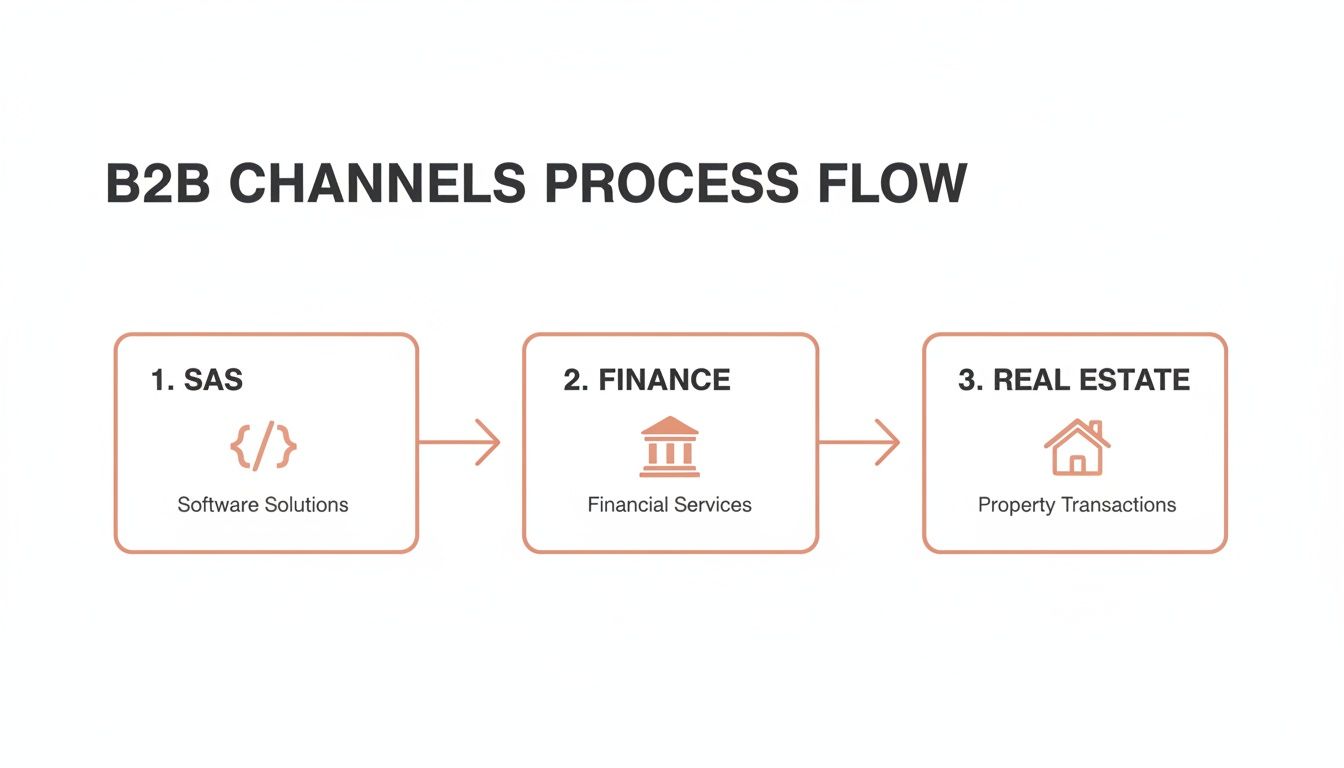
This flow shows that no matter your industry—SaaS, Finance, or Real Estate—a solid foundation of verified data and compliant outreach is where success begins.
Using Modern Tools for Automated Compliance
Trying to manually verify every contact and track consent is a recipe for disaster, especially as you scale. This is where modern sales tools become indispensable. AI-powered platforms can automate compliance checks and validate contact data in real-time, making sure your team only engages with high-fidelity prospects.
These systems do more than just protect your brand from accidental PDPA breaches. They free up your sales team to focus on what they do best: building relationships and closing deals, all while being confident that their outreach is both effective and compliant. Singapore's 2025 regulatory overhaul completely changed the game, shifting B2B lead generation from a numbers game to a trust-first, precision model. New rules demanded verified sender identities and traceable consent, pushing teams to adopt AI for validation. The result? A sharp drop in invalid leads and a huge boost in conversions for compliant teams. To really understand this shift, you can explore how regulatory changes reshaped B2B lead generation.
Personalizing Outreach with Buyer Archetypes
Let's be honest, generic outreach is the fastest way to get your email deleted in Singapore’s business scene. You’ve done the hard work of building a compliant list and picking the right channels. Now for the final, crucial step: tailoring your message so it actually connects with a real person.
The most powerful way to do this is to move past surface-level details like job titles. You need to personalise for your prospect's core communication style and what actually drives their decisions.

This is where understanding buyer archetypes becomes your secret weapon. Instead of blasting the same message to everyone, you tweak your language, tone, and the value you highlight to match how your prospect thinks. It’s the difference between sounding like spam and sounding like you wrote the message just for them.
Introducing the Four Buyer Archetypes
To truly personalise your outreach, you need a framework that's simple but effective. The Human Intelligence System (HIS) groups decision-makers into four distinct archetypes, each with its own motivators and communication quirks. When you get a handle on these, you can anticipate what they need and frame your solution in a way they'll find compelling.
Here’s a quick rundown of each:
- The Knight (Logic & Action): Knights are your decisive, goal-focused leaders. They care about efficiency, clear results, and getting a competitive edge. Just give them the bottom line.
- The Explorer (Innovation & Vision): These are the creative, big-picture thinkers who get fired up about new ideas and future possibilities. Talk about innovation and pushing boundaries, and you'll have their attention.
- The Healer (Relationships & Harmony): Healers are empathetic, team-first individuals. They prioritise trust, consensus, and how a decision will impact people. For them, it's all about collaboration and support.
- The Wizard (Data & Process): Wizards are the analytical, detail-oriented experts. They live for data, systems, and proven processes. They need to see the evidence and understand exactly how things work.
By figuring out which archetype your prospect is, you can start crafting messages that speak their language from the very first sentence.
Adapting Your Message for Maximum Impact
Once you have a good guess about your prospect's archetype, the real work begins. Your goal is to shine a spotlight on the parts of your offer that will resonate most with their core drivers. A pitch that gets an Explorer excited could easily make a Wizard’s eyes glaze over.
If you want to go deeper on this, our guide on advanced customer profiling techniques is packed with valuable insights.
This isn't about being manipulative; it's just about communicating clearly. You're translating your value into a language your prospect instinctively understands, which dramatically boosts your chances of getting a reply.
Effective personalisation is more than just using someone’s name in an email. It’s about showing you understand their unique world, which builds the trust you need to even earn a conversation.
Outreach Templates Tailored to Buyer Archetypes
To help you put this into practice, here are a few starting points for your emails and LinkedIn messages. These snippets are designed for each of the four archetypes and can be adapted for your specific lead generation in Singapore.
| Archetype | Key Motivators | Example Email Snippet | Example LinkedIn Message Snippet |
|---|---|---|---|
| Knight | Results, Efficiency, Control | "Our platform cuts project delivery times by an average of 30%. I have a three-point plan to achieve this for your team. Are you free for a 15-minute call next week to discuss the direct ROI?" | "Hi [Name], saw your post on optimising sales funnels. We helped a similar firm in your space boost their conversion rate by 22% in Q1. Worth a quick chat to see if we can do the same for you?" |
| Explorer | Innovation, Vision, New Ideas | "Imagine a workflow where your team's creative output could double without burning out. I have a groundbreaking concept for achieving this I'd love to share. Are you open to exploring a new approach?" | "Hi [Name], your vision for the future of [Industry] is inspiring. I've been working on a new model for [task] that could accelerate that vision. Would be great to brainstorm together." |
| Healer | Team Harmony, Trust, Support | "I was impressed by how your company values its team culture. We've helped organisations like yours improve employee satisfaction and collaboration with a more supportive system. Would your team find value in that?" | "Hi [Name], I really admire the supportive culture you've built at [Company]. We focus on tools that bring teams closer together and reduce friction. If that resonates, I'd be happy to share more." |
| Wizard | Data, Process, Accuracy | "Following my analysis of [Company]'s current process, our data shows a potential 15% efficiency gain. I've attached a brief technical document outlining the step-by-step methodology. Let me know if you have any questions." | "Hi [Name], I've been following your work on process optimisation. I have some data from a case study that shows how our system reduced errors by 40%. Can I send over the detailed report for your review?" |
When you use an archetype-driven approach, your outreach feels more relevant and respectful. You're showing prospects you’ve done your homework and you're ready to have a conversation that’s actually valuable to them. That small shift can make all the difference to your lead generation success.
Your Action Plan for Success in Singapore
Alright, let's bring all these insights together and turn them into a concrete plan. The final step is always the most important one: taking action. A powerful approach to lead generation in Singapore really boils down to four core pillars.
Getting these right will shift your team from just guessing what works to systematically building a predictable, high-quality sales engine. This isn’t about chasing down every possible lead; it's about attracting and converting the right ones. Especially when you consider that 80% of new leads never convert, focusing on quality over sheer numbers is the only way to get a real return on your efforts.
The Four Pillars of Modern Lead Generation
Think of this as your roadmap. Each pillar supports the others to create a strong system that not only works but also respects Singapore's unique business culture and regulations.
Dominate on LinkedIn: In Singapore, LinkedIn is the B2B battlefield. You can't just have a profile; you need to own your space. This means consistently sharing genuinely valuable content that solves real-world problems for your specific audience. Become the authority they turn to.
Adopt an Industry-Specific Strategy: A one-size-fits-all approach is a recipe for failure here. Whether you’re in SaaS, finance, or real estate, your channels and your messaging have to be fine-tuned to your vertical. Each has its own buyer behaviours and sales cycles, and you need to speak their language.
Prioritise PDPA Compliance: In Singapore, compliance isn't just a legal hurdle—it's a signal of trust. When you build your sales funnel around the Personal Data Protection Act (PDPA), you're showing respect. It immediately positions you as a professional and credible partner, which goes a long way.
Personalise Outreach with AI: Stop sending generic, templated messages. By using insights from buyer archetypes, you can tailor your communication style to what actually motivates each prospect. This small shift can dramatically boost your connection and reply rates.
Your Immediate Action Checklist
Ready to start? Use this simple checklist to give your current process a quick audit and pinpoint where you can make immediate improvements.
- LinkedIn Profile Audit: Does your headline clearly state the value you deliver to a Singaporean audience? Be specific.
- Content Relevance Check: Is your content actually addressing local market pain points, or is it just recycled global material?
- Compliance Review: Is your process for getting and tracking consent fully compliant with PDPA? Don't guess.
- Personalisation Test: Are you customising your outreach beyond just plugging in a name and company, or are you still sending one-size-fits-all messages?
By zeroing in on these key areas, you empower your team to stop guessing and start building a system that consistently brings in and converts high-value clients.
Got Questions About Lead Generation? We’ve Got Answers.
When you're trying to generate leads in Singapore, a lot of practical questions pop up, especially when every dollar of your budget counts. Let's tackle some of the most common ones we hear from B2B professionals on the ground.
What’s a Good Cost Per Lead in Singapore?
Honestly, there’s no magic number. A good Cost Per Lead (CPL) is completely relative to your industry.
A lead for a high-end B2B SaaS platform could reasonably cost several hundred dollars, while one for a corporate training programme might be far less. Trying to hit a universal benchmark is a fool's errand.
What you should focus on is the relationship between your CPL and your Customer Lifetime Value (CLV). Think about it this way: a high CPL is perfectly fine if that client ends up generating massive long-term revenue. The real goal isn't just a low CPL; it's building a profitable and scalable way to bring in new business.
Which Lead Generation Metrics Actually Matter?
It’s easy to get caught up in vanity metrics like website traffic or social media follows, but they don’t pay the bills. To get a real sense of how you're doing, you need to track the numbers that directly link to your sales pipeline and revenue.
The single most important metric isn't just how many leads you get, but your lead-to-opportunity conversion rate. This number tells you if you're attracting people who have a real problem you can solve and the power to make a decision.
A few other vital signs to keep an eye on include:
- Time to Conversion: How long does it actually take for a new lead to become a paying customer?
- Customer Acquisition Cost (CAC): What’s the total, all-in cost of sales and marketing needed to land one new customer?
- Lead Quality Score: A simple rating system to flag which prospects are hot and ready for a conversation with your sales team.
How Can Small Businesses Compete with the Big Players?
You’re probably not going to outspend the big enterprises, and that’s okay. You can win by being more agile, personal, and authentic. Large companies often get stuck with generic, one-size-fits-all messaging. That’s your opening.
Play to your strengths and focus on what they can't easily do:
- Hyper-Personalised Outreach: Go deep. Use smart tools and good old-fashioned research to craft messages that speak directly to a prospect’s specific pain points.
- Founder-Led Selling: People trust people. Position your founder as a genuine thought leader on LinkedIn, sharing real insights that build credibility and trust.
- Niche Content Marketing: Create ultra-specific content that solves problems your bigger competitors have completely overlooked.
By being more targeted and human, your small business can build the kind of authentic connection that attracts high-quality leads the giants will almost always miss.
Ready to stop guessing and start connecting with prospects on a deeper level? Mindreader uses communication-style AI to give you the insights you need to personalise every interaction, boost reply rates, and close more deals. See how it works at https://www.themindreader.ai.