

Forget the generic advice you’ve read elsewhere. When it comes to leads generation in Singapore, it all boils down to one powerful principle: trust comes before the transaction.
This is your playbook for navigating a sophisticated market that values genuine relationships over aggressive sales pitches. Stick with this approach, and you'll build a pipeline packed with high-quality opportunities.
Your Playbook for High-Quality Singapore Leads
Generating leads in Singapore is a different ball game compared to many Western markets. The business culture here is built on reputation and proven value. A hard sell right out of the gate is the fastest way to get shut down.
Whether you're a founder, a sales rep, or a financial advisor, you have to adopt a 'trust-first' mindset to get anywhere.
Before we get into the nitty-gritty of local tactics, it's worth getting the fundamentals right. A solid grasp of the basics is crucial, and you can get a great foundational perspective by understanding what lead generation marketing truly entails. This groundwork makes every local strategy that much more powerful.
The Foundation of Trust in the Local Market
In Singapore's high-context culture, prospects are incredibly discerning. They’re not just looking at what you sell; they’re evaluating who you are and the credibility you bring to the table.
Globally, a staggering 80% of new leads fail to convert into sales—a number that feels especially true in a market where trust is everything. This makes your first interaction absolutely critical.
Your main goal isn't to book a demo on the first call. It's to establish yourself as a helpful, credible expert in your field. This means shifting your focus from quick wins to building lasting relationships.
The most effective lead generation strategies in Singapore aren't about volume; they're about precision and patience. A single warm introduction from a trusted connection will almost always outperform a hundred cold emails.
Think of it this way: a trust-first approach is the central hub, and all your outreach channels are spokes extending from it.
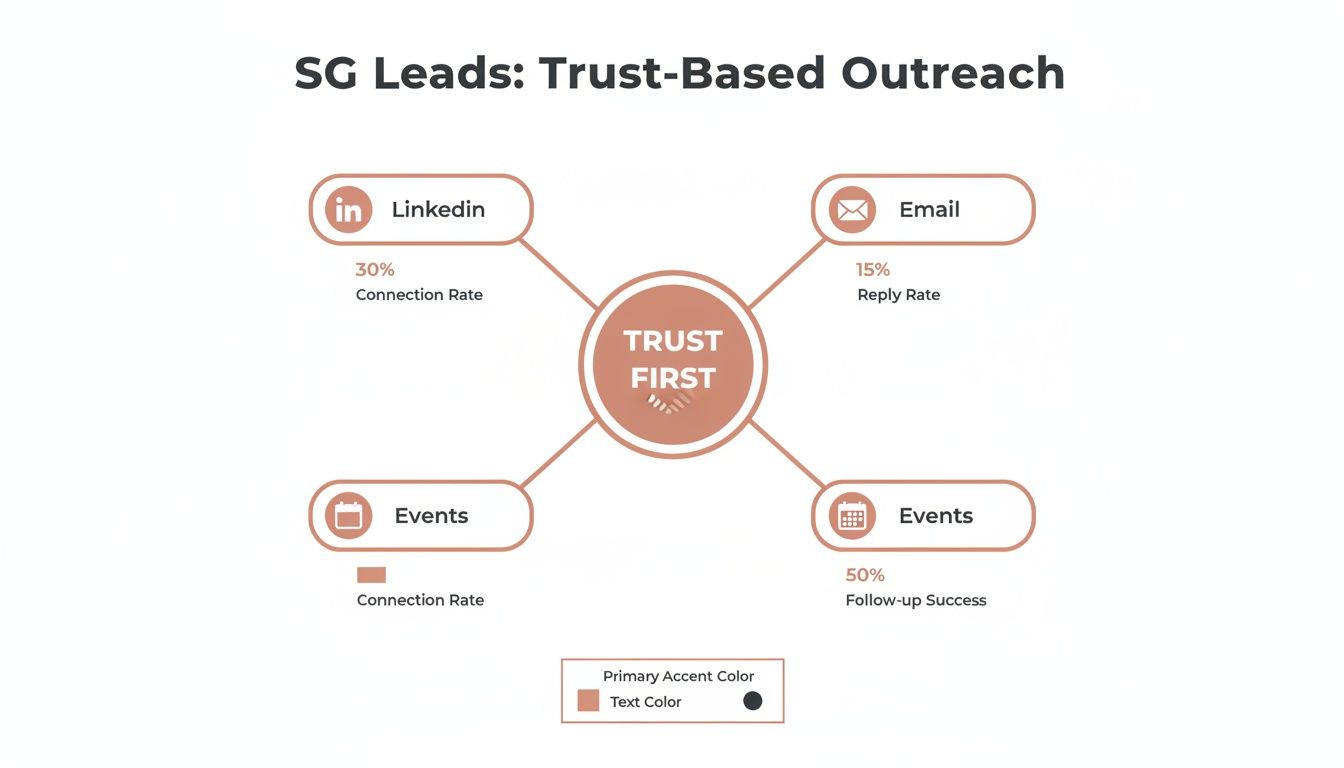
The takeaway here is simple. Channels like LinkedIn, email, and events are just tools. Their success hinges entirely on your underlying strategy of building genuine rapport first.
Top Lead Generation Channels in Singapore
Once you embrace the 'trust-first' philosophy, you'll find that certain channels naturally deliver better results. Instead of a scattergun approach, the most successful professionals focus their energy where building relationships feels most natural.
This table gives a quick rundown of where to focus your efforts.
| Channel | Best For | Key Success Factor |
|---|---|---|
| B2B professionals, high-value networking, and establishing thought leadership. | Consistent, value-driven content and genuine engagement, not just connection spam. | |
| Strategic Email | Highly personalised outreach to targeted decision-makers. | Deep research and addressing specific pain points. Generic blasts won't work. |
| High-Value Events | Accelerating trust through face-to-face interaction and building community. | Attending niche industry events (virtual or in-person) for quality conversations. |
| Partnerships | Tapping into existing networks and gaining warm introductions. | Finding non-competing businesses with a similar target audience for mutual benefit. |
| Paid Ads (Social/Search) | Generating inbound interest and capturing high-intent prospects. | Hyper-localised ad copy and creative that speaks directly to the Singaporean context. |
By mastering these channels—always with a focus on giving value before you ask for anything in return—you lay the groundwork for a predictable, high-quality flow of leads. Now, let’s get into how to do it.
How to Segment Your Singaporean Audience
If you don't know who you're talking to, your lead generation efforts in Singapore are dead on arrival. Firing off a generic message into the void is the fastest way to get ignored. Real success starts when you move past basic demographics and build a razor-sharp picture of your ideal customer.
This is where your Ideal Customer Profile (ICP) comes in. Think of it as a living document, not a static file. It describes the perfect-fit company for what you sell, not just a person. Your ICP is the compass that guides every single outreach message, piece of content, and sales call you make.
Moving Beyond Basic Demographics
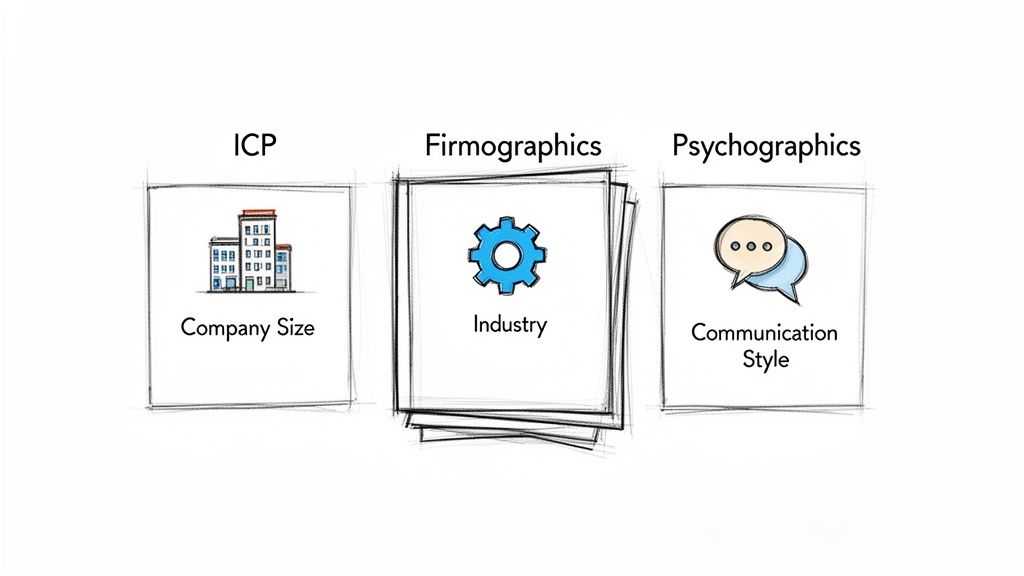
Sure, age and location have their place, but in a sophisticated market like Singapore, they barely scratch the surface. To build an ICP that actually works, you need to layer in deeper, more meaningful details. This is where firmographics and psychographics become your best friends.
Firmographics: These are the hard facts about a company—think of them as demographics for businesses. You'll want to lock down details like company size (employee count), annual revenue, their specific industry (e.g., FinTech, logistics, professional services), and their geographical footprint (are they Singapore-only, or is this a regional HQ?).
Psychographics: This is where you get inside their heads to understand the why behind their business decisions. What are their biggest priorities right now—are they trying to cut costs or drive innovation? What are their biggest challenges and pain points? And how do they like to communicate—are they formal and data-driven, or more informal and relational?
When you combine the two, you get a multi-dimensional view of your target. For a masterclass on building these profiles, you can dive into the principles of advanced customer profiling techniques in our detailed article. This is the foundational work that lets you craft messages that actually get a response.
An ICP isn't about who could buy your product; it's about who should buy it. Focusing on this specific slice of the market saves you a ton of time and resources and sends your conversion rates soaring because you're speaking directly to their most urgent needs.
Real-World Segmentation Examples in Singapore
Let's make this practical, because a generic approach just doesn't cut it here. A segmented one, however, can be incredibly powerful. Here’s how different professionals can put this thinking into action.
Scenario 1: The Financial Advisor
A financial advisor is looking to connect with High-Net-Worth Individuals (HNWIs) for their wealth management services.
- Weak Segmentation: "Men over 40 living in Singapore." (Too broad, you'll get lost in the noise.)
- Strong Segmentation: "C-suite executives (firmographics: job title) aged 45-60 at multinational corporations in the CBD (firmographics: location, company type). They prioritise legacy planning and capital preservation over high-risk growth (psychographics: priorities). They prefer discreet, face-to-face meetings and value data-backed recommendations over flashy pitches (psychographics: communication style)."
See the difference? This level of detail completely changes the game. Instead of a bland email, the advisor can now host an exclusive seminar on legacy planning for executives or reference specific industry challenges in their outreach.
Scenario 2: The B2B SaaS Sales Rep
A sales rep is selling a project management tool to local tech companies.
- Weak Segmentation: "Tech companies in Singapore." (You'll be one of a hundred emails they ignore today.)
- Strong Segmentation: "Series A to B tech startups (firmographics: funding stage) with 50-150 employees (firmographics: company size). Their biggest challenge is managing cross-functional team collaboration as they scale (psychographics: pain point). The main decision-maker is the Head of Operations, who cares deeply about efficiency and ROI metrics (psychographics: priorities)."
Armed with this ICP, the rep can ditch the generic "boost your productivity" line. Instead, they can lead with a powerful case study showing how a similar-sized startup slashed project delivery times by 20%. That kind of specific, problem-solving approach speaks directly to the Head of Operations' core drivers—and it's the key to successful lead generation in Singapore.
Dominating LinkedIn for B2B Lead Generation
Just having a LinkedIn profile in Singapore isn't enough anymore. It’s like printing a stack of business cards and then leaving them in your desk drawer. Too many professionals here use it passively, just waiting for the phone to ring. If you want to master leads generation in Singapore, you have to stop treating your profile like a static resume and start running it like a dynamic, lead-generating machine.
LinkedIn is the B2B playground in the Lion City, but you can't win with the same old tactics. Forget the hard sell and those spammy, generic connection requests. The real secret is building your authority and earning trust by consistently delivering value before you ever ask for a meeting.
Shift from Passive Profile to Authority Hub
Think of your LinkedIn profile as your digital storefront. Before any prospect agrees to give you their time, they're going to check you out. They’ll scrutinise your profile, your posts, and how you interact with others. An outdated profile with zero activity? It screams irrelevance. But an active, value-driven profile instantly positions you as a credible expert they should listen to.
Here’s how you can start making that shift today:
- Rethink Your Headline and Summary: Don't just list your job title. Your headline needs to broadcast who you help and how you help them. Instead of "Financial Advisor at ABC Wealth," try something like, "Helping Tech Executives in Singapore Secure Their Financial Future Through Strategic Wealth Planning." It immediately tells your ideal client you understand their world.
- Share Content That Actually Helps: Stop posting generic corporate announcements. The content that builds trust and gets attention is practical. Think short video insights (30-60 seconds) on market trends, sharp commentary on industry news, or simple tips that solve a real problem for your audience.
- Engage Like a Human: Don’t just post and ghost. Set aside 15 minutes a day to leave thoughtful comments on posts from industry peers or potential clients. Genuine engagement shows you’re an active part of the conversation, not just another salesperson shouting into the void.
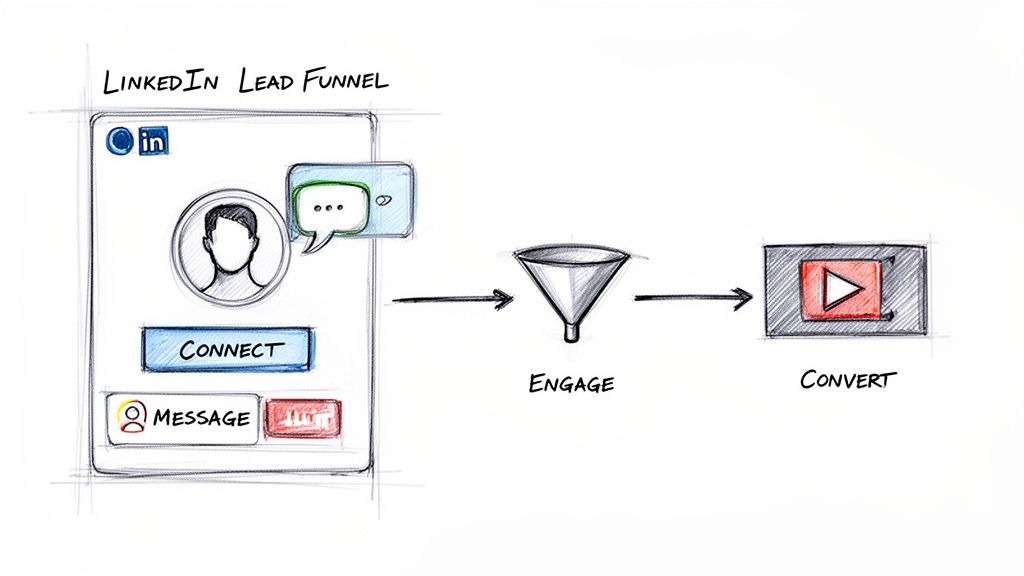
This strategic blend of content and engagement is non-negotiable in the Singaporean market. From what I’ve seen, decision-makers here increasingly use LinkedIn as a trust filter. They’ll scan your thought-leadership posts and founder commentary before they even think about replying to a cold message. This makes it the top channel for high-value B2B sectors like financial services and consulting. You can dig deeper into how Singaporean B2B marketing trends are shaping lead generation in 2025 to see where things are headed.
The Multi-Touchpoint Connection Strategy
Once you've turned your profile into an authority hub, you can start your proactive outreach. A single, generic connection request is just too easy to ignore. A better way—a much more effective way—is a thoughtful, multi-touchpoint strategy that builds rapport first.
This approach works because it respects local business etiquette, which always values relationship-building over transactional speed.
The Strategy in Action:
- The First Touchpoint (Engagement): Before you even think about sending a request, find a recent post or article they've shared. Leave a thoughtful, relevant comment. This simple act gets you on their radar in a completely non-intrusive way.
- The Second Touchpoint (The Request): A day or two later, send the connection request. Keep the message brief, make it personal, and reference your earlier comment. Crucially, do not pitch anything.
- The Third Touchpoint (The Value-Add): After they accept, give it a day, then send a message. And no, you’re still not selling. Instead, offer something of value. Share a relevant article, invite them to an industry webinar, or offer a quick insight related to their field.
The goal of your initial LinkedIn interactions is not to book a meeting. It's to earn the right to have a future conversation. By leading with value and showing genuine interest, you immediately separate yourself from the 90% of salespeople who just go straight for the pitch.
Message Templates for the Singaporean Context
Getting the message right is everything. Your tone should be respectful, subtle, and focused on mutual interest, not your immediate sales goal. Here are a couple of templates I've seen work incredibly well.
Template 1: The Personalised Connection Request
"Hi [Prospect's Name], I saw your recent comment on [Industry Leader]'s post about [Topic] and thought your point about [Specific Insight] was spot on. I’ve been following your work in the [Their Industry] space and would appreciate connecting with you here."
Why does this work?
- It’s Specific: It refers to a real action they took.
- It’s Flattering: It shows you actually value their opinion.
- It’s Non-Threatening: There is zero sales pressure.
Template 2: The Value-First Follow-Up
"Great to connect, [Prospect's Name]. I noticed from your profile that you’re focused on [Their Area of Focus]. I recently came across this report on [Relevant Topic] and thought you might find the section on [Specific Detail] particularly interesting. Hope it's a useful resource for you."
This follow-up builds on that initial goodwill by:
- Showing You Did Your Homework: You’ve clearly paid attention to their profile.
- Offering Pure Value: You’re giving them a helpful resource with no strings attached.
- Positioning Yourself as an Expert: You become a helpful resource, not just another salesperson.
By consistently applying this strategy—building authority first, then engaging with a multi-touchpoint, value-first approach—your LinkedIn activity will transform. It stops being a chore and becomes your most powerful engine for high-quality leads generation in Singapore.
Building Your Outreach Engine: Email, Events, and Compliance
LinkedIn is a fantastic starting point, but a truly powerful outreach strategy needs more fuel. To consistently generate high-quality leads in Singapore, you have to master a few other channels: cold email, strategic partnerships, and, crucially, the local regulatory landscape.
A well-oiled engine isn’t about just blasting out messages; it’s about starting genuine conversations.
The secret? Deep personalisation. The days of spray-and-pray templates are long gone. In a market like Singapore where relationships are everything, your first touchpoint has to show you’ve done your homework. It needs to be sharp, relevant, and speak directly to a problem you know they're facing.
This means you’ll spend more time researching than writing. Before you even think about hitting ‘send’, you should know about the company’s latest projects, what your prospect’s role actually entails, and a specific challenge they’re likely trying to solve. This effort alone will make you stand out from 99% of the noise in their inbox.
Crafting Emails That Actually Get Replies
Think of your email sequence as a patient, multi-step conversation, not a one-shot pitch. Your first email should never be a hard sell. It’s an opener—a short, compelling message that introduces one big idea and ends with a simple, low-pressure question.
Here's a simple framework that I've seen work time and time again:
- Personalised Opener: Start with something specific you noticed about them or their company (a recent award, a project they launched, a post they shared on LinkedIn).
- Problem Hypothesis: State a common pain point you see in their industry. Show you understand their world.
- Value Snippet: Briefly—and I mean briefly—mention how you help solve that exact problem.
- Soft CTA: End with an easy, interest-gauging question. Something like, "Is this on your radar for Q3?" works far better than "Can I have 15 minutes of your time?"
Your follow-ups shouldn't be annoying "just checking in" bumps. Each one is a new opportunity to provide value. Share a relevant article, a short case study, or a quick insight. For a deeper look at how to streamline this, our guide on sales and marketing automation shows how technology can help you scale this personalised approach without losing the human touch.
The Untapped Power of Events and Partnerships
Digital outreach is powerful, but never underestimate the magic of a real-world handshake. In Singapore, high-value networking events and strategic partnerships are absolute goldmines for qualified leads. Face-to-face interactions build trust at a speed that digital just can't match.
Forget the massive, generic expos. Your time is better spent at niche industry roundtables, focused seminars, or association meet-ups where your ideal customers actually hang out. The goal isn’t to collect a mountain of business cards; it's to have three or four truly meaningful conversations.
Partnerships are another game-changer. Find non-competing businesses that serve the exact same audience. A warm introduction from a trusted partner is one of the most powerful door-openers in sales, instantly bypassing that initial wall of skepticism.
In Singapore’s trust-based business culture, a referral is currency. A recommendation from a respected peer will almost always outperform even the most perfectly crafted cold email.
Navigating the Personal Data Protection Act (PDPA)
Let's talk about the rules. Compliance isn't just about avoiding fines; it's fundamental to building trust. Singapore's Personal Data Protection Act (PDPA) sets the rules for how you collect, use, and handle personal data. Getting this wrong can lead to serious fines and, worse, a damaged reputation.
Understanding the PDPA is non-negotiable. The core idea is consent—you generally need someone's permission before you can use their data for marketing. But there are some key details every B2B professional should know.
The PDPA has a crucial "business contact information" exception. This means data like a person's name, business title, work address, or work email is generally not covered by the main data protection rules when it’s used for business-to-business (B2B) purposes. This is the green light for compliant B2B outreach.
To keep your outreach clean and effective, stick to these ground rules:
- DO use publicly available business contact information for your initial B2B outreach. Think LinkedIn profiles and company directories.
- DON'T ever scrape or use personal email addresses (like Gmail or Yahoo) or mobile numbers without getting explicit consent first.
- DO include a clear and simple way for people to unsubscribe or opt out in every message. No exceptions.
- DON'T add contacts to a mass marketing list without their consent, even if you found their details publicly.
- DO be upfront about who you are and why you're reaching out. Transparency builds trust.
When you weave these principles into your outreach engine, you're building something that’s not only effective but also ethical and respectful. That’s the foundation for real, long-term business relationships.
Turning Leads into Real Sales Opportunities
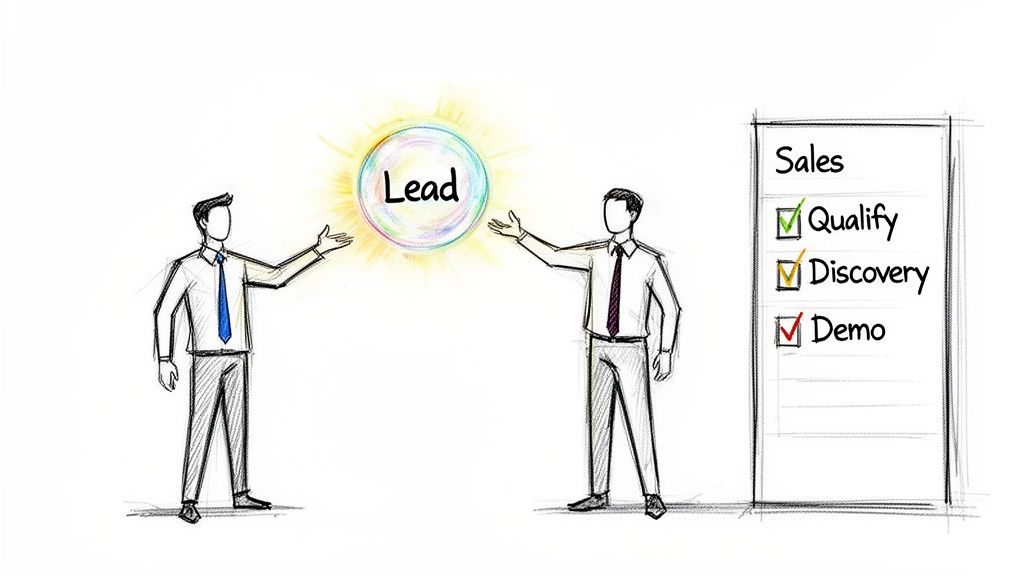
Getting a lead is a great start, but it's just that—a start. The real goal of any serious leads generation in Singapore is turning that initial flicker of interest into a proper sales opportunity. This is the critical handoff where a name in your system becomes a real conversation, and it’s where many sales pipelines either thrive or completely fall apart.
Not every lead is ready to buy the moment they land on your list. Treating them all the same is a surefire way to waste your time and theirs. Your focus is your most valuable asset, so you need a simple, effective way to figure out who’s genuinely ready for a sales chat and who needs a bit more nurturing. This is where a clear qualification framework makes all the difference.
A Simple Qualification Framework for Singapore
Forget the rigid, overly complex methodologies you might have read about. For the Singapore market, a localised, conversational approach to qualification just works better. Think of it as a friendly filter, not an interrogation.
Here’s a practical framework inspired by BANT (Budget, Authority, Need, Timeline) but tweaked for a more relationship-focused culture:
Problem (The "Need"): Always start here. Before you even think about budget or timelines, you have to find the pain. What specific business challenge are they dealing with that you can actually solve? Use open-ended questions like, "What’s the biggest hurdle your team is facing with [their area of focus] right now?"
Priority (The "Timeline"): Is this problem a "nice-to-have" or a "must-fix-now"? Decision-makers in Singapore are incredibly pragmatic—they focus on what’s urgent. You can gauge this by asking, "Where does solving this challenge sit on your list of priorities for this quarter?"
Process (The "Authority"): Directly asking "Are you the decision-maker?" can feel blunt and even a bit rude. It’s much smoother to ask about their internal process. Try something like, "Could you walk me through how your team typically evaluates new solutions like this?" This question naturally reveals who else needs to be involved without putting anyone on the spot.
Potential Fit (The "Budget"): Bringing up money too early can be a real turn-off. Frame it around value and making sure you’re a good fit. You could say, "To make sure I’m not wasting your time, solutions for this kind of challenge typically fall within a certain investment range. Does that align with how you generally approach these kinds of projects?"
This approach transforms qualification from a rigid checklist into a consultative conversation, building trust from the very first interaction.
Mastering the Discovery Call
Your first real conversation with a qualified lead—the discovery call—is where the magic happens. Your goal isn't to pitch; it's to listen. Question-based selling is your most powerful tool here. It’s about uncovering their genuine needs through active listening, not just waiting for your turn to talk.
To make your discovery calls far more effective, try focusing on these three types of questions:
- Problem Questions: Go deep on their challenges. "What happens if this problem isn't solved in the next six months?"
- Impact Questions: Help them quantify the pain. "How much time is your team losing each week because of this issue?"
- Ideal Outcome Questions: Get them to paint a picture of success. "If we were sitting here a year from now, what would have to have happened for you to feel this was a huge success?"
When you ask better questions, you guide them to their own conclusions about how valuable your solution really is.
Handling Objections and Building Trust
Let's be clear: objections are not rejections. They are requests for more information. When a prospect raises a concern, it's actually a sign they're engaged. The key is to listen, validate their concern, and then reframe the conversation around value.
For example, if they hit you with the classic, "Your price is too high," don't jump into a defensive monologue.
Instead, try this:
"I appreciate you sharing that. To make sure I understand, when you say it's too high, are you comparing it to another solution, or is it just more than you had allocated for this kind of initiative?"
This response opens up a dialogue instead of shutting it down. It shows you’re actually listening and helps you uncover the real issue behind the objection, which is often about perceived value, not just the price tag.
By focusing on a human-centric qualification process and mastering the art of the discovery call, you’ll dramatically increase your lead-to-opportunity conversion rate. This is how you transform a simple list of names into a pipeline of real, winnable deals.
For B2B campaigns in Singapore using targeted lists, it's common to see a 20–30% lead-to-opportunity rate for complex sales once a lead is qualified. These benchmarks are vital for founders and sales leaders looking to design realistic funnels. To get a better sense of local conversion metrics, you can explore detailed benchmarks for B2B telemarketing campaigns in Singapore.
Measuring and Optimising Your Strategy
You can't run a successful lead generation strategy in Singapore on guesswork. If you want to see real, continuous improvement, you have to let the data guide you, focusing only on the metrics that actually move the needle for your business.
This means ditching the vanity metrics and zeroing in on a handful of key performance indicators (KPIs) that give you a crystal-clear picture of what’s working and what’s not.
Key Metrics to Monitor
To keep your strategy sharp and agile, you'll want to keep a close eye on these core KPIs:
- Cost Per Lead (CPL): This tells you exactly how much you're spending to get a single lead from each channel. It's the fastest way to figure out where your budget is getting the best bang for its buck.
- Lead-to-Opportunity Rate: A crucial one. This shows what percentage of your leads are actually qualified and making their way into the sales pipeline. A low rate here is a massive red flag, often pointing to a mismatch between your marketing message and what sales actually needs.
- Conversion Rate by Channel: This metric reveals which of your channels—be it LinkedIn, email, or events—is delivering the highest-quality leads that actually become paying customers.
Of course, to properly measure success, you need to prove the value of your campaigns. A great starting point is learning about calculating your marketing ROI and applying that framework to your own efforts.
The goal isn’t just to collect data; it's about what you do with it. Let's say LinkedIn gives you a fantastic lead-to-opportunity rate but a high CPL. You know the leads are valuable. The next move is to figure out how to tweak your targeting to bring that acquisition cost down.
This data-driven mindset is more important than ever as Singapore’s digital economy continues to surge. It grew from 14.9% to 18.6% of the national GDP between 2019 and 2024, and you can bet that a lot of businesses are using AI for prospecting and qualification, making data-backed insights mission-critical. You can dig into the full report on Singapore's digital economy from IMDA for a deeper dive.
This constant feedback loop between data and action is what turns a static strategy into a high-growth engine. Throwing the right tools into the mix just accelerates the process. For more on that, check out our guide on how to use https://themindreader.ai/blog-insights/sales-intelligence to really sharpen your approach.
Got Questions? We've Got Answers
You're probably thinking through how these strategies apply to your specific situation in Singapore. That's a good thing. Let's tackle some of the most common questions that pop up when putting a lead generation plan into action.
What’s a Realistic Lead Generation Budget in Singapore?
There's no magic number here, as it really depends on your industry, who you're targeting, and the channels you decide to use. A practical way to look at it is through Cost Per Lead (CPL).
For paid channels like LinkedIn Ads or Google Search, you could be looking at a CPL anywhere from S$40 to S$150+ for a quality B2B lead. But a better approach is to work backwards from your revenue goals. Figure out how many deals you need to close, then calculate the number of qualified leads you need based on your historical conversion rates. This gives you a much more realistic budget to work with.
Does Cold Calling Still Work Here?
Yes, but it's not the cold calling you might be thinking of. The days of smiling-and-dialing from a random list are long gone, especially in a relationship-driven market like Singapore.
Think of it more like "warm calling." It's most effective when it comes after you've already made a connection elsewhere, like a personalised email sequence or some engagement on LinkedIn. The goal isn't to launch into a hard pitch. It's to reference that prior touchpoint and simply open a conversation. In more traditional sectors, it can be a great way to secure a meeting, but only if you've done your homework first.
What's the Single Best Channel for B2B Leads?
If I had to pick just one, it would be LinkedIn. Hands down. It's the de facto professional network in Singapore, making it the perfect ground for building authority and connecting directly with decision-makers. The targeting is incredibly precise, letting you zero in on your ideal customer.
But the real secret isn't finding one "best" channel. It's about creating a system where they all work together. A powerful strategy uses LinkedIn to build your brand and spot prospects, then moves the conversation to highly personalised emails. And for those high-value deals? Nothing builds trust faster than a face-to-face meeting at a targeted industry event.
The most successful strategies don't rely on a single channel. They integrate LinkedIn for visibility, email for direct outreach, and events for relationship building into a cohesive engine that drives consistent results.
Ready to stop guessing and start connecting with your ideal clients? Mindreader uses communication-style AI to give you the exact insights you need to build trust, handle objections, and close more deals. Learn how to adapt your approach for every prospect and turn outreach into revenue at https://www.themindreader.ai.