

Let’s be honest. In business, you can't be everything to everyone. Trying to sell to the entire market is like firing arrows randomly into a forest, hoping one hits something valuable. You’ll just end up with a lot of wasted energy and a quiver full of missed opportunities.
So, what’s the alternative? Instead of a scattergun approach, you need a high-powered rifle with a precision scope. That scope is your Ideal Customer Profile (ICP). It’s a laser-focused description of the perfect company to target with your product or service—the ones who get the most value, stick around the longest, and are the most profitable for your business.
Think of it as the bullseye on a target, guiding every single one of your sales and marketing efforts.
Your Business Compass: Why an Ideal Customer Profile Matters
An ICP moves you from guessing who might be interested to knowing, with data-backed confidence, the exact characteristics of a company that is almost guaranteed to succeed with your solution. This clarity becomes the compass for your entire organisation. It points everyone in the same direction, eliminating wasted resources on poor-fit leads.
The Foundation for Predictable Growth
A sharply defined ICP isn't just a nice-to-have; it's the bedrock of predictable revenue. When your whole team is aligned on exactly who you're targeting, the magic starts to happen across the board.
- Marketing teams can stop shouting into the void. Instead, they craft razor-sharp campaigns that speak directly to the pain points of the right companies, attracting higher-quality leads that actually want to talk.
- Sales teams become incredibly efficient. They can disqualify mismatched prospects in minutes, which shortens sales cycles and drives up win rates because they’re only pouring energy into accounts with the highest potential.
- Product development finally gets a clear picture of who they’re building for. This ensures every new feature solves a real, pressing problem for your most valuable customers, not just a random one.
This level of alignment is a game-changer. It puts an end to internal friction and ensures every department is rowing in the same direction—towards your most lucrative and successful client relationships.
An Ideal Customer Profile acts as a strategic filter for all your go-to-market activities. It helps you identify and engage the accounts with the highest propensity to buy, so you can drive predictable, profitable growth.
ICP vs. Buyer Persona: Understanding the Difference
People often mix these two up, but it's vital to understand the distinction. An Ideal Customer Profile and a buyer persona serve different, complementary roles. You need both to get a complete picture of your target market.
Let's break it down with a simple analogy:
- Ideal Customer Profile (The 'Where'): This defines the perfect company. It’s all about firmographics—industry, company size, annual revenue, location, and the tech stack they use. It answers the big question: "Which organisations should we be targeting?"
- Buyer Persona (The 'Who'): This zooms in on the ideal people within those target companies. It details their job titles, goals, daily challenges, and what motivates them to make a purchase. It answers the crucial follow-up: "Who do we need to talk to inside our target accounts?"
You can't have an effective strategy with just one. Your ICP identifies the right playground, and your buyer personas tell you who to play with once you get there.
The Four Pillars of a Powerful Ideal Customer Profile
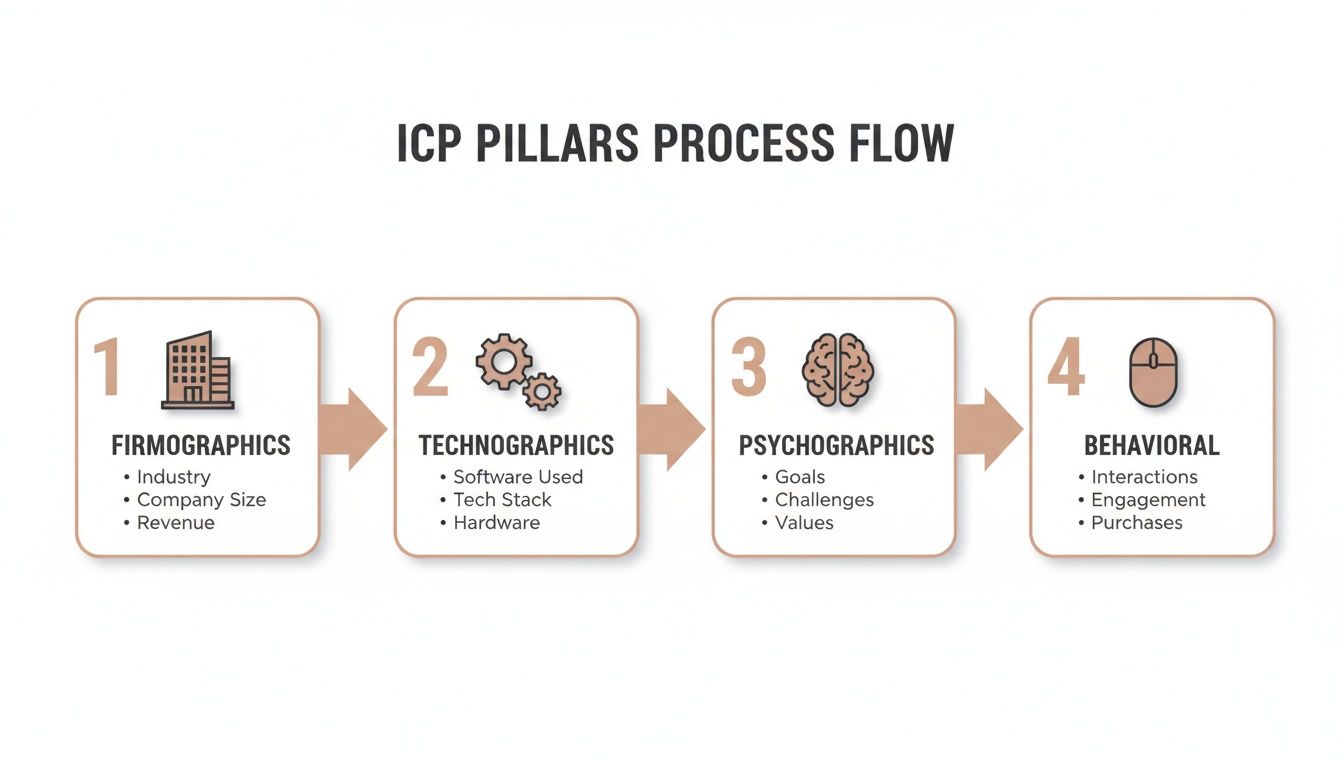
Building a solid Ideal Customer Profile isn’t about guesswork or gut feelings. It’s a deliberate, data-driven process. A truly powerful ICP is built on four distinct pillars, with each one giving you a different lens to see the companies that are a perfect match for what you offer.
When you bring these four pillars together, the vague idea of an "ideal customer" snaps into focus. It becomes a tangible, data-backed tool that your sales and marketing teams can use to spot high-potential accounts and, just as importantly, confidently walk away from poor-fit leads. This structured approach makes sure your efforts are always aimed at the right target.
Firmographics: The Foundational Blueprint
Let’s start with the basics. Firmographics are the most straightforward data points you can find, giving you a high-level blueprint of a company. Think of it as a business’s identity card, covering its core organisational details.
These facts are your first filter. They help you quickly map out your target market and segment it into manageable chunks.
- Company Size: How many people work there? Are you going after scrappy startups (1-50 employees), established SMBs (51-500), or large enterprises (500+)?
- Industry: What specific vertical do they live in? This could be anything from financial services and real estate to SaaS.
- Annual Revenue: What’s their yearly turnover? This is a great indicator of their purchasing power and whether they can afford a solution like yours.
- Geographic Location: Where are their headquarters and main offices? This is critical for planning sales territories and understanding local market nuances.
Technographics: Their Digital DNA
Next up, technographics. This pillar uncovers the technology stack a company uses to run its day-to-day operations. It’s like peeking into their digital DNA, showing you what tools they already find valuable enough to pay for.
Knowing their tech stack tells you a lot about their digital maturity, opens up potential integration opportunities, and can even clue you into which competitors they’re already using. You can find this data with tools like G2 or BuiltWith, or simply by asking smart discovery questions on a sales call.
For example, if you sell a marketing automation platform that has a slick integration with a specific CRM, any company already using that CRM is instantly a warmer lead. This pillar lets you sharpen your targeting with surgical precision. You can dive deeper into this in our guide to advanced customer profiling techniques.
Understanding a prospect's existing technology investments is a powerful qualifier. If they already use complementary software, it signals a pre-existing need and budget for solutions in your category.
Psychographics: The Company's Character
Firmographics and technographics tell you what a company is, but psychographics explain who they are. This is where we get into the less tangible—but equally vital—aspects of a company's culture, values, and overall mindset.
It’s all about understanding their personality and what truly drives them.
- Company Culture: Are they known for being innovative and happy to take risks, or are they more conservative and focused on process?
- Values and Mission: What does the company stand for? Do their core values align with what your brand represents?
- Growth Mentality: Are they aggressively investing in growth and expansion, or are they more concerned with maintaining the status quo?
- Buying Triggers: What events or pain points typically force their hand to look for a new solution? This could be a fresh round of funding, a new executive hire, or a recent merger.
A fast-growing tech startup with a "move fast and break things" culture is a completely different beast from a legacy financial firm that puts stability and compliance above all else. Psychographics help you tune your messaging so it hits home with their core motivations.
Behavioural Data: How They Interact
Finally, behavioural data zeroes in on the actions a company takes when they engage with your brand or the broader market. This is the most dynamic pillar of them all, giving you real-time signals of interest and intent.
In a market like Singapore, where digital adoption is through the roof, tracking online behaviour is non-negotiable. With 5.79 million internet users and a 96% penetration rate, a local company’s digital footprint is overflowing with valuable insights. The most active online group, those aged 25-54, also happens to be the core B2B decision-making demographic. As Meltwater’s data on Singapore’s digital consumers shows, they are tech-savvy, financially capable, and prioritise real value over slick marketing, making their online actions a reliable sign of their true needs.
To pull this all together, think of these four pillars as different layers of information that, when combined, create a complete picture.
The Four Pillars of ICP Data Collection
| Data Pillar | Description | Example Data Points |
|---|---|---|
| Firmographics | The basic, objective attributes of a company. | Company size, industry, annual revenue, geographic location. |
| Technographics | The technology and software a company uses. | CRM platform, marketing automation software, cloud provider, analytics tools. |
| Psychographics | The company’s culture, values, and mindset. | Growth mentality, risk tolerance, core mission, buying triggers (e.g., new funding). |
| Behavioural Data | The actions and engagement signals a company shows. | Website visits, content downloads, social media engagement, webinar attendance. |
By systematically collecting data across these four pillars, you move from a vague target audience to a highly specific, actionable profile that guides every sales and marketing decision you make.
A Step-by-Step Guide to Building Your ICP
Building an Ideal Customer Profile isn't some abstract marketing exercise. It's a practical, step-by-step process that turns raw data into a seriously powerful tool for growth. Think of it like drawing up a detailed blueprint before you start building a house.
By following a structured approach, you move past guesswork and create a profile that consistently points you toward your most valuable accounts. This process grounds your ICP in reality, reflecting the companies that actually get the most out of what you offer. It’s all about being methodical—starting with what you know and adding layers of detail to build a clear, actionable guide for your entire organisation.
Step 1: Identify Your Best Existing Customers
The foundation of any strong ICP is built on your current success stories. Before you look outward, you have to look inward.
Start by making a list of your best customers. I’m not just talking about the biggest names or the ones with the largest contracts. I mean the ones who truly thrive with your product. These are the clients with the highest retention rates, who generate the most revenue (including upsells), and who are your most vocal champions.
They see massive value in your solution, require less support, and often give you the best feedback. These accounts are your gold standard, the very model of the customer you want to clone. Once you have this list, you can start looking for the common threads that tie them together.
Step 2: Gather Comprehensive Data
With your top customers identified, it's time to dig into the data across the four pillars we've touched on: firmographics, technographics, psychographics, and behavioural data. This is the investigative phase where you blend hard, quantitative facts with qualitative insights to get the complete picture.
This is where you move from basic company details to the more nuanced signals that tell you who they really are.
To pull this information together effectively, you need to use a few different channels:
- Analyse CRM Data: Your CRM is a goldmine. Dig in for firmographic details like company size, industry, and location. Look for patterns in deal sizes and how long it takes to close a sale.
- Interview Your Customers: Go straight to the source. Set up short interviews with your best clients to understand their real pain points, what they’re trying to achieve, and that "aha!" moment that made them choose you.
- Talk to Your Sales Team: Your salespeople are on the front lines every single day. They have priceless insights into the challenges and motivations of the companies that are easiest to sell to—and the ones that are a constant struggle.
- Use Analytics Tools: Lean on your website and product analytics to track behavioural data. See what content your best customers engage with and how they actually use your product.
A massive part of building your ICP comes from gathering and making sense of the qualitative data from customer interviews. If you want to get better at pulling real insights from these conversations, it's worth brushing up by mastering qualitative research analysis methods.
Step 3: Synthesise and Document Your Findings
Raw data is just noise until you organise it into something clear and concise. The goal here is to distill all your research into a single, easy-to-digest document. Don't create a 20-page report no one will read; a one-page summary is almost always more effective.
Your ICP document should clearly outline the key attributes for each of the four pillars. Use bullet points and simple language to define the characteristics of a perfect-fit company. For instance, under "Firmographics," you might list: "B2B SaaS companies with 50-250 employees in the financial technology sector."
Your Ideal Customer Profile document should be a practical guide, not an academic paper. Make it scannable, specific, and immediately useful for anyone in a sales, marketing, or product role.
Step 4: Validate Your Profile
Okay, you have a draft of your ICP. Now you need to pressure-test it. An unvalidated profile is still just a hypothesis.
Start by applying it to your existing prospect list or lead pipeline. Run your new ICP criteria against a segment of your database. Does it do a good job of separating the high-potential accounts from the poor-fit ones?
Even better, share the document with your sales team and ask them to score recent leads against it. Their real-world feedback is absolutely critical. If the profile doesn't match what they're seeing in the field, it needs tweaking.
Step 5: Share and Operationalise the ICP
This is the final and most important step. You have to embed the ICP into your organisation's day-to-day work. A profile that sits in a forgotten folder is completely useless. It needs to become a living document that guides real decisions across departments.
Present the finalised ICP to your sales, marketing, and product teams. Walk them through how it was built and how it will help them hit their numbers. More importantly, build its criteria directly into your systems. Use it to create lead scoring models in your CRM, to sharpen the targeting of your marketing campaigns, and to guide your product roadmap. This is how you get everyone aligned and focused on winning and keeping your most valuable customers.
How to Put Your Ideal Customer Profile Into Action
Alright, so you’ve done the hard work and built your Ideal Customer Profile. That's a huge step, but let's be honest—it’s only half the battle. A beautifully crafted document gathering digital dust in a shared drive won't do much for your bottom line. The real magic happens when you weave it into the fabric of your daily sales and marketing workflows, turning it from a static file into a dynamic tool that actively drives decisions.
Think of your ICP as a powerful filter. It helps your teams stop chasing every lead that comes through the door and instead focus their energy where it truly counts. You’re no longer treating every prospect equally; you're prioritising the ones who look just like your best, happiest customers. This fundamental shift from a volume game to a value game is what separates the good sales organisations from the great ones.
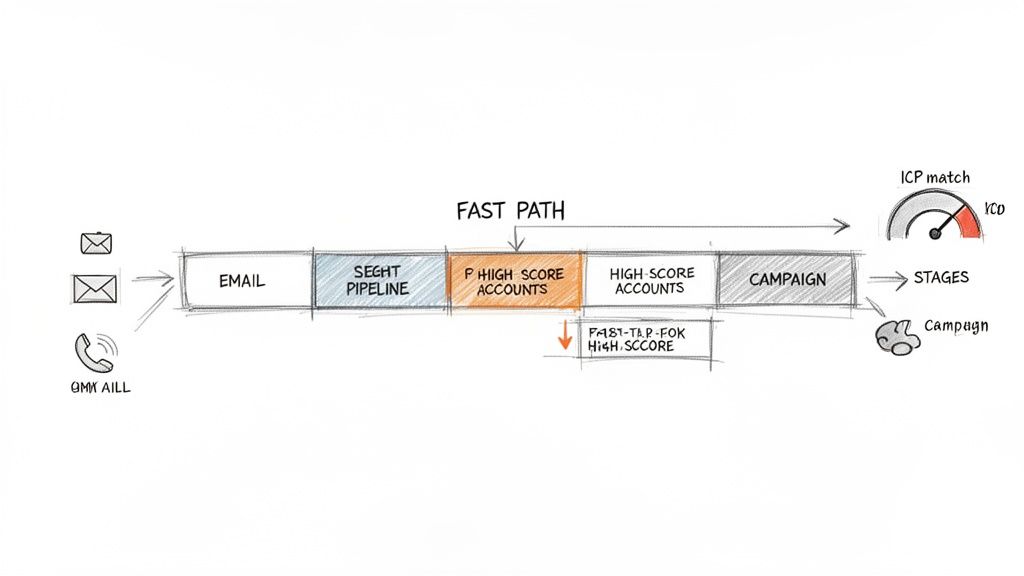
When you operationalise your ICP, it stops being another piece of forgotten internal homework. It becomes the very engine behind smarter, more efficient growth, paving the way for shorter sales cycles and much, much higher win rates.
Integrate Your ICP into Your CRM for Smarter Lead Scoring
Your CRM is the central nervous system of your entire sales operation. By plugging your ICP criteria directly into it, you can automate a huge chunk of lead qualification and scoring. This gives your team a clear, data-backed roadmap of who to talk to and when.
It starts by translating your ICP attributes into simple scoring rules. For example, you could set it up like this:
- Industry: If a lead is in your sweet spot, like FinTech, give them +20 points.
- Company Size: If they have between 50-250 employees, that’s another +15 points.
- Technology Used: Maybe they use a tool that pairs perfectly with yours? Add +10 points.
This system instantly pushes the highest-potential leads to the top of the pile, letting your sales team jump on them while they're hot. It also gives them the confidence to disqualify poor-fit leads early, saving countless hours that would otherwise be burned on dead-end conversations. A sharp ICP is also the foundation you need to strategically qualify leads with forms, making sure only the best prospects make it to your sales team.
An ICP-driven lead scoring model transforms your CRM from a simple database into a strategic asset. It tells your sales team not just who to call, but who to call first.
Refine Your Messaging for Deeper Resonance
Once you have a crystal-clear picture of who you're talking to, you can finally ditch the generic, one-size-fits-all messaging. Your ICP provides the deep insights needed to tailor every single piece of outreach—every email, cold call, and marketing campaign—to speak directly to the specific pain points and ambitions of your target accounts.
For example, if your ICP research reveals that your best customers are constantly wrestling with regulatory compliance, your marketing content should shout about your security and reporting features. If they're all about staying ahead of the curve, your sales pitches should highlight your product's most innovative capabilities.
This kind of personalisation makes prospects feel seen and understood. It proves you’ve done your homework and aren't just blasting out another generic email. You can go even deeper on this topic with our guide on using sales intelligence to enhance your outreach.
Tailor Your Approach for Specific Markets
Your ICP becomes incredibly powerful when you apply it to diverse and nuanced markets like Singapore, where a generic approach is practically guaranteed to fall flat. The local consumer landscape is a unique mix, heavily shaped by a large international community, which creates distinct customer segments with their own preferences.
For example, research shows that 23% of consumers in Singapore are "less is more" diners who show extreme loyalty to a handful of trusted spots—a perfect target if your business model thrives on retention. Even more telling, a staggering 87% of Singaporean consumers demand total transparency in how they interact with AI and technology. This signals that your ideal customer here values authenticity and clear communication above all else.
Knowing whether your prospect is loyalty-driven or a stickler for transparency is fundamental to crafting a message that will actually land. You can discover more insights about Singapore's unique customer segments to sharpen your local strategy even further.
Tailoring Your Outreach with Communication Intelligence
You’ve done the hard work of building your Ideal Customer Profile, and it’s paying off. You know exactly which companies to go after—the ones with the right headcount, industry focus, and tech stack. But here's the billion-dollar question: once you find the perfect company, how do you actually connect with the right person inside?
This is where the next layer of targeting comes into play. It's time to move beyond the company level and start understanding the individual communication styles of the key decision-makers. Think of it this way: your ICP gets you to the front door, but communication intelligence is the key that unlocks it.
It just makes sense, right? The way you'd talk to a Chief Financial Officer is worlds apart from how you'd engage a Head of Innovation. They have different goals, they're judged by different metrics, and they respond to entirely different triggers. A one-size-fits-all pitch is a one-way ticket to the deleted folder.
Speaking Their Language
Adapting your outreach isn’t about being fake; it’s about being relevant. A CFO at a company that fits your ICP perfectly will almost always respond best to a data-driven, direct message that screams ROI and cost savings. They want the numbers, fast.
But the Head of Innovation at that same company? They're looking for a more visionary conversation. They get excited by future possibilities, competitive advantages, and groundbreaking ideas. A pitch laser-focused on efficiency would completely miss the mark.
True connection happens when you stop broadcasting your message and start tailoring it to the way your buyer thinks. Understanding their communication style turns a cold outreach into a relevant conversation.
This is the crucial step that closes the gap between finding the right account and building real rapport with the people who sign the cheques. It’s how you turn a solid ideal customer profile into a powerful tool for actually closing deals. To see how this works in practice, check out how to apply these ideas with AI-powered sales intelligence.
A Simple Framework for Adaptable Communication
You don’t need a psychology degree to start tailoring your approach. A simple framework is all you need to start spotting communication preferences and tweaking your emails, calls, and presentations. The easiest place to start is by considering the buyer's role and what likely keeps them up at night.
This table is a great starting point for adapting your outreach based on the common buyer roles you'll find within your ICP accounts.
Mapping ICP Roles to Communication Styles
| Common ICP Role | Primary Motivator | Effective Communication Tactic | What to Avoid |
|---|---|---|---|
| CFO / Finance Lead | Efficiency, ROI, risk reduction, and predictable costs. | A concise, data-heavy message with a clear financial benefit. | Vague, visionary language and feature-focused pitches. |
| CEO / Founder | Strategic growth, market position, and long-term vision. | A high-level overview connecting your solution to their big-picture goals. | Getting bogged down in minor technical details. |
| Head of Sales/Marketing | Revenue growth, team productivity, and competitive advantage. | Case studies and success stories from similar companies. | A passive approach that doesn't show clear value. |
| CTO / IT Director | Security, integration, reliability, and technical scalability. | A detailed, fact-based explanation of your tech and security. | Overly emotional appeals or marketing buzzwords. |
When you align your communication style with the motivations of the person you're speaking to, you show respect for their time and an understanding of their world. This thoughtful approach builds trust far more effectively than any generic template ever could, making your ICP more actionable and powerful than ever.
Here is the rewritten section, crafted to sound completely human-written and natural, following the specified style and guidelines.
Your ICP Isn't Set in Stone: How to Keep It Sharp and Relevant
Getting your first Ideal Customer Profile defined is a huge win. But don't stick it in a drawer and forget about it. Markets pivot, your customers' needs evolve, and what worked wonders last year might fall flat today.
Think of your ICP as a living, breathing guide, not a one-and-done project. Its real magic comes from its ability to adapt. If you let it gather dust, it quickly becomes an outdated relic. But if you keep refining it, it remains the sharpest tool you have for guiding your go-to-market strategy.
Build a Feedback Loop with Your Frontline Teams
So, where do the best insights for refining your ICP come from? Straight from the trenches. Your sales and customer success teams are talking to the market every single day. Their feedback isn't just helpful—it's a goldmine.
You need a simple, structured way to get that intel out of their heads and into your strategy.
- Hold Regular Sales Debriefs: Get your reps together to talk about their recent wins and losses. What common threads are they seeing in the deals that close easily? What are the red flags popping up with prospects who ghost them?
- Run a Real Win/Loss Analysis: Go deeper than just whether you won or lost. For the wins, what specific pain points did you solve? For the losses, was it really about price, or was there a fundamental mismatch in how they operate?
- Listen to Your Customers: Encourage your account managers to ask better questions during their check-ins. How are their business priorities changing? What new challenges are keeping them up at night?
A static Ideal Customer Profile is a liability. The most successful companies build systems to continuously feed real-world insights from their sales and success teams back into their targeting strategy.
Know When It's Time for a Refresh
While constant feedback is great, you also need to schedule a formal review. This prevents your ICP from slowly drifting off course without anyone noticing. It’s a dedicated time to make deliberate changes and get everyone in the organisation on the same page.
You absolutely have to reassess your ICP at key moments. For example, in a dynamic market like Singapore, customer expectations are always on the move. Recent findings show a massive swing towards hybrid experiences, where customers want to engage both digitally and in person. In fact, this omnichannel approach scored 6.4 points higher in customer satisfaction than single-channel interactions.
What does that tell you? Your ideal customer in Singapore probably values flexibility and expects you to meet them wherever they are. You can read the full Forrester research about Singapore's CX trends to get a better handle on these shifts.
A good rule of thumb is to do a full-blown review every quarter. You should also trigger one anytime your business makes a big move, like launching a new product or expanding into a different region. This rhythm ensures your ICP stays a true compass for growth, not just a historical document.
Of course. Here is the rewritten section, designed to sound completely human-written and match the provided examples.
Common Questions About Ideal Customer Profiles
As you start weaving the Ideal Customer Profile into your strategy, a few questions always pop up. Getting these sorted out is key to making sure your whole team is on the same page and using the ICP to its full potential.
How Is an ICP Different From a Buyer Persona?
This is easily the most common question, and the difference is crucial. Think of it this way: your Ideal Customer Profile (ICP) is the blueprint for the perfect company you want to sell to. It’s about the organisation itself—its industry, employee count, annual revenue, and the tech it uses. The ICP answers the big-picture question, "Which companies are a perfect match for us?"
A buyer persona, on the other hand, zooms in on the specific people you need to talk to inside that perfect company. It gets into their job title, what keeps them up at night, their career goals, and what they need to succeed. You absolutely need both. The ICP points you to the right building; the buyer persona tells you exactly which door to knock on.
How Often Should I Update My Ideal Customer Profile?
Your ICP isn't a "set it and forget it" document. Markets change, customer pain points evolve, and your own product gets better. Because of this, you should make it a habit to review and tweak your ICP at least once a year.
A great Ideal Customer Profile is never truly "finished." It should adapt alongside your business, reflecting new market realities and customer insights to keep your targeting sharp and relevant.
That said, don't wait for the annual review if something big happens. A major product update, a new competitor shaking things up, or even noticing a new type of customer is getting incredible results—all of these are triggers to pull out your ICP and see if it still holds true.
What Are the Biggest Mistakes to Avoid?
Building a powerful ICP is as much about avoiding common traps as it is about getting the details right. The single most damaging mistake? Relying on gut feelings and assumptions instead of cold, hard data from your happiest, most successful customers.
Other classic blunders include making the profile so broad it becomes useless ("any company with a website" isn't an ICP) or, just as bad, not getting your sales and marketing teams to actually buy into it and use it. Always, always start with the real-world data from your best customers. Let their success be the foundation for your profile.
Ready to stop guessing and start connecting with your ideal customers on a deeper level? Mindreader uses communication-style AI to show you exactly how to adapt your message for every prospect, turning your ICP into actionable outreach that closes more deals. Discover how it works at themindreader.ai.