How to Create an Ideal Customer Profile

An ideal customer profile (ICP) isn't just a buzzword; it's a laser-focused description of the perfect company for your product or service. Think of it less as a person and more as a type of organisation that's not only most likely to buy from you but will also succeed with what you offer and stick around as a high-value partner.
This profile becomes the strategic blueprint for your entire go-to-market team.
What Is an Ideal Customer Profile and Why Does It Matter
Imagine you're fishing. You could just cast a massive net across the entire ocean, hoping you’ll snag something valuable. That approach is exhausting, expensive, and frankly, a total crapshoot.
Now, what if you had a detailed map showing you exactly where the prize fish gather? The specific depths, temperatures, and locations.

An ideal customer profile is that map for your business. It steers your sales and marketing efforts directly toward the accounts that are perfectly suited for what you sell, transforming random prospecting into a precise, targeted operation.
The Cost of Operating Without a Clear ICP
Without that map, sales teams end up chasing any lead that shows a flicker of interest. This spray-and-pray strategy creates huge problems that kill growth and burn through resources like you wouldn't believe.
The symptoms of a missing or poorly defined ICP are painfully obvious and hit your bottom line hard. It creates friction not just for the sales team but for everyone in the company.
You’ll start seeing common consequences like:
- Wasted Resources: Your team sinks valuable time and budget into prospects who will never buy. Or worse, they buy and then churn out almost immediately.
- Longer Sales Cycles: Your reps struggle to articulate value because they’re talking to companies whose problems your solution doesn’t really solve.
- High Customer Churn: You manage to sign a new client, but they're a terrible fit. They can't see the value, demand endless support, and eventually leave—damaging your reputation and revenue on their way out.
An ideal customer profile tells you exactly who to target and why. It helps you spot the key characteristics your best, most profitable customers share, giving you a solid foundation for deciding which leads are actually worth pursuing.
The Strategic Advantage of a Defined ICP
On the flip side, a well-defined ICP gets your entire organisation on the same page. It ensures that marketing, sales, and product development are all laser-focused on attracting and delighting the same type of high-value customer.
This alignment creates a powerful, self-reinforcing cycle of success. Marketing generates better leads, sales closes deals faster, and the product team builds features that your core customer base absolutely loves.
Ultimately, a strong ICP delivers real business results by focusing your energy where it generates the highest return. It’s not just some marketing exercise; it’s a critical tool for building a sustainable, profitable business.
The Building Blocks of a Powerful ICP
Moving from theory to practice means we need to break down an Ideal Customer Profile into its essential parts. A truly effective ICP isn't built on gut feelings or a hunch; it's assembled from layers of hard data that, when pieced together, create a multi-dimensional picture of your perfect-fit account.
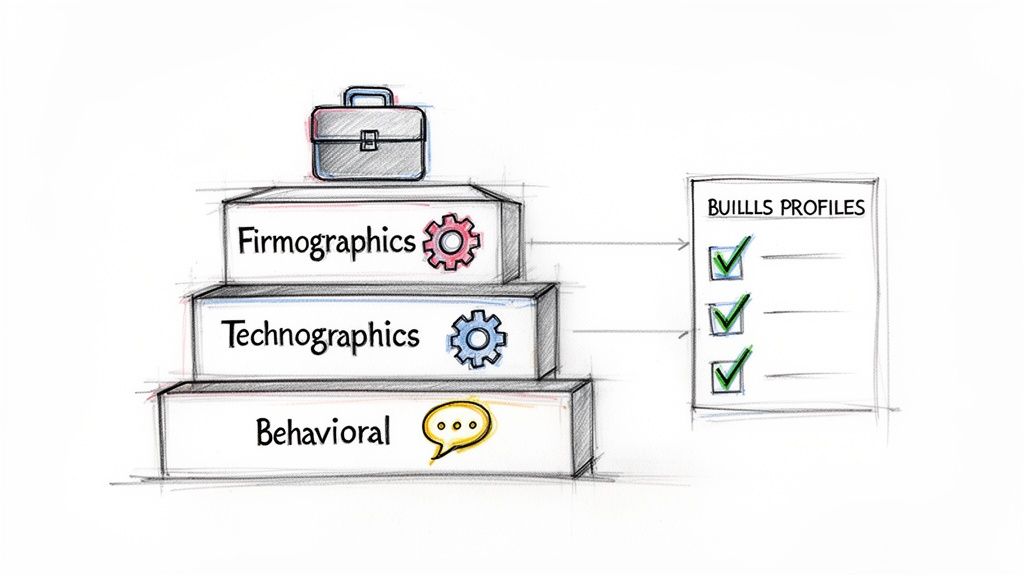
Think of this process like building a house. You start with the foundation and the frame before you even think about wiring up the electrical systems or picking out interior finishes. For an ICP, your foundation is built from firmographics, and the details come from technographic and behavioural data.
Firmographics: The Foundational Data
Firmographics are the quantifiable, objective characteristics of a company. These are the hard facts—the kind of stuff that's relatively easy to find and verify. They give you the basic structure for your profile and answer the simple "who" and "where" questions about a potential customer.
This foundational layer is crucial because it immediately filters out a massive chunk of the market that just isn't a good fit. It’s basic, but it’s powerful. For example, if your product is designed for large enterprises, firmographic data stops you from wasting cycles on a ten-person startup.
Key firmographic data points include:
- Industry or Vertical: Which specific sectors, like "FinTech" or "Healthcare Logistics," get the most value from what you sell?
- Company Size: This is usually measured by employee count (e.g., 500-2,000 employees) or annual revenue (e.g., $50M - $250M ARR).
- Geographic Location: Are your best customers clustered in a specific region, city, or country?
- Organisational Structure: Do you typically sell to public companies, private entities, or non-profits?
- Financial Health: Metrics like funding rounds, profitability, or recent growth can signal a company's ability and willingness to invest.
These details paint the initial, broad strokes of your ideal customer. They are the non-negotiables that help you define your total addressable market and create a focused list of accounts to dig into. Without this solid base, any other analysis is just guesswork.
Technographics and Behaviours: The Actionable Insights
Once you have the firmographic frame in place, it’s time to add the more nuanced layers that reveal how a company operates. This is where technographic and behavioural data come in, providing critical context that firmographics alone can't.
Technographics tell you what technologies a company uses. Knowing their tech stack can reveal integration opportunities, competitive threats, or just a general willingness to adopt new software. A company already investing in a suite of premium marketing automation tools, for instance, is far more likely to be open to another advanced sales technology.
A company’s technology stack is a direct reflection of its priorities and pain points. Understanding what they use—and what they don't—tells you a story about their operational maturity and where they see value.
This data goes beyond simple observation; it allows you to tailor your outreach with surgical precision. Mentioning how your solution integrates with their existing CRM or complements a tool they already pay for makes your pitch instantly more relevant.
Layering these data types is what gives you a truly comprehensive view. The table below breaks down how these pieces fit together to build a robust Ideal Customer Profile that your sales team can actually use.
Key Data Points for Building Your ICP
| Data Type | What It Tells You | Example Metric |
|---|---|---|
| Firmographic | The basic, verifiable facts about a company's identity. | Annual revenue between $20M and $100M. |
| Technographic | The specific technologies and software the company uses. | Currently uses Salesforce and Marketo. |
| Behavioural | The actions and patterns that signal intent or need. | Recently hired a new VP of Sales. |
By combining these building blocks, you move from a generic description like "tech companies" to a highly specific and actionable profile. This detailed blueprint ensures your sales team isn't just busy but productive, focusing their energy exclusively on the accounts that are most likely to become your next best customers.
ICP vs Buyer Persona: Understanding the Critical Difference
It’s a common mistake, but a costly one: using "Ideal Customer Profile" and "Buyer Persona" as if they’re the same thing. They’re absolutely not. While they work together, they have very different jobs in your go-to-market strategy. Getting this wrong leads to mixed messages, wasted effort, and targeting that’s just plain off.
Let's break it down with an analogy. Your Ideal Customer Profile (ICP) is like a blueprint for the perfect building to sell to. It tells you it’s a 10-storey office in the city centre, housing a tech company with over $50M in revenue. The ICP is all about the organisation.
Your Buyer Persona is about the people you need to meet inside that building. It’s a sketch of individuals like "IT Director Dave" or "CFO Susan," bringing their personal goals, frustrations, and motivations to life. The persona is all about the person.
The Strategic Filter vs. The Tactical Guide
Think of your ICP as your strategic filter. It operates at the company level, answering the big question: "Which companies are even worth our time?" It uses hard data—firmographics, technographics—to qualify or disqualify an entire organisation before a single salesperson even thinks about reaching out. This is your first, most crucial layer of focus.
Once your ICP points you to the right company, your buyer persona steps in as the tactical guide. It helps your team answer, "Now that we’re here, how do we actually talk to these people?" It digs into the human side of things—psychographics, pain points, job roles—to help you craft a message that actually resonates.
An ICP tells you who to call, while a buyer persona tells you what to say. Both are essential, but they are not the same. Mastering both is the key to unlocking both efficient account targeting and personalised, effective communication.
Nailing this distinction is everything in B2B sales. It’s a subtle but powerful difference. For a deeper dive into crafting the human side of the equation, check out this guide on how to create B2B buyer personas that truly connect.
ICP vs Buyer Persona: A Quick Comparison
To make it even clearer, let's put them side-by-side. The ICP is your wide-angle lens on the market, showing you which companies fit. The persona is your zoom lens, focusing on the specific decision-makers inside those companies.
Here’s a simple table to show how they stack up.
| Attribute | Ideal Customer Profile (ICP) | Buyer Persona |
|---|---|---|
| Focus | The Company/Account | The Individual/Person |
| Data Points | Firmographics (revenue, industry, size) | Demographics & Psychographics (job title, goals, pain points) |
| Purpose | Strategic Targeting (Which accounts to pursue) | Tactical Communication (How to engage individuals) |
| Used For | Account list building, territory planning, lead scoring | Content creation, email outreach, sales messaging |
| Example | A B2B tech company with 500-1,000 employees. | "Marketing Mary," a 35-year-old Marketing Director. |
At the end of the day, your ICP and buyer persona aren’t rivals; they're partners in a powerful one-two punch. First, you use your ICP to build a list of perfect-fit companies. Then, you lean on your buyer personas to have meaningful conversations with the key players inside them. This two-step process ensures you’re not just talking to the right people, but you’re also speaking their language.
A Step-by-Step Guide to Building Your ICP
Building an ICP from the ground up can feel like a massive task, but it’s actually a straightforward, data-driven process. The secret is to start with your most valuable asset: your existing customers. This isn't about daydreaming up a list of perfect clients. It's about uncovering the truth of who already gets the most value from what you do.
The whole approach is built on one simple idea. If you can deeply understand the DNA of your best customers today, you can build a reliable blueprint to find more of them tomorrow.
Step 1: Start With Your Best Customers
First things first, look inward. Your CRM and billing systems are absolute goldmines of information, just waiting for you to start digging. The mission here is to pinpoint your top 10 to 20 customers.
But "best" isn't just about who pays you the most. You're looking for a mix of positive signals that point to a genuinely great partnership.
These are the customers who:
- Have the highest Lifetime Value (LTV): They've stuck with you the longest and bring in significant, predictable revenue.
- Were the most profitable to acquire: Think short, efficient sales cycles that didn't drain your resources.
- Are your biggest advocates: They're the ones giving you glowing testimonials, participating in case studies, and sending referrals your way.
- Show high product engagement: They're actively using your solution and seeing real, tangible results from it.
Once you have this shortlist, you've created a focused data set that perfectly represents what success looks like. These are the companies your ICP will be modelled on.
Step 2: Combine Quantitative and Qualitative Data
With your A-list of customers in hand, it's time to dig into the data and find the common threads tying them all together. This is where you blend the hard numbers with real human insights.
Start with the quantitative data—the stuff you can pull straight from your CRM. Look for patterns in firmographic and technographic data points. What industries are they in? What's their typical employee count or annual revenue? Where are they located?
Next, layer on the qualitative insights. This is how you go from knowing what your best customers look like to understanding why they're your best. Grab coffee with your sales and customer success teams—the people who live and breathe these relationships every day.
The most powerful insights often come from conversations, not spreadsheets. Ask your sales team which deals felt the smoothest and why. These anecdotal clues often point to powerful underlying patterns.
To keep things organised, using an ideal customer profile template can give you a structured place to start. A good template makes sure you don’t miss any critical data points while pulling all your findings together.
This visual shows how the targeting process flows from the broad, company-level ICP down to the individual buyer persona.
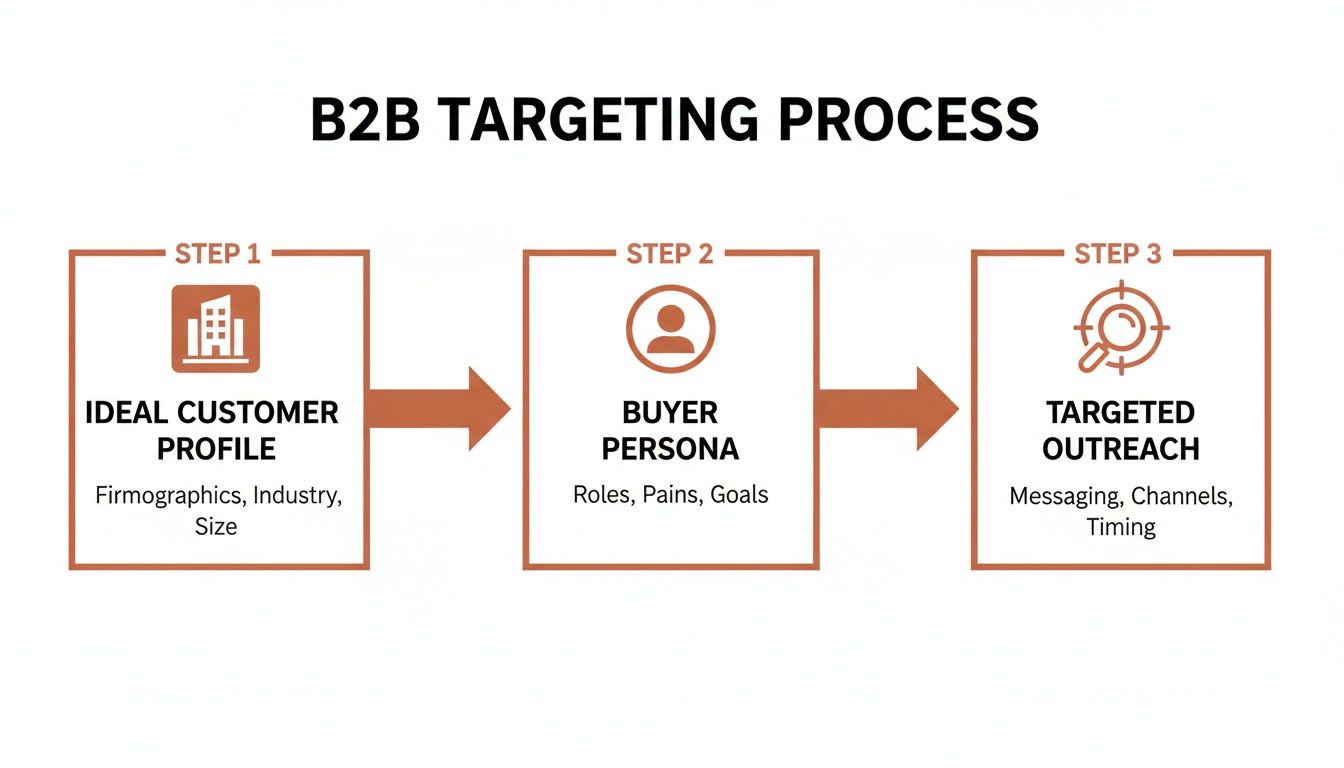
It really drives home that defining your ICP is the essential first move that makes all your later targeting and outreach efforts click.
Step 3: Ask the Right Questions
To get that rich qualitative data, you need to ask sharp, targeted questions during customer interviews and internal debriefs. These questions should be crafted to uncover motivations, challenges, and the specific value they get from your product.
Here are a few key questions to guide your research:
- What specific event or pain point triggered your search for a solution like ours?
- What were the most important criteria in your evaluation process?
- Which other solutions did you consider before choosing us?
- What tangible business outcome have you achieved since using our product?
- How would you describe our solution to another professional in your industry?
The answers will reveal the core problems you solve and, just as importantly, the language your best customers use to describe your value. That's pure gold for refining your messaging. You can dive deeper into this with our guide on advanced customer profiling techniques.
Step 4: Validate Your Draft ICP
The final step is to pressure-test your new ICP against the real world. An ICP created in a vacuum is just an echo chamber. You have to make sure it's a realistic tool for targeting actual companies out in the market.
This validation process is simple: take your ICP criteria and see if you can find enough prospects who match it. Use market intelligence tools to confirm that your target market is big enough to support your growth goals.
Think about the market in Singapore, for example. The nation's digitally savvy consumer base, heavily concentrated in the 25-54 age group, is a prime target for many businesses. Data shows 3.49 million Singaporeans in this demographic buy consumer goods online, spending a whopping $5.04 billion USD collectively. For B2B sales, understanding this group's digital-first mindset is key, as search is almost always their first step.
If your research gives you the green light, you're ready to put your ICP into action. This iterative, data-backed approach ensures your ICP becomes a reliable guide for predictable, sustainable growth.
An Ideal Customer Profile gathering dust in a spreadsheet is a massive missed opportunity. Its real power only gets unlocked when you weave it into your team's daily workflow, turning a static document into a dynamic engine for sales.
The goal here is simple: make your ICP an active participant in how your team finds, prioritises, and talks to potential customers.
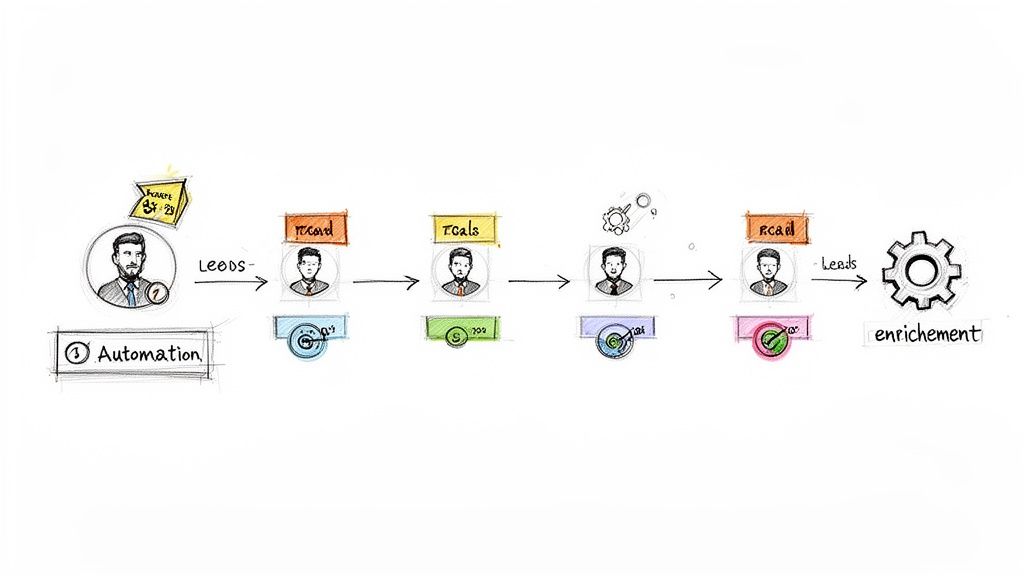
This all starts with the most fundamental piece of sales tech you have: your Customer Relationship Management (CRM) system. By translating your ICP criteria into concrete rules inside your CRM, you can automate the work of spotting and elevating your best-fit leads.
Automating Prioritisation in Your CRM
Think of your CRM as the central nervous system for your ICP. Instead of reps manually cross-referencing a document, you can set up the system to do the heavy lifting for them. This means building out custom fields and scoring rules based directly on your ICP's firmographic and technographic data.
What this does is create an immediate, visual hierarchy of opportunity. When a new lead lands, your system can automatically tag and score it based on how well it aligns with your profile.
For example, you could set up a simple lead scoring system:
- +20 points: Company is in a Tier 1 industry (e.g., FinTech, SaaS).
- +15 points: Employee count is between 500-2,000.
- +10 points: Uses a complementary technology (e.g., Salesforce).
- -10 points: Located in a region you don't serve.
Reps can then build their daily call lists based on these scores, making sure they always focus their energy on leads with the highest chance of closing. This simple bit of automation turns your ICP from a guideline into a direct, daily instruction.
By integrating your ideal customer profile into your CRM, you’re not just organising data; you’re building a systematic process that forces your team to focus on the accounts that truly matter. It’s the difference between working hard and working smart.
Enriching Accounts with Advanced Intelligence
Beyond basic prioritisation, modern tech lets you enrich your understanding of accounts that match your ICP. This is where you move past just identifying the right company and start personalising outreach for the people inside it. Advanced sales intelligence tools can give you deep insights that a CRM alone never could.
For instance, communication intelligence platforms like Mindreader can analyse the behavioural archetypes of key decision-makers within a target company. This lets your team understand an individual's specific communication style before ever sending an email or hopping on a call.
This layer of intelligence is especially effective in markets like Singapore, where high digital adoption meets a strong preference for clarity. Singapore's internet penetration is at 96%, and a recent report found that 87% of Singaporean consumers value transparency in their interactions with AI. This points to an expectation for smart, personalised engagement, creating a real opportunity for sales teams to stand out through the thoughtful use of prospect intelligence. You can find more insights about Singapore's consumer landscape at Kadence.com.
Turning Insights into Actionable Workflows
The final step is to embed these enriched insights into repeatable sales workflows. Technology shouldn't just hand you data; it should guide your actions. When a tool identifies a prospect's communication style, it should also suggest specific talking points, email openers, or meeting strategies.
This creates a powerful loop:
- Identify: The CRM flags a high-fit account based on your ICP criteria.
- Enrich: An intelligence tool provides behavioural insights on key contacts.
- Engage: The rep uses these insights to craft hyper-personalised outreach.
By connecting these technologies, you transform your ICP from a theoretical concept into a practical, day-to-day advantage. Your sales team is no longer guessing. They're equipped with a clear, data-driven plan for every high-value interaction, which dramatically improves their efficiency and odds of success.
Using Your ICP to Refine Your Entire Sales Process
Defining your ideal customer profile isn’t the finish line—it’s the starting gun for a much smarter sales approach. An ICP should be more than just a targeting document. Think of it as a comprehensive playbook for every single customer interaction, designed to sharpen each stage of the sales cycle.
When your team really gets the ICP, you start having more relevant and successful conversations. It means tailoring your messaging, value propositions, and sales materials to directly address the specific pain points and goals that keep your ideal customers up at night.
Tailoring Your Messaging and Value Proposition
Generic messaging falls flat. It’s just noise. Your ICP, on the other hand, gives you the deep insights needed to craft a value proposition that truly resonates. Instead of just listing features, you can speak directly to the outcomes your ideal customer actually cares about.
Let's say your ICP is a mid-sized logistics company struggling with route optimisation. Your messaging shouldn't drone on about your software's "advanced algorithm." Instead, you should hit them with how you help them "cut fuel costs by 15% and slash delivery times."
This shift from talking about features to talking about benefits is everything. It shows you understand their world and have a real solution for their most pressing problems.
A great value proposition doesn't just explain what your product does; it articulates the specific relief or gain your ideal customer will experience. It’s the difference between selling a tool and selling a solution.
Optimising Outreach Channels
Where does your ideal customer hang out? A well-researched ICP answers this question, letting you choose your outreach channels for maximum impact. There’s no point spamming LinkedIn messages if your ICPs are mostly active in niche industry forums or only attend regional trade shows.
This insight guides your entire engagement strategy:
- Digital Presence: Are they on LinkedIn, hiding in specific Slack communities, or commenting on industry blogs? Focus your digital efforts there.
- Communication Preferences: Do they prefer a quick, punchy email, a formal demo, or a direct phone call?
- Hybrid Engagement: For many markets, a mix of channels works best.
According to Forrester's Singapore Customer Experience Index, hybrid experiences—those that blend digital and physical touchpoints—significantly outperform single-channel approaches. This just highlights the need for a smart, omnichannel strategy, using your ICP's preferences to blend that initial digital outreach with more personalised follow-ups. You can read more about Forrester's findings on the Singapore CX Index here.
Anticipating Objections and Closing Deals Faster
When you deeply understand your ideal customer, you can get ahead of the conversation. You already know their common hesitations, their likely budget constraints, and the hoops you'll have to jump through in their internal decision-making process—all before you even make the first call. This lets you proactively address potential objections right in your pitch.
For instance, if your ICP is typically cautious about adopting new tech because they're worried about integration headaches, you can lead with a case study detailing a seamless implementation for a company just like theirs. Building this kind of rapport and showing you've done your homework builds trust and dramatically shortens the sales cycle. You can learn more about optimising your go-to-market approach in our guide on sales and marketing automation.
Ultimately, using your ICP to refine your sales process just means every action you take is more intentional. You stop wasting energy on prospects that are a poor fit and instead focus on building meaningful relationships with the accounts most likely to become your next great customers.
Answering Your Top Questions About Ideal Customer Profiles
Even with a clear roadmap, building and using an ideal customer profile can bring up a few questions. I've pulled together the most common ones I hear from sales leaders to give you quick, practical answers that will help you sidestep common traps and get the most out of your ICP.
Think of this as your go-to reference for keeping your sales strategy sharp.
How Often Should I Update My Ideal Customer Profile?
Your ICP is a living, breathing document, not a "set it and forget it" project. You should plan to give it a proper review at least once a year.
But more importantly, you need to revisit it whenever your business hits a major milestone. Think new product launches, a big shift in the market, or breaking into a new region. Your sales team is your best source of intel here—their constant feedback, combined with fresh customer data, will tell you when it's time for a refresh.
What's the Biggest Mistake People Make When Creating an ICP?
The single most common—and costly—pitfall is building an ICP based on wishful thinking. It’s easy to describe the customer you want to have, but a truly powerful profile is built on who your customers actually are.
The truth is always buried in your data. Look at which customers are getting the most value from your product, who has the highest lifetime value, and which ones were the easiest to bring on board. Always let performance data, not a wishlist, guide you.
Can a Company Have More Than One Ideal Customer Profile?
Absolutely. In fact, it's pretty common—and often necessary—to have multiple ICPs. This is especially true if you sell to different industries or have products that solve completely different problems.
For instance, you might have one ICP for enterprise financial firms and a totally separate one for mid-market tech startups. The trick is to build out a detailed, data-backed profile for each unique segment. This way, your messaging and outreach stay razor-sharp and relevant, never generic.
How Is an ICP Different from a Target Market?
This question comes up a lot. A target market is the broad group you're aiming for, like "healthcare companies in Southeast Asia." It’s casting a wide net.
An ideal customer profile, on the other hand, is a laser-focused description of the perfect company within that market. It adds layers of detail that make your targeting truly actionable. For example: "Singapore-based private hospitals with 500-2,000 employees, currently using specific legacy software, and struggling with new regulatory compliance." See the difference? The ICP gives you a precise bullseye to aim for.
Ready to connect with your ideal customers on a deeper level? Mindreader helps you understand the communication style of key decision-makers, turning your ICP into a playbook for every conversation. Close more deals by adapting to how your clients think. Learn more at themindreader.ai.