EQ vs IQ: Unlocking Sales Success
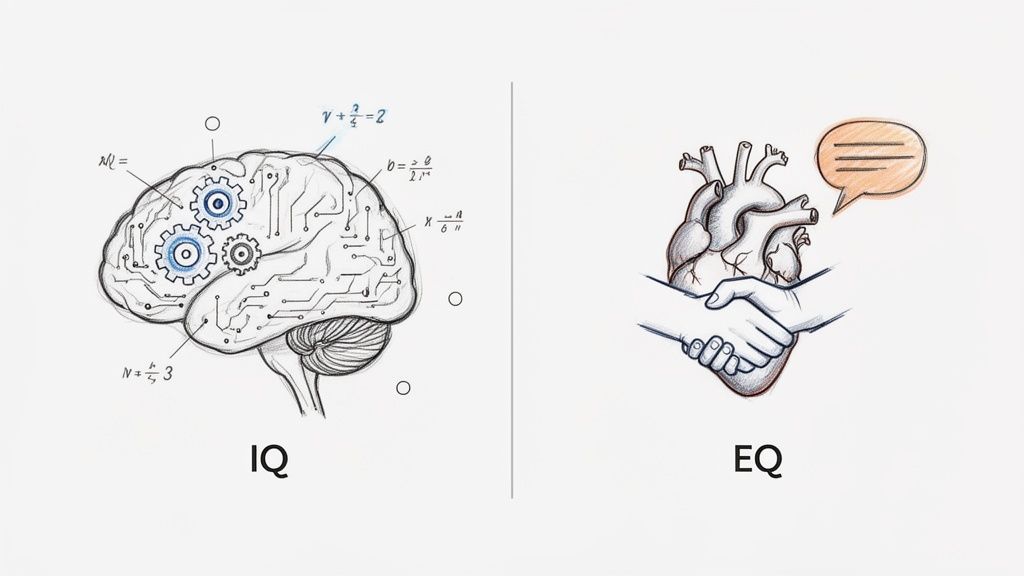
The real difference between emotional intelligence (EQ) and intelligence quotient (IQ) boils down to this: IQ is your engine for logical reasoning, while EQ is your skill in navigating the human side of things—understanding and managing emotions in yourself and others.
They’re often talked about as if they’re polar opposites, but in sales, they’re two sides of the same coin. Top performers aren’t just one or the other; they’ve learned how to blend both. For anyone serious about their sales career, getting this distinction right is the first step toward levelling up.
Defining EQ and IQ in a Sales Context
It's tempting to think of this as a "head vs. heart" debate. In reality, the best sales professionals use both seamlessly.
IQ is your raw analytical horsepower. It's what helps you grasp complex product specs, break down market data, spot patterns in customer behaviour, and build a logical, data-driven pitch. Think of it as the strategic foundation of your sales game.
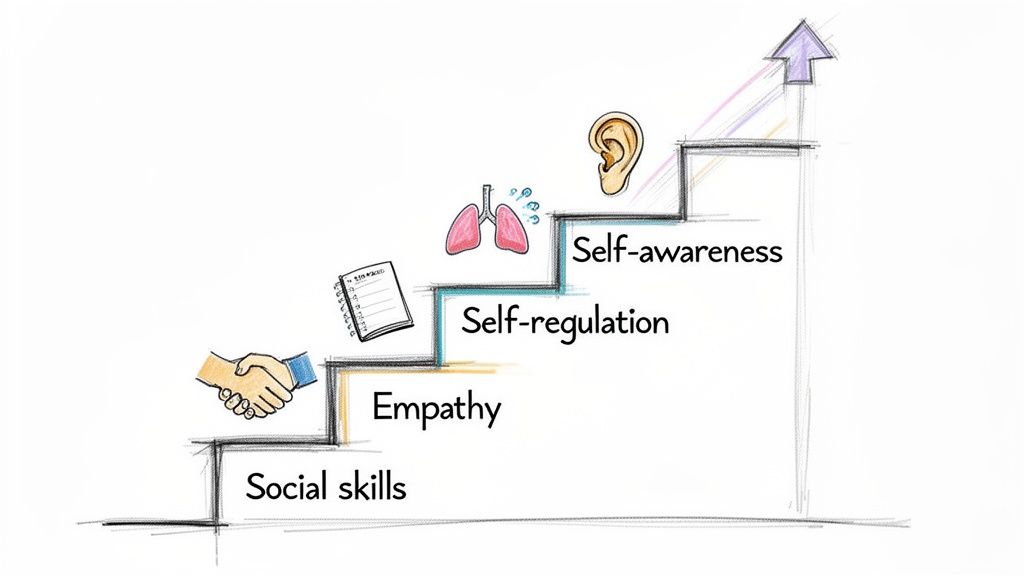
On the other hand, EQ is what allows you to actually connect with people. It’s built on four key pillars:
- Self-Awareness: Knowing your own emotions and how they influence your actions.
- Self-Regulation: Keeping your cool under pressure, especially when facing rejection.
- Social Awareness: Reading the room and genuinely understanding a prospect's perspective and feelings.
- Social Skills: Using that emotional insight to build real rapport, guide decisions, and manage tricky relationships.
EQ vs IQ At a Glance
To make the differences crystal clear, it helps to see them side-by-side. This quick table breaks down how each type of intelligence shows up in the real world.
| Attribute | Emotional Intelligence (EQ) | Intelligence Quotient (IQ) |
|---|---|---|
| Primary Focus | Understanding and managing emotions (self and others) | Cognitive abilities, logic, and reasoning |
| Key Skills | Empathy, communication, self-regulation, motivation | Analytical thinking, problem-solving, memory |
| Measurement | Assessed through self-reports and situational tests | Standardised tests (e.g., WAIS, Stanford-Binet) |
| Malleability | Can be developed and improved throughout life | Largely stable after late adolescence |
This table shows that while IQ provides the raw processing power, EQ is the skill that can be continuously honed and developed—a massive advantage for anyone in a people-focused role.
Looking at the workplace in Singapore puts this into perspective. While Singapore boasts a high average IQ of 108, some studies suggest cognitive ability is over five times more effective than EQ in generating employee revenue. Yet, a broader meta-study found IQ only explained 14% of job performance, with EQ accounting for less than 1%.
So what does this mean for a salesperson? It suggests that a high IQ is a great starting point, but it's your EQ that truly unlocks your potential to connect, persuade, and close deals. You can find more on Singapore's workplace intelligence landscape in this deep dive.
Analysing the Real-World Impact on Sales Performance
Let's move past the theory. When you’re in a demanding sales role, the real-world outcomes of high emotional intelligence versus a high intelligence quotient become crystal clear. While a sharp mind provides the analytical foundation, it’s often EQ that turns a promising conversation into a signed contract.
In sales, IQ is non-negotiable for certain tasks. A salesperson with a high IQ can tear through complex market data, grasp intricate product specs, and build a logical, data-backed pricing strategy. They spot patterns in sales cycles and forecast revenue with unnerving accuracy.
But the sales process is rarely a purely logical exercise. At its heart, it’s a human interaction, and this is where emotional intelligence becomes the game-changer.
Where EQ Delivers Tangible Results
A high EQ is what allows a salesperson to build genuine rapport, navigate a tense negotiation without burning bridges, and earn the kind of long-term client loyalty that goes far beyond a simple transaction. It’s the knack for reading a prospect’s subtle hesitation or catching unspoken concerns during a demo.
Think about it this way: an IQ-driven salesperson might deliver a flawless, feature-rich presentation. But an EQ-driven salesperson will notice the client’s furrowed brow, pause the pitch, and ask, "I get the feeling there might be a concern about how this integrates with your current workflow. Can we talk about that?" That small moment of empathy can salvage a deal that logic alone would have lost.
"Emotional intelligence is critical in building and maintaining relationships and influencing others — key skills that help people throughout their career and wherever they sit in an organizational structure."
This insight really drives home why top performance is a strategic blend of both, not an either-or choice. The smartest strategy on paper is useless if you can’t get buy-in, and the strongest relationship won't close a deal if the underlying logic is flawed.
The Financial and Career Impact in Singapore
The financial implications of getting this balance right are huge, especially in relationship-driven markets like Singapore. Here, in the local sales and consulting sectors, emotional intelligence is directly tied to career progression and revenue.
Data from Travis Bradberry, co-author of Emotional Intelligence 2.0, shows a startlingly direct link: every one-point increase in EQ adds roughly S$1,300 to an employee's annual salary. Even more striking, employees with high emotional intelligence earn an average of S$29,000 more per year than their low-EQ colleagues in the Singapore market. This proves EQ isn't just a "soft skill"; it's a hard financial asset.
This research reinforces what many of us know intuitively. Cognitive ability gets your foot in the door—it helps you understand complex products and spot opportunities. But it’s emotional intelligence that builds a lasting career through client trust, team collaboration, and leadership.
Blending IQ and EQ for Peak Performance
The best sales professionals don't choose between being smart and being emotionally astute; they weave both into their daily rhythm.
Here’s what that blend looks like in the real world:
- IQ identifies the opportunity: Sifting through CRM data to pinpoint high-potential leads.
- EQ initiates the connection: Writing a personalised outreach email that actually resonates with the prospect's known pain points.
- IQ structures the solution: Building a customised proposal with crystal-clear ROI calculations.
- EQ navigates the negotiation: Sensing a decision-maker's reservations and addressing them with empathy before they become deal-breakers.
This balanced approach is vital for roles like account executives, financial advisors, and real estate agents. For these professionals, the ability to recognise and influence a prospect's emotions is just as critical as technical product knowledge. In Singapore's cut-throat business environment, sales leaders who build teams that balance analytical rigour with emotional acuity will always have the upper hand. If you're looking to give your own team a lift, check out our guide on ways to increase sales and performance.
A Situational Comparison of Strengths and Limitations
Knowing the difference between emotional intelligence and intelligence quotient is one thing. Knowing which one to lean on in a high-stakes sales meeting is another ball game entirely. The best sales pros don't just rely on one or the other; they’re chameleons, drawing on the right skills at the right moment to build momentum and get the deal signed.
The secret is realising that different situations call for different strengths. A complex technical demo needs a totally different approach than a delicate pricing negotiation or soothing a frustrated client. Let's break down a few common sales scenarios to see where IQ's analytical firepower shines and where EQ's empathetic touch becomes the real game-changer.
This decision tree shows how various sales situations can lead to success. It's not about choosing one path, but about knowing when to tap into your analytical side versus your emotional intuition to achieve top performance.
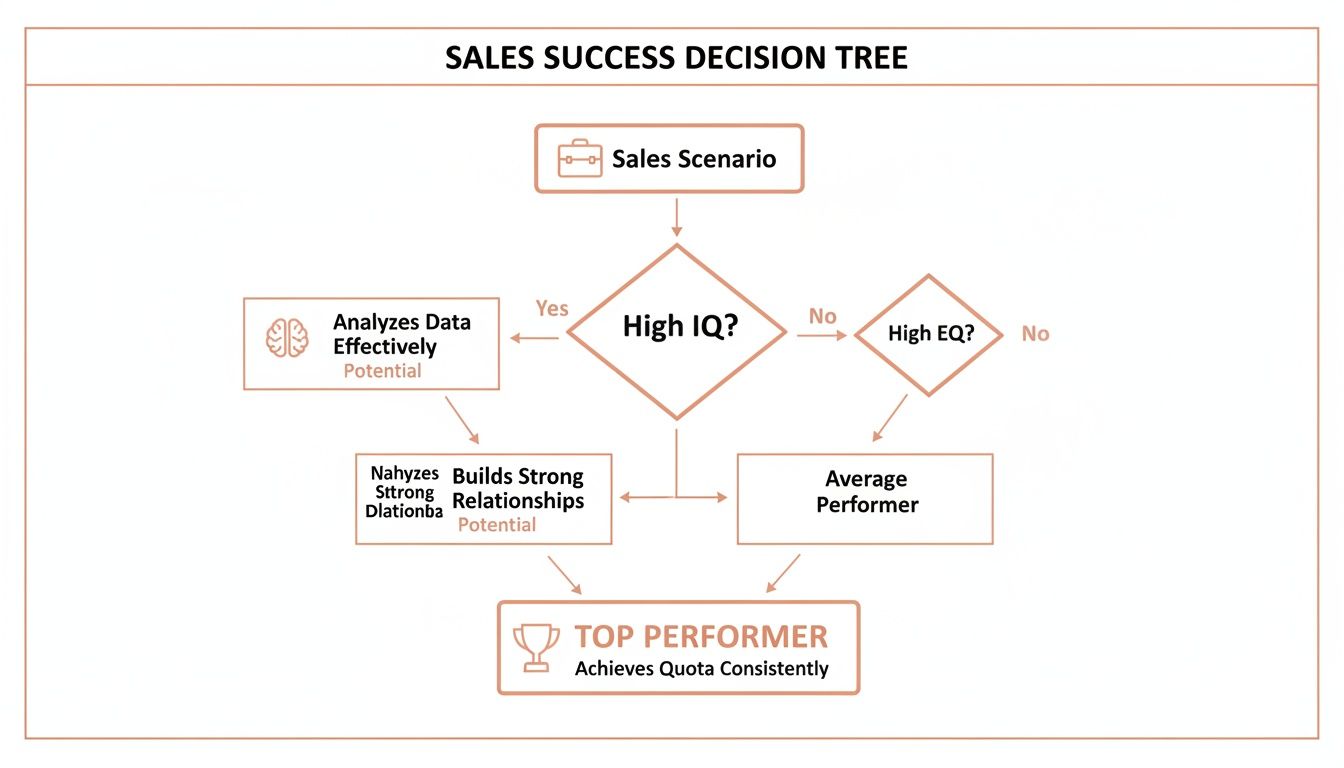
As you can see, there's no single route to becoming a top performer. Success comes from correctly diagnosing the core challenge of a situation and applying the right kind of intelligence.
The IQ-Dominant Scenario: Technical Product Demonstrations
Imagine a B2B account executive presenting a complex software solution to a room full of engineers. In this moment, IQ is king. This is a scenario where raw cognitive horsepower and analytical depth build instant credibility. The audience cares about precision, hard data, and a logical argument above all else.
In this context, a salesperson’s high IQ allows them to:
- Master Technical Nuances: They can fluently discuss intricate product features, API integrations, and security protocols without missing a beat.
- Anticipate Logical Questions: Their analytical mind can predict the technical queries and a potential roadblocks the engineering team will inevitably raise.
- Articulate a Clear ROI: They can build a compelling, data-driven business case that logically connects the product's features to the client's bottom line.
Sure, EQ helps in reading the room for engagement, but the sale here is won through intellectual muscle and provable expertise. Fumbling a technical question is a quick way to lose all trust, no matter how likeable you are.
The EQ-Dominant Scenario: Handling a Dissatisfied Client
Now, let's flip the script. Picture a financial advisor meeting with a long-term client whose portfolio has tanked due to market volatility. The client is anxious, upset, and probably thinking about pulling their money. Here, EQ takes centre stage.
A high IQ might explain the market fluctuations with perfect clarity, but a high EQ will validate the client's feelings first, de-escalating the tension before any logical explanation can land.
An advisor with strong emotional intelligence will:
- Practise Active Empathy: They'll listen intently to the client's worries, acknowledging their frustration without getting defensive.
- Exercise Self-Regulation: They stay calm and collected, even if the client is angry, which helps stabilise the emotional tone of the conversation.
- Rebuild Trust Through Connection: By showing genuine concern, they reinforce the relationship, making the client feel heard and valued as more than just an account number.
In this emotionally charged situation, a purely data-driven, IQ-based response would feel cold and dismissive, likely killing the relationship for good. It's the advisor's ability to manage emotions—their own and the client's—that saves the day and keeps the client for the long haul.
The table below breaks down how these different types of intelligence play out across various sales contexts, showing which one is often the primary driver of success.
Situational Effectiveness of EQ and IQ in Sales
| Sales Scenario | Role of IQ (Cognitive Skills) | Role of EQ (Emotional Skills) | Primary Driver of Success |
|---|---|---|---|
| Complex B2B Negotiation | Analysing contract terms, calculating discounts, and understanding competitor pricing structures. | Reading the other party's non-verbal cues, managing tension, and building rapport to find a win-win solution. | Balanced Blend |
| Prospecting and Cold Outreach | Researching company data, identifying key decision-makers, and crafting logical value propositions. | Writing personalised, empathetic messages that resonate with a prospect's specific pain points and motivations. | EQ |
| Upselling to an Existing Account | Identifying new product fits based on usage data and demonstrating a clear, logical ROI for the upgrade. | Leveraging the existing relationship, understanding the client's evolving needs, and communicating value with trust. | Balanced Blend |
| Closing a High-Value Deal | Navigating final legal and financial hurdles with precision and attention to detail. | Sensing the final decision-maker's hesitation and providing reassurance or addressing unspoken concerns to get the sign-off. | EQ |
As you can see, the best salespeople don't pick a side. They understand the landscape and deploy the right tool for the job, seamlessly blending analytical prowess with genuine human connection to navigate any sales challenge.
How to Develop Your Emotional Intelligence
Here’s a critical difference between emotional intelligence and your intelligence quotient: while IQ tends to hit a plateau after our teenage years, EQ is a skill you can systematically build throughout your entire career. This isn't just some feel-good mantra; it’s grounded in neuroplasticity—the brain's incredible capacity to rewire itself by forming new neural pathways. Every time you consciously manage a tough reaction or push yourself to practise empathy, you're literally strengthening those emotional circuits.
This makes working on your EQ a tangible, strategic investment in your professional growth. For sales professionals, this is a massive advantage. You aren't stuck with a fixed set of cognitive skills. Instead, you can actively build the emotional sharpness needed to truly connect with clients, navigate tricky conversations, and ultimately, close more deals.
Actionable Strategies to Enhance Your EQ
Improving your emotional intelligence boils down to intentional, consistent practice. Here are four practical techniques you can weave into your daily sales routine, each targeting a core component of EQ.
1. Sharpen Self-Awareness Through Journaling
Take five minutes after a key client call to quickly jot down your thoughts and feelings. Don't overthink it. Just ask yourself:
- What emotions did I feel during that conversation? (Was it frustration, confidence, maybe a bit of anxiety?)
- What specific moments triggered those feelings?
- How did my emotions shape what I said and did?
This simple act of reflection forges a stronger link between your feelings and your actions—the very foundation of self-awareness.
2. Master Self-Regulation by Managing Reactions
Let's be honest, sales is full of rejection and high-stakes moments. Instead of impulsively reacting to a lost deal or a tough objection, just practise the "pause." When you feel that hot spike of a negative emotion, take one deep breath before you say anything. This tiny gap creates the space you need to choose a constructive response over a knee-jerk emotional one, helping you stay professional and in control.
3. Build Empathy with Active Listening Exercises
In your next meeting, set one simple goal: understand the other person’s perspective without immediately formulating your reply. Focus completely on their words, their tone, their body language. Afterwards, try to summarise their main points and the feelings behind them. This exercise trains your brain to go beyond just hearing words and start truly understanding the person.
Curious about where you stand now? You might want to try this free emotional intelligence test to get a baseline.
4. Improve Social Skills by Adapting Your Style
Pay close attention to how your prospect communicates. Are they direct and all about the data, or are they more personal and focused on building a relationship? Make a conscious effort to mirror their pacing and language. Adapting your approach isn't about being fake; it shows you're paying attention and makes the other person feel more comfortable and understood.
The Neurological Advantage in the Workplace
The fact that emotional intelligence is malleable gives professionals in demanding markets like Singapore a distinct edge. While IQ is largely fixed, EQ can be improved with conscious effort, which aligns perfectly with a business culture that prizes continuous upskilling. Research shows that developing emotional resilience—a key part of EQ—is vital for managing the high-stress interactions common in sales.
By investing in EQ development, sales teams can not only survive but thrive in emotionally complex situations, joining the 90% of top performers who have mastered using both types of intelligence.
For anyone looking to go deeper into developing their emotional intelligence, resources like The Emotionally Intelligent Man Book offer valuable frameworks and insights.
Using AI to Amplify Your EQ
Developing your emotional intelligence is a career-long journey. But let's be realistic—in sales, you don't always have the luxury of time. Every single interaction counts, and you need to get it right, right now. How do you consistently apply these nuanced skills at scale?
This is where technology comes in, acting as an ‘EQ co-pilot’. It bridges the gap between knowing what to do and actually doing it in the heat of the moment.
Modern AI tools aren't here to fake the genuine connection that high EQ creates. Not at all. Instead, they give you the data-driven insights needed to make emotionally intelligent decisions faster and more accurately. It takes the guesswork out of adapting your communication style, turning empathy from a noble goal into a repeatable, winning strategy.
For salespeople, this is a game-changer. Imagine having a system that analyses a prospect's communication style before you even pick up the phone. It provides a structured way to apply the principles of social awareness and skill, ensuring your message actually lands.
Turning EQ Theory into Actionable Sales Plays
An advanced AI Human Intelligence System (HIS) gives you a practical framework to put emotional intelligence to work. By profiling prospects into distinct archetypes—like Mindreader's Knight, Explorer, Healer, and Wizard—it translates personality insights into concrete sales tactics. This isn't generic advice; it's specific guidance tailored to the person you're about to talk to.
This approach gives you a clear path to boosting reply rates and shortening sales cycles by focusing on three key workflows:
- Pre-Call Analysis: Before any meeting, the AI scans a prospect's digital footprint to identify their core personality archetype. This gives you a massive head start, helping you anticipate their priorities and prepare talking points that will genuinely resonate.
- Tailored Messaging: Based on the prospect's archetype, the system helps you craft specific phrases, email templates, and even call scripts. This ensures your communication style clicks with how they prefer to process information, whether that’s data-heavy and direct (like a Knight) or collaborative and visionary (like an Explorer).
- Real-Time Pacing Guidance: During a live conversation, these tools can offer subtle cues on pacing and tone. If you're talking to a methodical Healer, the AI might suggest slowing down and asking more open-ended questions to build trust. It stops you from accidentally steamrolling the conversation with a high-energy pitch they’ll hate.
This screenshot shows how a platform like Mindreader breaks down a prospect's communication style into a clear, visual format.
The dashboard provides actionable advice, like preferred talking points and potential red flags, allowing a salesperson to prepare for a call in seconds flat.
The Practical Edge of an EQ Co-Pilot
The real magic here is the ability to scale your emotional intelligence. Let's be honest, no salesperson can flawlessly psychoanalyse every single person in their pipeline. But an AI assistant can process vast amounts of data to surface these insights instantly. This frees you up to do what you do best: build genuine human relationships.
This technology doesn't make EQ less important; it makes it more powerful. By handling the heavy lifting of analysis, it equips you with the context to apply your empathy and social skills far more effectively, right from the first hello.
Think about a financial advisor about to meet a new high-net-worth client. The AI flags the client as a "Wizard" archetype—analytical, cautious, and obsessed with the details. Armed with this intel, the advisor can structure the entire meeting differently:
- Lead with Data: Forget the small talk. They can open by presenting a detailed market analysis first.
- Anticipate Scepticism: They can prepare in-depth answers to technical questions, proving they’ve done their homework.
- Adjust Pacing: They can adopt a more measured, thoughtful tone instead of a high-pressure sales pitch.
This targeted approach shows respect for the client's communication style, building trust much faster than a generic, one-size-fits-all strategy ever could. It’s a perfect example of how human emotional intelligence, combined with AI-powered sales intelligence, creates better outcomes. By understanding the core differences between emotional intelligence vs intelligence quotient and using tools to supercharge your EQ, sales teams can gain a serious competitive edge.
Your Actionable Playbook for a Balanced Approach
Knowing the difference between emotional intelligence and raw intellect is one thing. Turning that knowledge into a concrete plan that actually boosts your sales performance? That's the real game-changer. This playbook is your roadmap to consciously using your innate IQ while actively building your EQ.
Success isn’t about picking a side; it’s about weaving both together into a killer strategy. Let's get into the daily habits, tools, and tracking you need to become a more adaptable and effective sales pro, no matter what the market throws at you.
Step 1: Start with a Brutally Honest Self-Assessment
Before you can improve, you need to know where you stand. Take a moment to get real with yourself about your strengths and weaknesses across both IQ and EQ. This isn't about beating yourself up; it's about spotting your biggest opportunities for growth.
Ask yourself these questions:
- On the IQ front: "Do I truly grasp the technical ins and outs of my product? What about the hard data driving my market? Where are the gaps in my analytical game?"
- And for EQ: "How do I really react when a client gets frustrated or a deal goes south? Am I listening to understand their world, or just waiting for my turn to talk?"
Grab a simple journal and track your thoughts for a week. That initial dose of self-awareness is the bedrock for everything else. It gives you a clear starting point for mastering the interplay between your emotional intelligence vs intelligence quotient.
Step 2: Weave Daily EQ Habits into Your Routine
Building emotional intelligence is a lot like hitting the gym—it takes consistent, intentional reps. You can strengthen your EQ by baking small, manageable habits into your daily sales grind.
Here are a few simple exercises to get you started:
- The Pre-Call Pause: Before you even think about dialling, take 30 seconds to just breathe and centre yourself. Picture a positive, successful conversation. This small act helps you get a handle on any pre-call jitters and puts you in the right headspace.
- Name That Emotion: After a tough call, pause and put a specific name to what you're feeling. Is it "frustration"? "Disappointment"? "Excitement"? Just recognising and labelling the emotion is a massive step towards self-regulation.
- Practise Active Empathy: In your next team meeting, pick a colleague and just listen. Don't plan your reply, don't formulate a counter-argument. Your only goal is to completely understand their point of view.
Step 3: Track Your Progress with the Right Metrics
To make sure your efforts are actually moving the needle, you need to connect your EQ development to tangible sales results. While EQ can feel less concrete than raw numbers, you can absolutely track metrics that reflect a stronger emotional connection with your clients.
Start monitoring these key performance indicators:
- Meeting-to-Close Ratio: If this number starts climbing, it's a good sign you're building better rapport and trust in your meetings.
- Client Retention Rate: Higher retention is almost always a direct result of deeper, more empathetic client relationships.
- Response Rate to Outreach: Getting more replies often means your messaging is hitting the mark on a more personal, emotionally resonant level.
By focusing on these practical steps, you create a powerful feedback loop. You’re not just improving your skills in a vacuum—you’re seeing the direct impact on your bottom line as you master the balance between IQ’s logic and EQ’s connection.
Your Questions, Answered
Let's clear up some of the most common questions people have when weighing up emotional intelligence against the intelligence quotient.
Can Someone Be Book-Smart but Lack People Skills?
Absolutely, and it’s more common than you might think. We’ve all met someone who is technically brilliant and can solve complex problems (high IQ) but just can’t seem to read a room, handle their own stress, or connect with colleagues (low EQ). They might be a genius on paper, but they struggle to lead a team or collaborate without causing friction.
On the flip side, you get people with an average IQ who are fantastic communicators and collaborators. Their high EQ makes them natural leaders who can rally a team and inspire action, even if they aren't the most analytical person in the group.
For Career Success, What Matters More: IQ or EQ?
For a long time, IQ was seen as the golden ticket to success. But the conversation has shifted. While you obviously need a certain level of intelligence to do your job well, modern research and real-world experience show that emotional intelligence is often the key differentiator, especially when it comes to leadership and top-tier performance.
Think about it: for highly technical roles, IQ might get your foot in the door. But for leadership, sales, or any client-facing position, a high EQ is non-negotiable. You need it to navigate tricky human dynamics and build genuine, lasting trust.
At the end of the day, it really depends on the specific demands of the role. But across most fields, a healthy balance of both IQ and EQ is the surest path to long-term career growth.
Is It Possible to Get Better at EQ?
Yes, and this is probably the biggest difference between the two. Your IQ tends to stabilise after your teenage years, but EQ is a skill you can actively develop throughout your entire life. It's like a muscle that gets stronger with exercise.
You can genuinely improve your EQ by focusing on a few key areas:
- Practise Self-Awareness: Take time to reflect on your emotions. What triggers them? Why are you feeling a certain way?
- Improve Self-Regulation: Instead of reacting instantly in a stressful moment, learn to hit the pause button and manage your response.
- Build Empathy: Make a conscious effort to see things from other people's perspectives. This starts with active listening—really hearing what they're saying, not just waiting for your turn to talk.
Putting effort into your emotional intelligence is one of the highest-return investments you can make in your professional journey.
Ready to turn emotional intelligence into your competitive advantage? Mindreader provides the AI-powered insights you need to understand your clients and adapt your communication style in seconds, helping you build trust and close deals faster. Discover how it works at https://www.themindreader.ai.