10 Proven Ways to Increase Sales and Performance in 2026
In today's competitive landscape, generic sales tactics no longer deliver the results they once did. High-performing teams recognise that success isn't just about what you sell, but how you sell. True excellence comes from understanding the fundamental human drivers behind every decision, from the first cold email to the final negotiation.
This article moves beyond surface-level tips to provide a comprehensive blueprint of actionable ways to increase sales and performance. We will explore 10 powerful, data-driven strategies grounded in behavioural science and enabled by modern technology. These methods empower you to connect with prospects on a deeper level, anticipate their needs, and navigate complex deals with precision.
Developing these sophisticated skills within your team is a critical investment. To truly maximise growth and see tangible results, understanding the value of professional development is key; this can be illustrated by assessing the directly measurable benefits, such as exploring an article on executive coaching's ROI to maximize growth. By implementing targeted training and the frameworks outlined here, you build a more adaptable and effective sales organisation.
Whether you're a founder, a sales leader, or an account executive, these methods will equip you with the frameworks to transform your approach. This guide will provide concrete examples, scripts, and measurement guidance tailored to demanding B2B roles, helping you to achieve breakthrough results in 2026 and beyond.
1. Prospect Profiling & Communication Style Adaptation
One of the most effective ways to increase sales and performance is to stop using a one-size-fits-all communication strategy. Instead, leverage a data-driven approach to identify a prospect's inherent communication style, decision-making archetype, and key buying triggers before the first interaction. By analysing behavioural signals from digital footprints like social media activity, past email exchanges, and even facial landmarks in video calls, you can precisely tailor your messaging to how your prospect prefers to process information.
This method, popularised by platforms like Mindreader's Human Intelligence System and rooted in modern behavioural psychology, allows you to adapt your tone, pace, and content. The core benefit is a dramatic reduction in conversational friction, which accelerates trust-building and shortens the sales cycle.
How It Works in Practice
- Financial Advisors: A financial advisor can identify if a high-net-worth individual is a risk-averse "Healer" seeking security or a bold "Knight" looking for high-growth opportunities. This insight dictates whether the pitch focuses on capital preservation or aggressive investment strategies.
- SaaS Sales: An account executive can determine if a key decision-maker is a meticulous "Wizard" who requires deep technical data or an "Explorer" who wants to understand the big-picture vision and potential outcomes. This knowledge helps tailor demos and objection handling.
- Real Estate: Agents profiling a buyer can understand if they need reassurance and hand-holding ("Healer") or if they prefer a rapid, direct negotiation process ("Knight"), which significantly speeds up closing timelines.
Actionable Implementation Tips
To effectively integrate this technique, focus on a systematic approach:
- Gather Multi-Source Data: For the highest accuracy, pull information from LinkedIn profiles, company websites, previous email communications, and CRM interaction history.
- Prime Before Calls: Spend 5-10 minutes before a meeting reviewing the prospect’s archetype. This primes your mental model and prepares you to adapt your approach from the first sentence.
- Document and Refine: Record the identified archetypes in your CRM. This creates a valuable data set for your entire team, allowing you to recognise patterns and refine messaging across different buyer personas. For a deeper understanding of personality frameworks often used in sales, you can explore the fundamentals of DISC personality types.
2. Precision Objection Handling with Archetype-Specific Responses
Generic, one-size-fits-all objection scripts often fail because they don't address the core emotional driver behind a prospect's resistance. A far more effective way to increase sales and performance is to map responses directly to a prospect's decision-making archetype. This strategy moves beyond the surface-level words of an objection to tackle the underlying worldview that creates it in the first place, transforming resistance into forward momentum.
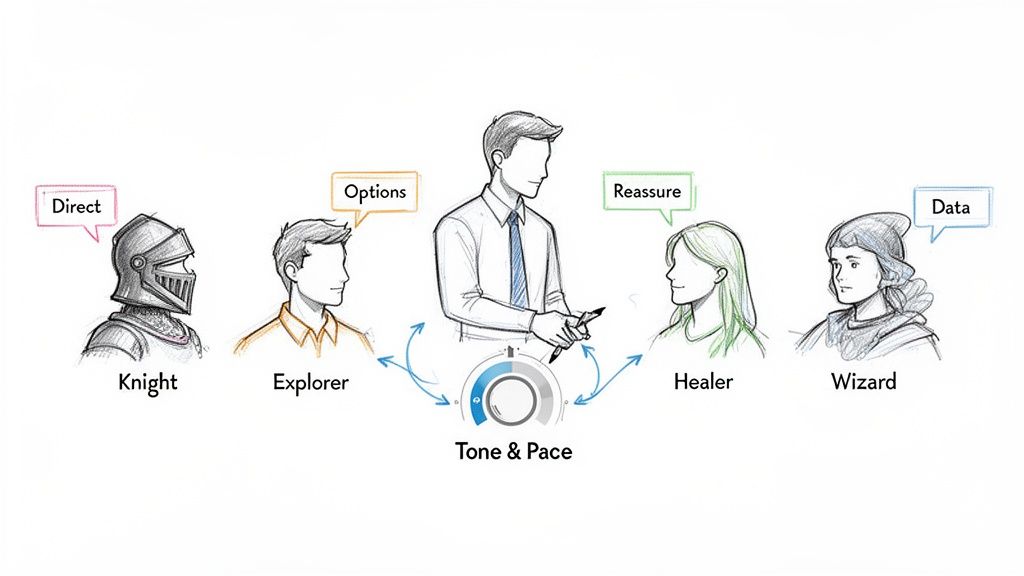
This approach, validated by sales analytics platforms and rooted in behavioural economics, recognises that different archetypes have predictable fears. Knights fear a loss of control, Explorers want to preserve options, Healers need reassurance against risk, and Wizards demand intellectual rigour. By customising your response to align with their specific psychological needs, you validate their concerns while reinforcing the value of your solution in a language they understand.
How It Works in Practice
- High-Ticket Sales: When a "Knight" objects to the price of a luxury watch, a salesperson would avoid a simple cost justification. Instead, they would frame it around control and exclusivity: "You're in complete control of the asset, and this reference is a proven store of value."
- Consulting Services: If an "Explorer" prospect asks about alternatives, the consultant provides three distinct implementation pathways with clear trade-offs. This satisfies their need for options rather than pushing a single, rigid solution.
- Enterprise Software: A "Healer" concerned about vendor risk and implementation disruption is met with an emphasis on dedicated support, guaranteed success metrics, and long-term partnership value, directly addressing their need for security.
Actionable Implementation Tips
To integrate this advanced technique, build a systematic objection-handling playbook:
- Listen for the Core Emotion: Train yourself to hear the underlying fear behind the objection. Is it a fear of being wrong ("Wizard"), being trapped ("Explorer"), or being let down ("Healer")?
- Pause Before Responding: After an objection, pause for 3-5 seconds. This demonstrates thoughtfulness and prevents a reactive, scripted reply, allowing you to formulate an archetype-specific response.
- Build a Team Playbook: Document which responses convert best for each archetype. This creates a powerful, shared knowledge base that refines your team's accuracy and helps close more complex deals. For more strategies on managing these crucial conversations, you can discover advanced techniques for high-ticket closing.
3. Outreach Cadence Optimisation Based on Prospect Archetype
A generic, high-volume outreach sequence is a leading cause of prospect fatigue and ghosting. The next evolution in boosting sales performance involves customising not just the message, but the entire outreach cadence, including its frequency, channel mix, and timing, based on the prospect's communication archetype. Different personalities process information and prefer to be engaged at different rates, and aligning with these preferences dramatically increases positive engagement.
This strategy moves beyond simple automation to intelligent sequencing. By understanding if a prospect is a direct "Knight" who values efficiency or a relationship-focused "Healer" who needs nurturing, you can design a contact strategy that feels helpful rather than intrusive. This prevents burnout and ensures your touchpoints land with maximum impact, improving meeting conversion rates.
How It Works in Practice
- Knights (Direct & Decisive): This archetype responds best to a concise, low-frequency cadence. For example: a crisp email, followed by a 5-day gap, then a direct phone call. The entire sequence might involve only 3-4 touchpoints over three weeks, respecting their time.
- Explorers (Curious & Experimental): Engage this archetype with a varied, multi-channel approach. Start with an email, follow up on LinkedIn with a fresh angle after two days, then make a call to discuss possibilities. The variety keeps them intrigued.
- Healers (Relationship-Focused): Build trust with a consistent, value-driven cadence. A warm email can be followed by a personal video message a few days later, then a success story, and finally a gentle check-in call, all spaced out to build rapport.
- Wizards (Analytical & Detailed): This archetype needs time and data to process. A cadence might involve a data-rich email, a 7-day gap before sending a relevant whitepaper, and another week before requesting a technical conversation.
Actionable Implementation Tips
To effectively integrate this technique, focus on a systematic approach:
- Develop Archetype Templates: Create baseline cadence templates for each primary archetype (Knight, Explorer, Healer, Wizard) that define the sequence, timing, and channel for each touchpoint.
- A/B Test Cadence Variables: Systematically test elements within your templates. For Wizards, test if a whitepaper performs better than a technical case study. For Knights, test if a 3-day gap is more effective than a 5-day gap.
- Monitor Engagement Metrics: Track reply rates, open rates, and meeting conversion rates for each archetype-specific cadence. Adjust your templates based on what the data shows is most effective for increasing sales and performance.
- Integrate and Automate: Use your CRM or sales engagement platform to automate these sequences. This ensures consistency and allows your sales team to execute sophisticated, personalised outreach at scale. For a deeper look into the technology that enables this, you can explore the applications of AI-powered sales intelligence.
4. Email Subject Line & Body Copy Customisation by Communication Style
The subject line of an email dictates the open rate, while the body copy drives the response. A critical way to increase sales and performance is to customise both elements based on the prospect's communication style. Generic, mass-produced email templates are easily ignored, but messages crafted to resonate with a specific personality archetype stand out and command attention.
This strategy moves beyond simple name-field personalisation and into deep psychological alignment. It leverages copywriting frameworks and modern email marketing research to match your language to the recipient's core motivators. Knights respond to urgency and authority, Explorers to novelty, Healers to social proof, and Wizards to data. The result is a dramatic increase in email engagement and a higher likelihood of securing a meeting.
How It Works in Practice
- Subject Line for a Knight: A fintech salesperson targeting a decisive CFO could use,
"[Action Required] 3-Point ROI improvement available - 30 min audit". The body copy would be direct, focusing on clear value and an immediate next step. - Subject Line for an Explorer: A marketing consultant approaching an innovative CMO might try,
"[New Idea] Shifting industry trends - curious about your approach?". The email body would present multiple options and frame the conversation as an exploratory discussion. - Subject Line for a Healer: An HR software provider reaching out to a Head of People could use,
"[Company Name] + [Prospect Name] - partnership opportunity". The message would highlight success stories and use collaborative, reassuring language. - Subject Line for a Wizard: A cybersecurity analyst targeting a CTO could write,
"[Data Insight] New threat vector analysis for your tech stack". The email would contain detailed research, benchmarks, and technical depth.
Actionable Implementation Tips
To effectively integrate this technique into your outreach:
- A/B Test Subject Lines: Send 50% of your targeted emails with one archetype-specific variant and 50% with another. Track the open rate differential to see what resonates most with each persona group.
- Tailor Email Length: Keep emails to Knights concise and action-oriented (3-5 sentences). In contrast, emails to analytical Wizards can be longer (8-12 sentences) if they are packed with valuable data and insights.
- Use Archetype-Specific Power Words: Weave in keywords that align with each style. For Knights, use words like 'achieve,' 'control,' and 'proven.' For Explorers, try 'discover,' 'explore,' and 'new.' For Healers, use 'support,' 'together,' and 'trust.' For Wizards, focus on 'data,' 'research,' and 'technical.'
5. Call & Meeting Preparation Playbooks Tailored to Prospect Archetype
Preparing for a high-stakes call is critical, but generic preparation is inefficient. A powerful way to increase sales and performance is to shift from ad-hoc prep to a strategic playbook tailored to your prospect's specific archetype. By analysing their profile before a meeting, you can prepare targeted talking points, anticipate likely objections, and structure your agenda to match their inherent thinking style. This transforms routine calls into precisely engineered conversations designed to resonate deeply.
This targeted approach, championed by modern sales enablement platforms and high-performance teams, ensures you present information in the format the prospect prefers. Whether they need data-heavy slides, a collaborative whiteboarding session, or a conversation focused on ROI, you arrive prepared. The result is a more effective meeting that builds momentum and accelerates the decision-making process.
How It Works in Practice
- Engaging a "Knight" Prospect: A call prep playbook would focus on a concise agenda prioritising timeline and ROI proof. You'd prepare a three-slide deck showing clear control points and have pre-written objection responses centred on risk mitigation.
- Collaborating with an "Explorer" Prospect: The agenda would be structured as an open discovery conversation. You would prepare five or more potential pathways and have visual whiteboarding tools ready for real-time, collaborative exploration of ideas.
- Supporting a "Healer" Prospect: Preparation involves an agenda that emphasises partnership, security, and support. You would gather relevant success stories and testimonials and be ready to address stakeholder alignment and potential team concerns.
- Informing a "Wizard" Prospect: The playbook would demand a data-dense agenda with industry benchmarks and peer validation research. You'd have technical architecture diagrams and a detailed competitive analysis prepared for deep scrutiny.
Actionable Implementation Tips
To integrate this strategy, focus on pre-call discipline and continuous improvement:
- Conduct Just-in-Time Prep: Spend 5-10 minutes reviewing the prospect’s archetype and your tailored playbook immediately before the call, not hours ahead. This keeps the insights fresh and top of mind.
- Prepare Multiple Agenda Sequences: Create two or three potential agenda flows. This allows you to pivot naturally if the conversation takes an unexpected but productive turn, without losing control of the meeting.
- Define Archetype-Specific Outcomes: Set one or two concrete call outcomes based on the archetype, such as securing a technical deep-dive for a "Wizard" or confirming budget authority from a "Knight". Avoid vague goals like "build rapport".
- Create a Team Playbook Library: Build and share a centralised library of preparation playbooks, organised by archetype and industry. This scales best practices across the entire sales organisation and accelerates ramp-up time for new hires.
6. Real-Time Call Coaching & Adaptive Messaging During Conversations
Instead of relying solely on pre-call preparation, elite sales teams are now leveraging real-time guidance during live conversations to boost performance. This strategy involves using AI-powered tools to analyse prospect responses as they happen, triggering on-screen coaching prompts that help sales reps adapt their messaging, tone, and tactics instantly. The result is a dynamic, responsive approach that addresses concerns before they become objections and capitalises on buying signals the moment they appear.
This method, championed by revenue intelligence platforms like Gong and Chorus alongside modern enablement tools, transforms every call into a guided, high-impact interaction. By providing reps with archetype-aligned suggestions mid-conversation, it removes guesswork and ensures the messaging always resonates with the prospect's personality and immediate needs, which is a powerful way to increase sales and performance.

How It Works in Practice
- Enterprise Software Sales: A "Knight" prospect expresses scepticism about implementation time. A real-time prompt suggests: ‘Shift to ROI proof and control language,’ helping the rep pivot to discussing measurable outcomes and putting the prospect in the driver’s seat.
- Consulting Services: When an "Explorer" asks an unexpected question about a competitor, the system prompts the consultant to ‘Explore their thinking vs. pushing solution.’ This encourages a discovery-led response rather than a defensive one.
- Financial Services: A risk-averse "Healer" client mentions concerns about market volatility. A prompt instantly provides a templated response: ‘Emphasise support and long-term success metrics,’ reassuring them with data on stability and client success.
Actionable Implementation Tips
To integrate real-time coaching effectively, a structured rollout is key:
- Keep Prompts Scannable: Ensure coaching cues are five to seven words maximum. They must be glanceable within two seconds so the rep can absorb the advice without disrupting the conversational flow.
- Test in Low-Stakes Scenarios: Before using the system in a critical deal, run internal role-playing sessions or use it on lower-priority calls to build confidence and refine the prompts.
- Frame as Enablement, Not Surveillance: Position the technology as a supportive tool designed to help reps win more deals. Emphasise that its purpose is to augment their skills, not to micromanage their performance.
7. Persona-Aligned Value Proposition & Pricing Presentation Strategy
A critical way to increase sales and performance is to abandon standardised value propositions and pricing presentations. Instead, you must dynamically frame your solution’s value and cost based on the prospect's decision-making archetype. The same product can be positioned as a competitive weapon, a flexible experiment, a supportive partnership, or a technically superior tool, depending on who you are speaking to.
This approach, rooted in value-based selling methodologies and modern pricing psychology, ensures your message directly addresses what the prospect cares about most. Presenting ROI to a "Knight" who values dominance is far more effective than discussing partnership benefits, just as a "Wizard" will dismiss a pitch that lacks technical depth. Aligning the presentation with the persona’s core motivations removes friction and makes the "yes" feel like an obvious conclusion.
How It Works in Practice
- SaaS Sales: When selling to a "Knight" CFO, the pitch is, "This delivers 23% faster pipeline velocity with zero implementation risk," focusing on authority and control. For an "Explorer" Head of Innovation, it becomes, "Test three deployment models; you choose the pace and scope," highlighting options and discovery.
- Financial Advisors: A "Healer" client seeking security is shown a plan emphasising "long-term growth together" with dedicated support. A "Wizard" client who is a data-driven analyst receives a presentation with proprietary benchmarks, customisable API integrations, and technical specifications.
- Consulting Services: A consultant pitching a "Healer" CHRO would frame the engagement as, "Partner with us to transform your team with dedicated support and success milestones." This focuses on the relational and supportive aspects of the service.
Actionable Implementation Tips
To effectively implement this strategy, you must prepare multiple value narratives in advance:
- Develop Archetype Summaries: Create a one-page value proposition summary for each key persona (Knight, Explorer, Healer, Wizard). Distil your core message down to the essence that will resonate most powerfully with each.
- Tailor Your Pricing Structure: Test different pricing presentation styles. A "Knight" may prefer a single, powerful package, while an "Explorer" will respond better to tiered options that offer flexibility.
- Use Their Language: Listen for the prospect's key metrics. If they mention "efficiency," frame your ROI discussion around efficiency. If they talk about "risk," centre your value proposition on de-risking their decision.
- Prepare Options in Advance: Never fumble with pricing on a call. Have your different packages and flexible terms prepared so you can present the right option confidently when the moment comes.
8. Follow-Up Sequencing & Deal Momentum Maintenance by Archetype
One of the most critical ways to increase sales and performance is to recognise that the deal doesn't end with the first meeting; it lives or dies in the follow-up. Deal momentum often evaporates when sales representatives use a generic, one-size-fits-all follow-up cadence. Instead, a highly strategic approach involves architecting follow-up sequences tailored to a prospect's inherent archetype to keep them engaged and prevent stalls.
This method, popularised by sales engagement platforms like Outreach and HubSpot and integrated into Mindreader’s playbooks, ensures that the content, timing, and format of your follow-up align with how the prospect processes information and makes decisions. A bold "Knight" needs direct, urgent communication, while a meticulous "Wizard" requires detailed documentation. Customising this journey maintains forward momentum and significantly reduces the risk of deals going cold.
How It Works in Practice
- Enterprise Software Sales: After a demo, a rep sends a "Knight" decision-maker a concise email with clear action items and deadlines. In contrast, they send the "Wizard" on the technical team a detailed summary with architecture documents and peer validation data to satisfy their need for deep information.
- Consulting Services: A consultant following up with a potential "Healer" client sends a thank-you note with a relevant testimonial to build trust. For an "Explorer" prospect, they share a new industry insight or a thought-provoking case study to nurture their interest in future possibilities.
- High-Value Capital Equipment: A sales executive knows a "Knight" will lose interest quickly, so they use a rapid-fire sequence of status checks and timeline reminders. A "Healer," however, receives a sequence designed to deepen the relationship, including introductions to the implementation team.
Actionable Implementation Tips
To effectively integrate this technique, focus on a systematic and personalised follow-up process:
- Automate Timing, Customise Content: Use a sales engagement platform to automate the timing of your sequences. However, spend a few minutes before sending each touchpoint to add personal customisation based on the prospect's archetype and your last conversation.
- Match Format to Archetype: Align your follow-up channel with the prospect’s preference. Knights often prefer concise emails or texts, Explorers engage well with video messages, Healers respond to phone calls, and Wizards want documents and data links.
- Clarify Next Steps: Ensure every single follow-up message contains a specific action item and clearly defines ownership. This removes ambiguity and makes it easy for the prospect to know what is required to move the deal forward. For more on optimising sales communication, you can learn about different sales methodologies.
9. Stakeholder Mapping & Multi-Threaded Selling by Decision-Maker Archetype
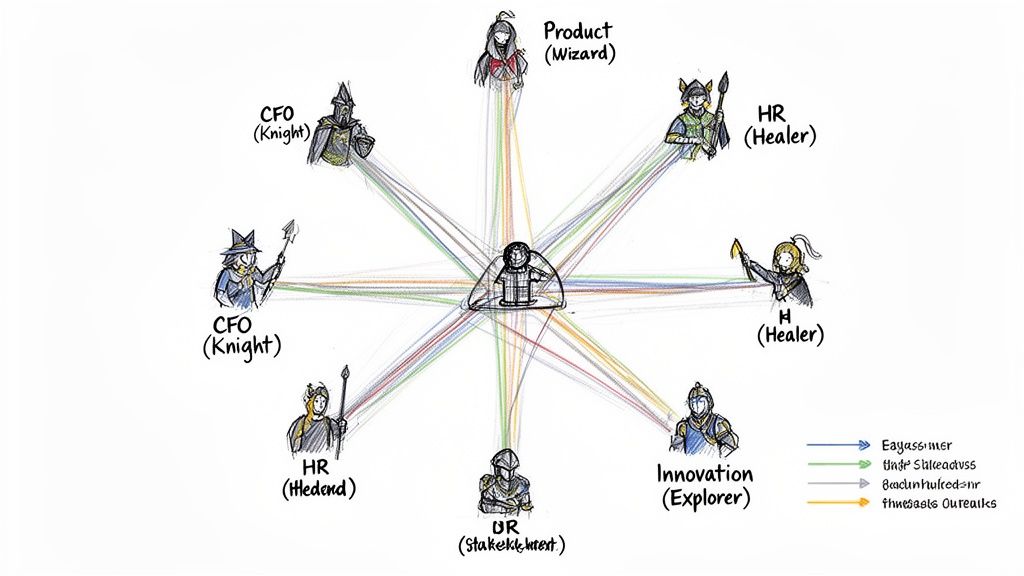
Relying on a single champion in a complex B2B deal is a high-risk strategy that often leads to stalled opportunities. A powerful way to increase sales and performance is to shift from single-threaded communication to a multi-threaded approach, where you build relationships with multiple stakeholders simultaneously. The key is to map each stakeholder's decision-making archetype and tailor your outreach to their unique priorities and communication style.
This strategy, central to methodologies like MEDDIC and modern account-based marketing (ABM), de-risks the deal by creating a coalition of internal support. Instead of one person advocating for you, you have a network of allies, each convinced of your value proposition from their own perspective. This diversification of influence significantly improves deal resilience and momentum.
How It Works in Practice
- Enterprise Software Deal: The VP of Sales (a "Knight") needs to see a clear ROI and speed-to-value case study. Meanwhile, the Head of Product (a "Wizard") requires deep technical documentation, and the HR lead (a "Healer") is focused on change management and team adoption support. Each stakeholder receives parallel, customised communication.
- Financial Services Deal: The CFO (a "Knight") is primarily focused on cost savings and efficiency gains. In contrast, the Chief Risk Officer (a "Healer") prioritises compliance and security assurances, while the Chief Innovation Officer (an "Explorer") is excited by new capabilities and future potential. You build three distinct business cases.
- Luxury Goods Sale: The primary buyer (a "Wizard") meticulously researches customisation options and exclusivity. Their spouse (a "Knight") wants to validate the item's status and investment value, while a personal stylist (an "Explorer") is keen to explore how it complements new trends. Each conversation thread is managed separately.
Actionable Implementation Tips
To effectively implement multi-threaded selling, adopt a structured approach:
- Identify and Map Stakeholders: For any significant deal, identify 3-5 key players. Use your CRM to map their roles, influence levels, and hypothesised decision-maker archetypes.
- Customise Outreach Channels: Engage stakeholders through different mediums. Send a data-heavy email to the "Wizard," a concise video message highlighting ROI to the "Knight," and schedule a supportive check-in call with the "Healer."
- Brief Your Champion: Keep your primary contact informed of your multi-threading strategy. Frame it as a way to build broad consensus and support their internal efforts, ensuring they feel aligned, not sidelined.
- Document Archetype Insights: Use your CRM to track engagement and record what you learn about each stakeholder's priorities and communication preferences. This data becomes a strategic asset for forecasting and future account planning.
10. Post-Sale Success & Expansion Revenue through Archetype-Aligned Engagement
One of the most powerful ways to increase sales and performance long-term is to recognise that the close is not the finish line. True revenue growth stems from retaining and expanding existing accounts. This requires shifting the same archetype-based communication strategy used in prospecting into the post-sale journey to ensure customer success, reduce churn, and systematically uncover expansion opportunities. By continuing to adapt your engagement style to match each stakeholder's personality, you deepen the relationship and position yourself as a trusted, indispensable partner.
This ongoing adaptation moves the relationship from transactional to strategic. When a customer feels understood, their time-to-value accelerates, their loyalty solidifies, and they become more receptive to discussions about new products or service tiers. This method is crucial for building sustainable, high-growth accounts by transforming satisfied customers into vocal advocates and sources of new revenue.
How It Works in Practice
- SaaS Customer Success: A Customer Success Manager (CSM) identifies a key stakeholder as a detail-oriented "Wizard." Instead of generic check-ins, they provide proactive, data-rich reports on product usage and ROI, directly appealing to the stakeholder's need for analytical proof and strengthening the case for renewal and upsell.
- Financial Advisors: An advisor knows their client is a security-focused "Healer." During quarterly reviews, they lead with updates on portfolio stability and risk mitigation before discussing potential growth, reassuring the client's core emotional needs and building profound trust for future investments.
- Consulting Services: A consultant working with an executive "Knight" avoids lengthy reports. Instead, they deliver concise, action-oriented summaries focused on competitive advantages and decisive next steps, aligning with the client's desire for rapid, impactful results and paving the way for project expansion.
Actionable Implementation Tips
To effectively integrate this into your account management process, follow these steps:
- Transfer Archetype Data: Ensure the prospect's personality archetype, identified during the sales cycle, is clearly documented in the CRM and handed over to the account management or customer success team.
- Tailor Onboarding and Check-ins: Customise the onboarding experience and all subsequent communication based on the primary contact’s archetype. A visionary "Explorer" will want to discuss future possibilities, while a pragmatic "Judge" will focus on meeting initial KPIs.
- Map the Account Hierarchy: As you engage with the organisation, profile other key influencers and decision-makers. This creates a holistic understanding of the account's political landscape and communication dynamics, which is vital for securing large-scale expansion deals.
10-Point Sales & Performance Strategy Comparison
| Strategy | Implementation complexity | Resource requirements | Expected outcomes | Ideal use cases | Key advantages |
|---|---|---|---|---|---|
| Prospect Profiling & Communication Style Adaptation | Medium–High — data integration and model tuning | Data from LinkedIn/email/video, analytics platform, rep training | Higher reply rates; faster rapport (30–50% quicker) | Complex B2B, high-ticket, consultative sales, teams with high ghosting | Scales personalized outreach; reduces guesswork; improves trust-building |
| Precision Objection Handling with Archetype-Specific Responses | Medium — build libraries & train delivery | Objection libraries, A/B testing, coaching time | Better deal recovery; fewer stalled negotiations | Long sales cycles, enterprise deals, late-stage negotiations | Converts resistance into negotiation; boosts rep confidence |
| Outreach Cadence Optimization Based on Prospect Archetype | Medium — automation + testing | Sales engagement platform, clean data, cadence templates | Higher engagement (40–60% reply uplift); lower unsubscribe rates | High-volume SDR/BDR teams, companies tackling low reply rates | Personalizes timing/channels at scale; improves efficiency |
| Email Subject Line & Body Copy Customization by Communication Style | Low–Medium — template creation and testing | Email platform, archetype templates, A/B testing volume | Increased open (25–35%) and reply rates (40–60%) | Cold outreach, high-volume follow-ups, email-first channels | Faster email production; higher open/reply performance |
| Call & Meeting Preparation Playbooks Tailored to Prospect Archetype | Low–Medium — playbooks + CRM integration | Prep workflows, agenda templates, rep discipline | Higher call-to-meeting conversion (35–50%); fewer no-decisions | High-stakes calls, consultative demos, multi-stakeholder meetings | Structured prep; anticipates objections; consistent messaging |
| Real-Time Call Coaching & Adaptive Messaging During Conversations | High — real-time ML, transcription, low-latency UX | Revenue-intel tools, conferencing integration, compliance controls | Improved close rates (20–30%); consistent rep performance | High-velocity inside sales, video-based selling, coaching cultures | In-the-moment guidance; reduces rep anxiety; captures signals |
| Persona-Aligned Value Proposition & Pricing Presentation Strategy | Medium–High — multiple value stories and pricing flows | Finance alignment, ROI calculators, tailored materials | Higher conversion (25–40%); larger deal sizes; fewer price objections | High-ticket offers, complex solutions, multi-use-case sales | Frames value for decision criteria; clarifies ROI; upsell-ready |
| Follow-Up Sequencing & Deal Momentum Maintenance by Archetype | Medium — automation + engagement scoring | Engagement platform, follow-up templates, momentum tracking | Fewer stalled deals; higher close rates (30–50%) | Long sales cycles (>60 days), multi-stakeholder deals, AEs | Maintains momentum; automates personalized persistence |
| Stakeholder Mapping & Multi-Threaded Selling by Decision-Maker Archetype | High — stakeholder discovery and coordination | CRM mapping, research resources, coordinated outreach | Higher win probability (40–60%); less single-point failure | Enterprise deals, committee-based approvals, ABM programs | Builds coalition; parallelizes buying process; reduces risk |
| Post-Sale Success & Expansion Revenue through Archetype-Aligned Engagement | Medium — ongoing profiling and tailored success plans | Customer success teams, monitoring tools, tailored onboarding | Higher retention (20–30%); more expansion/upsell opportunities | Renewal-driven businesses, SaaS, large accounts | Reduces churn; accelerates time-to-value; drives expansion revenue |
From Strategy to Execution: Making These Methods Your Own
We have navigated through a comprehensive framework designed not just to tweak your sales process, but to fundamentally revolutionise it. From meticulously profiling prospects and adapting your communication style to optimising outreach cadences and handling objections with surgical precision, the path to elite performance is clear. It’s about moving beyond generic scripts and embracing a deeply personalised, archetype-driven methodology.
The journey to finding effective ways to increase sales and performance can often feel like searching for a single silver bullet. However, the reality is that sustainable success is built on a foundation of interconnected systems, not isolated tactics. The true power of the strategies discussed - stakeholder mapping, persona-aligned value propositions, and adaptive follow-up sequences - is realised when they are woven together into a cohesive, intelligent sales motion.
The Shift from Reactive to Proactive Selling
The core theme connecting all ten strategies is a monumental shift from reactive to proactive engagement. Instead of waiting for an objection to arise and fumbling for a response, precision objection handling prepares you with archetype-specific answers. Instead of sending a generic follow-up and hoping for the best, optimised sequencing maintains deal momentum by aligning with your prospect's decision-making style.
This proactive stance transforms the sales conversation. You are no longer just a vendor pitching a product; you become a strategic advisor who understands the prospect's world, speaks their language, and anticipates their needs. This is the cornerstone of building trust, shortening sales cycles, and ultimately, closing larger, more sustainable deals. It is the definitive route to elevating your team's capabilities and results.
Your Actionable Blueprint for Implementation
Feeling overwhelmed by the sheer volume of information is a natural response. The key is to avoid trying to implement everything at once. True mastery comes from focused, incremental improvement. Here is a practical plan to get started:
- Select Your Pilot Programme: Choose just one or two strategies to begin with. For instance, you could start with Prospect Profiling & Communication Style Adaptation (Strategy #1) and apply it to your Email Subject Line & Body Copy Customisation (Strategy #4). This creates a focused experiment with measurable outcomes.
- Establish Baseline Metrics: Before you begin, document your current key performance indicators. Note your current email open rates, reply rates, meetings booked, and sales cycle length for a specific segment. This data will be crucial for measuring the impact of your new approach.
- Run a Time-Bound Test: Dedicate a specific period, perhaps 30 or 60 days, to applying your chosen strategies consistently. Train the relevant team members, provide the necessary playbooks, and ensure everyone is aligned on the goals and execution.
- Analyse and Iterate: At the end of the test period, compare your new results against your baseline metrics. What worked? What didn't? Gather feedback from the team and use these insights to refine your approach before rolling it out more broadly or selecting the next strategy to integrate.
By committing to this structured, data-informed process, you transform abstract concepts into tangible, repeatable ways to increase sales and performance. You build an internal culture of continuous improvement, where adaptation and personalisation are not just buzzwords but are central to your organisation's success. This is how you build a resilient, high-achieving sales engine that thrives in any market condition.
Ready to eliminate the guesswork and instantly apply these advanced strategies? Mindreader uses AI to analyse your prospect's personality archetype and generates the exact messaging, playbooks, and insights you need to close deals faster. Discover how to operationalise a truly adaptive sales process by visiting Mindreader and seeing it in action.