Mastering the DISC Personality Types Test for Sales Success
A disc personality types test is a behavioural assessment tool that helps us understand how people tick—how they prefer to interact, communicate, and react to the world around them. It groups individuals into four main styles: Dominance, Influence, Steadiness, and Conscientiousness, giving us a framework to anticipate their actions and preferences, especially in a professional setting.
What Is the DISC Personality Types Test
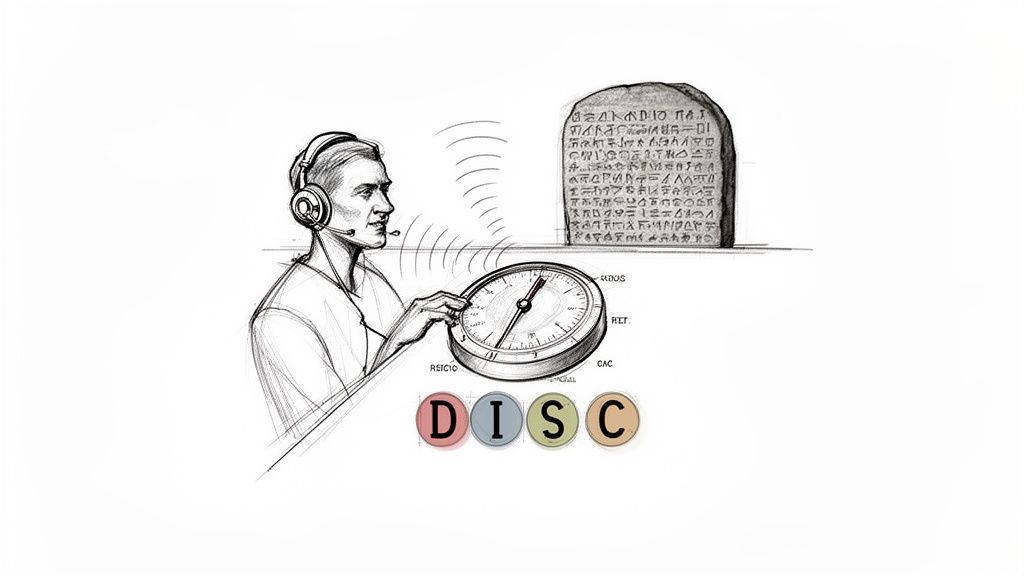
Think of the DISC test as a kind of Rosetta Stone for human interaction, particularly in those high-stakes sales conversations. It’s not about slapping a label on a client and shoving them into a restrictive box. Far from it. It's about learning the fundamental "language" they use to express their needs, motivations, and concerns.
This powerful framework gives sales professionals a genuine edge. When you can build rapport and establish trust quickly, you're already halfway there. By getting a handle on a client's core drivers, you can transform your pitch from a generic monologue into a conversation that truly resonates, feels personal, and actually gets heard.
The Four Core Styles Explained
At its heart, the DISC model maps out behaviour on two simple axes: are you more outgoing or reserved? And are you more task-oriented or people-oriented? Where these traits intersect, we get the four core personality styles.
- Dominance (D): These are your direct, results-focused, and decisive people. They want to get straight to the point.
- Influence (I): Think enthusiastic, optimistic, and collaborative. They’re energised by interacting with others.
- Steadiness (S): These folks are calm, patient, and incredibly supportive. They value stability and cooperation.
- Conscientiousness (C): You’ll find these individuals to be analytical, precise, and focused on the details. They need facts and data.
Each style has its own distinct preferences for how they take in information, make decisions, and build relationships. While DISC offers this four-style framework, it's not the only one out there. Other assessments offer different perspectives; for instance, you can learn more about how a colour personality test categorises behavioural traits.
The real goal of using a disc personality types test in sales isn't to label a prospect. It's to adapt your communication style to match theirs, making sure your message lands clearly and effectively.
To give you a clearer picture, here's a quick summary of what makes each DISC type tick.
The Four DISC Styles at a Glance
This table provides a simple, at-a-glance reference to help you quickly identify and understand the core motivations of each personality style.
| DISC Type | Core Trait | Primary Motivation | Preferred Communication Style |
|---|---|---|---|
| Dominance (D) | Direct & Decisive | Results & Control | To the point, bottom-line focused |
| Influence (I) | Enthusiastic & Social | Recognition & Approval | Friendly, informal, and personal |
| Steadiness (S) | Calm & Patient | Stability & Support | Sincere, gentle, and methodical |
| Conscientiousness (C) | Analytical & Precise | Accuracy & Quality | Detailed, factual, and logical |
Keep this cheat sheet handy. It’s a great starting point for tailoring your approach before you even pick up the phone.
From Theory to Practical Application
The theory behind DISC isn't new; it dates back to the 1920s with the work of psychologist William Moulton Marston. He was fascinated by how normal human emotions led to such different behaviours among people. His work was later developed into the practical assessment tool we use today.
For a sales professional, this isn't just some dusty academic theory—it's a blueprint for success. Knowing whether your prospect is a D-style who just wants the bottom line or a C-style who needs every single data point allows you to prepare and present your solution in the most impactful way possible. This simple shift can make a world of difference to your engagement and closing rates.
Decoding the Four Core DISC Profiles
Getting a handle on the four core DISC profiles is a bit like learning to spot four distinct characters in a play. Each one has its own script—their motivations, their fears, and their unique way of interacting with the world.
Once you can identify who you're talking to, you can anticipate their needs and communicate in a way that actually connects. For anyone in sales, this is where the magic happens, turning standard pitches into genuinely effective conversations.
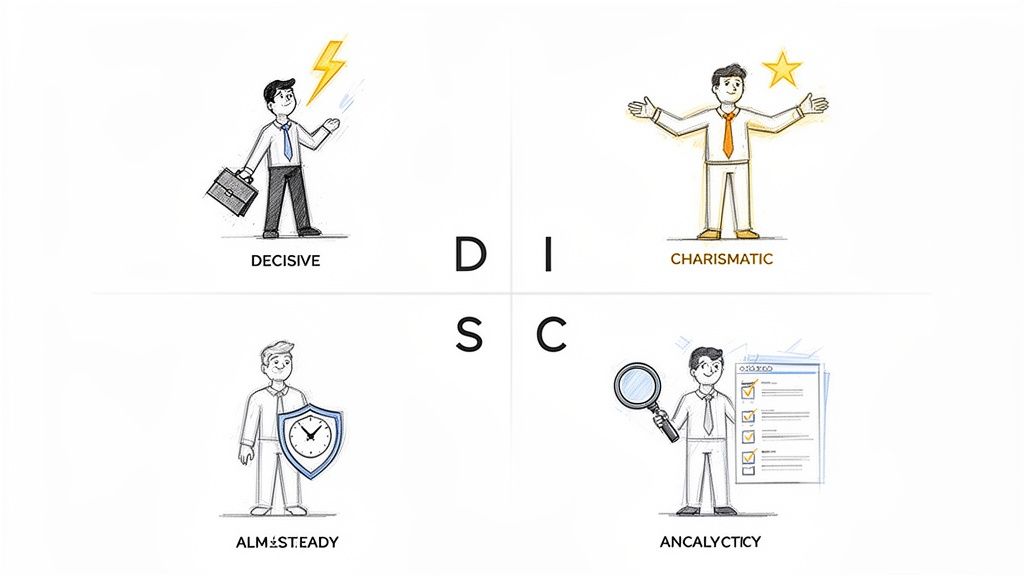
So, let's go beyond simple labels. It’s time to paint a clear picture of what makes each of these profiles tick, from what drives their decisions to what keeps them up at night.
The Decisive 'D' Profile
Picture the classic, no-nonsense CEO who lives and breathes the bottom line. That’s your 'D' profile, defined by Dominance. They're direct, results-obsessed, and don’t have time for fluff. They thrive on challenges, love taking charge, and want you to get straight to the point.
Their whole world revolves around achieving results and staying in control. They want to win. In a sales meeting, they’re the ones cutting in with, "What's the ROI?" and "How fast can this be done?"
- Key Motivators: Winning, control, tangible results, and immediate action.
- Core Fears: Being taken advantage of or, worse, losing control.
- Decision-Making Habit: They decide fast. It’s often a gut call based on what they feel will get the best outcome, and efficiency trumps everything else.
When you're in front of a 'D', project confidence and be direct. Ditch the small talk and lead with the results. Show them exactly how your solution helps them hit their goals faster and better than anyone else.
The Charismatic 'I' Profile
Next up, we have the Influence profile—the ultimate relationship builder. An 'I' is enthusiastic, optimistic, and a social butterfly. They feed off collaboration and positive energy, making them natural networkers and magnetic leaders.
What really drives them is social recognition and approval. They want to be liked and admired, which means they’re often swayed by powerful testimonials, great success stories, and the feeling that they’re joining a popular movement.
They make decisions with their heart. If they like and trust you, you're already halfway to a closed deal. The tiny details don't matter as much as the big picture and the people involved.
The Steady 'S' Profile
The Steadiness profile is the loyal, dependable manager who acts as the stable backbone of any team. They’re calm, patient, and incredibly supportive people who value security, consistency, and sincerity above all else.
Sudden change is their kryptonite. Their core motivation is keeping things stable and supporting their people. They crave harmony and are fantastic listeners, which is why they excel at building unshakable, long-term client relationships.
An 'S' profile’s decision-making is a slow, methodical process. They need plenty of reassurance and a clear, step-by-step plan before they’ll even consider moving forward.
- Key Motivators: Security, stability, genuine appreciation, and helping others.
- Core Fears: Sudden changes, letting people down, and losing that sense of security.
- Decision-Making Habit: They prefer to make decisions as a group and need solid guarantees that there will be as little disruption as possible.
The Analytical 'C' Profile
Finally, let's meet the Conscientiousness profile, the quintessential detail-oriented analyst. A 'C' profile is all about accuracy, quality, and expertise. They are logical, systematic, and need hard data to make a decision. They have to understand the 'why' behind everything.
Their biggest fear is being wrong or facing criticism. This pushes them to be incredibly thorough, checking and double-checking every fact and figure before they commit. When you're presenting to a 'C', have your data locked down and be ready for a deep dive into the details. They will spot any crack in your logic.
How to Spot DISC Types in Sales Conversations
You don’t need a prospect to sit down for a formal disc personality types test to get a read on their communication style. The clues are usually hiding in plain sight, sprinkled throughout your everyday interactions. Learning to spot these signals is a massive advantage, letting you adapt your approach from the very first email or call.
The real key is to listen beyond what they’re saying and tune into how they're saying it. Pay close attention to their language, their pacing, and the kinds of questions they ask. These subtle cues are your field guide to making an educated guess on the fly.
Reading the Verbal and Non-Verbal Cues
Think of every interaction as a chance to gather a little intel. Each email, call, and meeting is dropping hints about where your prospect lands on the spectrum—are they more task-oriented or people-oriented? Do they move quickly or at a more considered pace?
Here are the key signals to look out for:
- Pace and Tonality: Does the conversation feel quick and to the point, or is it more relaxed and methodical? D and I styles often speak rapidly and with a lot of energy. S and C styles, on the other hand, are typically more measured and thoughtful in their speech.
- Language Focus: Is their vocabulary all about results, goals, and efficiency (classic D and C)? Or do they talk more about people, teamwork, and feelings (a sure sign of I and S styles)? Listen for phrases like "the bottom line" versus "our team feels."
- Questioning Style: D-types tend to ask "what" questions (What's the outcome?). I-types ask "who" questions (Who else is using this?). S-types ask "how" questions (How will we implement this?). And C-types ask "why" questions (Why is this the best option?).
- Email Communication: Short, blunt, action-oriented emails often come from a D-style. Enthusiastic messages peppered with exclamation points? Probably an I-style. Warm, polite, relationship-focused emails point to an S-style. And those long, detailed emails with numbered questions are a dead giveaway for a C-style.
This kind of observation is especially useful in fast-moving business hubs. In Singapore, for example, DISC personality tests reveal a higher-than-average concentration of D-style (Dominance) personalities. This puts the city-state in line with other competitive markets, making the ability to quickly identify and adapt to assertive, results-driven people a critical sales skill. You can learn more about these trends by exploring global DISC distribution patterns.
A Practical Checklist for On-the-Go Analysis
To make your assessment a bit more systematic, just keep this simple checklist in your head during your next sales call.
Key Takeaway: Spotting a prospect's DISC type isn't about getting a perfect diagnosis. It's about gathering enough directional insight to tweak your communication style, build rapport faster, and make your message land with more impact, right from the start.
Use what you observe to form a working hypothesis. Are they fast-paced and all about the task at hand? You could be talking to a D-style. Are they slower-paced and focused on people? An S-style is a good bet. This initial read gives you a huge head start, letting you tailor your pitch immediately before you even get into the nitty-gritty of their business needs.
Tailoring Your Sales Strategy to Each Personality
Knowing the four DISC profiles is one thing. Actually using that insight to close deals? That's a whole different ball game. This is where the theory hits the road and becomes practical, profitable action. Applying the DISC framework successfully means tweaking your communication, your pacing, and even your value propositions to connect with what truly motivates each prospect.
When you manage to align your sales strategy with a client's personality, you stop just selling a product. Instead, you start offering a solution in the language they instinctively understand. This subtle but powerful shift can transform the entire sales dynamic from a standard pitch into a real partnership.
This simple infographic is a great visual cheat sheet for spotting different personality types just by observing their pace and focus.
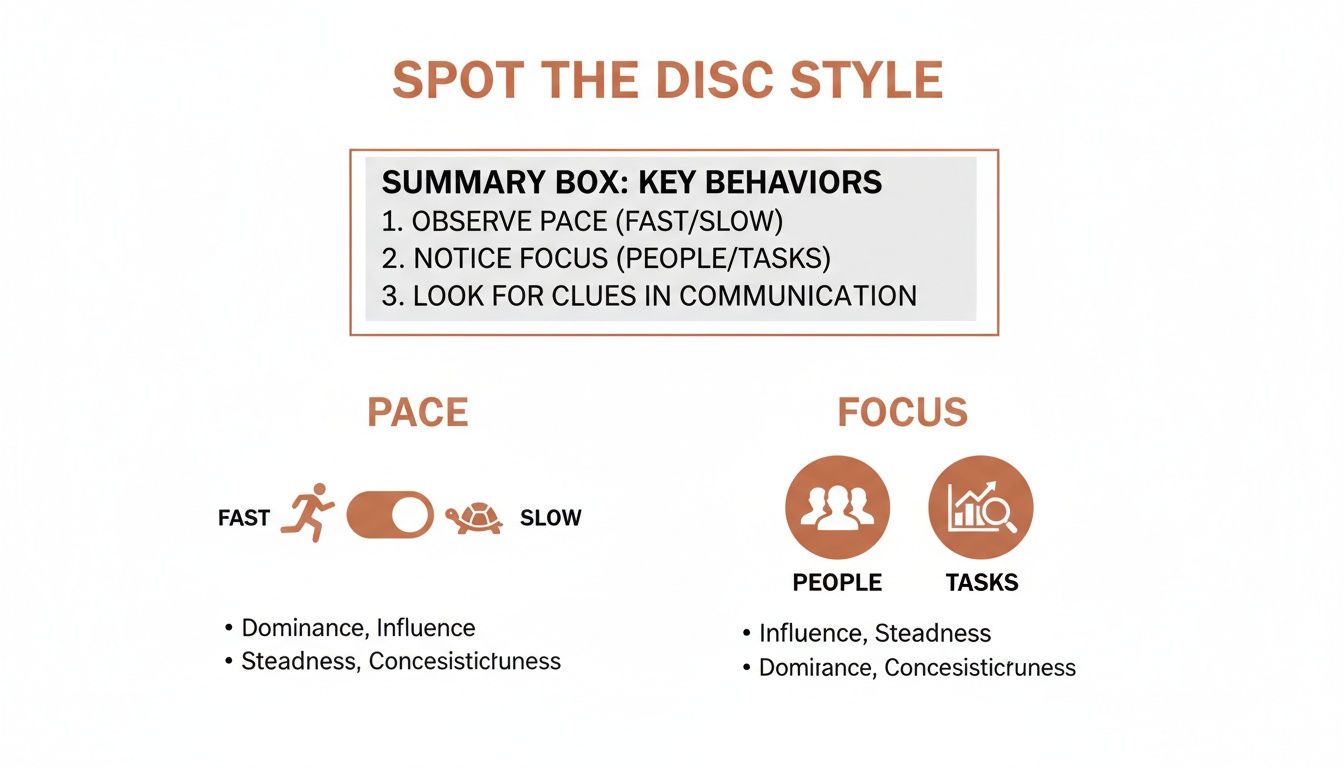
It shows how a prospect's communication speed and whether they prioritise people or tasks can quickly point you toward their likely DISC style.
Selling To The Dominant 'D' Profile
When you're dealing with a D-style prospect, cut to the chase. They live for efficiency, results, and being in control. Wasting their time with idle chit-chat is the fastest way to get shut down.
- Initial Outreach: Your cold email subject line needs to be direct and scream results. Think "Boosting Your Q3 Revenue by 15%" instead of something vague like "A quick question."
- During the Meeting: Lead with the bottom line. Seriously. Start with the ROI, the key results, and exactly how your solution gives them a competitive edge. Keep your presentation tight, confident, and laser-focused on tangible outcomes.
- Handling Objections: Treat their objections less like roadblocks and more like requests for more data on the results. If they push back on price, immediately reframe the conversation around the value and return on investment they stand to gain.
Engaging The Influential 'I' Profile
An I-style prospect is all about relationships, social recognition, and a bit of excitement. They buy from people they genuinely like and trust, which means building that personal rapport is your number one job.
They need to feel good about their decisions and are hugely swayed by what others are doing. Your approach has to be energetic, optimistic, and packed with compelling stories.
Let them talk about their ideas and their vision. I-styles need to feel heard and appreciated. Show genuine enthusiasm for their goals and connect your solution to their desire for innovation and positive recognition.
- Initial Outreach: Use a friendly, enthusiastic tone. Dropping the name of a mutual connection or mentioning a recent company achievement of theirs can be a fantastic hook.
- During the Meeting: Use social proof like it’s going out of style. Share testimonials, case studies, and stories of how other well-regarded companies have found success with your solution. Paint a vivid picture of the awesome future they can expect.
- Handling Objections: Reassure them and lean on the relationship you've built. Address their concerns by sharing how others in their position felt the exact same way at first but went on to achieve fantastic success.
Connecting With The Steady 'S' Profile
For S-style prospects, it all comes down to trust, security, and stability. They are naturally risk-averse and need plenty of reassurance that any change will be smooth, predictable, and well-supported.
Your entire sales process should feel safe and sincere. Trying to rush them or using high-pressure tactics is a guaranteed way to make them retreat.
- Initial Outreach: Your tone should be warm, respectful, and completely non-threatening. Offer to help and ask for permission to share information—this shows you value their time and input.
- During the Meeting: Lay out a clear, step-by-step implementation plan. Offer guarantees, provide details on your robust customer support, and give them assurances of a long-term partnership. The key words here are reliability and ease of use.
- Handling Objections: Acknowledge their concerns with genuine empathy. Reassure them that you understand their hesitation, then provide clear, logical steps to mitigate any risks they're worried about.
Persuading The Conscientious 'C' Profile
A C-style prospect runs on data, logic, and accuracy. They need to be thoroughly convinced that your solution is the most logical and effective choice, and they'll want undeniable proof to back that up.
Get ready to dive deep into the details. Arm yourself with technical specifications, comprehensive data sheets, and any third-party validation you can find. For more on how to adjust your approach, check out these in-depth personality-based sales strategies.
- Initial Outreach: Be formal, professional, and precise. Providing a clear agenda or specific data points in your very first email will instantly demonstrate your credibility.
- During the Meeting: Present your case logically and systematically. Be prepared for a barrage of detailed questions and have all the necessary data right at your fingertips. Whatever you do, avoid making broad, unsubstantiated claims.
- Handling Objections: Welcome their objections! See them as an opportunity to provide even more information. Address their points with facts and hard evidence, not emotional appeals. Once you've honed your approach for different DISC types, you can further boost your revenue by understanding how to implement effective strategies for optimizing your sales process.
To bring it all together, here’s a quick-reference playbook for adapting your tactics at each stage of the sales cycle.
Sales Adaptation Playbook by DISC Type
| Sales Stage | Dominance (D) Tactic | Influence (I) Tactic | Steadiness (S) Tactic | Conscientiousness (C) Tactic |
|---|---|---|---|---|
| Outreach | Be direct. Lead with a bold, results-oriented subject line and get straight to the point. | Be friendly and enthusiastic. Mention mutual connections or recent company wins to build rapport. | Be warm and respectful. Offer help and ask for permission to share information. No pressure. | Be professional and precise. Provide a clear agenda or key data points in the initial email. |
| Meeting | Focus on the bottom line: ROI, efficiency, and competitive advantage. Keep it brief and confident. | Tell stories. Use social proof, case studies, and testimonials. Build a personal connection. | Provide a clear plan. Offer guarantees and details on support to build trust and show reliability. | Present logically with hard data. Be prepared for detailed questions and have specs ready. |
| Objections | Reframe objections as requests for more data about results. Connect price back to value and ROI. | Reassure them. Share stories of others who had similar concerns but found great success. | Acknowledge their concerns with empathy. Provide clear steps to mitigate any perceived risks. | Welcome objections. Address them with facts, figures, and third-party evidence. Avoid emotion. |
Think of this table not as a rigid script, but as a guide to help you stay flexible. The real skill is in reading the room and adjusting on the fly, ensuring your message always lands exactly as intended for each unique personality you encounter.
Navigating the Limits and Ethics of DISC
While the DISC framework is a powerful tool for better communication, its real value comes from using it responsibly. Any disc personality types test is meant to be a guide to someone's likely preferences, not a rigid diagnosis of who they are. The goal should always be to open up a conversation, not to stuff your prospects into neat little boxes and assume you’ve got them all figured out.
The biggest mistake you can make is treating a DISC profile as some kind of unchangeable truth. People are complex, they adapt, and any salesperson who leans too heavily on stereotypes will lose credibility fast. Think of these insights as a starting point—a way to build a genuine connection by treating every person with the respect they deserve, not just as a profile to be managed.
This becomes especially critical in a diverse market. DISC assessments in Singapore, for example, reveal a unique blend of personality styles. Global DISC maps show that while the C-style (Conscientiousness) is common worldwide, professionals in Singapore often fuse these meticulous traits with a healthy dose of D-style (Dominance) characteristics. This creates a business culture with its own distinct flavour. You can discover more insights about how DISC styles vary across the globe.
Ethical Use in the Age of AI
As technology marches on, so do the ethical questions we need to ask ourselves. The rise of AI tools for personality analysis brings a new layer of responsibility. Using these insights to communicate more effectively and build authentic relationships is one thing; using them to manipulate or exploit a prospect's perceived weaknesses is another entirely.
The line between influence and manipulation is crossed when your intent shifts from creating mutual benefit to chasing a self-serving advantage. Building trust should always be the primary objective.
At the end of the day, maintaining your professional integrity means using these tools to better serve your client. For a deeper look into this topic, you might find our article on the limitations and challenges of AI in personality typing interesting. By putting transparency and respect first, you not only protect your clients but also strengthen your own reputation as a trustworthy advisor.
Still Have Questions About the DISC Test?
Diving into any personality framework is bound to bring up a few questions. Let's tackle some of the most common ones that sales professionals have when they start putting the DISC model into practice.
Can a Person's DISC Type Change Over Time?
While your core DISC style tends to be pretty stable, your behaviour is anything but fixed. We all adapt to our environment, our job role, or the stress we're under. Think of your natural style as your factory default setting—you can always tweak the controls depending on the situation.
A disc personality types test will often measure both your natural tendencies and how you've adapted your style for work. For sales, the takeaway is simple: focus on the prospect's communication preferences right now, in a professional context. That’s what’s going to shape their buying decisions today.
Is One DISC Profile Better for Sales Than Another?
Absolutely not. You'll find top performers across all four styles, and no single profile is inherently "the best" for sales. Each one brings unique strengths to the table that, when understood and used correctly, are incredibly effective.
A high-D personality, for instance, might be a master at creating urgency and closing the deal. On the other hand, a high-S is brilliant at building the deep, long-term client loyalty that keeps business coming back year after year.
The most successful salespeople aren't the ones with a specific DISC profile. They’re the ones who truly understand their own style and have mastered the art of adapting to connect with everyone else.
How Accurate Is Spotting DISC Types Without a Formal Test?
Think of it less as a clinical diagnosis and more as a strong directional guess. When you observe someone's verbal and non-verbal cues, your goal isn't to be 100% accurate on the first go. It's about making an educated guess that lets you start personalising your approach immediately.
You're essentially forming a working hypothesis. As you keep interacting with a prospect, you’ll gather more information, sharpen your understanding of their style, and adjust your strategy on the fly. It's a constant process of observing and adapting.
Ready to stop guessing and start connecting with clients on their own terms? Mindreader translates these kinds of personality insights into actionable sales tactics. Find out how to adapt your messaging, pacing, and objection handling for any prospect you meet. Learn more and start closing more deals.