Unlock B2B Sales with the Color Personality Test
What Is a Colour Personality Test?
Ever wished you had a cheat sheet that could tell you exactly how a prospect likes to communicate before you even pick up the phone? That's pretty much what a colour personality test offers in a business setting. It’s a simple framework that connects certain colours to dominant personality traits, communication styles, and even how people make decisions.
This isn’t about putting people in rigid boxes. It’s about gaining a strategic edge by understanding what really drives them.
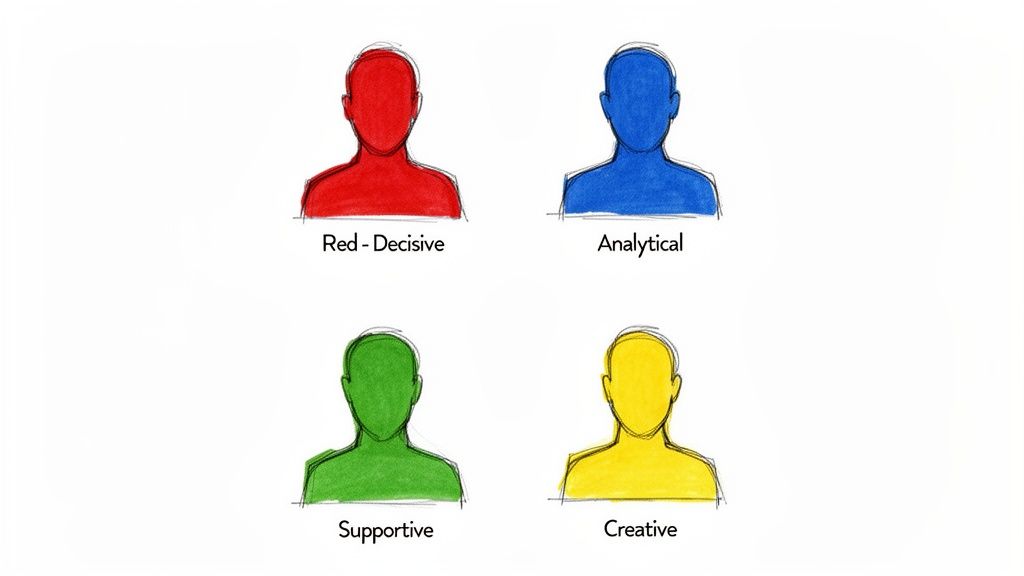
Most of these models categorise people into four main groups, often using the colours Red, Blue, Yellow, and Green. Each colour represents a cluster of predictable behaviours and preferences. Knowing whether you're talking to a direct, no-nonsense 'Red' or an analytical, detail-hungry 'Blue' lets you tailor your entire sales approach for maximum impact.
It’s a practical way to speak your prospect's language from the get-go, helping you build rapport faster and steer conversations with way more precision. While there are a few different models out there, they all share one goal: to make human behaviour a little more understandable and predictable.
A Practical Framework for Sales Success
In B2B sales, every single interaction counts. Using a colour personality framework gives you a powerful—yet surprisingly simple—lens for viewing your clients, helping you adapt everything from your pitch to your follow-up emails.
Think of it this way: you wouldn't talk to a highly analytical engineer the same way you’d chat with a relationship-focused marketing manager, right? Colour personality tests give you a shorthand to spot these differences quickly.
The real power here is in the application. It’s about moving away from a one-size-fits-all script and toward a dynamic, responsive style that truly connects with each prospect on their own terms.
This approach helps you get ahead of their needs and even address potential objections before they come up. For example, you’ll learn to arm a 'Blue' personality with plenty of data and a clear plan, whereas a 'Red' will appreciate a crisp summary that gets straight to the ROI.
Of course, while these models offer a solid foundation, it's worth noting their limitations compared to more dynamic approaches. You can learn more about the differences between AI-powered and static personality tests to get a clearer picture.
The Four Core Colours in B2B Sales
To help you start putting these ideas into practice, we’ve put together a quick reference guide. The table below breaks down the four core colour types, what drives them, and what that means for you in a typical B2B sales conversation.
Think of this as your starting point for identifying and adapting to the different personality styles you’ll meet.
Quick Guide to Core Colour Personalities in Sales
| Color | Dominant Traits | What This Means for Sales Reps |
|---|---|---|
| Red | Direct, Decisive, Goal-Oriented, Confident | Focus on the bottom line. Be concise, present clear results, and avoid small talk. They respect efficiency and directness. |
| Blue | Analytical, Detail-Oriented, Cautious, Systematic | Provide data, facts, and a logical process. They need to trust the information and will appreciate thorough preparation. |
| Yellow | Enthusiastic, Social, Creative, Optimistic | Build a personal connection. Focus on the big picture, new ideas, and how your solution will be exciting or innovative. |
| Green | Supportive, Patient, Diplomatic, Reliable | Emphasise security, reliability, and long-term partnership. They value trust and want assurance that you’ll support them. |
Use this guide as a foundation, but always remember to listen and observe. The goal is to connect authentically, and these colour profiles are just another tool to help you do that more effectively.
The Psychology Behind Colour and Personality
Let’s be honest. Linking your personality to your favourite colour can feel a bit like reading your daily horoscope. But what if there was more to it than that? The link between colour, emotion, and our behaviour is actually a pretty well-established field in psychology. A colour personality test isn't just a party trick; it's a simplified way to apply real, observable patterns in human psychology that can give you a surprising edge in sales.
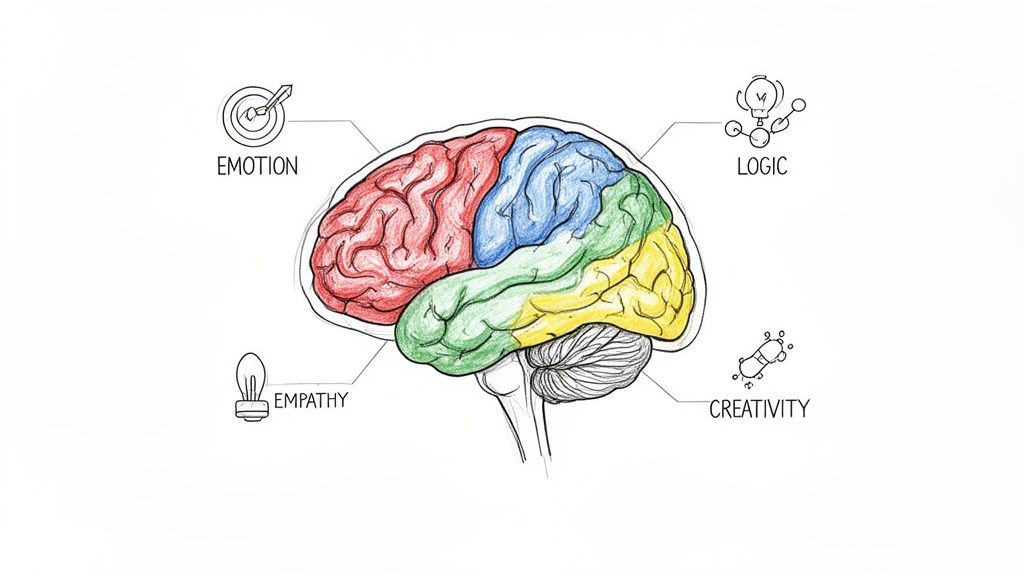
The core idea is that colours trigger specific emotional and psychological responses, often without us even realising it. Think about how brands use colour to influence us every single day. A fast-food chain plastering its walls with bold reds and yellows isn't a random design choice—it’s meant to evoke excitement and speed. A bank uses a deep, solid blue to signal trust and stability. This is all intentional, based on years of research into how our brains process and associate different hues.
These associations run deep. Warm colours like red and orange are often linked to energy, passion, and urgency because they can literally increase our heart rate and stimulate brain activity. On the flip side, cool colours like blue and green tend to have a calming effect, making us feel secure and relaxed.
Linking Colours to Proven Personality Models
So, how do we get from a general feeling to a specific personality profile? This is where many frameworks cleverly map colour theory onto established psychological models. The gold standard here is the ‘Big Five’ personality traits, a model that’s widely accepted and respected in psychology. It assesses people across five core dimensions:
- Openness: How open are you to new experiences?
- Conscientiousness: How organised and dependable are you?
- Extraversion: How energetic and sociable are you?
- Agreeableness: How compassionate and cooperative are you?
- Neuroticism: How easily do you feel stress and negative emotions?
When a colour test pegs someone as a 'Red,' it’s really just shorthand. It’s a simple way of saying they likely score high in extraversion and low in agreeableness, making them assertive and goal-oriented. A 'Blue' personality, in contrast, would probably align with high conscientiousness, pointing to someone who is detail-oriented and systematic.
This mapping is what gives a well-designed colour personality framework its credibility. It’s not about pulling colour associations out of thin air. It’s about connecting those colours to behaviours that have been measured and validated by decades of psychological research.
To put these insights into practice, exploring tools like color palette generators can help you create consistent branding and communication materials. This ensures your visual messaging lines up perfectly with the psychological profile you're trying to reach.
Cultural Context Is Crucial Especially in SG
While many of our emotional responses to colour feel universal, culture plays a massive role in how they’re interpreted. This is mission-critical for sales teams working in diverse markets like Singapore and the wider East Asian region. The meaning of a single colour can flip entirely from one culture to another. For instance, in Western cultures, white symbolises purity and weddings, but in many parts of Asia, it's the colour of mourning.
These cultural nuances aren't just interesting trivia; they directly affect the validity of any colour-based assessment. A landmark 2022 study in Seoul, Republic of Korea, explored the deep ties between personality traits and colour preferences among 854 Koreans. The research confirmed that colour preference is a significant predictor of personality, with vibrant reds and oranges strongly linked to extraversion.
Crucially, it also showed how Korea's Confucian emphasis on social harmony influences colour choices—a finding that directly challenges many Western-centric tests. You can discover more about these cultural findings in the full study.
For sales professionals in the SG region, this really drives home the need to be aware of how a prospect's cultural background shapes their perceptions. What you intend as an energetic and bold choice might be seen as aggressive or inappropriate by someone else. By understanding these principles, you can feel confident that you’re not just using a gimmick, but a tool rooted in real psychological patterns—bridging the gap between abstract theory and what actually works in the field.
A Look at the Major Colour Personality Models
While the four core colours give us a solid foundation, different industries and consultants have cooked up their own frameworks over the years. Don't think of these as competing theories—it's better to see them as different dialects of the same language. Each one offers a slightly different lens for understanding human behaviour, making the colour personality test a really flexible tool for all sorts of business needs.
For anyone in sales, getting to know the key players in this space is a huge advantage. It gives you instant context when a client casually mentions their "colour" from a recent team-building day. Two of the biggest models you'll probably bump into are the Hartman Color Code and the Insights Discovery model. We'll break them down, not like a dry academic paper, but as a practical field guide for what you actually need to know.
The Hartman Color Code
Developed by Dr. Taylor Hartman, the Color Code is one of the most famous systems out there. Its big idea is that we're all driven by a core motive. It neatly sorts personalities into four types based on what truly gets them out of bed in the morning.
- Reds (Power): These folks are motivated by power. Not in a scary, evil-villain way, but the power to create results and get things done. In a sales context, a Red prospect is decisive, logical, and just wants to see a clear path to hitting their goals. No fluff.
- Blues (Intimacy): Driven by deep connection and intimacy, Blues place a massive premium on quality relationships and personal integrity. When you're selling to a Blue, building genuine trust is everything. They need to feel you actually care about their needs, far more than hearing a slick pitch.
- Whites (Peace): Motivated by peace, Whites are the agreeable, kind people who do their best to avoid conflict. They're steady and logical, but that desire for harmony can sometimes make them a bit indecisive. A sales approach that is patient, non-confrontational, and offers plenty of reassurance will win them over.
- Yellows (Fun): Then you have the Yellows, who are all about fun and social energy. They're enthusiastic, optimistic, and love bouncing around new ideas. To get on their wavelength, you need to bring the energy, focus on the exciting big picture, and keep the conversation friendly and sociable.
The real beauty of the Color Code is its simplicity. By focusing on those core motives, it’s easy to remember and apply in your day-to-day chats.
The Insights Discovery Model
The Insights Discovery model is another heavyweight, especially popular in corporate training and development circles. It’s built on the psychological work of the legendary Carl Jung and uses a four-colour energy model to map out personality preferences.
A key twist here is the idea of "colour energies." Insights Discovery suggests that while we all have a dominant colour, we actually use all four to different degrees. This creates a much more nuanced profile, recognising that our behaviour isn't fixed—it flexes depending on the situation.
The colours themselves will look pretty familiar, mirroring the archetypes we've seen but with slightly different names.
- Fiery Red (Extraverted Thinking): Competitive, demanding, and dead-set on their goals.
- Sunshine Yellow (Extraverted Feeling): Sociable, dynamic, and naturally persuasive.
- Earth Green (Introverted Feeling): Caring, encouraging, and incredibly patient.
- Cool Blue (Introverted Thinking): Cautious, precise, and deeply analytical.
This model's strength is its depth. It provides a detailed "wheel" that can show a person's conscious style versus their less-conscious, more instinctive persona. This is incredibly helpful for navigating complex team dynamics or leadership styles inside a big B2B client's organisation.
To pull it all together and help you see the differences at a glance, here’s a quick comparison of these frameworks.
Comparing Popular Colour Personality Models for Sales
A side-by-side comparison of leading colour personality frameworks, highlighting their core archetypes and suitability for different business applications.
| Model | Core Colours/Archetypes | Primary Focus | Best Use Case for Sales |
|---|---|---|---|
| Hartman Color Code | Red (Power), Blue (Intimacy), White (Peace), Yellow (Fun) | Core motives that drive behaviour | Quickly identifying a prospect's primary driver to tailor the value proposition effectively. |
| Insights Discovery | Fiery Red, Sunshine Yellow, Earth Green, Cool Blue | Behavioural preferences and conscious vs. less-conscious styles | Understanding complex team dynamics within a client's organisation and adapting communication for different stakeholders. |
The Next Step: AI-Powered Insights
These traditional models are a brilliant starting point for understanding personality. They give you a solid mental framework. But they all share one major limitation: they rely on someone actually taking a test. In B2B sales, you can't exactly ask your top prospect to fill out a questionnaire before you jump on a discovery call. It just doesn't happen.
This is where modern AI platforms like Mindreader are changing the game. They take the foundational concepts of these colour models and add a layer of something far more practical: dynamic, real-time insights without needing any formal assessment.
By analysing a prospect's digital footprint, these tools can predict their communication style and core drivers, saving you all the guesswork. You can learn more about how this leap was made in our guide on traditional vs AI-powered personality assessment. It's the perfect bridge between classic personality theory and the immediate, actionable intelligence that salespeople need today.
Turning Colour Insights Into Sales Wins
Knowing the theory behind a colour personality test is one thing. But turning that knowledge into actual results is what separates the top performers from everyone else. This is where the abstract ideas of Reds, Blues, Greens, and Yellows become a concrete playbook for every part of your sales process, from that first cold email to the final negotiation.
When you adapt your approach to fit a prospect's core personality, you stop sounding like you're reading from a script. Instead, you're having a conversation that feels personal, relevant, and genuinely persuasive. It’s all about building rapport faster, figuring out what they need before they even say it, and closing more deals with a lot less friction.
The point isn't to manipulate anyone. It’s about communicating with more clarity and empathy. When you speak a prospect's language, you earn their trust—and their attention.
Crafting Emails That Actually Get Replies
Your first outreach is your first—and maybe your only—chance to make an impression. A generic email blast is destined for the trash folder, but a message dialled into a specific personality type can cut right through the noise. The trick is to adjust your tone, structure, and call to action.
- For a 'Red' (Decisive & Goal-Oriented): Keep it short and sharp. Use bullet points to lay out key outcomes and ROI. Get straight to the point with a direct subject line like, "A 3-point plan to boost your Q4 revenue."
- For a 'Blue' (Analytical & Cautious): Give them details and proof. Include a link to a case study, a white paper, or a technical spec sheet. Structure your email logically and end with a softer call to action, something like, "Would you be open to reviewing some data on this?"
- For a 'Yellow' (Enthusiastic & Social): Inject some energy and personality. Focus on the big picture and exciting new ideas. Open with a personalised compliment or mention a shared connection to build that instant rapport.
- For a 'Green' (Supportive & Relationship-Focused): Talk about safety, reliability, and partnership. Use a warm, reassuring tone and mention things like long-term support or customer testimonials. A gentle approach works wonders here.
Tweaking your emails this way shows you've done your homework and respect their time. It dramatically increases your chances of getting a real response.
Structuring More Effective Discovery Calls
Once you have a prospect on the phone, colour insights help you frame the conversation for maximum impact. This is about more than just asking good questions; it's about matching the call's pace and positioning your solution in a way that truly clicks with their core motivations.
A 'Red' prospect, for instance, will get antsy with a long, drawn-out introduction. They want you to take charge and show them value right away. A 'Green' personality, on the other hand, needs time to warm up and build trust before they'll open up about their real challenges.
The core principle is simple: match their energy and meet their needs. If you're talking to an analytical 'Blue,' slow down and walk them through your process step-by-step. If you're engaging with an expressive 'Yellow,' let the conversation flow more freely and allow space for brainstorming.
This kind of adaptive approach turns a standard discovery call into a genuine connection. You can find more in-depth strategies for this in our complete guide to personality-based sales strategies, which offers playbooks for different archetypes.
Handling Objections with Precision
Objections are a normal part of any sales cycle, but how you handle them often determines whether you win or lose the deal. Colour profiling gives you a framework for understanding the real concern hiding behind the objection, letting you respond with the exact right kind of reassurance.
Think about these common scenarios:
A 'Red' says, "Your price is too high."
- The Real Concern: It's not about the cost; it's about the value. They're asking if it's worth it.
- Your Response: Pivot directly to ROI. Show them exactly how your solution will generate more revenue or save more money than it costs. Frame it as an investment, not an expense.
A 'Blue' says, "I need to think about it."
- The Real Concern: They don't have enough information to make a logical decision. They feel like they're missing something.
- Your Response: Don't pressure them. Instead, ask, "What specific information would be most helpful for your evaluation?" Offer to provide more data, a detailed implementation plan, or a technical deep-dive.
A 'Green' says, "I'm not sure the team will be on board."
- The Real Concern: They are worried about upsetting the team's harmony and need to build consensus.
- Your Response: Emphasise support and how easy the transition will be. Offer to run a demo for the whole team, provide training materials, and share testimonials from similar teams who had a smooth rollout.
When you address the underlying motivation, your response is so much more powerful. This level of insight is absolutely crucial in high-stakes situations. To see just how these principles apply when the pressure is on, looking into the psychology of color in investor presentations can be incredibly valuable. It shows how these same ideas work when millions are on the line, reinforcing their power in any sales conversation.
How Mindreader Maps Colours to Sales Archetypes
While the traditional colour models give us a solid footing, let's be honest—they can be a bit clunky in the real world. You can't exactly ask a busy executive to fill out a colour personality test minutes before you pitch them. That’s the gap Mindreader’s Human Intelligence System (HIS) was built to bridge. It takes the core principles of colour psychology and translates them into practical, actionable sales archetypes you can use on the fly.
Instead of relying on static labels, Mindreader analyses a prospect's digital footprint to get a read on their dominant communication style. It then maps these traits to one of four distinct archetypes: the Knight, the Wizard, the Healer, and the Explorer. Each one lines up with a core colour profile, giving you a clear playbook to follow without ever needing a questionnaire. It’s a way of putting colour theory to work, turning abstract ideas into a real strategic advantage.
This infographic shows just how critical it is to adapt your communication at every stage, from that first email to handling the final objections.
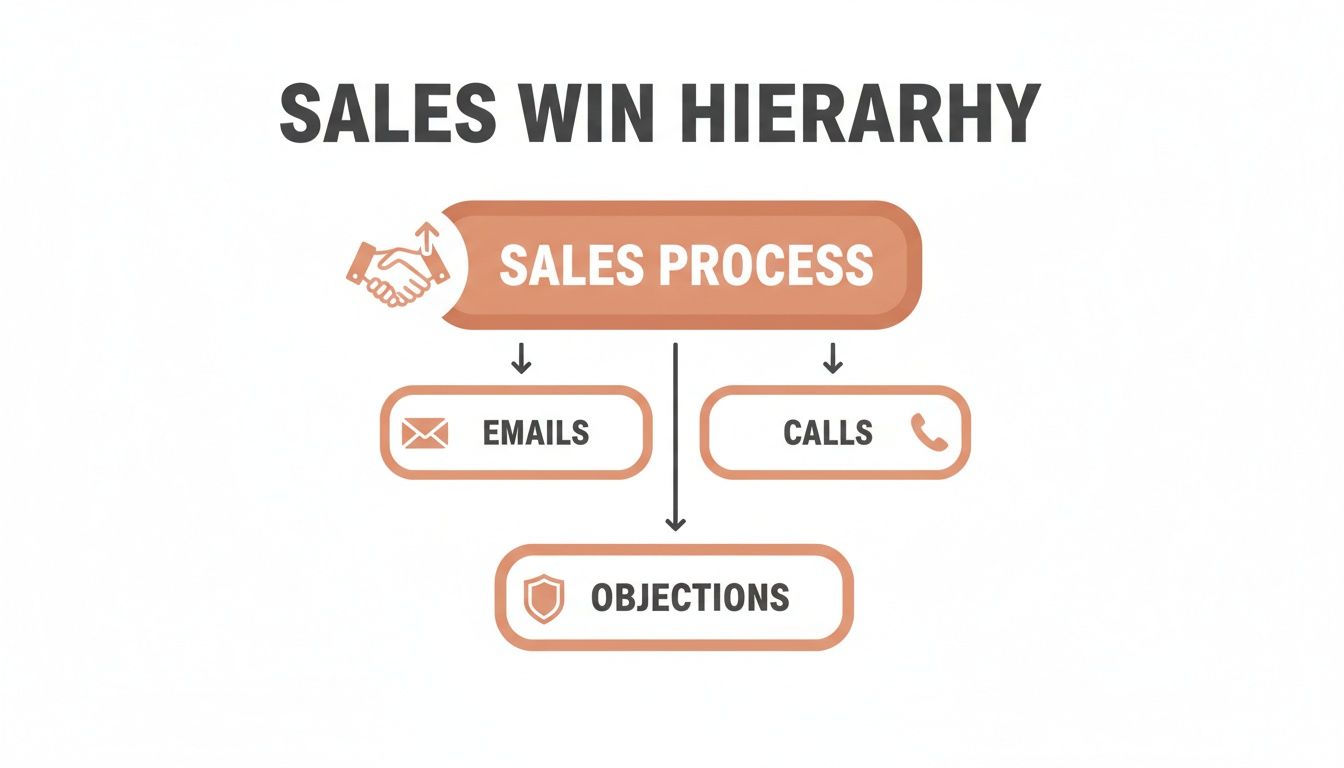
It’s a great visual reminder that a winning sales process is built on tailored communication, from your first outreach right through to overcoming those last-minute hurdles.
The Knight: The Decisive Red Profile
The Knight is the embodiment of the 'Red' personality. They are direct, decisive, and completely focused on the bottom line. Knights are all about achieving goals and proving their competence. When you’re talking to a Knight, they expect you to get straight to the point and respect their time.
Your playbook for a Knight should be built around two things: efficiency and impact.
- Communication Style: Be concise and confident. Ditch the small talk and lead with your most important point.
- Core Motivators: They care about ROI, tangible outcomes, and anything that gives them a competitive edge.
- How to Sell to Them: Present a clear, logical case that revolves around results. Use strong data and frame your solution as a strategic weapon that will help them win.
The Wizard: The Analytical Blue Profile
Mapping directly to the 'Blue' personality, the Wizard is analytical, detail-oriented, and naturally cautious. Wizards are driven by logic, accuracy, and a need to understand the how and why behind everything. They need to trust the information you give them and won't be impressed by hype or vague promises.
With a Wizard, building credibility is everything.
To effectively engage a Wizard, you must become a trusted expert. They value a well-prepared, data-driven approach that demonstrates you've done your homework and respect their need for thoroughness.
Your entire strategy should centre on providing comprehensive information and showcasing your expertise.
- Communication Style: Be precise, organised, and systematic. Structure your conversation logically and be ready for deep-dive questions.
- Core Motivators: Their decisions are guided by data, quality, and minimising risk.
- How to Sell to Them: Come armed with detailed case studies, technical specifications, and a clear implementation roadmap. Give them the time and space they need to do their own analysis.
The Healer: The Supportive Green Profile
The Healer mirrors the 'Green' personality, a profile that values relationships, reliability, and harmony above all else. They are supportive, patient, and motivated by trust and a sense of security. Healers want to know you'll be a dependable partner and that your solution won't cause chaos for their team.
Your approach here needs to be reassuring and relationship-focused. This archetype responds incredibly well to empathetic communication, a trend backed by research into personality baselines in Southeast Asia. A 2018 study noted that in urban SG, where 40% of the workforce comes from regions like Thailand and Vietnam, Healer archetypes respond favourably to softer, more harmonious approaches, boosting conversions by 19% in certain sectors. For Mindreader users, this means profiling for these cues can help cut down objections by up to 27%. You can read the full research about these regional personality traits for a deeper look.
- Communication Style: Be warm, patient, and genuine. Focus on building a real connection and listen carefully to their concerns.
- Core Motivators: They’re driven by consensus, the well-being of their team, and long-term stability.
- How to Sell to Them: Emphasise your customer support, share testimonials from happy clients, and position yourself as a long-term partner who’s invested in their success.
The Explorer: The Enthusiastic Yellow Profile
Finally, the Explorer channels the creative and optimistic energy of the 'Yellow' personality. They are enthusiastic, social, and motivated by innovation and the big picture. Explorers get fired up by new ideas and future possibilities.
To grab an Explorer's attention, you have to match their energy and focus on what’s new and exciting.
- Communication Style: Be energetic, inspiring, and engaging. Use storytelling and focus on the vision.
- Core Motivators: They are driven by recognition, creativity, and being part of the next big thing.
- How to Sell to Them: Brainstorm with them. Talk about the potential for innovation and paint a vivid picture of what the future could look like with your solution in hand.
Using Personality Insights Ethically in Sales
Wielding the power of a colour personality test in sales is a serious responsibility. While these insights can help you build incredible rapport, they have to be used to create genuine connections, not to manipulate people. There’s a fine line between strategic adaptation and harmful stereotyping—and every ethical sales professional needs to know exactly where that line is.
Think of these frameworks as a starting point, a guide to help you speak a prospect's preferred language. They were never meant to put people into boxes. A 'Red' personality is so much more than just their drive, and a 'Blue' isn't only their analytical mind. People are complex. These tools should be used to build bridges of understanding, not walls of assumption.
The real goal here is to foster genuine connection and trust. When you use personality insights the right way, you’re simply meeting your prospect where they are. You’re showing respect for their communication style, which makes the entire sales process feel more collaborative and less like a battle.
This ethical approach is absolutely essential for any kind of long-term success.
Protecting Privacy in the AI Era
As tools like Mindreader analyse digital footprints to give you real-time insights, the conversation around data privacy becomes more important than ever. It's crucial to understand that ethical AI platforms operate within very strict boundaries. They only analyse publicly available information that a prospect has willingly shared online, like cues from a LinkedIn profile or the tone of a public blog post.
There is a clear ethical line that should never be crossed:
- Public vs. Private: Ethical tools will never access private emails, direct messages, or any other confidential data. The focus is always on a person's public professional persona.
- Adaptation, Not Manipulation: The insights are there to help you adjust your communication style for better clarity and rapport. They are not there to help you exploit psychological triggers.
- Transparency and Trust: The ultimate aim is to build a solid foundation of trust. Using insights to mislead or pressure a prospect completely shatters that principle and is just a bad, short-sighted strategy.
By committing to these guidelines, sales teams can use powerful tools like a colour personality test to become more effective while upholding the highest standards of integrity. This is how you build credibility and ensure that technology actually serves to strengthen human connection, not undermine it.
Got Questions? We’ve Got Answers.
Here are some of the most common questions we get about using colour personality tests in a professional setting. Let’s clear things up and get you feeling confident about this approach.
Are Colour Personality Tests Actually Scientifically Valid?
This is the big one, isn't it? While you wouldn’t mistake a colour test for a clinical psychological assessment, many are built on well-established principles, like the Big Five personality traits. In fact, studies have shown some pretty significant links between colour preferences and personality, particularly in East Asian cultures.
The trick is to see them for what they are: a guide for understanding communication styles, not an infallible diagnostic tool. The best modern platforms don't just rely on colour theory alone; they pull in multiple data points to create a far more reliable and nuanced profile.
Can Someone’s Colour Personality Change Over Time?
A person's core personality tends to be pretty stable throughout their life. What can change, however, are their communication preferences based on their role, their environment, or the project they're working on. Think of a naturally creative 'Yellow' who has to step up and manage a complex project—they might start adopting more analytical 'Blue' traits to get the job done.
This is exactly why dynamic, AI-driven profiling is so much more powerful than a one-off, static test. It captures how someone is showing up right now. The best way to think about it is that their core colour is the foundation, and their current behaviour is a layer painted on top.
How Can I Figure Out a Prospect’s Colour Without Making Them Take a Test?
This is the million-dollar question and the main problem that advanced tools are built to solve. Instead of awkward self-reporting questionnaires, these platforms analyse the trail of digital breadcrumbs people leave online.
The AI sifts through publicly available cues—like the specific language someone uses on their LinkedIn profile, their communication style in emails, or even subtle facial landmarks in a profile picture. It’s looking for patterns that strongly correlate with specific archetypes, giving you an evidence-based starting point for your conversation without ever needing to say, "Hey, can you take this colour test for me?"
Ready to stop guessing and start connecting with precision? See how Mindreader translates these powerful insights into actionable sales playbooks that help you close more deals. Discover the Mindreader advantage today.