

Client profiling is all about painting a detailed picture of your ideal customer. It’s the art of gathering clues—demographics, behaviours, motivations—to figure out who your best clients are, what makes them tick, and how to talk to them in a way that actually connects. This isn't about guesswork; it's about building a solid foundation for a real relationship from the very first hello.
Why Modern Client Profiling Is Non-Negotiable
In a market as competitive as Singapore's, a generic sales pitch is a dead end. The days of treating sales like a simple transaction are long gone. Today, success is built on genuine relationships, and that starts with truly understanding the person on the other side of the screen.
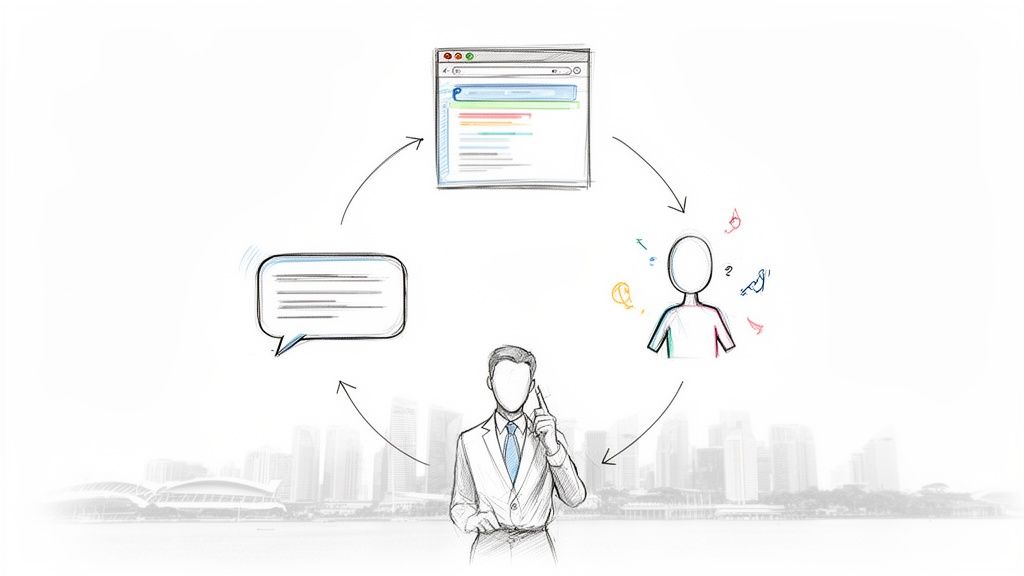
This is where a modern take on client profiling becomes your most valuable tool. It’s a fundamental shift in thinking: you’re not just selling to someone, you’re solving problems for them. To do that well, you need to know more than just their job title. You have to get a feel for their core drivers, their preferred way of communicating, and even the needs they haven’t voiced yet.
Beyond The Transactional Mindset
If you're only thinking about the immediate sale, you're leaving money on the table. The real goal is to build enough trust to become a valued advisor, which is what keeps clients coming back. This relationship-first approach needs a smarter, more nuanced way of understanding prospects.
A modern framework for this process pulls from several key data sources to create a complete client picture:
- Digital Footprint Analysis: What’s their professional story online? Look at their LinkedIn activity, company announcements, and what's being said about their industry. This gives you context before you ever speak.
- Communication Signals: The words they use in an email, their tone, the keywords they repeat—all of these are signals that reveal their personality and what they truly care about.
- Behavioural Cues: In a video call or a face-to-face meeting, how do they react? Their non-verbal signals are a goldmine for building rapport and knowing when to adjust your approach on the fly.
The Power of Data-Driven Insights
For B2B professionals in Singapore—whether you're a financial advisor or a real estate agent—this kind of data-driven approach is a game-changer. High-stakes deals are won on trust and relevance.
Take a real-world example: a regional agri-business in Southeast Asia used predictive analytics to profile its customers from end to end. By segmenting clients based on their buying habits and logistics data, they saw a 30% jump in productivity and got their B2C products to market faster. It's a clear example of how understanding consumer digital maturity can drive serious growth.
The real art of sales isn't just knowing your product; it's knowing your client. Effective client profiling bridges that gap, turning cold outreach into a warm, relevant conversation that feels human.
The good news is that you don't need to be a data scientist to do this. Sophisticated, AI-powered tools can now digest all these different signals and serve up actionable insights in seconds. This allows you to connect on a human level, build the trust that drives conversions, and secure the kind of client loyalty that lasts.
Gathering Actionable Intelligence On Your Clients
Guesswork has no place in effective client profiling. It’s all about building a solid foundation of high-quality, actionable intelligence before you even start a conversation. A smart profiling strategy starts with a clear data collection methodology. This organised approach is what lets you ditch the generic outreach and start having hyper-relevant conversations.
To really build that complete picture, we can focus on three core pillars of modern data gathering. Each one gives you a different layer of understanding, helping you connect with prospects on a genuinely human level.
Uncovering The Digital Footprint
Long before you send that first email, your prospect has already told you a great deal about themselves online. Their digital footprint is a goldmine of professional context and personal drivers. Digging into this publicly available information is the first real step in smart client profiling.
Start with the basics, like their LinkedIn profile, but don't stop there. Go deeper. Look at the articles they share, the posts they comment on, and the professional groups they're active in. These actions are breadcrumbs leading you directly to their professional priorities and interests.
And beyond social media, check out these sources:
- Company News & Press Releases: Did their company just land a new round of funding, launch a product, or expand into a new market? This stuff is pure gold for starting conversations and shows you’ve done your homework.
- Industry Reports & Publications: Understanding the big-picture trends affecting their industry helps you position your solution as a strategic asset, not just another product.
- Personal Blogs or Portfolios: If they have a personal site, it’s a direct window into their passions, their expertise, and how they see themselves in the professional world.
Pro Tip: Don't just skim their online presence—look for the patterns. If a prospect consistently shares articles about sustainable business practices, you’ve just found a core value you can align with in your pitch.
Decoding Communication Cues
Once you’ve started a conversation, every single email, message, and comment is packed with subtle clues. These communication cues reveal a prospect's personality and preferences, and learning to read them is key to adapting your style to match theirs. This builds rapport almost instantly.
For a deeper dive, check out our guide on how effective sales intelligence can completely transform your approach.
Pay close attention to the words they use. Is their language formal and data-heavy, or is it more casual and focused on building a relationship? The keywords they keep repeating often point directly to their main priorities or biggest pain points.
Think about this real-world scenario. A real estate agent is emailing a potential client about a new listing. The client’s replies are short, direct, and repeatedly mention "school district" and "commute time." This isn't just a casual question; it's a massive signal that logistics and family are their top decision-making factors. The agent can now tailor their next move to highlight properties that are perfect for those specific needs.
Reading The Behavioural Signals
The final pillar comes from direct interaction, whether it's on a video call or in a face-to-face meeting. Behavioural signals like body language, tone of voice, and facial expressions give you real-time feedback on how your message is actually landing.
On a video call, watch their engagement level. Are they leaning in and nodding, or are they multitasking on another screen? Positive signals, like good eye contact and a smile, tell you that you've got their attention and are building a real connection.
On the flip side, if you see folded arms, a furrowed brow, or a sudden change in tone, it could be a sign of disagreement or confusion. That’s your cue to pause. Ask a clarifying question and adjust your approach. You could say something like, "It looks like that last point might not have landed clearly. Can I explain it in a different way?" This shows you’re paying attention and builds trust, keeping the conversation moving forward.
Mapping Client Data To Practical Archetypes
Gathering intelligence is the first crucial step, but let's be honest—raw data has never closed a deal. The real magic happens when you turn that information into a practical playbook that guides your every move. This is where client archetypes come in, transforming scattered facts into a clear picture of who you're talking to.
Instead of getting lost in endless data points, you can map your insights to a simple, powerful framework. This helps you quickly grasp a prospect’s core motivations, their preferred communication style, and what really makes them tick. It’s all about working smarter.
This concept map breaks down how various intelligence sources feed into one unified client profile.
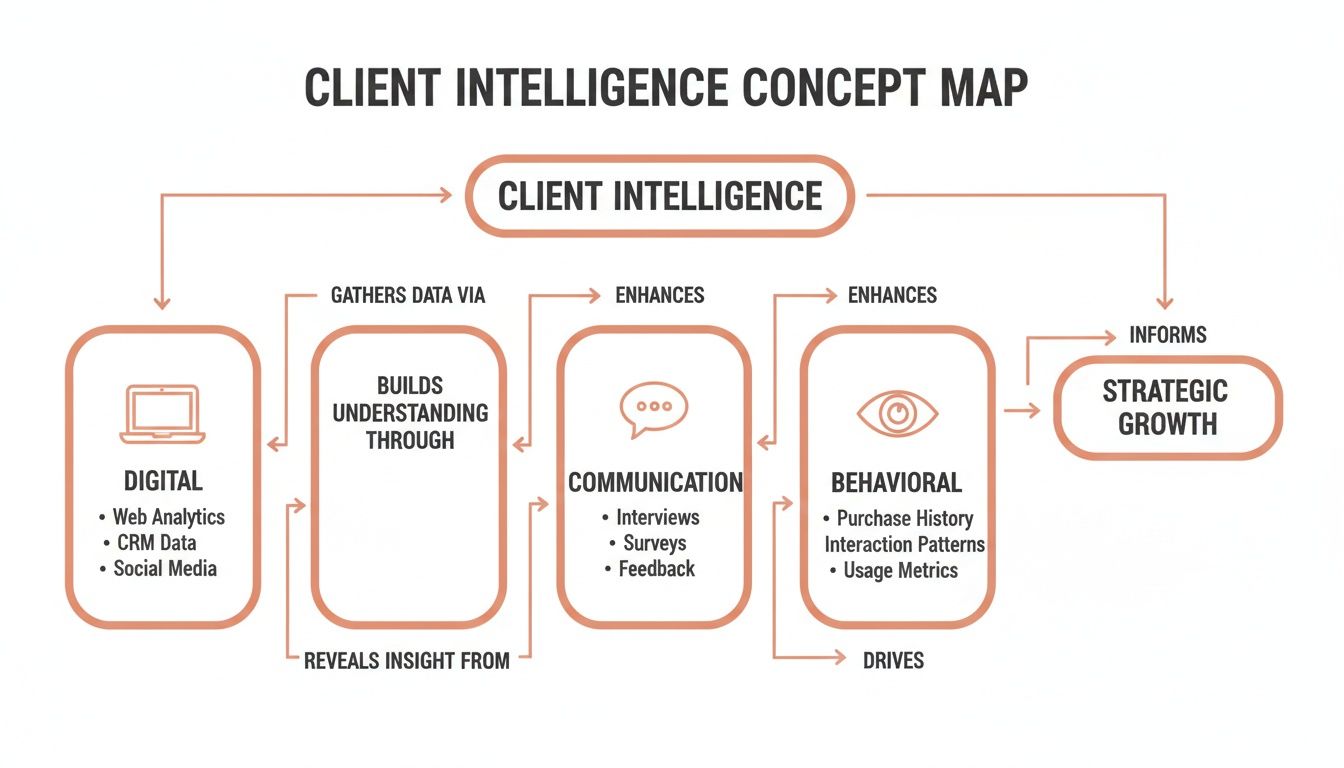
As you can see, digital signals, communication patterns, and behavioural data aren't separate streams. They're interconnected pillars that, when combined, build a complete, actionable view of your client.
A Guide To Client Archetypes And How To Engage Them
After years of analysing communication patterns and decision-making behaviours, we’ve found that nearly everyone falls into one of four primary client archetypes. Each one requires a distinct approach to build trust and drive the conversation forward. Think of these as your strategic starting points for any sales interaction.
This guide will help you identify which archetype you're dealing with and adapt your sales approach on the fly.
| Archetype | Core Motivator | Communication Style | Winning Sales Tactic |
|---|---|---|---|
| Knight | Results & Efficiency | Direct, decisive, and action-oriented. They get straight to the point. | Present a clear, confident action plan with tangible outcomes and ROI. |
| Explorer | Possibility & Innovation | Visionary, creative, and future-focused. They love big ideas. | Frame your solution as a partnership that unlocks new opportunities and innovation. |
| Healer | Trust & Harmony | Collaborative, empathetic, and relationship-driven. They prioritise people. | Build genuine rapport, use team-focused case studies, and become a trusted advisor. |
| Wizard | Logic & Proof | Analytical, data-driven, and methodical. They need to verify everything. | Provide hard data, detailed specs, and a step-by-step logical argument. |
Identifying these patterns early helps you frame your pitch in a way that resonates on a fundamental level. To see how these profiles fit into your wider strategy, check out our guide on creating an https://themindreader.ai/blog-insights/ideal-customer-profile.
Engaging The Decisive Knight
When you're talking to a Knight, cut to the chase. They have very little patience for small talk or long-winded explanations. Their first—and often only—question is, "What's the bottom line, and what's the plan?"
Your approach needs to be confident and crystal clear. Hand them a direct action plan that outlines the steps, timeline, and expected outcomes. They respect decisiveness, so avoid hedging your language. Use strong, action-oriented verbs and keep the focus squarely on tangible results and ROI.
Inspiring The Innovative Explorer
The Explorer lights up when the conversation turns to the future. They want to know what’s possible and how your solution can help them innovate or get a leg up on the competition. If your pitch is all about features and immediate returns, you'll lose them.
Instead, pull them into a strategic discussion. Ask about their long-term vision and connect what you're offering to that bigger picture. Use brainstorming language and frame your pitch as a partnership that can unlock new doors. For them, the journey and the destination are equally important.
Client profilling isn't about putting people in boxes. It’s about having a better map to navigate their world, allowing you to speak their language and address the needs they truly care about.
Connecting With The Collaborative Healer
For a Healer, relationships and trust are non-negotiable. They make decisions based on how a solution will impact their team and foster a positive, collaborative environment. Aggressive sales tactics or claims that seem too good to be true will send them running.
To win them over, you need to slow down and build genuine rapport. Focus on demonstrating empathy and a deep understanding of their team’s unique challenges. Share testimonials and case studies that highlight successful teamwork and collaboration. Your goal here isn't to be another vendor; it's to become a trusted advisor.
Convincing The Analytical Wizard
The Wizard operates on a strict diet of data, logic, and proof. Before they even consider making a decision, they need to understand every last detail and verify every single claim. Don't bother with emotional appeals or grand visions; they need the facts, plain and simple.
Walk into that meeting armed with detailed data, solid ROI projections, technical specifications, and a clear, logical process. Be prepared to walk them through your reasoning step-by-step and answer tough, in-depth questions. When you provide comprehensive information upfront, you show respect for their analytical nature and build immediate credibility. Knowing how to effectively qualify leads like the Wizard is one of the most powerful outcomes of a solid profilling strategy.
Applying Your Insights With Proven Scripts And Templates
Knowing your client's archetype is a huge step, but the real magic happens when you turn that insight into action. This is where theory gets real. To do it well, you need the right communication frameworks ready to go—ones that are specifically tuned to each client's unique style.
It’s one thing to know you’re talking to a 'Wizard'; it's another to know exactly what to say. Having proven templates and scripts for your outreach, meetings, and follow-ups takes the guesswork out of the equation. It allows you to put your profiling skills to work immediately, which leads to far more effective conversations and much better response rates.
Crafting Outreach That Resonates
That first email is your first impression. Get it right, and the door opens. A generic message is a ticket to the trash folder, but one that speaks the client's language? That gets attention. Your client profiling insights should dictate the tone, the content, and the call to action of every initial message you send.
Let's imagine you're selling the same product to two very different people:
Email for a 'Wizard' (Analytical): Here, you lead with the facts. The subject line could be something like, "Data on Improving Your Team's Sales Efficiency by 18%." The body of the email would be packed with specific metrics, ROI projections, and a direct link to a detailed case study. It's concise, factual, and shows you respect their time by getting straight to the point.
Email for a 'Healer' (Collaborative): The approach is completely different. It's about building trust and showing you get them. A subject line like, "A Thought on Supporting Your Team's Growth" works well. The email might mention a recent team win you saw on LinkedIn (hello, digital footprint research!) and focus on how your solution reduces stress and improves collaboration. You're framing it as a tool to help their people succeed together.
This isn't just a minor tweak; this level of customisation dramatically increases your odds of getting a reply. You’re not just selling; you're solving a problem in a way they instinctively connect with.
Structuring Meetings For Maximum Impact
Once you’ve booked that meeting, how you run the conversation is just as important as what you say. Your client profile is your guide for everything from your presentation style to the agenda itself. Some clients want a rapid-fire summary, while others need you to slow down and walk them through the details.
Think about how you’d adjust your pitch for different archetypes:
For the 'Knight' (Decisive): Keep it moving. Start with the bottom line—the outcome—and then briefly cover how you’ll get there. Use bullet points, clear action items, and focus everything on results. They want to know the destination, not every single turn on the map.
For the 'Explorer' (Visionary): Open big. Start with a provocative question about the future of their industry. Use visuals and storytelling to paint a picture of what’s possible. They get bored with granular details but light up when you talk about innovation and strategic leaps forward.
The goal isn’t to become a different person for each client. It's about adjusting your communication channel to match their preferred frequency, ensuring your message is received loud and clear.
Handling Objections With Precision
This is where client profiling really proves its worth. Instead of a generic, one-size-fits-all rebuttal, you can address the real concern behind their objection. This is also where AI-powered client profiling is giving Singapore's account executives and startup founders a serious edge.
The EY Future Consumer Index found that only 29% of consumers in Southeast Asia trust generic AI promotions. However, sales-specific tools that deliver deep behavioural insights are a different story. As 89% of consumers worry about the cost of living, customised messaging that speaks to their specific concerns is critical. In fact, platforms that offer tailored objection-handling tactics are seeing up to a 30% lift in conversions for professionals like financial advisors. You can read more about how economic pressures are shaping consumer trust on ey.com.
For instance, when a 'Wizard' says, "I'm not sure about the ROI," they're asking for the spreadsheet. Your response should be a detailed breakdown of the numbers. But when a 'Healer' says, "I need to think about how this affects my team," they're worried about their people. The perfect response is a case study showing how another team happily and successfully adopted your solution.
By using these tangible scripts and templates, you turn profiling from a cool concept into your most reliable sales tool.
Integrating Profiling Into Your Daily Sales Workflow
Having a solid client profiling framework is one thing. Actually weaving it into your daily grind is something else entirely. For these powerful insights to turn into closed deals, they can't just be another task on your to-do list—they need to become second nature.
The goal is to make your preparation smart and almost effortless. This means moving beyond scattered notes and last-minute manual research. The real magic happens when client intelligence is right where you need it, when you need it: inside your CRM, your calendar invites, or your email drafts. That's how profiling becomes a constant, powerful asset instead of a chore.
Connecting Your Tech for Seamless Insights
Modern profiling platforms are built to plug into the tools you already live in every day. When you connect one to your Customer Relationship Management (CRM) system, you kill the friction of toggling between tabs and copy-pasting notes.
Imagine opening a client’s record and instantly seeing their communication archetype, a few key talking points, and potential red flags.
This kind of integrated approach does a few crucial things for you:
- Kills Manual Data Entry: Insights get populated automatically. This frees up precious time you should be spending on strategy and actual conversations.
- Gives You Instant Context: Right before a call, you get a quick, powerful refresher on who you're talking to and how to best engage them. No more going in cold.
- Keeps the Whole Team Aligned: When everyone sees the same profiling data, the client gets a consistent, personalised experience, no matter who they speak with.
A unified system gives your entire team a single source of truth for every customer. And that’s what clients expect. Recent Zendesk reports show that 61% of consumers want businesses to use their data to create more personal experiences. Integration is what makes that level of personalisation possible at scale.
Upholding Ethical Data Practices
As we bring these powerful tools into our workflow, we have to commit to using them responsibly. This isn't about manipulation; it's about genuine understanding and better service. In a market like Singapore, where reputation is everything, building high-value relationships requires a foundation of absolute trust.
The guiding principle is simple: focus on publicly available information and cues the client offers willingly. We’re analysing their professional history on LinkedIn, the language in their emails, or their non-verbal signals on a video call—not digging into their private lives. Transparency is key.
The best sales professionals use client profiling to build bridges, not to exploit weaknesses. The goal is to understand a client's world so deeply that you can serve them better than anyone else, building trust that lasts far beyond a single transaction.
To make sure you always stay on the right side of the line, you need a clear set of best practices. Ethical profiling isn't just the right thing to do; it's a critical part of a sustainable business. It's also a vital piece of any strong strategy for lead generation in Singapore.
A Checklist for Ethical Profiling
To keep your approach grounded in respect and integrity, stick to these simple guidelines. They’ll help you build trust and ensure your profiling efforts are always a force for good.
- Prioritise Transparency: If a client asks, be open about your preparation. You can frame it as doing your homework to make sure the conversation is valuable for them.
- Focus on Public Information: Stick to professional networks, company websites, press releases, and industry news. Never try to access private social media profiles or personal data.
- Use Insights to Serve, Not Sell: Your primary goal should always be to solve the client's problem more effectively. Use your understanding of their archetype to frame solutions in a way that genuinely helps them.
- Always Verify Your Assumptions: Profiling gives you a starting hypothesis, not a rigid script. Stay present in the conversation, listen actively, and be ready to adjust your understanding based on what they're telling you in the moment.
Got Questions About Client Profiling? We’ve Got Answers.
Jumping into client profiling always sparks a few good questions. It's a powerful way to approach sales, but it's totally normal to wonder about how accurate it is, where it fits in, and how to avoid the common slip-ups. Let's dig into some of the most frequent queries we hear from sales pros.
This is where we tackle the practical side of things, giving you clear, straightforward answers to help you get the most out of profiling from day one. We’ll cover everything from the reliability of AI insights to how fast you can realistically expect to see results.
How Accurate Is This AI-Based Profiling, Really?
This is usually the first thing on everyone's mind. The high accuracy of AI-based profiling comes from its ability to analyse complex patterns across thousands of data points. Think of it less like mind-reading and more like incredibly advanced pattern recognition. The system picks up on subtle cues in language, digital footprints, and communication styles that would be impossible for a human to catch at scale.
Its accuracy gets sharper as it processes more relevant data. But the real key is using these insights as a strategic guide to sharpen your own intuition, not as an absolute script to be followed blindly.
The best sales professionals treat AI profiling like a co-pilot. It gives you a highly educated starting point, but you still need to listen and validate its suggestions with what you're seeing and hearing in real-time. That's how you build a genuine, human connection.
Does Client Profiling Work for Both New and Existing Clients?
Yes, absolutely. Its application just looks a little different for each, but it's incredibly valuable for both. Client profiling is a versatile tool that adapts to where your customer is in their journey, whether it’s the first cold email or a long-standing partnership.
- For New Leads: Profiling is your secret weapon for that first touchpoint. It helps you cut through the noise with a message that feels instantly relevant, making a strong first impression that can dramatically boost your reply rates.
- For Existing Clients: With current customers, profiling becomes a tool for deepening the relationship. It helps you uncover unspoken needs, spot natural upsell or cross-sell opportunities, and handle contract renewals with a much clearer picture of their shifting priorities.
Using these insights with existing clients cements your role as a trusted advisor, not just another vendor who pops up once a year.
What's the Biggest Mistake to Avoid When Starting Out?
The single biggest mistake is boxing someone into their client archetype. People are complex, and they’re not static. A prospect might be super analytical (a 'Wizard') when you’re talking budget but turn into a visionary 'Explorer' when brainstorming long-term strategy. These archetypes are a flexible framework, not a rigid rulebook.
Relying too heavily on a profile can make you jump to conclusions and, worse, stop listening. The most successful reps use data to inform their approach but pair it with genuine curiosity and active listening. This lets them adapt their communication style on the fly, responding to the actual person in front of them, not just a label in their CRM. Always let the live conversation be your ultimate guide.
How Quickly Will I See Results from These Techniques?
You might be surprised by how fast the impact shows up, especially in your initial outreach. Many reps see an immediate jump in their email and LinkedIn reply rates within the first few weeks of tailoring messages based on profiling insights. A personalised message that speaks a client's language just stands out.
Now, for deals with longer sales cycles, the effect on your overall conversion rates might take a full quarter to become obvious. That’s because you're applying these techniques across multiple meetings and touchpoints. Consistency is the key here. The more you weave client profiling into your daily prep and follow-up, the more the benefits will compound over time, leading to stronger relationships and, ultimately, more closed deals.
Ready to stop guessing and start connecting? Mindreader gives you the AI-powered insights to understand any client's communication style in seconds. Prepare for meetings faster, write emails that get replies, and close more deals by adapting your approach to how your clients think.
Discover how Mindreader can transform your sales conversations at https://www.themindreader.ai