Behavioral Segmentation in Marketing A Guide to Customer Insight
Behavioural segmentation isn't about who your customers are; it's about what they do. Think of it as grouping people based on their actions and interactions—things like their purchase history, how they use your product, or how often they engage with your brand. This shift in focus from demographics to actions gives you a much clearer lens to understand what your customers truly need and intend to do.
Understanding Behavioural Segmentation
Imagine a master tailor crafting a bespoke suit. A good tailor doesn't just take your measurements. They ask about your lifestyle, the kinds of events you attend, and your personal sense of style. This deeper understanding ensures the final suit isn't just a perfect fit for your body, but the right fit for your life. That's the essence of behavioural segmentation. It goes beyond static data like age or location to focus on the dynamic, observable actions customers take.
This approach decodes the "why" behind their decisions, allowing you to group customers based on those behavioural patterns. Once you understand these patterns, you can tailor your sales and marketing with incredible precision. This is especially vital in high-stakes B2B sales, where genuine personalisation is what builds trust and, ultimately, closes deals.
From Niche Tactic to Core Strategy
Behavioural segmentation isn't some fringe tactic anymore; it's a foundational strategy for engaging with modern buyers. In our digital-first world, every click, download, and page view leaves behind a valuable data trail. Capturing and making sense of this information is absolutely key to staying relevant. For a deeper dive, check out our guide on effective https://themindreader.ai/blog-insights/customer-profiling to see how you can turn raw data into powerful insights.
You can see the global importance of this shift just by looking at the numbers. Southeast Asia's advertising market, for example, is projected to hit USD 63.89 billion by 2031, a surge driven almost entirely by behavioural data. In places like Thailand, digital ad spend has already blown past television, showing a fundamental move towards online channels. For sales professionals, this trend makes one thing clear: understanding and acting on behavioural signals is the new playbook for success.
By grouping customers based on shared behaviours, you can move from one-size-fits-all messaging to creating conversations that resonate deeply with individual needs and motivations. This is the key to building lasting relationships and driving sustainable growth.
At the end of the day, behavioural segmentation gives you the power to:
- Identify High-Intent Prospects: Pinpoint who is actively interested by tracking their engagement with your content, pricing pages, or case studies.
- Personalise Communication: Craft messages that speak directly to a prospect's observed needs and where they are in their journey.
- Improve Customer Retention: Recognise patterns in product usage to proactively solve issues or spot the perfect upsell opportunity.
By focusing on what people do, you get a much sharper picture of what truly matters to them. That's how you build more effective, and more empathetic, interactions.
Why Behavioural Insights Matter in High-Stakes Sales
In any high-stakes sale, information is power. For decades, sales teams have relied on demographic data—a prospect’s title, industry, or company size—to guide the conversation. But that approach only tells you who the prospect is, not what they actually care about right now.
This is where behavioural segmentation flips the script and gives you a game-changing advantage.
It shifts the focus from static profiles to dynamic, real-time actions. Instead of just knowing a prospect is a CFO, you can see they’ve spent the last week downloading your ROI case studies, re-watching a webinar on cost-cutting, and visiting your pricing page three times. This digital footprint is a massive signal of active interest and specific pain points.
These insights transform your outreach from a generic pitch into a hyper-relevant conversation. You're no longer guessing what matters; you’re responding to their observed needs. In complex B2B sales cycles, this ability to connect on a deeper level is exactly what separates top performers from the rest of the pack.
Moving from Guesswork to Genuine Intent
In high-stakes deals, your most valuable asset is time. Sales teams simply can't afford to chase leads that have little to no real intention of buying. Behavioural segmentation acts as a powerful filter, helping you zero in on the prospects who are genuinely moving towards a decision.
Think about it: a prospect who only downloads a top-of-funnel eBook is showing curiosity. But a prospect who interacts with bottom-of-funnel content—like implementation guides or competitor comparison pages—is signalling a much higher level of intent. In fact, a recent study found that companies using behavioural data outperform competitors in sales growth by a staggering 85%.
By tracking these digital cues, you can score leads with far greater accuracy and put your energy where it will have the most impact. This means less time wasted on cold, unresponsive leads and more time building relationships with prospects who are actively looking for a solution.
The core value of behavioural insights is moving from selling a product to proactively solving a prospect’s observed problems. It changes the dynamic from a sales pitch to a consultative partnership from the very first interaction.
Building Trust and Anticipating Needs
Trust is the currency of every significant deal. It’s not built overnight but through a series of relevant, valuable, and timely interactions. Behavioural insights are the key to unlocking this process, allowing you to anticipate needs and proactively address objections before they’re even spoken.
Consider these scenarios:
- Anticipating Objections: If a prospect repeatedly views your security and compliance page, you can proactively prepare materials that address data protection and integration safety. This shows foresight and true expertise.
- Personalising Demonstrations: By knowing which features a prospect has explored on your website, you can tailor your product demo to focus on the exact capabilities they care about most, making the session far more impactful.
- Shortening Sales Cycles: When you understand a prospect’s pain points through their content consumption, you can skip the generic discovery questions and get straight to discussing how your solution solves their specific challenges. This focus accelerates the entire sales process.
This level of preparation shows you’ve done your homework and are genuinely invested in their success. It builds the credibility needed to guide a prospect through a complex buying decision and, ultimately, close the deal. By understanding their behaviour, you’re not just selling—you’re building a foundation of trust that leads to long-term partnerships.
Of course. Here is the rewritten section, crafted to sound completely human-written and natural, following all your specified requirements.
Key Criteria for Segmenting Your B2B Customers
Great behavioural segmentation isn't about hoarding every scrap of data you can find. That’s a fast track to analysis paralysis. Instead, it’s about knowing what to look for—the specific actions that scream intent, need, and urgency. Think of yourself as a detective. You don’t care about every footprint at the scene; you care about the ones that lead to the culprit.
Your goal is to pinpoint the behaviours that give your sales team the most actionable intelligence. This is how you turn a messy pile of raw data into a clear roadmap that tells your team exactly who to talk to, what to say, and when to reach out.
Segmenting by Engagement Level
How a prospect interacts with your brand is one of the clearest signs of their interest. It’s the digital breadcrumb trail that leads you straight to their pain points and tells you just how actively they’re looking for a solution like yours.
These are the signals that should set off alarm bells for your sales team:
- Content Consumption: Did they just download a heavy-duty asset, like a technical whitepaper or a competitor comparison guide? That’s not a casual browse. It shows they’re past the window-shopping phase and are now deep in the evaluation trenches.
- Webinar and Event Attendance: Anyone who gives up an hour of their day for a live webinar is showing serious interest. This is a significant time investment and a clear signal that the topics you’re covering are hitting close to home.
- Website Interaction: Are you seeing the same person repeatedly visiting your pricing page or digging into specific feature pages? These are massive buying signals. A prospect doing this should immediately be flagged as a high priority.
By tracking these actions, you can create practical segments like ‘Highly Engaged Evaluators’ or ‘Early-Stage Researchers,’ allowing you to tailor your outreach perfectly.
Segmenting by Purchase Behaviour
A customer's buying history is a goldmine. It tells a story about their loyalty, their value to your business, and their potential for future growth. Digging into this data helps you understand the financial side of the relationship and spot opportunities to make it even stronger.
For B2B sales, that means looking at a few key things:
- Contract Value: Your approach for a customer with a massive Annual Contract Value (ACV) should be completely different from a smaller account. Segmenting by contract size is fundamental for allocating your resources where they’ll have the biggest impact.
- Renewal History: A customer who consistently renews is a happy, loyal partner. On the flip side, an account with a spotty renewal history is a flashing red light, flagging a potential churn risk that needs immediate attention.
- Upsell and Cross-sell History: Have they bought add-on services or upgraded their plan before? This is a huge tell. It means they see growing value in what you provide and are prime candidates for future expansion plays.
Understanding a customer's purchasing DNA allows you to move from reactive support to proactive partnership, anticipating their needs and delivering value before they even have to ask.
Segmenting by Product and Service Usage
How customers actually use your product is the ultimate truth serum. It reveals exactly where they’re finding value and, just as importantly, where they might be getting stuck. This data is absolutely critical for keeping customers happy and spotting opportunities to expand the account.
Keep a close eye on these usage patterns:
- Login Frequency: It’s a simple metric, but it’s a powerful health score for any account. Are they daily active users, or have they gone dark for the last 30 days? The answer tells you a lot.
- Feature Adoption: Are they taking advantage of the core features that deliver the best results? Separating your ‘Power Users’ from ‘Limited Users’ allows you to create targeted educational campaigns to drive deeper adoption.
- Integration Usage: When a customer integrates your product into their wider tech stack, they’re showing deep commitment. They’ve woven you into their daily operations, making them far less likely to churn and often turning them into your best advocates.
This is also where knowing global trends can give you an edge. Take Southeast Asia’s e-commerce market, for example. Behavioural data shows purchasing patterns are massively influenced by social and live commerce on platforms like TikTok. This insight—that customers expect real-time, trust-building interactions—is incredibly valuable for sales teams targeting the region. It shows the need for a more personal, interactive sales approach. You can discover more insights about online shopping behaviour in Southeast Asia on Statista.
For a deeper look into building detailed customer profiles from this kind of data, check out our guide to creating actionable persona profiles.
How to Implement Your Segmentation Strategy
Turning a pile of raw behavioural data into a coherent sales strategy doesn't just happen. It takes a clear, methodical process—one that connects what you know about your customers to what your sales team actually does. This framework is the bridge between insightful data and real-world results, like better conversion rates and shorter sales cycles.
The whole point is to define what you want to achieve, gather the right information, create smart segments, and then build repeatable sales plays for each group. Think of it as a cycle of action and refinement that keeps your efforts sharp and effective.
The visual below maps out the core flow of this process, showing how behavioural signals become actionable stages, from a prospect's first click to their ongoing use of your product.
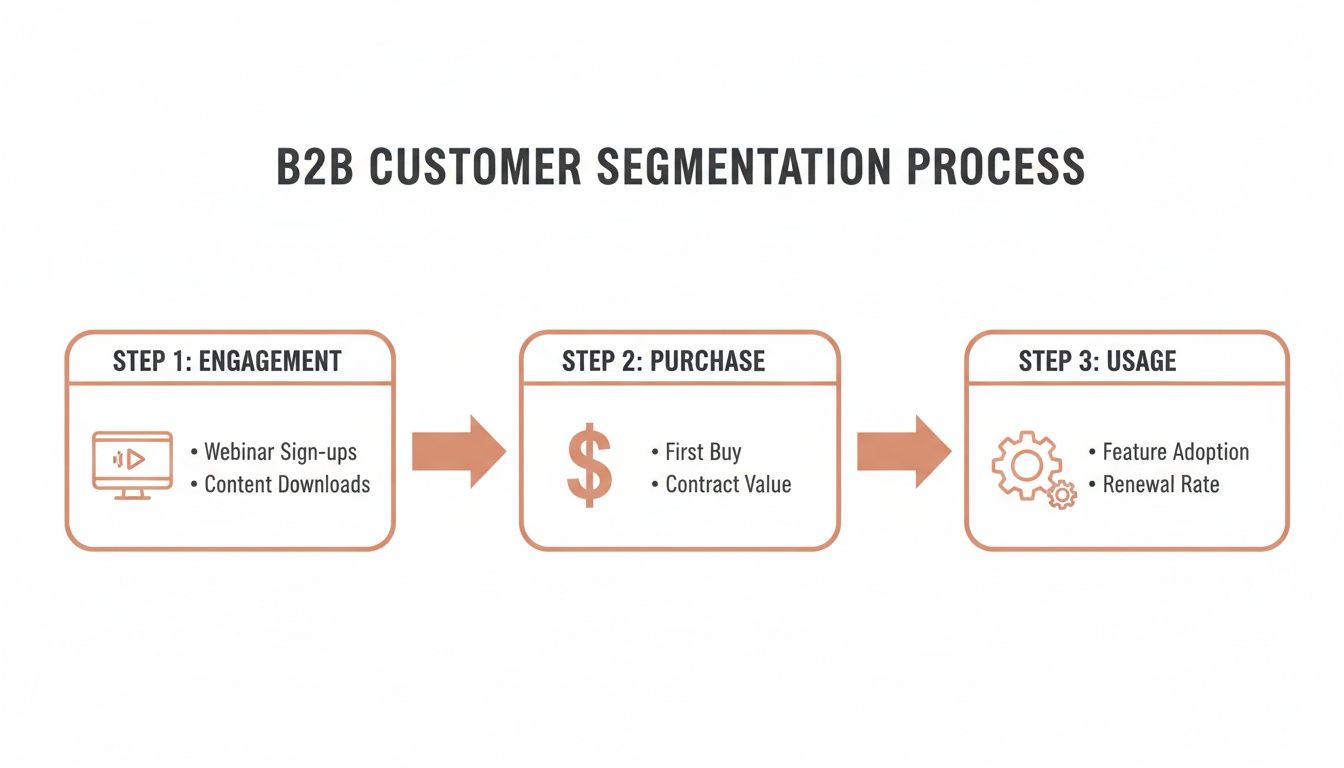
As you can see, every stage of the journey—engagement, purchase, and usage—spits out distinct behavioural data. These are the puzzle pieces you need to build powerful, effective segments.
Step 1: Define Clear Sales Objectives
Before you even think about building a segment, you need to know what you're trying to accomplish. Vague goals like "increase sales" won't cut it. You need specific, measurable objectives that will steer every single decision you make from here on out.
Your goals are your compass. They ensure the segments you build are directly tied to meaningful business outcomes. Without that clarity, it’s all too easy to get lost in a sea of data, creating segments that are interesting but totally useless to your sales team.
Here are a few examples of objectives that actually mean something:
- Increase the sales-qualified lead (SQL) to customer conversion rate by 15% within the next quarter.
- Reduce the average sales cycle for enterprise deals from 90 days down to 75 days.
- Improve the renewal rate for mid-market accounts by 10% over the next six months.
- Boost the adoption of a specific high-value feature among new customers within their first 30 days.
Step 2: Identify and Connect Key Data Sources
With your objectives locked in, it’s time to hunt for the right data. Actionable behavioural segmentation runs on a unified view of the customer. That means you need to connect the dots between all the different platforms where they interact with you.
This isn’t about hoovering up every scrap of data you can find. It’s about zeroing in on the most potent sources that reveal what a customer truly wants and how they behave. Start by focusing on the core systems that track the entire customer lifecycle, from their first website visit to their day-to-day product usage.
A disconnected data ecosystem is the number one obstacle to effective segmentation. When your data lives in silos, you only see fragments of the customer story, making it impossible to build a complete and accurate picture.
Key data sources you absolutely need to integrate include:
- Customer Relationship Management (CRM) System: This is your command centre for account info, deal stages, and interaction history. It provides the foundational context for all other behavioural data.
- Website Analytics: Tools like Google Analytics show you which pages prospects linger on, what content they consume (like case studies or whitepapers), and how much time they spend on critical pages like pricing.
- Marketing Automation Platform: This is where you track engagement with emails, webinars, and other marketing campaigns, giving you a direct line of sight into a prospect's interest level.
Step 3: Create Actionable Segments
Now for the fun part: building your segments. The biggest trap here is over-segmentation. Creating dozens of tiny micro-segments might sound smart, but it just dilutes your focus and becomes a nightmare for the sales team to manage. The real goal is to create a handful of distinct, meaningful groups whose behaviour clearly signals a specific need or intent.
A great segment is one a salesperson can look at and immediately know what to do next. For example, in Southeast Asian markets, financial institutions use AI to cluster customers based on spending habits and digital channel usage. But even the experts there warn that creating too many micro-segments can be unprofitable. It's about striking a balance—groups that are specific enough to be relevant but broad enough to be scalable. You can find more insights on this in the context of the Thai market on Iconic Thai.
Start with a few high-impact segments, such as:
- Potential Champions: Users who have high product usage and have recently checked out case studies or information on your referral programme.
- High-Intent Evaluators: Prospects who have hit the pricing page multiple times, downloaded a competitor comparison guide, or requested a demo in the last week.
- Disengaged Users: Customers who haven't logged into your product in over 30 days. These are your biggest churn risks.
- Expansion Opportunities: Existing customers who are bumping up against the limits of their current plan or have shown interest in premium features they don’t yet have.
Using AI to Power Your Sales Plays
Behavioural data is fantastic. It tells you what a prospect does—which pages they visit, what they download, how long they stay. But it hits a wall. It can't tell you how to actually talk to them.
This is the critical gap where even the most data-heavy segmentation strategies fall flat. Raw data is just noise until you can translate it into a real-world sales conversation that connects, persuades, and builds genuine trust. This is where Artificial Intelligence stops being a background tool and becomes your most valuable sales co-pilot.
AI doesn’t just sort behavioural signals; it translates them into powerful communication intelligence. It helps you connect the dots between knowing a prospect downloaded a whitepaper and knowing precisely how to open a conversation with them about it. You move from simply watching what they do to actively shaping the sales dialogue.
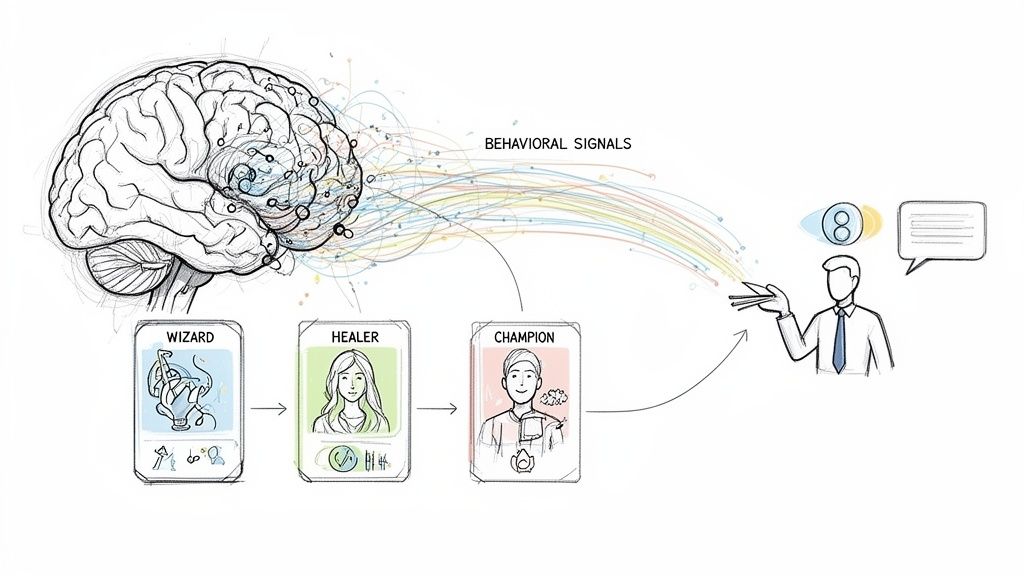
This process isn't about replacing your intuition as a salesperson. Far from it. It’s about sharpening it with data-driven insights that make every interaction more relevant and impactful. By using AI to decode these patterns, you can develop sales plays that feel less like a rigid script and more like a natural, insightful conversation.
From Segments to Communication Archetypes
Let's be honest, traditional behavioural segmentation is a great start, but it often stops at the surface. Creating a segment called ‘High-Intent Evaluators’ is useful, sure. But it doesn't tell a salesperson whether that prospect wants a direct, data-heavy pitch or a more relationship-focused, trust-building chat.
This is where AI-driven communication archetypes provide a practical, more advanced layer.
An archetype is a model of communication style built from a combination of behavioural signals. It gives you a practical framework for how to approach each prospect, not just what to talk about. The secret to developing these smart sales strategies is effective AI data analysis, which can uncover the deep insights into customer behaviour needed for this level of segmentation.
Communication archetypes transform behavioural data from a passive report into an active playbook. They turn the ‘what they did’ into a clear ‘how you should connect,’ making personalisation scalable and effective for the entire sales team.
At Mindreader, for instance, we profile prospects into four practical archetypes: the Wizard, the Knight, the Healer, and the Explorer. Each one is tied to specific behavioural patterns and comes with a clear playbook for how to communicate effectively.
Mapping Behaviours to Practical Sales Plays
Let’s make this real. Imagine two prospects who both land in your ‘High-Intent Evaluators’ segment. On paper, they look identical. But by applying an AI-powered archetype lens, you quickly see two very different people who need completely different sales approaches.
Example 1: The Wizard Archetype
- Behavioural Signals: This prospect has downloaded multiple technical whitepapers. They've spent a lot of time on your product specification pages and even attended a deep-dive webinar comparing features. Crucially, they’ve completely ignored your ‘About Us’ page and customer testimonials.
- Archetype Insight: These actions scream Wizard. This person is analytical, data-driven, and focused on proving ROI. They value expertise and efficiency above all else.
- The Sales Play: Your approach has to be direct and packed with data. Lead with hard numbers, focus on technical specs, and be ready for detailed, evidence-based questions. Ditch the fluffy language and build credibility through your deep product knowledge.
Example 2: The Healer Archetype
- Behavioural Signals: This second prospect has spent their time on your team bio pages and has read multiple customer success stories. They’ve engaged with social media posts that highlight your company culture and client relationships. They downloaded one high-level eBook but haven't touched your technical docs.
- Archetype Insight: These behaviours map perfectly to the Healer archetype. This person is relationship-oriented, motivated by trust, and concerned with the human impact of a decision. They want to know who they are partnering with.
- The Sales Play: Your outreach needs to focus on building rapport and establishing trust. Use social proof, highlight successful client partnerships, and frame the conversation around collaboration and support. Lead with stories, not statistics.
In both examples, the starting behavioural segment was the same. But the AI-driven archetypes provided the crucial communication intelligence needed to make the interaction a success. This is the core of modern, human-centric selling. You can learn more about applying these techniques with our insights into AI-powered sales intelligence.
The table below breaks down how you can map common online behaviours to these practical archetypes.
Mapping Behavioral Cues to Communication Archetypes
| Communication Archetype | Common Behavioral Signals | Effective Sales Communication Tactic |
|---|---|---|
| The Wizard | Downloads technical specs, attends deep-dive webinars, focuses on ROI calculators, ignores "About Us" pages. | Be direct and data-driven. Lead with facts, figures, and technical details. Demonstrate clear ROI and efficiency gains. |
| The Knight | Compares pricing pages, reads reviews and testimonials, seeks out established, reliable solutions. | Emphasise value, reliability, and security. Use case studies and testimonials to build confidence and prove long-term stability. |
| The Healer | Reads team bios, engages with company culture posts on social media, looks at customer success stories. | Focus on building trust and rapport. Share stories of successful partnerships and highlight the human impact of your solution. |
| The Explorer | Views introductory videos, signs up for free trials, engages with interactive demos, seeks novelty. | Create an engaging, exciting experience. Highlight immediate benefits and showcase what makes your product innovative and unique. |
By adding this layer of communication intelligence, you give your sales team the ability to adapt their style instantly. Every conversation lands with maximum impact because it's tailored not just to what the prospect did, but to who they are.
This is how you stop just segmenting your audience and start genuinely connecting with them.
The Future Is Human-Centric Selling
Behavioural segmentation isn’t some passing fad; it's the bedrock of modern, effective selling. While knowing what your customers do is the crucial first step, the real magic happens when you translate that knowledge into personal, human conversations that build genuine trust.
AI-driven tools aren’t here to make great salespeople obsolete. Think of them as a way to supercharge your intuition with hard data, turning subtle behavioural cues into clear, actionable playbooks for how to communicate. This blend of human empathy and machine intelligence is precisely what builds real, lasting connections.
The goal is to finally leave behind the tired, one-size-fits-all pitch. We're moving toward an adaptive, empathetic, and far more effective way of selling—a human-centric mindset that turns simple transactions into loyal, long-term relationships.
Frequently Asked Questions
Switching to a behavioural approach often brings up a few questions. We’ve tackled some of the most common ones from sales professionals to give you clear, practical answers for putting this strategy into action.
How Is Behavioural Segmentation Different from Demographic Segmentation?
Think of it like this: demographics tell you who your customers are, while behaviour shows you what they do.
Demographics give you a static picture—things like age, industry, or company size. It’s a good starting point for broad targeting, but it doesn't really help you predict who’s ready to buy right now.
Behavioural segmentation, on the other hand, is all about their actions. It looks at dynamic signals like which pages they visit, what content they download, or how often they use your product. This is a much stronger signal of a prospect's immediate intent because it’s based on what they're actively doing, not just their job title. It's the difference between knowing someone is a CFO versus knowing they just spent 20 minutes looking at your pricing page.
Can I Start Without Expensive Tools?
Absolutely. You don't need a huge investment to get started. You can lay the initial groundwork for behavioural segmentation by digging into the data you already have. Start by looking at your CRM, website analytics, and email marketing software—there's a goldmine of information waiting there.
But as you get more serious about it, dedicated AI tools can really put things on overdrive. While your basic platforms might show you what prospects did, more advanced solutions offer deeper insights into their communication style. They help you understand how to talk to each segment, turning that raw data into sales plays that standard tools just can't generate.
What Are the Biggest Ethical Considerations?
The golden rule here is to use data to add genuine value, not to manipulate people. It’s all about creating a better, more relevant experience for your customers that builds trust over the long haul. This comes down to a few non-negotiable practices for your team.
First and foremost, be transparent about how you collect and use data. You also need to be buttoned up on privacy compliance, following regulations like GDPR to the letter. Ultimately, a goal is to use the insights you gather to personalise your conversations in a way that makes the customer feel understood and respected.
The most ethical way to use behavioural data is when your personalisation feels like a helpful service, not surveillance. When you use insights to solve their problems more effectively, you build the kind of trust that turns into lasting partnerships.
Ready to turn behavioural insights into powerful, human-centric conversations? Mindreader translates prospect actions into clear communication playbooks, helping you connect the way your clients think. Discover how to adapt your sales approach and close more deals.