A Guide to AI for Sales Teams and How to Use It
Think of AI for sales teams as an intelligent co-pilot. It’s not here to take the wheel, but to handle the repetitive, time-consuming tasks while feeding you data-driven insights so you can close more deals. It’s a fundamental shift from a reactive, gut-feel sales process to a proactive, predictive one. This lets your team do what they do best: build relationships and sell strategically, not get bogged down in admin.
How AI Is Reshaping the Modern Sales Floor
Let’s try an analogy. Imagine you’re trying to navigate a sprawling city. The traditional sales team is using a paper map. It’s reliable, sure, but it's completely static. An AI-powered sales team, on the other hand, is using a real-time GPS that finds the fastest routes, reroutes you around traffic jams, and predicts your arrival time with uncanny accuracy. That’s the core difference AI for sales teams brings to the floor.

The goal has never been to replace skilled salespeople. It’s about giving their intuition and experience a serious upgrade with precise, data-backed insights that help them cut through the noise of an increasingly crowded market. Today's sellers are up against some major headwinds, from prospects worn out by generic outreach to a growing demand for hyper-personalisation.
To see this shift in action, let's compare the old way with the new.
Traditional Sales vs AI-Powered Sales
This table gives a quick snapshot of how AI is rewriting the sales playbook, turning familiar activities into smarter, more effective strategies.
| Sales Activity | Traditional Approach | AI-Powered Approach |
|---|---|---|
| Lead Generation | Casting a wide net with cold calls and generic email blasts. | Identifying high-intent prospects based on behavioural data. |
| Lead Scoring | Relying on basic demographic data (title, company size). | Using predictive models to rank leads based on their likelihood to convert. |
| Outreach | Using one-size-fits-all templates for all prospects. | Crafting hyper-personalised messages based on individual needs and personality. |
| Meeting Prep | Manually searching LinkedIn and company websites for basic info. | Getting AI-generated briefs with deep insights, talking points, and likely objections. |
| Forecasting | Guesswork based on a salesperson's gut feeling and past performance. | Data-driven predictions based on historical trends and deal engagement. |
As you can see, AI introduces a layer of intelligence that was simply out of reach before, allowing for a much more targeted and efficient approach.
The New Competitive Edge in Sales
AI tackles these modern hurdles head-on by transforming information overload into a strategic weapon. It crunches massive datasets to spot hidden patterns, predict what a customer will do next, and suggest the most effective next step. This frees up sellers from the 70% of their time that’s often swallowed by administrative tasks and other non-selling duties.
This is all about shifting from working harder to working smarter. Instead of digging through a CRM to find a good lead, reps can have AI surface the most promising opportunities automatically. Rather than crossing their fingers and hoping a message lands, they can use AI-driven insights to tailor their pitch with genuine confidence.
Here in Singapore, the hub of AI innovation for Southeast Asia, sales teams are already using this tech to supercharge their results. A 2023 study from Salesforce Research gave Singapore an AI readiness score of 70.1—the highest in the region, leaving neighbours like Malaysia (47.3) and Thailand (43.6) in the dust. You can dig into this trend further by exploring the latest findings on AI adoption in the APAC retail market.
AI doesn't just make existing processes faster; it creates entirely new capabilities. It empowers sellers to understand their customers on a deeper level, anticipating needs before they are even articulated.
From Manual Guesswork to Intelligent Action
This evolution is fundamentally changing what it takes to succeed in sales. The focus is shifting away from brute-force activity—like dialling hundreds of numbers a day—and towards strategic, meaningful engagement. And new tools are emerging to provide exactly that level of deeper insight.
For instance, platforms like Mindreader use AI to analyse communication styles and identify client archetypes. This lets a rep know if they’re about to speak with an analytical "Wizard" who needs hard data, or a relationship-focused "Healer" who values trust above all else.
By arming teams with these kinds of capabilities, AI helps build stronger, more authentic connections where it counts the most. It transforms the sales floor from a place of repetitive grind into a hub of intelligent, personalised, and incredibly effective customer engagement.
Understanding the Core AI Sales Technologies
To really get the most out of AI for sales teams, you need to peek under the bonnet and understand what’s driving it all. You don't need a degree in data science, but getting a feel for the fundamental technologies helps demystify what can feel like an AI "black box." This is what allows sales leaders to pick the right tools and build a truly intelligent sales process.
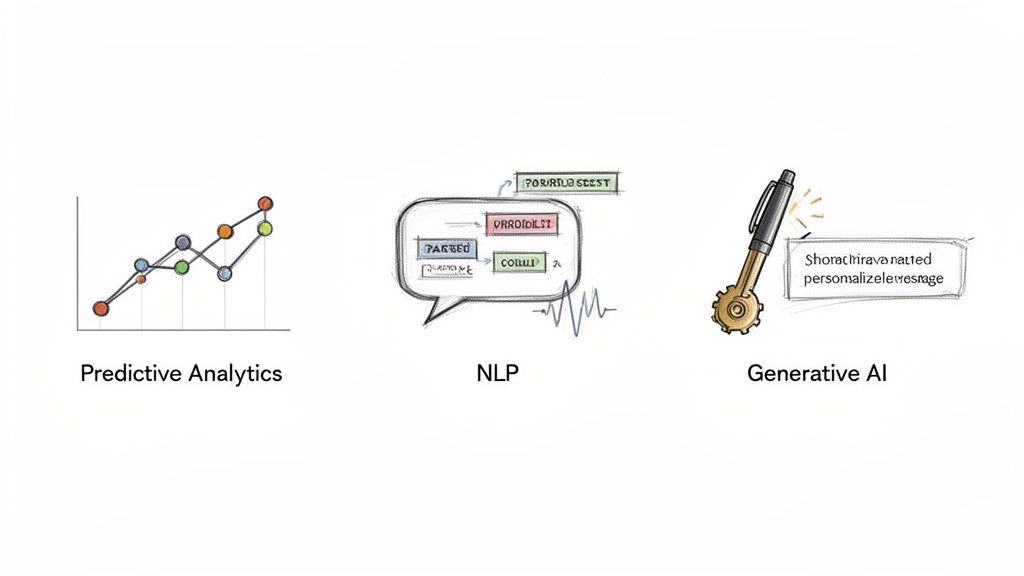
Think of these core AI technologies as specialists on your team, each with a very specific skill set. They often work together, creating a powerful system that shifts your sales strategy from guesswork to data-driven precision.
Predictive Analytics: The Sales Forecaster
Predictive analytics is like a sophisticated weather forecast for your sales pipeline. It digs through mountains of historical data—past wins and losses, client interactions, market trends—to find patterns that point to future outcomes.
This tech answers the big questions: "Which of these 1,000 new leads is most likely to actually close?" or "Which of my existing accounts are at risk of churning?" By scoring each lead, it lets your team pour their energy into the opportunities that have the highest chance of success.
For example, a predictive model might spot that leads from the financial services industry who downloaded a specific whitepaper and visited your pricing page three times have a 90% conversion rate. It then automatically flags any new leads matching this profile, bumping them right to the top of a rep's to-do list.
By analysing past behaviours to forecast future actions, predictive analytics helps sales teams prioritise their efforts, shorten sales cycles, and improve the accuracy of their revenue projections.
Natural Language Processing: The Conversation Analyst
Natural Language Processing (NLP) is the magic that lets machines understand, interpret, and respond to human language. For a sales team, it’s like having a skilled interpreter who can analyse every email, call transcript, and chat message to pull out the hidden meaning.
This is way more than just simple keyword spotting. NLP can pick up on:
- Customer Sentiment: Is the prospect sounding frustrated, excited, or maybe a bit hesitant in their emails?
- Purchase Intent: Are they using language that signals they're ready to buy, like asking about implementation timelines or pricing tiers?
- Key Objections: What are the most common roadblocks or questions coming up during sales calls?
Instead of manually sifting through hundreds of emails, a salesperson can get an instant summary of a prospect's mood and biggest concerns. This lets them tailor their follow-up with incredible precision, addressing unspoken needs and building much stronger rapport.
Generative AI: The Creative Assistant
The newest player on the field, and the one everyone’s talking about, is Generative AI. This is the creative powerhouse that can produce entirely new content—from text and images to even code—based on the data it's been trained on. For sales, it’s like having a tireless and highly skilled creative assistant on call 24/7.
Generative AI shines when it comes to personalisation at scale. While many of these tasks fall under the banner of sales automation, AI adds that crucial layer of intelligence. A key concept to grasp when exploring AI for sales is understanding what is sales automation, as AI often takes these efficiencies to a whole new level.
Imagine needing to write 100 personalised outreach emails. Generative AI can draft every single one, weaving in the prospect's industry, job title, recent company news, and even insights from NLP analysis. It ensures every message feels unique and relevant, which can dramatically increase reply rates. If you want to dive deeper into this topic, you can learn more about the best sales AI tools available in our detailed guide.
Putting AI to Work: Practical Use Cases for Every Sales Stage
Knowing the tech behind AI is one thing, but seeing it deliver real results on the ground is another entirely. The true power of AI for sales teams clicks into place when you apply it to the daily grind of moving a deal from prospect to close. From spotting the most promising leads to navigating a complex negotiation, AI can act as a strategic partner every step of the way.
Let’s get practical and explore four high-impact applications that show how AI stops being a buzzword and starts driving revenue and building stronger relationships.
Intelligent Lead Scoring Finds the Needle in the Haystack
Every sales team knows the feeling: you’re staring at a mountain of leads with only so many hours in the day. Traditional lead scoring, which often just looks at job titles or company size, barely scratches the surface of a prospect's real intent. This is where AI completely changes the game.
Instead of just static data, AI-powered lead scoring dives deep, analysing thousands of data points in real-time. It moves beyond simple firmographics to track behavioural signals—like which pages a prospect lingered on, the whitepaper they downloaded, or how they engaged with your last email. By spotting patterns that mirror your past successful deals, the AI assigns a predictive score to every single lead.
What does this mean for your team? Your SDRs stop wasting time chasing lukewarm leads. Their CRM now automatically surfaces the hottest prospects first, letting them focus 100% of their energy where it actually counts. Imagine your reps starting their day with a prioritised list of ten leads who are already 85% more likely to convert. That's efficiency you can measure.
Hyper-Personalised Outreach at Scale
Let's be honest: generic, one-size-fits-all email blasts are dead on arrival. Today’s buyers expect communication that speaks directly to their world and their problems. Trying to craft those messages manually for hundreds of leads is a recipe for burnout, but Generative AI makes it almost effortless.
AI tools can scan a prospect's LinkedIn profile, recent company news, and past interactions in seconds to draft a message that feels human and relevant. It can reference a recent funding round or a comment they made on a post, creating an opening that feels authentic, not automated. This level of customisation is what gets replies.
AI lets you create a "segment of one." It delivers the kind of bespoke, one-to-one communication that used to be reserved for your top-tier accounts, but now you can do it for your entire pipeline.
Automated Meeting Briefings for Perfect Preparation
Walking into a sales meeting unprepared is the fastest way to lose a deal. Reps often burn hours digging through a prospect's website, professional profiles, and news feeds, searching for that one useful nugget of information. AI automates this entire scavenger hunt, delivering a concise, comprehensive briefing document moments before the call.
These AI-generated briefs can pull together everything you need:
- A summary of all previous emails and call notes.
- Recent company news, like product launches or leadership changes.
- Insights into the prospect’s personality and communication style.
- Potential pain points and smart talking points to address them.
For example, a consultant using Mindreader might see their prospect fits the "Explorer" archetype—someone who gets excited by big-picture ideas and innovation. The AI will then suggest talking points focused on future possibilities rather than getting bogged down in tiny technical details, ensuring the pitch lands perfectly.
Real-Time Call Coaching and Objection Handling
Finally, what if AI could help your reps during a live sales call? Using natural language processing, modern call coaching tools listen in on the conversation, providing discreet, on-screen suggestions to the sales rep in real-time. This is an absolute game-changer for newer team members still learning the ropes.
When a prospect brings up a tough objection, the AI can instantly surface a proven response or a relevant case study, empowering the rep to answer with confidence. It turns every call into a live training session and ensures a consistent, high-quality customer experience. AI also smooths out the tedious admin work that follows a call. Think about integrating speech-to-text with HubSpot; it can effortlessly update CRM records and transcribe client meetings, slashing the time spent on manual data entry.
This on-the-fly support helps reps handle tricky questions with precision and poise. And the confidence in this kind of tech is growing. A recent Deloitte study found that 60% of Southeast Asian employees believe businesses are fully using Generative AI, with 65% expecting it to augment their tasks within five years. In Singapore, this optimism stands at 64%, showing a strong belief in AI's collaborative power. You can discover more about GenAI's impact in the region from Deloitte's report.
These applications prove AI isn’t some far-off concept—it’s a toolkit you can use right now to build a smarter, more effective sales organisation.
How to Build Your AI-Powered Sales Engine
Switching to an AI-powered sales model isn’t as simple as buying new software. It’s more like building a new operational engine from the ground up. The whole process needs a smart, step-by-step approach that starts with your data, gets your people on board, and ultimately reshapes your entire sales culture. If you follow a clear roadmap, you can sidestep the usual traps and make sure your investment actually pays off.
The journey kicks off with the one thing every successful AI project needs: clean, reliable data. Your AI tools are only as sharp as the information you feed them. If your CRM is a mess of incomplete records, duplicate contacts, or outdated info, your AI's predictions and recommendations will be flawed right from the start.
Start with a Solid Data Foundation
Think of your CRM data as the fuel for your new AI engine. Before you can even think about turning the key, you need to make sure that fuel is pure. This means dedicating real effort to cleaning up, organising, and enriching the customer data you already have.
This initial cleanup is non-negotiable. It’s about standardising formats, merging duplicate contacts, and filling in the blanks. Getting this foundation right ensures that when you plug in an AI tool for lead scoring or personalisation, it has accurate, high-quality information to work with. The result? Insights you can actually trust. For a deeper look into streamlining these processes, check out our guide on the synergy between sales and marketing automation.
Choose Tools That Solve Real Problems
Once your data is clean, it's time to pick the right AI tools. The market is saturated with options, and it’s incredibly easy to get sidetracked by flashy features that don't solve anything. Instead, focus like a laser on your team's biggest headaches. Are your reps burning too much time on manual research? Is your lead qualification process leaky and inefficient?
Make a checklist of your most pressing challenges. Then, evaluate potential AI vendors based on how directly their tools solve those specific issues. Don't chase trends. Prioritise tools that offer clear, immediate solutions to your team's daily grind. This problem-first approach ensures you invest in tech that delivers instant value, not just another layer of complexity to your stack.
The diagram below shows how AI can bring order to the key stages of the sales process, turning raw data into intelligence your team can act on.
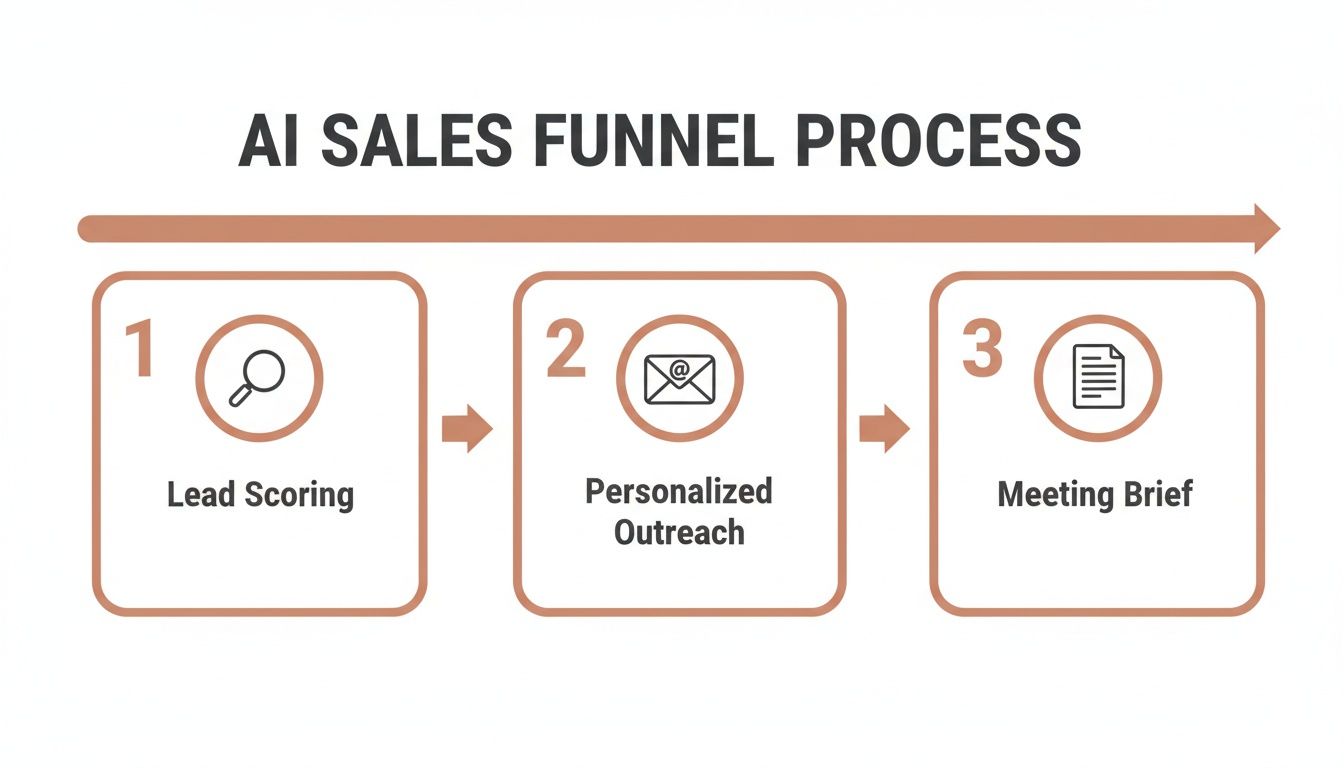
This flow isn’t just theoretical. It illustrates how AI transforms a chaotic funnel into a streamlined, intelligent engine that points reps toward their most valuable activities.
Empower Your Team with Training and Onboarding
Technology alone won't get you there; your people will. The single most critical factor in any AI implementation is user adoption. If your team doesn't understand, trust, or feel confident using the new tools, even the most powerful platform will collect digital dust.
You need a comprehensive training programme that’s grounded in practical, real-world application. Show your reps exactly how the AI will help them save time, walk into meetings better prepared, and ultimately close more deals. Move beyond dry technical tutorials and focus on building their confidence. Show them the direct benefits to their daily workflow and, yes, their commissions.
The goal of training isn't just to teach reps how to use a tool, but to inspire them by showing them why it makes their jobs better. Focus on outcomes, not just features.
Foster a Culture of Change and Experimentation
Finally, bringing AI for sales teams into the fold demands a cultural shift. You need to encourage a mindset of continuous learning and experimentation. Not every AI-driven tactic is going to be a home run on the first swing. It's crucial to create a safe environment where reps can test new approaches, share what’s working, and learn from what isn’t—without fear of blame.
Leadership has to champion this change from the top down, celebrating early wins and reinforcing the long-term vision. This is especially true in dynamic markets like Singapore, where sales teams are riding a massive wave of AI investment. Over the past year through H1 2025, Southeast Asia saw more than $2.3 billion poured into over 680 AI startups. Singapore is leading the charge with $1.31 billion and a stunning 55% funding growth from H2 2024 alone. This flood of capital makes it clear: adapting is no longer optional.
Overcoming resistance is key. Address concerns head-on, be transparent about the goals, and actively involve your team in the rollout. When your salespeople start to see AI as a partner in their success, you’ve built an engine that’s truly ready for the future.
Measuring the ROI of Your Sales AI Investment
So, you’ve brought AI into your sales process. How do you actually prove it’s working? To keep the investment going and show real business impact, you have to look past the flashy dashboards and focus on the numbers that truly matter to the people holding the purse strings.
Measuring the return on investment (ROI) isn't about finding one magic number. It’s about building a solid business case by tracking improvements across three distinct but deeply connected areas: efficiency, effectiveness, and the human element of your team.
1. Quantifying Efficiency Gains
The first place you'll see AI make a difference is in the daily grind. It smooths out workflows, and these efficiency metrics are usually the easiest to track, offering a clear picture of how much time and manual effort your team is getting back.
Think of it like this: AI becomes an automated assistant, scooping up all the repetitive, low-value tasks that bog reps down. Our own research shows that sellers can spend a staggering 70% of their time on administrative duties. When you measure how much of that time AI reclaims, you can calculate a direct ROI in pure productivity.
Here are the key efficiency metrics to watch:
- Time Saved on Manual Research: Track the average hours your reps save each week on things like pre-call digging and data entry. At Microsoft, some teams using AI are saving an average of four hours per week for every single seller.
- Volume of Qualified Leads Processed: How many more high-quality leads can your SDRs actually engage now that AI is handling the initial filtering and prioritisation? Measure that increase.
- Reduction in Admin Tasks: Quantify the drop in time spent on CRM updates, report generation, and transcribing call notes.
2. Tracking Effectiveness Lifts
Efficiency is about doing things faster, but effectiveness is about getting better results. This is where AI’s strategic value really comes to life, because it directly impacts the core activities that generate revenue and move you closer to your most important sales targets.
These metrics prove that AI isn’t just making your team quicker; it’s making them smarter and more successful. For example, one business group at Microsoft saw sellers using AI generate 9.4% more revenue per seller.
Keep a close eye on these effectiveness KPIs:
- Higher Conversion Rates: Is your lead-to-opportunity conversion rate ticking up? Are you closing a higher percentage of the opportunities you create?
- Shorter Sales Cycles: Measure the average time it takes to get a deal from first contact to signed contract. AI-driven insights should be speeding this up.
- Increased Average Deal Size: By surfacing deeper insights into what a customer truly needs, AI helps reps spot upselling and cross-selling opportunities that lead to bigger contracts.
The ultimate goal is to draw a straight line from AI adoption to revenue. When you track these effectiveness metrics, the conversation shifts from "how much time are we saving?" to "how much more money are we making?"
3. Assessing Team Enablement and Adoption
A powerful tool is useless if nobody uses it. This is the final, and most crucial, piece of the ROI puzzle. Measuring how your team adopts the technology and gathering their feedback is the only way to know if the tool is genuinely helping them win.
Low adoption is a huge red flag. It means the tool isn’t solving a real-world problem, or maybe the training just wasn't good enough. Track hard numbers like weekly active users and which features are getting the most use inside the AI platform.
But don’t stop there. The qualitative feedback is just as important. Run regular surveys and have one-on-one chats to understand how reps feel about the AI. Are they walking into meetings with more confidence? Do they feel better prepared to handle tough objections? This is the context that gives meaning to the numbers and helps you build a culture where technology truly empowers your people.
To put this shift in perspective, it helps to see how the metrics themselves are changing. AI doesn't just improve old KPIs; it introduces new ways to measure what 'good' looks like.
Evolving Sales Metrics From Traditional to AI-Augmented
This table shows how key performance indicators for sales teams evolve with AI tools, shifting the focus from pure activity to intelligent outcomes.
| Metric Area | Traditional KPI | AI-Augmented KPI |
|---|---|---|
| Lead Management | Number of leads contacted | Lead-to-opportunity conversion rate (by AI-generated score) |
| Sales Activity | Number of calls made or emails sent | Time saved on administrative tasks (e.g., CRM updates, research) |
| Pipeline Health | Total pipeline value | Pipeline velocity (how quickly deals move through stages) |
| Deal Success | Win rate (overall) | Win rate for AI-recommended actions or talk tracks |
| Customer Engagement | Number of meetings booked | Meeting outcome effectiveness (e.g., conversion to next stage) |
| Team Performance | Quota attainment | Increase in average deal size through AI-identified upsell/cross-sell opportunities |
| Onboarding | Time to first deal | Speed to productivity (time for a new rep to consistently hit targets using AI) |
Ultimately, the shift is from measuring effort to measuring impact. Instead of just counting calls, you're tracking how those calls, now supercharged with AI insights, are turning into real revenue faster than ever before.
Using Sales AI Ethically and Building Customer Trust
Diving into AI for sales brings a serious responsibility to the table. Yes, these tools are brilliant at spotting opportunities and personalising outreach, but they demand a real commitment to ethical practices. Long-term success isn't just about clever algorithms; it's built on the customer trust that every healthy business relationship relies on.
This means being upfront and always putting the customer first. Using AI ethically is about making interactions better, not manipulating them. It calls for a thoughtful game plan for data privacy, transparency, and dealing with the ever-present risk of algorithmic bias.
Navigating Data Privacy and Transparency
People are savvier than ever about how their data is used. When you bring in AI to analyse their behaviour or guess their needs, you have to be ready to be open about it. This doesn't mean you have to lay out your entire sales playbook, but it does mean being honest if a customer asks.
Transparency can be a huge trust-builder. Simply saying that you use technology to better understand customer needs can make your team seem thoughtful and modern, not intrusive. The key is making sure that data is used to give genuine value back to the customer, like more relevant recommendations or a less painful buying process.
Trust is the currency of modern sales. An AI strategy without a clear ethical framework is a liability waiting to happen, potentially damaging customer relationships and brand reputation beyond repair.
Maintaining the Human Element
Maybe the most important rule of thumb is this: AI is the co-pilot, not the pilot. AI-driven suggestions are powerful, but they always need to be filtered through human judgment, empathy, and gut instinct. A great salesperson's intuition is something you just can't replace.
Here are a few practical ways to keep your team grounded:
- Always Validate AI Insights: Before jumping on an AI suggestion, reps should ask themselves, "Does this actually make sense for this specific person and the relationship we have?"
- Avoid Over-Automation: Never let an AI run a whole customer relationship on autopilot. Those personal, human touchpoints are where you build real rapport.
- Be Accountable: If an AI-powered interaction feels cold or off to a customer, the salesperson needs to own it completely and make it right.
Mitigating Algorithmic Bias
AI models learn from the data you feed them. If your past sales data has hidden biases—maybe favouring certain industries or demographics—your AI will learn and even amplify those same biases. This can lead you to unintentionally ignore great prospects or completely misread what a customer needs. You can see how similar biases are tackled in other fields by reading about the ethics of face analysis for job applications.
It's crucial to regularly audit your AI tools and the data they run on. You need to actively hunt for skewed outcomes and retrain your models with more diverse, balanced data. By using AI for sales teams responsibly, you give your people the power to build stronger, more lasting customer relationships that will drive growth for years to come.
Got Questions About AI for Sales? We’ve Got Answers.
As AI becomes a bigger part of the sales conversation, it’s only natural for leaders and reps to have some questions. Getting to grips with how it all works—from setup to cost to the actual impact on your team—is the first step to making a smart decision. Let's tackle some of the most common ones we hear.
A big one is always about the setup time. You might be picturing a months-long IT nightmare, but most modern AI sales tools are built to get you up and running fast. Cloud-based platforms can often be set up in a few days, focusing on a smooth connection with the CRM you already use, provided your data is in decent shape.
How Does AI Actually Work with Our CRM?
This is a critical point. The best AI sales platforms aren't trying to replace giants like HubSpot or Salesforce; they're built to make them better. They typically use secure connections (APIs) to create a two-way street for information. The AI pulls your customer data for analysis, then pushes genuinely useful insights right back into the contact records your team lives in every day.
The whole idea is to enhance your team's existing workflow, not blow it up. When it's done right, the AI feels like a natural extension of your CRM, giving reps the intelligence they need without making them learn a whole new system.
A common worry we hear is, "Will AI take our sales jobs?" The short answer is no. Think of it as an assistant, not a replacement. AI is brilliant at handling the tedious, administrative stuff that drains your sellers' time. This frees them up to focus on what humans do best: building real relationships, thinking strategically, and navigating the nuances of a complex deal.
What’s the Real Cost and What Kind of ROI Can We Expect?
Pricing for AI tools varies, from monthly per-user subscriptions to larger enterprise packages. But focusing only on the price tag misses the bigger picture. The real question is about the return you get, not just in closed deals but in reclaimed time.
Look at Microsoft; some of their sales teams using AI assistants are saving each seller an average of four hours per week. Now, multiply that by the number of reps on your team. The productivity gains alone can often justify the cost, and that's before you even factor in the higher win rates and bigger deals that come from smarter selling. It's less about the expense and more about the value it creates.
Ready to stop guessing and start connecting with clients on their terms? See how Mindreader uses archetype-based AI to give your sales team the exact talking points and tactics needed to build trust and close deals faster. Prepare for your next high-stakes conversation in seconds by visiting https://www.themindreader.ai.