A Guide to Face Analysis for Job Interviews and Sales
Face analysis in professional settings isn't about making snap judgments. Think of it as a tool that helps decode someone's communication style and engagement level by looking at their facial cues. It provides data-driven insights that help professionals build real rapport and adapt their approach on the fly, making it a key advantage for streamlining hiring and supercharging sales conversations.
Why Face Analysis Is Becoming a Professional Tool
Not long ago, the idea of analysing faces at work felt like something out of a science fiction movie. Today, it’s a practical tool that helps businesses understand people on a deeper level. It's like having the intuition of a seasoned expert, but backed by objective data.
This technology isn’t about deciding if someone is “good” or “bad.” Far from it. Instead, it decodes the non-verbal signals that reveal how an individual prefers to communicate. This opens the door to more meaningful and effective interactions, whether you're talking to a potential new hire or a major client.
Decoding Communication for Better Outcomes
The main reason to use face analysis for job-related tasks is to get a clearer picture of an individual's communication preferences. Armed with this insight, professionals can tailor their approach for maximum impact.
For example, in a sales pitch, knowing whether a prospect is more analytical or relationship-driven can completely change how you frame your value proposition. This simple shift leads to more productive conversations and helps you cut through the noise in a crowded market. You can learn more about how to instantly discover buyer preferences with facial AI in our detailed guide.
Face analysis provides a roadmap to another person's communication style. It’s not about reading their mind, but about understanding their preferred language of interaction so you can connect more authentically.
A Growing Trend in Professional Settings
The adoption of AI-powered tools is picking up speed, especially in forward-thinking markets. Here in Singapore's competitive job market, face analysis is gaining serious traction. With the local facial recognition market set to grow significantly, it's no surprise that 94% of Singaporean employers believe their companies will be AI-driven by 2028. This signals a huge shift where tools that analyse facial cues could reshape both recruitment and sales.
This technology is a game-changer for B2B sales reps and founders who are tired of high ghosting rates. By understanding a prospect’s communication style right from their public profiles, tools like Mindreader’s Human Intelligence System (HIS) can help boost reply rates and melt away objections in high-stakes calls.
It's also worth noting that advanced facial analysis is bolstering security and trust. For instance, using a biometric-first approach to reducing fraud risk shows why this technology is becoming so important beyond just communication insights. It helps build a foundation of trust and verification in our increasingly digital business world.
Let's take a quick look at how these applications play out in recruitment and sales.
Key Applications of Facial Analysis in Business
| Application Area | Primary Goal | Example Use Case |
|---|---|---|
| Recruitment & Hiring | Assess candidate communication style and cultural fit. | An AI-powered tool analyses a candidate's video interview to provide insights on their problem-solving approach and collaborative tendencies. |
| Sales & Client Relations | Understand prospect preferences to tailor pitches. | A sales rep uses an AI tool to analyse a prospect's LinkedIn photo to prepare a personalised outreach message that resonates with their communication style. |
As you can see, the focus is on creating better alignment and stronger connections from the very first interaction.
How AI Learns to Read a Face
So, how does an AI actually perform a face analysis for job interviews or sales calls? It helps to think of it as a digital detective learning to spot the most subtle, often invisible, clues. The technology doesn't have human intuition. Instead, it relies on complex algorithms trained on massive datasets to recognise patterns in our facial structures and movements.
The process starts with teaching the AI to map a human face. It learns to identify key anchor points—like the corners of your mouth, the arch of your eyebrows, and the shape of your nose—to create a dynamic digital blueprint. This map is the foundation for understanding everything else that follows.
From there, the AI analyses how these points move in relation to each other. A slight lift of an eyebrow or a brief tightening of the lips aren't just random movements; they're data points. When combined, they start to tell a story about a person's state of mind or communication style.
The Geometry of Expression
The first layer of analysis is all about identifying facial landmarks. An AI model is trained to pinpoint dozens, sometimes hundreds, of specific coordinates on a person’s face. Picture a connect-the-dots puzzle that creates a detailed geometric model of the face in real-time.
But this isn't a static picture. The AI constantly measures the distances and angles between these landmarks. When you smile, the distance between the corners of your mouth and the outer corners of your eyes shortens. When you frown, the space between your eyebrows narrows. These tiny geometric shifts are the raw data the AI uses to interpret expressions.
For example, a wider eye-opening combined with a raised brow might signal surprise or keen interest. A subtle, one-sided smile could indicate a touch of scepticism. By quantifying these changes, the AI moves from simply seeing a face to understanding the mechanics behind its expressions. This map below breaks down how these insights are applied in professional settings.
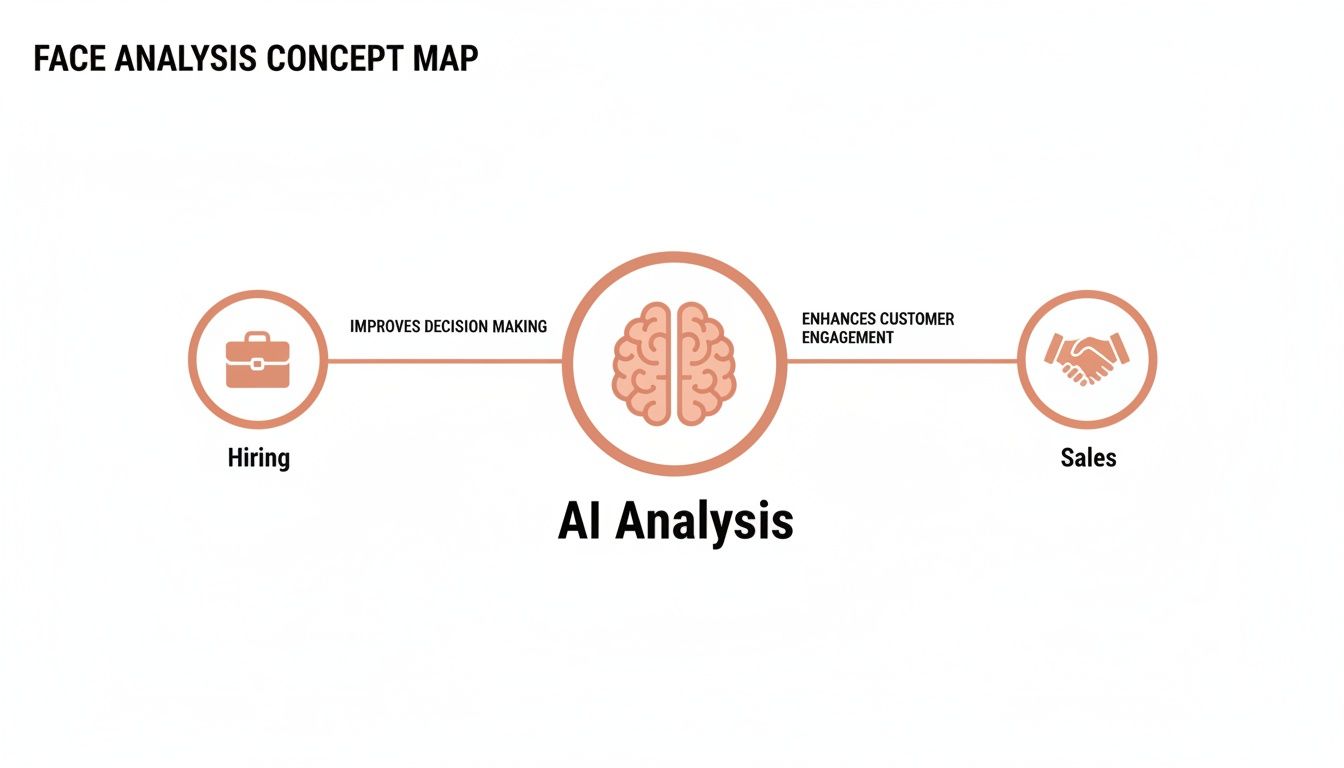
As the visualisation shows, this AI analysis acts as a central engine. It branches out to serve distinct goals in hiring and sales—optimising decisions in one and deepening engagement in the other.
Detecting Involuntary Clues
Beyond the expressions we consciously make, the AI is trained to spot micro-expressions. These are fleeting, involuntary facial movements that last for just a fraction of a second, often revealing a person's genuine emotional response before they even have a chance to mask it.
Micro-expressions are like emotional leakage. They offer a brief, unfiltered glimpse into someone's true feelings, making them an incredibly valuable source of information for understanding underlying drivers and potential objections.
Because these reactions are so quick—sometimes lasting as little as 1/25th of a second—they are nearly impossible for the untrained human eye to catch consistently. An AI, however, can analyse video frame by frame to detect these subtle flickers with ease.
This is the capability that allows tools to move beyond a surface-level analysis. It's the difference between hearing someone say "that's interesting" and knowing whether they mean "I'm genuinely intrigued" or "I have serious doubts." For a deeper look, check out our guide on building accurate facial AI for personality prediction.
From Data to Actionable Archetypes
The final, and most critical, step is translating this wealth of data into a practical framework. A sophisticated system like Mindreader doesn't just report isolated data points like "eyebrows raised by 15%." It synthesises thousands of these signals—from facial geometry, micro-expressions, and even language patterns—to build a coherent, useful profile.
This synthesis leads to the creation of communication archetypes, such as the Knight or the Explorer. Each archetype represents a distinct communication style and a unique set of preferences.
- The Knight: Might exhibit facial cues associated with directness and decisiveness, preferring a straightforward, bottom-line approach.
- The Explorer: May show more expressions linked to curiosity and openness, responding well to innovative ideas and future-focused discussions.
This translation from raw data into actionable archetypes is what makes face analysis for job tasks so powerful. It gives professionals a simple yet profound guide to adapting their communication, building rapport, and ultimately achieving better outcomes in their high-stakes conversations.
So, you understand the theory behind face analysis. But what does it actually look like in the real world? This is where the technology stops being a collection of abstract data points and becomes a powerful tool for connection and preparation, especially when the stakes are high.
It's not about letting an algorithm make decisions for you. Think of it more as a guide that sharpens your own judgment. By giving you a deeper read on someone's communication style before you even start talking, these tools help you build rapport faster and walk into any interaction with a lot more confidence.
Let's look at two completely different scenarios to see how this plays out.
Efficient Screening in Modern Hiring
Recruitment is a tough game. Finding the right person for a role is about so much more than just ticking off skills on a CV. Recruiters need to find people with the right behavioural traits and communication styles that fit the job's demands. This is where face analysis for job screening can make a huge difference.
Picture this: a company needs to hire someone for a stressful client support role. They need people who are resilient, empathetic, and can communicate clearly under pressure. The recruiter gets dozens of video applications and uses an AI tool to help sift through them.
- The system isn't making the hiring decision.
- Instead, it flags candidates whose non-verbal cues—like staying composed while talking about a tough problem or showing facial expressions linked to active listening—suggest they have the right stuff.
- This lets the recruiter focus their time on a shortlist of people who not only have the right experience but also show the soft skills needed to thrive.
The whole screening process becomes far more efficient, freeing up HR teams to have deeper, more meaningful conversations with the strongest candidates.
Using face analysis in hiring isn't about finding a "perfect" candidate. It's about efficiently identifying individuals whose communication patterns are naturally suited to the demands of a specific role, leading to better-informed interview shortlists.
Singapore's hiring scene is quickly embracing these kinds of technologies. A staggering 79% of companies report struggling to fill roles, pushing many toward Applicant Tracking Systems (ATS) and biometrics. Globally, some platforms claim they can speed up hiring by up to 90% by processing thousands of facial elements. For account executives and founders using Mindreader’s HIS, this ability to decode a prospect's digital footprint into a clear playbook is a game-changer, especially with around 700 firms worldwide testing similar tools. To get a better sense of this trend, you can explore detailed findings on hiring systems in Singapore.
Tailoring the Pitch for High-Stakes Sales
Now, let's switch gears to a sales meeting. A financial advisor is prepping for a big conversation with a high-net-worth prospect. The advisor's usual pitch is conservative and safe, all about stability and managing risk. It's a solid approach that has worked plenty of times before.
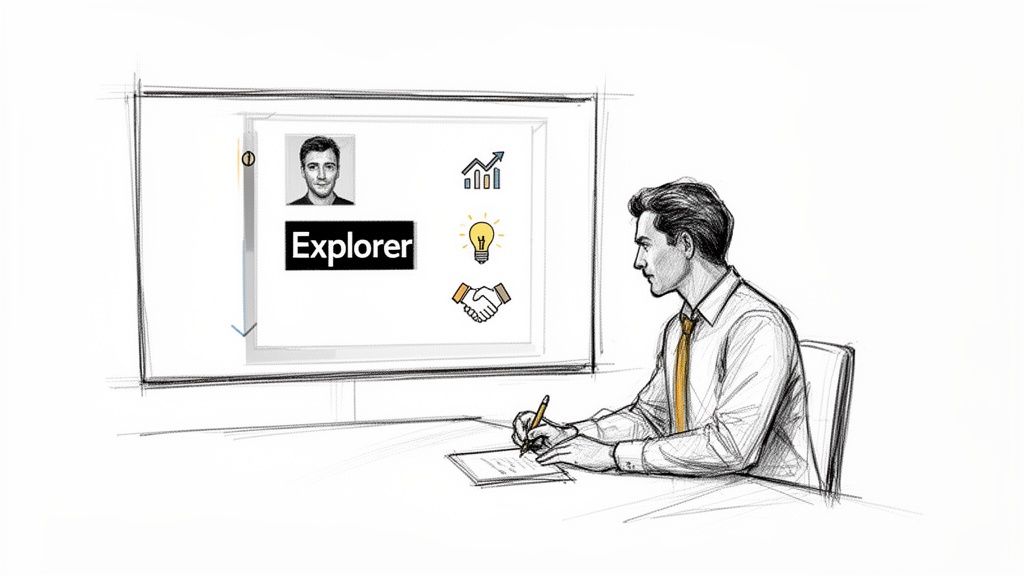
But this time, before the meeting, the advisor uses Mindreader. They analyse the prospect’s public videos—maybe a recent talk from a conference posted online. The system crunches the prospect's facial cues and communication patterns and identifies them as an 'Explorer' archetype. Explorers are all about innovation, growth, and big, forward-thinking ideas.
This one little insight changes everything.
The advisor immediately realises their standard, safety-first presentation would be a total dud. They scrap it and rebuild their pitch from the ground up to connect with that Explorer mindset.
- The Opener: They kick off with a bold vision for where the market is headed, not a dry review of past performance.
- The Core Message: They spotlight innovative investment opportunities and data-backed growth projections instead of just talking about protecting capital.
- The Close: The call to action is framed as a chance to be on the cutting edge of a new economic trend, speaking directly to the prospect’s inner pioneer.
By using face analysis to truly understand the person across the table, the advisor turned a conversation that could have been a mismatch into one that felt deeply personal and exciting. This is a perfect example of how the technology helps you adapt, build real trust, and move beyond a generic script to create a connection that actually means something.
Face Analysis in Action: Hiring Versus Sales Prep
While the underlying technology is similar, its application in hiring versus sales prep is worlds apart. One is about broad-stroke filtering for role suitability, while the other is about creating a deeply personalised strategy for a single, high-value interaction.
Here's a quick comparison to make the distinction clear:
| Aspect | Application in Hiring | Application in Sales (via Mindreader) |
|---|---|---|
| Primary Goal | Efficiently screen large candidate pools for role-specific soft skills and communication styles. | Develop a hyper-personalised communication strategy to build rapport with a specific prospect. |
| Focus | Identifying general behavioural traits (e.g., resilience, empathy) across many individuals. | Understanding one person’s unique archetype (e.g., Explorer, Wizard) to tailor the pitch. |
| Output | A filtered shortlist of candidates who appear to be a good fit for further human-led interviews. | An actionable playbook with specific talking points, messaging angles, and a strategic approach for a meeting. |
| Ethical Guardrail | Augments recruiter judgment; never used as the sole decision-making factor for hiring. | Used for preparation and strategy; helps the salesperson adapt their style to connect more effectively. |
In hiring, the tool acts like a powerful filter, helping recruiters find needles in a haystack. In sales prep, as with Mindreader, it acts more like a compass, giving you the precise direction needed to navigate a crucial conversation and build a genuine connection.
Navigating the Ethical Challenges of AI Analysis
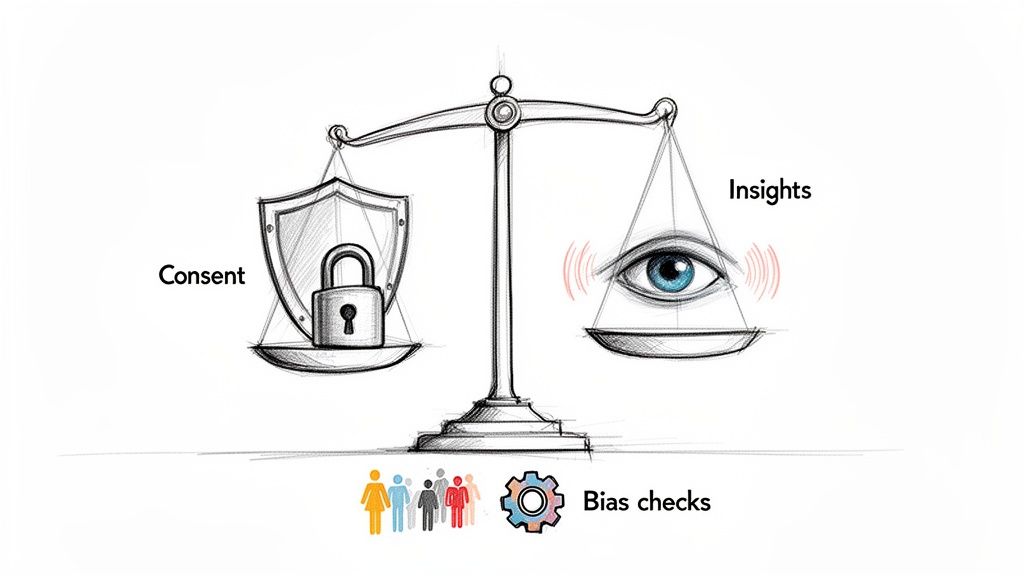
As powerful as face analysis for job applications can be, it's a technology that walks a fine ethical line. Like any powerful tool, its real impact comes down to how it's used. The conversation has to be about more than just what the tech can do—it needs to be about doing it responsibly, with systems built to be fair, transparent, and respectful of every individual.
The biggest hurdle is algorithmic bias. Let's be clear: an AI model is only as good as the data it learns from. If that data mostly shows one demographic, the algorithm is going to be less accurate when interpreting signals from people of different backgrounds. This can create unfair disadvantages, and it's not a hypothetical problem; it’s a known challenge across the entire AI industry.
This is exactly why the purpose of the analysis is so crucial. When a tool is used to make a final judgement call on someone's character or potential, the risk of bias causing real harm shoots way up. But when the focus shifts to simply understanding someone’s communication style to better connect with them, the tool becomes a bridge instead of a gatekeeper.
The Shadow of Human Bias
One of the sneakiest forms of bias is what’s known as "attractiveness discrimination." It’s an uncomfortable truth, but we humans are often subconsciously swayed by physical appearance. Without careful design, this bias can easily get baked right into an AI system, creating a huge ethical problem for any face analysis for job applications.
Research from Singapore shows just how deep this prejudice runs. Studies on 'attractiveness discrimination' found that good-looking candidates can earn about 20% more than their peers. This isn't just a local quirk; it’s rooted in evolutionary psychology and is surprisingly consistent across different ethnic groups. This is precisely why ethical AI has to do more than just automate our own flawed thinking. You can read the full research on workplace attractiveness biases to see the full picture.
Truly ethical platforms have to actively fight this. The only way forward is to build systems that are explicitly blocked from making judgements based on static features like attractiveness. The focus must be on dynamic, communication-related cues—insights about style, not appearance.
The Non-Negotiable Need for Privacy and Consent
Beyond bias, data privacy is the absolute bedrock of ethical AI. When using face analysis for job interviews or screening, getting explicit consent isn't just a nice-to-have; it's a legal and moral must. Candidates need to be told in plain language what data is being collected, how it’s being analysed, and why.
Transparency is everything. People have a right to know if an algorithm is part of the hiring process. Of course, this works a bit differently when you're looking at publicly available information, like a professional's video on LinkedIn to prepare for a sales call. In those cases, ethical platforms like Mindreader analyse signals for communication insights without storing personal data, keeping things well within privacy boundaries.
The golden rule for ethical AI is simple: Analyse to Adapt, Not to Judge. The goal should always be to foster better understanding and communication, never to label or exclude individuals based on algorithmic assessments.
This simple principle ensures technology serves to empower people, not discriminate against them. For a deeper look at this critical topic, check out our guide to ethical AI and facial recognition.
How Ethical Platforms Mitigate Risks
Building a responsible AI tool isn't an afterthought; it requires weaving safeguards directly into the architecture from day one. You can't just hope for the best. You have to actively design systems to minimise harm and promote fairness.
Here are the core strategies that ethical platforms put into practice:
- Focus on Communication Style: The system’s output is all about how someone communicates (e.g., are they direct, inquisitive, or empathetic?), not about judging their personality, honesty, or skills.
- Avoid Definitive Judgments: Instead of a "pass/fail" score or a rigid personality label, the tool offers a communication archetype—a simple framework for building rapport.
- Human in the Loop: The insights are there to augment human intelligence, never replace it. The AI provides the data, but a person makes the strategic call.
- Bias Auditing: The algorithms are constantly tested and audited against diverse datasets to find and fix potential biases related to age, gender, and ethnicity.
When these principles are followed, face analysis technology can be a powerful force for good. It can help professionals break down communication barriers, build stronger relationships, and navigate complex conversations with far more empathy and awareness.
How to Bring Face Analysis Tools into Your Workflow—Responsibly
Adopting any new technology, especially one as sensitive as face analysis for job applications and sales prep, requires a thoughtful strategy. A successful rollout isn't just about flipping a switch; it's about building a framework that champions fairness, transparency, and human oversight. The goal is to create a process your team trusts and your clients or candidates respect.
It all starts with a clear vision. This kind of technology should always be seen as a supportive tool—something that augments professional judgement, not replaces it. By establishing this principle from day one, you set the stage for a responsible and effective implementation.
Choosing the Right Technology Partner
The first and most critical step is picking a vendor that aligns with your ethical standards. Let's be clear: not all face analysis tools are created equal. Digging deep into a provider's methodology and data policies is non-negotiable before you even think about signing a contract.
When you're evaluating potential partners, you need to ask tough questions that go beyond their sales pitch. Your due diligence should zero in on their commitment to fighting bias and protecting privacy. A partner you can trust will be transparent and ready with clear answers.
Here are a few essential questions to guide your search:
- How do you mitigate algorithmic bias? Ask for a detailed explanation of their process for auditing algorithms for fairness across different demographics.
- What is your data privacy policy? You need to know exactly what data is stored, for how long, and how it’s protected. For sales prep, a crucial question is whether the tool analyses public data without storing it.
- Is the output focused on communication style or judgment? Make sure the tool provides insights to help adapt communication, not definitive labels or scores about a person's character or abilities.
Choosing a vendor that openly addresses these concerns is the foundation of building a responsible AI practice.
Training Your Team for Success
Once you’ve found the right tool, your next priority is your people. Solid training is crucial to ensure everyone understands the technology's capabilities and, just as importantly, its limitations. This is how you prevent misuse and build internal confidence.
The training must hammer home the point that the AI's insights are just a single data point, not the final word. The professional always remains in control, using the information to inform their strategy.
Think of the AI as a scout that brings back valuable intelligence from the field. It’s up to the commander—the sales professional or recruiter—to analyse that intelligence and decide on the best course of action.
This approach keeps the human element at the heart of every decision. It frames the tool as a powerful assistant, empowering your team to make smarter choices without giving up their own expertise and responsibility.
Establishing Clear Guidelines for Use
Finally, you need to create and document clear internal guidelines for using the technology. A formal policy ensures consistency, manages expectations, and gives everyone a reference point for ethical decision-making. These guidelines should be practical and easy to follow.
Consider outlining specific do's and don'ts for different scenarios:
- For Hiring: Specify that AI insights can be used to inform interview questions but must not be used as the sole reason to advance or reject a candidate.
- For Sales Prep: Clarify that the tool is for understanding communication styles to prepare for meetings. It should never be used to make assumptions about a prospect’s intent or character.
- For Data Handling: Reinforce your company’s commitment to privacy, reminding the team to only analyse data obtained ethically and legally, like a prospect's public professional profile.
By taking these measured steps—choosing the right partner, training your team thoroughly, and setting clear rules—you can implement face analysis for job-related tasks in a way that is both effective and ethical.
The Mindreader Method for Building Connections
Theory is one thing, but putting it into practice is what really counts. A responsible and effective approach to face analysis for job-related tasks has to move beyond generic scores and give you a real, actionable strategy. It's not just about flagging signals; it's about translating those signals into a clear plan for building genuine human connections. That’s the entire philosophy behind Mindreader's Human Intelligence System (HIS).
The platform was built for one simple purpose: to help professionals get ready for high-stakes conversations in seconds. It looks at a prospect’s public digital footprint—combining facial signals from videos with language cues from text—to build a clear communication profile. This gives you the insight needed to adapt your approach and build rapport before you even say hello.
From Data Points to Powerful Archetypes
Instead of giving you a vague personality assessment, Mindreader profiles people into one of four powerful archetypes. Each one represents a distinct communication style, giving you a simple but incredibly effective framework for how to approach your conversation.
Think of these archetypes not as rigid labels, but as practical guides to understanding how someone prefers to receive and process information.
- Knight: Direct, decisive, and focused on the bottom line. They appreciate efficiency and want you to get straight to the point.
- Explorer: Innovative, curious, and future-oriented. They get excited by big ideas, data-backed possibilities, and conversations about growth.
- Healer: Empathetic, relationship-focused, and collaborative. They value trust, harmony, and solutions that benefit everyone involved.
- Wizard: Analytical, logical, and detail-oriented. They need to understand the "how" and "why" behind everything and value a well-reasoned argument.
Knowing which archetype you're talking to instantly clarifies your strategy. You can tailor your messaging, your pace, and even the kinds of questions you ask to create a conversation that just clicks.
Turning Insights Into Concrete Tactics
Where the Mindreader approach really shines is in how it turns these archetypes into specific, actionable advice. The platform doesn't just tell you someone is a "Knight"; it hands you a playbook of messaging tactics tailor-made for that style.
This method is all about preparing smarter, not harder. It transforms pre-call anxiety into quiet confidence by arming you with a clear understanding of the person you're about to meet, allowing you to connect authentically.
Imagine you're prepping for a call and the system flags your prospect as a Wizard. The recommended game plan would be completely different from how you'd approach an Explorer.
Example Playbook for a 'Wizard' Prospect
- Messaging Tactic: Lead with data and evidence. Skip the emotional language and focus on logical, step-by-step explanations.
- Pacing: Allow plenty of time for questions. For a Wizard, asking a lot of questions is a sign of engagement, not resistance.
- Objection Handling: Address their concerns with detailed information and case studies. Be ready to back up every single claim you make.
This level of preparation helps you anticipate what they need, handle objections with precision, and build momentum from the very first interaction. For those looking to build even stronger connections, digging into related topics like how to improve eye contact can complement these advanced communication techniques. By understanding your audience and refining your own non-verbal signals, you create a powerful formula for building trust and closing more deals.
Your Questions, Answered
Jumping into the world of face analysis for hiring or sales prep understandably brings up a few big questions. Let's tackle the most common ones head-on, giving you clear, straightforward answers about the legal, ethical, and practical sides of this technology.
Is It Legal to Use Face Analysis for Job Interviews in Singapore?
Yes, but it's not a free-for-all. Everything is guided by strict data privacy laws like the Personal Data Protection Act (PDPA). The two most important principles are transparency and consent. You can't just spring it on people.
If you're using it for hiring, candidates must be told that AI analysis is part of the process and they have to agree to it. It's non-negotiable.
For sales preparation, where you might be analysing a prospect’s public LinkedIn video, the approach is different. Ethical platforms focus on giving you communication insights without ever storing that sensitive personal data, keeping everything well within legal boundaries.
Can AI Facial Analysis Technology Be Biased?
Absolutely, and this is something any responsible developer has to take very seriously. If an AI model is trained on a dataset that isn't diverse, it can easily end up amplifying the exact human biases we’re trying to avoid. This is a huge ethical red flag for the entire AI field.
The best way to guard against bias is to make sure AI is there to inform human decisions, not make them for us. Its insights should be just one piece of the puzzle, helping professionals make fairer, more complete judgements.
This is exactly why it’s so important to partner with a technology provider who is upfront about how they fight bias. Look for a team that’s committed to constantly auditing their algorithms—it’s a clear sign you’re dealing with an ethical platform.
How Is This Different From a Personality Test like DISC or Myers-Briggs?
Great question. While personality frameworks like DISC or Myers-Briggs are useful for painting a broad picture of someone's general tendencies, they give you a static report. Tools like Mindreader, on the other hand, are built for the here and now—for immediate, practical use in sales and professional communication.
Instead of a fixed profile, Mindreader’s system analyses current digital signals to give you actionable tactics for a specific conversation. You get advice tailored to your prospect’s unique communication style, helping you craft the right message, strike the right tone, and anticipate objections.
It’s about preparing in minutes, not hours, so you walk into every conversation with a clear strategy to build genuine rapport from the get-go.
Ready to stop guessing and start connecting? Mindreader gives you the actionable insights to understand your clients' communication styles in seconds. See how our Human Intelligence System can help you build rapport, handle objections, and close more deals by visiting https://www.themindreader.ai.