The Top 12 Sales AI Tools to Close More Deals in 2025
The world of sales is no longer just about intuition and charisma; it's increasingly driven by data-informed strategy. The right sales AI tools can transform your process, automating tedious tasks, uncovering deep customer insights, and predicting outcomes with remarkable accuracy. This allows you and your team to focus on what truly matters: building relationships and closing deals. However, with a vast array of platforms available, each claiming to revolutionise your workflow, choosing the correct one can feel overwhelming.
This guide is designed to cut through the noise. We will provide a comprehensive, in-depth analysis of the top sales AI tools on the market, organised by their primary function so you can find exactly what you need. Whether you're looking to enhance your outreach, gain intelligence from conversations, score leads more effectively, or personalise communication at scale, we have you covered. The goal is to equip you with the knowledge to select a tool that integrates seamlessly into your existing tech stack and delivers a tangible return on investment.
Inside this resource, you will find:
- Detailed breakdowns of each platform’s core features and limitations.
- Practical, real-world use cases to show how these tools perform on the ground.
- Direct links and clear screenshots for every tool we analyse.
We will explore everything from comprehensive CRM-integrated AI to specialised assistants for specific sales functions. To better understand the diverse landscape of intelligent tools available, exploring top AI chatbot platforms can also offer insights into conversational AI's expanding role in the sales cycle. Let's dive in and find the perfect AI-powered addition to your sales toolkit.
1. Mindreader
Mindreader positions itself as a premier communication AI, engineered specifically to give high-stakes sales professionals a decisive edge. It moves beyond generic analytics to offer a proprietary Human Intelligence System (HIS) that translates a prospect's communication signals into a practical, repeatable sales strategy. By profiling buyers into four core archetypes - Knight, Explorer, Healer, and Wizard - it equips reps to adapt their messaging, pacing, and objection handling to the client's cognitive style.
This platform is purpose-built for scenarios where understanding the buyer's psychology is critical to closing a deal. Instead of just providing data, Mindreader converts it into actionable outputs like tailored call openers, email subject lines, and meeting debriefs. The system analyses facial landmarks, text cues, and digital footprints to generate its recommendations, allowing reps to prepare for critical meetings in seconds, not hours.
Why It Stands Out as a Top Sales AI Tool
Mindreader's main differentiator is its laser focus on sales execution. While other tools offer personality insights, Mindreader’s HIS is designed to directly influence deal outcomes. It answers the crucial question: "How should I communicate with this specific person to build trust and move the sale forward?" The platform reports significant ROI, with case studies citing conversion lifts from 16-20% to over 33% and routine 10-15% gains in qualified leads. This focus on measurable results makes it one of the most compelling sales AI tools for performance-driven teams.
- Who It's For: Ideal for B2B account executives, financial advisors, real estate agents, and luxury goods sellers who rely on consultative, high-trust relationships.
- Practical Use Case: An enterprise account executive uses Mindreader to analyse the LinkedIn profile and email correspondence of a key decision-maker. The AI identifies them as a "Wizard" archetype, prompting the AE to lead with data-driven insights and a clear, logical business case, bypassing generic rapport-building to align with the prospect's analytical mindset.
- Ethical Considerations: The platform provides guidance on consent and privacy, particularly regarding photo analysis, and encourages users to validate AI-generated insights with their own judgment.
Key Features & Considerations
| Feature | Description |
|---|---|
| Human Intelligence System (HIS) | Profiles prospects into four actionable archetypes for tailored communication. |
| Actionable Sales Outputs | Generates scripts, talking points, email subjects, and objection-handling tactics. |
| Multi-Signal Analysis | Combines facial cues, text analysis, and digital footprint data for a holistic profile. |
| Team & CRM Integration | Offers API access and integrations for seamless workflow adoption in sales teams. |
Pros:
- Sales-First Design: Its HIS is built specifically to improve sales conversations and close deals, not just categorise personalities.
- Actionable & Fast: Delivers concrete talking points and strategies in seconds, streamlining meeting preparation.
- Proven ROI: Backed by strong social proof, with numerous testimonials reporting measurable uplifts in conversion rates and lead quality.
Cons:
- Pricing Transparency: Pricing is not publicly listed; potential users must contact sales to understand the cost of credits, plans, or Lifetime Deals (LTDs).
- Risk of Oversimplification: Archetype-based profiling can risk stereotyping; users must apply insights with nuance and professional judgment.
For those interested in exploring how to leverage these kinds of advanced platforms, Mindreader provides deeper insights into the strategic application of AI-powered sales intelligence on their blog.
Website: https://www.themindreader.ai
2. Salesforce AgentExchange
For organisations already embedded within the Salesforce ecosystem, AgentExchange is the most direct route to deploying powerful sales AI tools. It functions as a specialised marketplace where teams can discover, test, and implement pre-built AI agents and components directly within their Sales Cloud or Slack environments. These aren't just generic bots; they are security-reviewed, purpose-built automations designed to handle specific sales tasks like automated lead follow-up, dynamic content insertion into emails, or instant quote generation.
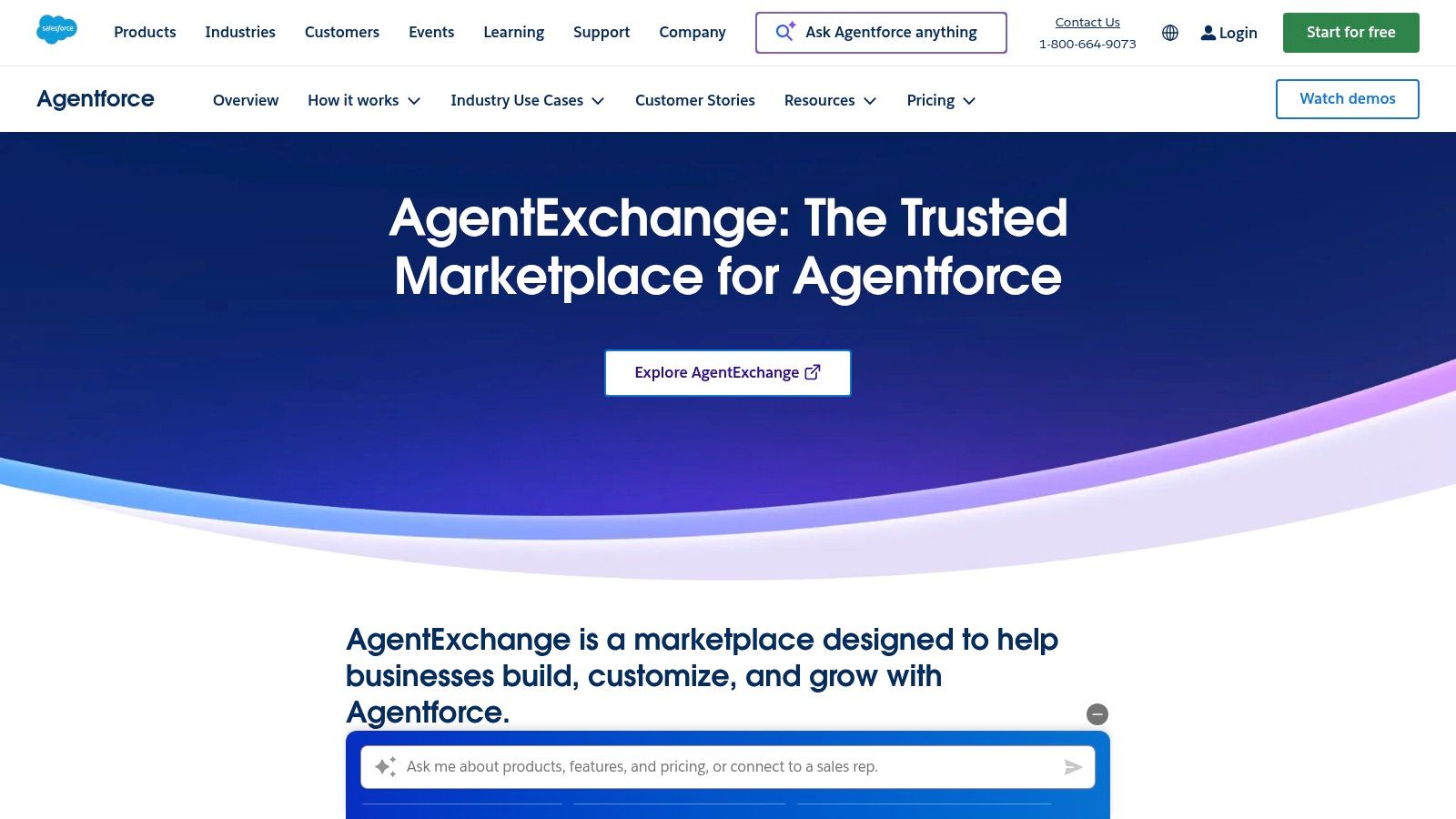
The platform’s core strength lies in its native integration. Billing, provisioning, and security are all handled through the familiar Salesforce interface, eliminating the procurement and integration headaches that often come with third-party tools. This streamlined approach allows teams to quickly deploy agents that enhance their existing workflows, rather than overhauling them. For example, an agent can be configured to automatically pull relevant case studies into a proposal based on the prospect's industry, a task that would otherwise require manual research and effort from the sales rep.
Key Details & Use Cases
- Best For: Sales teams heavily invested in the Salesforce stack looking for a secure, native, and scalable way to introduce agentic automation.
- Primary Use Case: Automating repetitive, high-volume tasks directly within Salesforce. This includes scheduling meetings, updating CRM records based on email conversations, and qualifying inbound leads before they reach a human representative.
- Integration: Natively built for Salesforce Sales Cloud and Slack. This deep integration is its main advantage, providing seamless data flow and a unified user experience.
- Pricing: Varies by listing. Some agents are developed by partners and require contacting sales for a quote, while others have set pricing. Eligible organisations can get started with the free "Foundations" add-on, which includes starter credits for Agentforce.
Key Takeaway: AgentExchange excels by offering a governed, secure, and tightly integrated marketplace. The robust partner ecosystem ensures a growing selection of specialised sales AI tools that work out-of-the-box, significantly reducing the time to value for Salesforce customers.
Visit Salesforce AgentExchange
3. Salesforce AI for Sales (Sales Cloud with Einstein/Agentforce)
For organisations seeking a fully integrated AI solution within an enterprise-grade CRM, Salesforce AI for Sales is the definitive platform. Instead of being a separate add-on, powerful AI tools like Einstein and Agentforce are woven directly into the Sales Cloud fabric. This approach embeds predictive intelligence across the entire sales cycle, from initial lead scoring and opportunity insights to automated forecasting and conversation intelligence, creating a unified, end-to-end workflow.
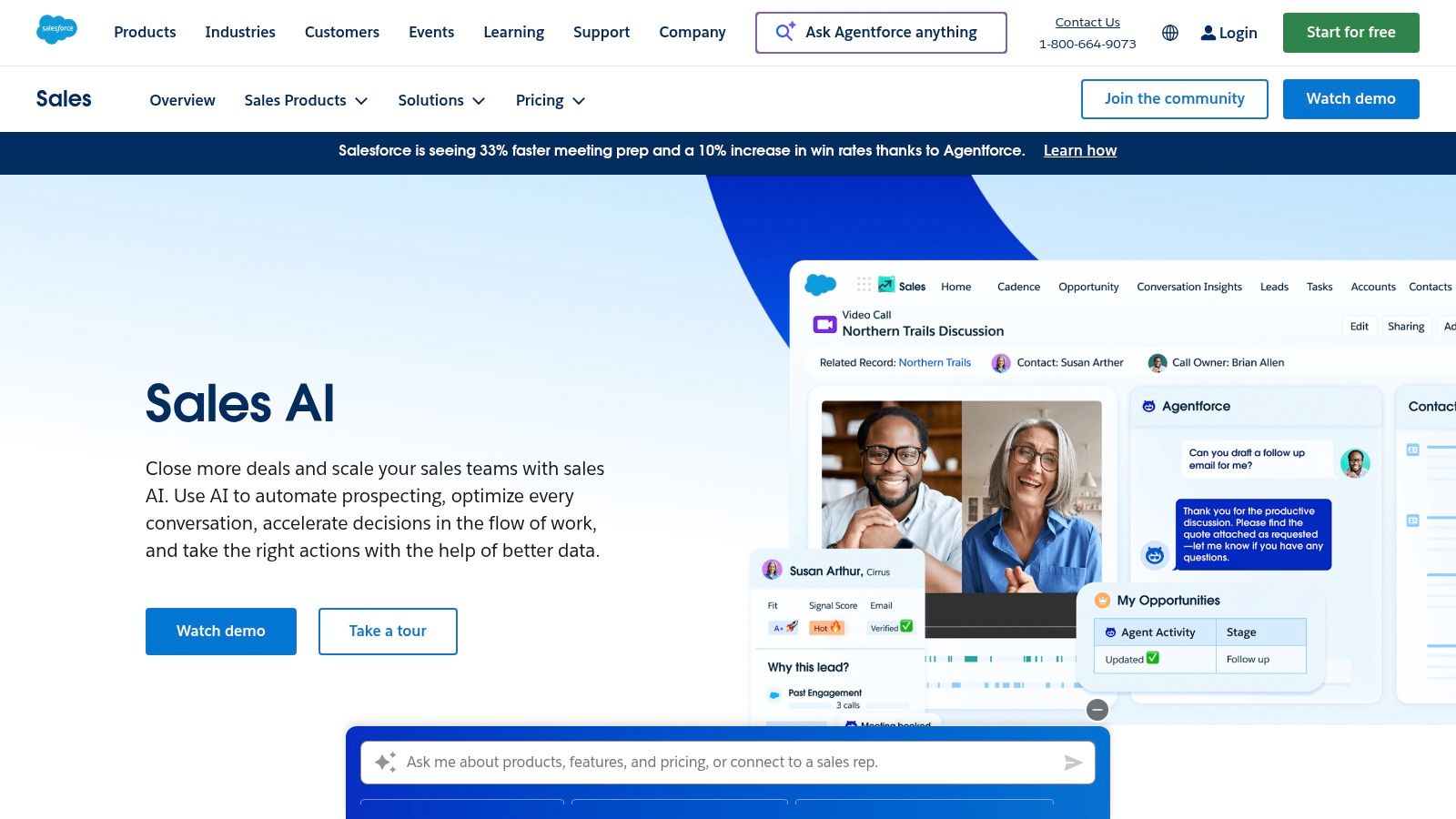
The platform's main advantage is its holistic nature. AI isn't just a feature; it's the engine powering smarter sales processes. Einstein automatically surfaces deals that are most likely to close, highlights at-risk opportunities, and recommends next best actions for sales reps. With the addition of Agentforce, teams can further automate routine tasks, ensuring data hygiene and freeing up reps to focus on strategic selling, all within a secure and compliant environment trusted by large enterprises.
Key Details & Use Cases
- Best For: Medium to large sales organisations that require an all-in-one CRM and AI platform with robust security, compliance, and scalability.
- Primary Use Case: Leveraging predictive insights to prioritise sales efforts. This includes AI-driven lead and opportunity scoring, pipeline inspection with predictive forecasting, and analysing call recordings for key trends with conversation intelligence.
- Integration: Natively built within Salesforce Sales Cloud. It offers deep integrations with the wider Salesforce ecosystem and the AppExchange for extended functionality.
- Pricing: AI features are included in higher-tier Sales Cloud plans (starting from the "Unlimited" edition). Annual contracts are typical, and costs scale with advanced tiers and user count.
Key Takeaway: Salesforce AI for Sales offers a powerful, all-in-one solution for teams that want their sales AI tools deeply embedded within their core CRM. Its enterprise-grade security and end-to-end workflow make it a formidable choice, though it comes with greater administrative complexity than SMB-focused tools.
4. Microsoft Dynamics 365 Sales (with Copilot for Sales)
For organisations entrenched in the Microsoft ecosystem, Dynamics 365 Sales with the integrated Copilot offers a seamless path to leveraging powerful sales AI tools. It embeds AI assistance directly into the daily workflows of sales professionals within familiar applications like Outlook and Teams. Instead of context-switching to a separate platform, Copilot provides real-time conversation intelligence, generates email drafts, and summarises long meeting transcripts, allowing reps to focus on building relationships rather than on administrative tasks.
The platform’s greatest advantage is its native integration with Microsoft 365. Copilot can pull data from CRM records, calendar appointments, and email conversations to provide contextual insights and recommendations. For instance, it can prepare a sales rep for an upcoming meeting by summarising previous interactions, highlighting unresolved issues from emails, and presenting relevant sales collateral. This deep-rooted connection turns everyday productivity tools into an intelligent sales hub, improving preparation and follow-up efficiency.
Key Details & Use Cases
- Best For: Sales teams already using Microsoft 365 and Teams who want to embed AI-driven assistance and insights into their existing workflows.
- Primary Use Case: Enhancing seller productivity through AI-powered email composition, meeting summaries, and real-time CRM updates from within Outlook and Teams. Predictive scoring helps prioritise high-potential leads.
- Integration: Natively built for the entire Microsoft stack, including Dynamics 365, Microsoft 365 (formerly Office), and Teams. This tight integration is its core value proposition.
- Pricing: Core Dynamics 365 Sales editions have transparent per-user pricing. Copilot for Sales is included in some higher-tier plans or available as a paid add-on, so it is vital to verify entitlements.
Key Takeaway: Dynamics 365 with Copilot excels by bringing sophisticated sales AI tools into the applications sellers use every day. Its strength is not just the AI features themselves but their seamless, native embedding within the Microsoft ecosystem, which dramatically lowers the barrier to adoption.
Visit Microsoft Dynamics 365 Sales
5. HubSpot Sales Hub
For small to mid-market teams seeking an all-in-one platform with accessible AI capabilities, HubSpot Sales Hub is a leading contender. It integrates a user-friendly CRM with a suite of sales engagement tools, making it easy to adopt without extensive technical resources. The platform's AI features are designed to enhance existing workflows, offering tools like content assistance for crafting emails and predictive lead scoring to help teams prioritise their efforts on the most promising prospects.
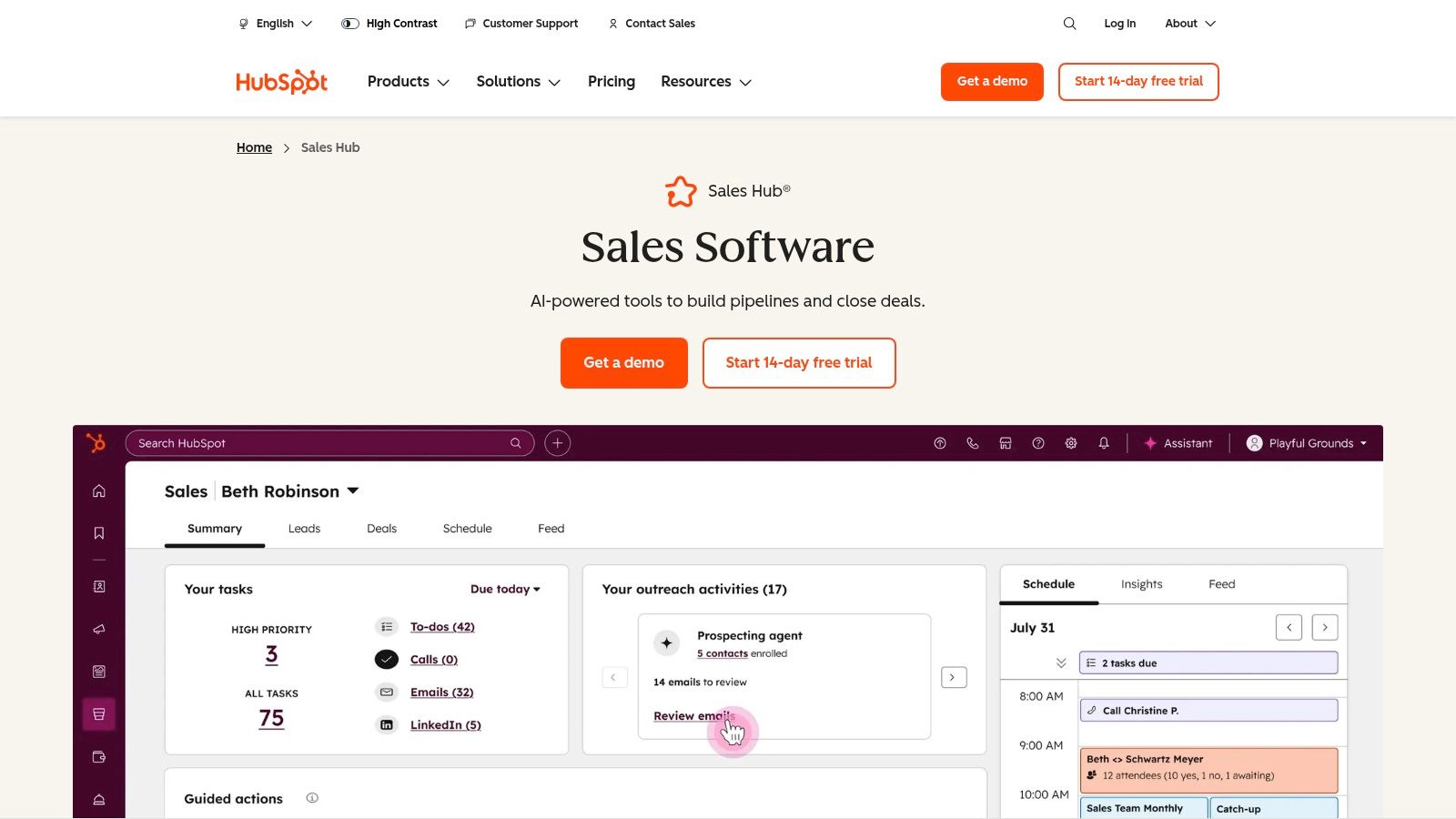
HubSpot's primary advantage lies in its unified ecosystem. Sales, marketing, and service data all live in one place, providing a complete view of the customer journey. This integration allows the AI to draw on a richer dataset for more accurate predictions and recommendations. For instance, its conversation intelligence tools can transcribe calls and surface key insights, which are then logged directly against the contact record, making it easier for reps to prepare for follow-ups and for managers to coach their teams effectively. This makes it an ideal platform for those focusing on strategies like high-ticket closing, where a deep understanding of the prospect is crucial.
Key Details & Use Cases
- Best For: SMBs and mid-market sales teams that need a quick-to-deploy, intuitive CRM with integrated sales AI tools and a strong focus on usability.
- Primary Use Case: Streamlining the entire sales process, from lead generation and outreach using email sequences to call analysis and sales forecasting, all within a single platform.
- Integration: Native integration with HubSpot's Marketing, Service, and CMS Hubs. It also features a vast app marketplace with hundreds of third-party integrations.
- Pricing: Offers a free tier for basic tools. Paid plans start at the Starter level, with AI features like predictive lead scoring primarily available in the Professional and Enterprise tiers. Onboarding fees apply for higher-tier plans.
Key Takeaway: HubSpot Sales Hub excels by packaging powerful sales AI tools within an exceptionally user-friendly and integrated CRM platform. Its strength is in its accessibility, making it possible for teams without dedicated IT support to quickly adopt and benefit from AI-driven sales automation and insights.
6. LinkedIn Sales Navigator
While not a pure-play AI tool in the same vein as others on this list, LinkedIn Sales Navigator is an indispensable asset for B2B sellers, leveraging AI to surface opportunities from its unparalleled professional data graph. It moves beyond simple keyword searches, using algorithms to provide real-time alerts on lead job changes, company growth signals, and relevant content shares. This allows sales professionals to engage with prospects at precisely the right moment with contextually relevant information.
The platform's strength is its direct access to LinkedIn’s first-party data, offering a level of accuracy and timeliness that third-party scrapers cannot match. Features like Smart Links for content tracking and advanced lead filtering transform prospecting from a manual chore into a strategic, data-driven activity. Furthermore, its CRM write-back capabilities ensure that insights gleaned from the platform are seamlessly integrated into existing workflows within systems like Salesforce or HubSpot, keeping the single source of truth updated.
Key Details & Use Cases
- Best For: B2B sales teams who rely on relationship-building and need to identify and track key decision-makers within target accounts.
- Primary Use Case: Prospecting, lead discovery, and account monitoring. It excels at finding the right people, understanding their professional context, and identifying triggers for outreach based on their activity.
- Integration: Offers robust CRM integrations for Salesforce, HubSpot, and Microsoft Dynamics 365, allowing for seamless data sync and activity logging.
- Pricing: Available in Core, Advanced, and Advanced Plus tiers with clear monthly and annual pricing. Plans start from around S$130 per user per month when billed annually.
Key Takeaway: LinkedIn Sales Navigator is a foundational sales AI tool for modern B2B outreach. Its AI-powered alerts and search functionalities turn LinkedIn’s vast network into a predictable pipeline of high-intent leads.
Visit LinkedIn Sales Navigator
7. Google Workspace – AI for Sales (Gemini in Workspace)
For sales professionals whose day-to-day operations live inside Gmail, Google Docs, and Sheets, Gemini in Workspace offers a frictionless way to embed generative AI into their existing workflows. Instead of adopting a new platform, it brings powerful sales AI tools directly into the applications they already use. This allows teams to draft personalised outreach emails in Gmail, generate proposal outlines in Docs, or summarise long meeting threads to quickly catch up on a deal's status.
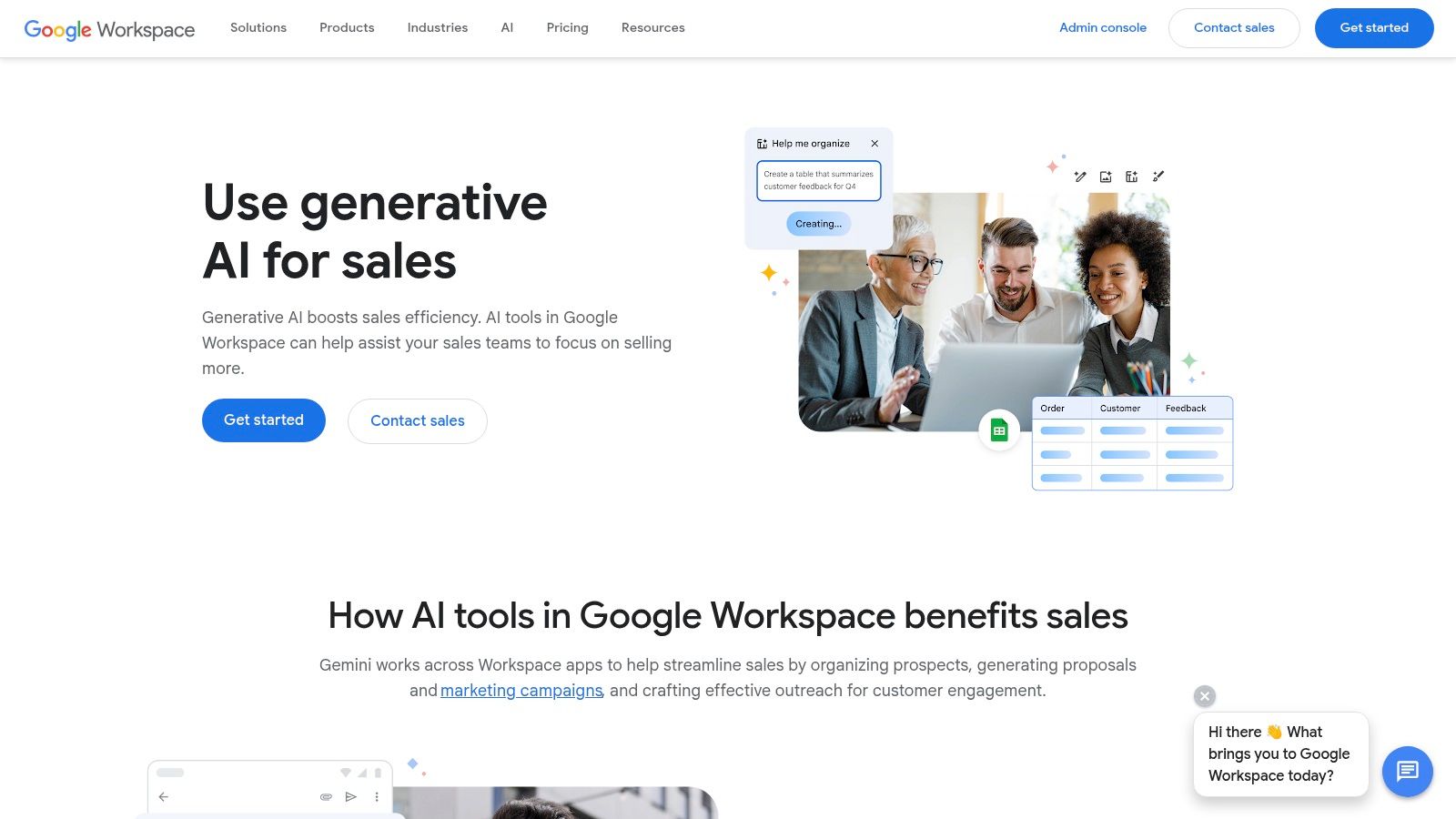
The platform’s strength is its seamless integration and contextual awareness across the Google ecosystem. For example, a sales rep can ask Gemini to create a presentation in Slides based on a project plan in Docs, or to extract action items from a Google Meet recording. This interconnectedness streamlines administrative tasks and content creation, freeing up valuable time for reps to focus on building relationships and closing deals. It's an incremental but powerful enhancement to a familiar suite of tools.
Key Details & Use Cases
- Best For: Individuals and teams deeply embedded in the Google Workspace ecosystem looking for native AI assistance to boost productivity.
- Primary Use Case: AI-assisted content creation and task automation within Google's apps. This includes drafting and summarising emails, generating proposals, creating pipeline trackers in Sheets, and getting automated notes from meetings.
- Integration: Natively built into Gmail, Docs, Sheets, Meet, and Slides. It also connects to a growing marketplace of third-party sales AI add-ons.
- Pricing: Requires a Google Workspace plan plus the Gemini for Google Workspace add-on, which starts at S$27.20 per user/month for the Business tier (annual commitment).
Key Takeaway: Gemini in Workspace excels by making AI a natural extension of a sales professional's existing toolkit. It reduces the friction of adopting new sales AI tools by enhancing the familiar applications teams rely on every day for communication and collaboration.
Visit Google Workspace AI for Sales
8. AWS Marketplace
For large enterprises prioritising governance and streamlined procurement, the AWS Marketplace offers a centralised platform to discover, purchase, and manage third-party sales AI tools. Instead of being a specific tool itself, it functions as a comprehensive digital catalogue where organisations can find a wide array of SaaS solutions, from lead intelligence platforms to data analytics services. This approach simplifies the often-complex processes of security, legal, and budget approvals associated with adopting new software.
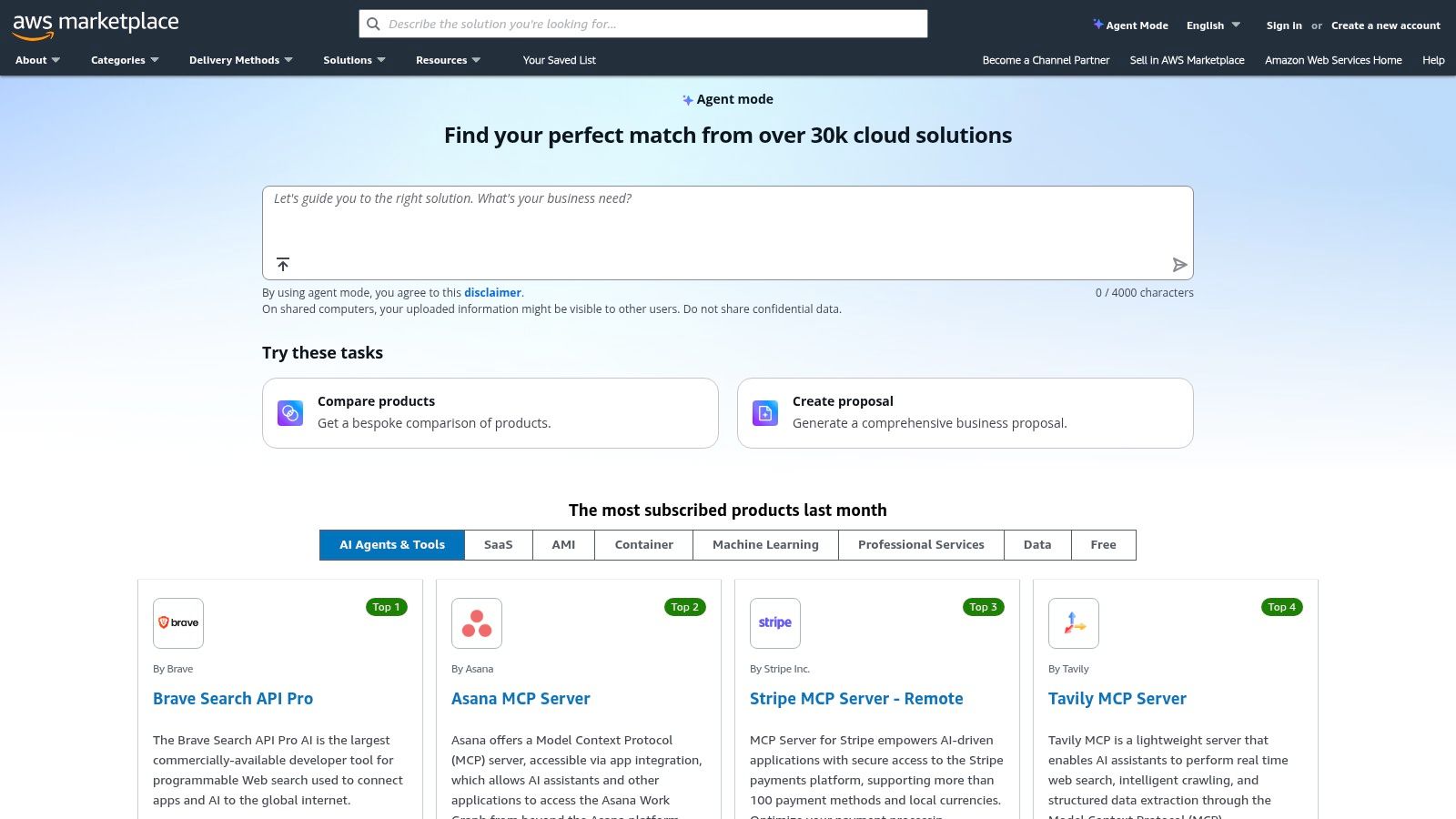
The primary advantage of using the AWS Marketplace is its integration with existing enterprise cloud infrastructure and billing. Purchases are consolidated into a single AWS bill, and companies can leverage private offers for customised pricing and terms. Each listing provides crucial vendor compliance details, such as SOC2 or GDPR status, which drastically accelerates the internal review cycle. This allows sales operations and IT teams to quickly assess and deploy vetted sales AI tools without the typical procurement friction.
Key Details & Use Cases
- Best For: Enterprise sales and IT teams that require a governed, secure, and centralised way to procure and manage a portfolio of third-party sales AI tools.
- Primary Use Case: Streamlining the procurement of various sales AI solutions through a single vendor relationship. It facilitates consolidated billing, simplifies vendor security reviews, and enables customised pricing negotiations via private offers.
- Integration: Integrates with your organisation's AWS account for billing and management. The integration level of individual tools purchased through the marketplace varies by vendor.
- Pricing: Pricing is determined by each individual software vendor. Models range from free trials and pay-as-you-go to annual subscriptions and "contact seller" for private quotes.
Key Takeaway: AWS Marketplace is not a sales tool, but a strategic procurement channel. It excels by providing enterprises with the governance, security, and financial controls needed to safely and efficiently adopt a diverse range of powerful sales AI tools from multiple vendors.
9. G2 – AI Sales Assistant category
While not a tool itself, G2’s category for AI Sales Assistants is an indispensable resource for navigating the crowded market. It acts as a comprehensive discovery platform, aggregating rankings, comparisons, and over 150,000 verified user reviews to help sales teams evaluate and shortlist potential sales AI tools before committing. Instead of relying on marketing materials, teams can access authentic feedback on usability, support quality, and real-world performance.
The platform’s strength is in its granular filtering capabilities and user-generated insights. You can sort vendors by company size, geographical region, or specific features, allowing you to quickly identify solutions that match your organisation’s unique needs. The Grid and Momentum reports provide a visual overview of the competitive landscape, highlighting market leaders and emerging innovators based on user satisfaction and market presence. This data-driven approach removes much of the guesswork from the procurement process.
Key Details & Use Cases
- Best For: Sales leaders and operations teams conducting due diligence and looking for unbiased, peer-driven reviews to validate their tool selection process.
- Primary Use Case: Comparing different sales AI tools based on authentic user experiences, feature sets, and satisfaction ratings. It is ideal for creating a shortlist of vendors for demos and trials.
- Integration: N/A. G2 is a review platform, but individual vendor listings often detail their integration capabilities with CRMs like Salesforce, HubSpot, and others.
- Pricing: Free to browse and use. Pricing information for individual tools is often not listed directly and requires visiting the vendor's site.
Key Takeaway: G2 is the essential starting point for any serious evaluation of sales AI tools. Its vast library of recent, real-user reviews and powerful comparison features provide critical context that vendor websites alone cannot offer, ensuring a more informed purchasing decision.
Visit G2 – AI Sales Assistant category
10. Apollo.io
Apollo.io has rapidly become a go-to platform for outbound sales teams, combining a massive B2B contact database with a robust sales engagement and intelligence engine. It stands out by integrating prospecting, sequencing, and AI-powered writing assistance into a single, cohesive workflow. This allows sales reps to find verified contacts, enrol them in automated email sequences, and use AI to personalise outreach without switching between multiple applications. The platform's AI helps research prospects and generate relevant, context-aware messaging to boost reply rates.

The core value of Apollo lies in its efficiency and accessibility, particularly for SMBs and scale-ups that need powerful sales AI tools without enterprise-level complexity or cost. Instead of just providing data, Apollo's AI assists in the entire top-of-funnel process, from identifying high-intent buyers using its advanced filters to crafting the initial message. For example, its AI can summarise a prospect's recent LinkedIn activity into a concise, personalised opening line for an email, a task that saves significant manual research time for each contact.
Key Details & Use Cases
- Best For: Outbound sales teams, SDRs, and startups looking for an all-in-one platform for prospecting, engagement, and AI-powered personalisation at a competitive price.
- Primary Use Case: Building targeted lead lists and executing multi-step outreach campaigns. The platform’s AI features are crucial for personalising emails at scale, researching prospects, and optimising sequence performance.
- Integration: Offers native integrations with major CRMs like Salesforce and HubSpot, along with a robust API for custom connections. This ensures lead and activity data flows seamlessly between systems.
- Pricing: Provides a free plan with limited credits. Paid plans start at $49/user/month (billed annually) for the Basic tier, scaling to Custom plans for larger enterprise needs. The credit-based system for contacts and exports can add complexity.
Key Takeaway: Apollo.io excels as a unified sales intelligence and engagement platform. Its combination of a vast contact database with practical, embedded AI tools for research and writing makes it an incredibly efficient solution for driving top-of-funnel activity.
11. Gong
Gong has established itself as a cornerstone in the revenue intelligence space, leveraging AI to analyse customer-facing interactions across phone, email, and web conferencing. The platform records, transcribes, and dissects sales conversations to uncover insights that drive coaching, improve sales predictability, and identify deal risks. It moves beyond simple recording by highlighting key topics, talk-to-listen ratios, and successful sales behaviours, making it an indispensable tool for data-driven sales organisations.

The platform's strength is its ability to transform raw conversation data into actionable strategy. For sales leaders, this means a clear view into pipeline health and more accurate forecasting based on actual customer sentiment rather than just CRM entries. For reps, it provides objective feedback and a library of best-practice call examples. Gong is a leading example of a platform that embodies What is Conversation Intelligence, using AI to analyse customer interactions for scalable sales insights. This focus on post-call analysis makes it one of the most powerful sales AI tools for coaching and performance improvement.
Key Details & Use Cases
- Best For: Enterprise sales teams and mid-market organisations focused on improving sales execution, coaching at scale, and achieving predictable revenue.
- Primary Use Case: Analysing sales conversations to identify winning patterns, flag at-risk deals, and provide data-backed coaching to sales representatives.
- Integration: Offers robust integrations with major CRM platforms like Salesforce and HubSpot, as well as communication tools like Zoom, Slack, and Microsoft Teams.
- Pricing: Available upon request. Pricing is quote-based and tailored to team size and feature requirements, often positioned as a premium enterprise solution.
Key Takeaway: Gong provides unparalleled visibility into what truly happens during sales interactions. Its deep analytics and AI-driven recommendations empower teams to replicate top-performer behaviours and mitigate deal risk before it's too late.
12. 6sense
For sales teams focused on account-based marketing (ABM), 6sense provides an AI-driven platform that uncovers which accounts are actively in-market for their solution. It moves beyond simple lead scoring by analysing anonymous web activity, third-party intent data, and technographics to predict which prospects are ready to buy. This allows sales and marketing teams to align their efforts and engage high-value accounts at the perfect moment.
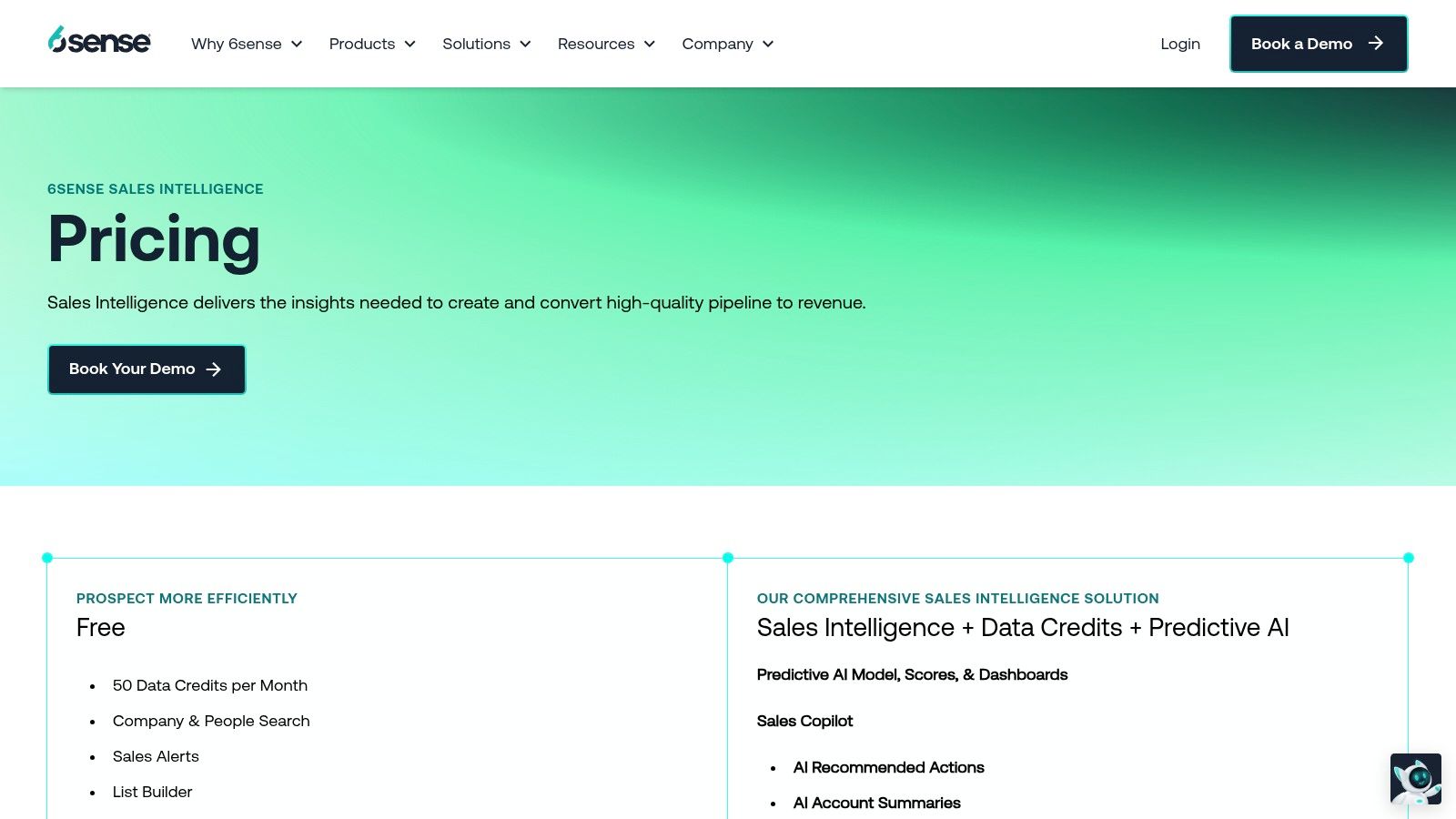
The platform’s strength is its ability to prioritise accounts with precision, ensuring sales representatives spend their time on opportunities most likely to convert. Instead of casting a wide net, 6sense equips reps with detailed insights into an account's buying committee, their research topics, and their stage in the buying journey. The AI Sales Copilot then recommends specific actions and talking points, creating a highly relevant and personalised outreach strategy directly within the user’s existing CRM or sales engagement platform.
Key Details & Use Cases
- Best For: B2B organisations with a defined Ideal Customer Profile (ICP) looking to implement or scale an effective account-based sales strategy.
- Primary Use Case: Identifying and prioritising in-market accounts. The platform’s predictive models highlight accounts showing buying intent, enabling proactive and timely engagement before competitors even know they are looking.
- Integration: Offers robust integrations with major CRMs like Salesforce and HubSpot, as well as sales engagement platforms such as Outreach and Salesloft, to push account insights and trigger workflows.
- Pricing: A free tier is available for basic prospecting. Full-featured plans are quote-based and tailored for enterprise needs, requiring a conversation with their sales team to get specific pricing.
Key Takeaway: 6sense is one of the most powerful sales AI tools for account prioritisation. It bridges the gap between marketing and sales by providing a unified view of account activity and buying intent, turning anonymous signals into actionable revenue opportunities.
Top 12 Sales AI Tools — Feature Comparison
| Product | Core features | Target audience | Unique selling point | Reported UX & ROI | Pricing / Integrations |
|---|---|---|---|---|---|
| Mindreader | HIS archetype profiling, facial/text/digital-signal analysis, instant scripts & playbooks | High‑ticket sellers, AEs, advisors, real estate, sales enablement | Sales‑first personality→script engine that generates tailored talking points, pacing & objection tactics | Case studies: routine 10–15% lead gains, conversions to ~33%, claim up to 50% more closes; privacy/ethics guidance | Credit/LTD/team plans; flexible pricing — CRM/API integrations; contact sales |
| Salesforce AgentExchange | Curated Agentforce agents, templates, prebuilt actions | Salesforce customers and admins | Native, security‑reviewed agent marketplace with Salesforce billing/provisioning | Fastest path to agent automation inside Sales Cloud; governed partner ecosystem | Listing‑dependent pricing; native billing and provisioning |
| Salesforce AI for Sales (Sales Cloud) | Einstein insights, predictive scoring, convo intelligence, forecasting | Enterprises using Sales Cloud | End‑to‑end CRM with embedded AI and enterprise security | Enterprise‑grade insights and forecasting; strong governance | Tiered/annual contracts; advanced tiers increase cost |
| Microsoft Dynamics 365 Sales (Copilot) | Copilot summaries, email/meeting assistance, predictive scoring | Teams invested in Microsoft 365 & Teams | Tight Office/Teams integration with native Copilot capabilities | Improves email/meeting productivity; transparent per‑user pricing on main editions | Copilot add‑ons/credits vary; best value inside Microsoft stack |
| HubSpot Sales Hub | Sequences, playbooks, convo intelligence, predictive scoring | SMB to mid‑market teams seeking quick deployment | Intuitive UI, fast time‑to‑value, integrated marketing/service ecosystem | Free tier and public pricing; quick adoption for small teams | Public pricing; advanced automation gated to higher tiers |
| LinkedIn Sales Navigator | Real‑time lead alerts, saved searches, account mapping, CRM write‑back | B2B prospecting and account teams | First‑party professional graph for discovery and warm outreach | Strong discovery impact; messaging limits can add cost | Clear monthly/annual plans; CRM integrations available |
| Google Workspace – AI for Sales (Gemini) | Draft/rewrite emails, summarize threads, Meet notes, Sheets templates | Teams using Gmail/Workspace | Seamless AI inside Gmail/Docs/Meet for content and meeting automation | Great for drafting and summaries; feature rollout varies by plan | Plan‑dependent availability; often paired with third‑party CRMs |
| AWS Marketplace | SaaS procurement, private offers, compliance details, consolidated billing | Enterprises centralizing procurement & legal/security | Consolidated purchasing, private pricing and vendor compliance visibility | Streamlines procurement and vendor review for enterprises | Varies by listing; supports AWS deployment and consolidated billing |
| G2 – AI Sales Assistant category | Grid reports, rankings, thousands of user reviews, filters | Buyers researching and shortlisting vendors | Large volume of authentic user reviews and comparative reports | Useful for validating UI fit, support quality and real‑world usage | Free to browse; vendor pricing usually indirect on platform |
| Apollo.io | Prospector database, email sequencing, personalization, API | Outbound teams, startups, SMBs | Large B2B contact data with sequencing and affordable plans | Competitive price‑to‑value; rapid product iteration | Public pricing page; credit/export limits apply |
| Gong | Call recording/transcription, conversation intelligence, deal risk analytics | Revenue teams focused on coaching and forecasting | Deep conversation analytics and coaching at scale | Improves forecasting and win rates; strong enterprise adoption | Quote‑based pricing; implementation effort required |
| 6sense | Intent data, predictive AI models, account prioritization, alerts | ABM teams and sales‑marketing alignment | Strong intent signals and account prioritization for ABM | Useful for prioritizing accounts; free tier for lightweight use | Quote‑based for full plans; CRM integrations available |
Final Thoughts
Our journey through the landscape of top-tier sales AI tools has revealed a profound shift in the sales profession. The question is no longer if AI can help, but how it can be strategically deployed to amplify human expertise. From automating outreach with tools like Apollo.io to deciphering the nuances of customer conversations with Gong, the message is clear: AI is now a foundational pillar of high-performing sales organisations.
We've seen how comprehensive platforms like Salesforce Sales Cloud with Einstein and HubSpot Sales Hub are embedding AI directly into the CRM workflow, creating a unified ecosystem where data-driven insights are always at your fingertips. Similarly, Microsoft’s Copilot for Sales demonstrates the power of integrating generative AI into the daily tools sales professionals already use, drastically reducing administrative burdens and freeing up time for what truly matters: building relationships.
The core takeaway is that the most effective sales teams won't be those that simply adopt AI, but those that adopt the right AI for their specific challenges. A tool that excels at top-of-funnel lead generation may not be the best fit for an organisation focused on post-sale expansion and customer retention. The true power lies in creating a thoughtfully curated tech stack that addresses each stage of your unique sales cycle.
Your Action Plan for Adopting Sales AI Tools
Navigating this new era requires a clear strategy. Instead of feeling overwhelmed by the options, consider this a framework for making an informed decision that will genuinely elevate your sales performance.
- Identify Your Biggest Bottleneck: Where does your sales process slow down? Is it finding quality leads (consider Apollo.io), understanding customer needs during calls (look at Gong), or crafting personalised follow-ups (explore Gemini in Workspace)? Pinpoint your most significant challenge first.
- Start with a Focused Pilot: Avoid a full-scale, company-wide rollout from the outset. Select a small, motivated team to pilot a new tool. This allows you to measure its impact, gather honest feedback, and develop best practices in a controlled environment before scaling.
- Prioritise Integration Capabilities: A powerful sales AI tool that doesn't communicate with your CRM is a liability, not an asset. Ensure any solution you consider offers seamless integration with your existing systems, like Salesforce or HubSpot, to maintain a single source of truth for all customer data.
- Emphasise Ethical AI Usage: As we discussed, data privacy and transparency are paramount. Educate your team on the ethical implications of using AI, ensuring compliance with data protection regulations and building trust with your clientele. Your reputation depends on it.
- Focus on Augmentation, Not Replacement: Frame the adoption of AI as a way to empower your sales team, not replace them. The goal is to automate the mundane so they can concentrate on the strategic, relationship-driven aspects of selling where human intuition and empathy are irreplaceable.
Ultimately, the successful integration of sales AI tools is less about technology and more about a change in mindset. It’s about embracing a data-centric approach, fostering a culture of continuous learning, and empowering your team with the intelligence they need to not just meet their targets, but to build lasting, meaningful customer relationships. The future of sales isn't a battle of humans versus machines; it's a partnership where technology enhances our uniquely human ability to connect, persuade, and solve problems.
Ready to move beyond generic insights and connect with prospects on a truly personal level? Mindreader uses advanced psycholinguistics and communication style analysis (HIS) to give you the precise language needed to build instant rapport and trust. Explore how you can tailor every message to your buyer's unique personality at Mindreader.