Top 12 Sales Training Singapore Providers for 2026
In Singapore's intensely competitive market, a skilled sales team is not just an asset; it is the engine of revenue and growth. Foundational sales techniques are no longer sufficient to secure deals and build lasting client relationships. Today's success demands a sophisticated skill set, one that combines a deep understanding of buyer psychology, strategic negotiation tactics, and the proficient use of technology to personalise outreach and manage pipelines effectively. Simply put, investing in the right professional development is critical for staying ahead.
This guide is designed to cut through the noise and provide a definitive roadmap to the best sales training Singapore has to offer. We have meticulously curated and analysed the top programmes, from university-led executive certifications to globally recognised methodologies tailored for the local market. Whether you are a founder building a sales function from scratch, a seasoned sales leader looking to upskill your enterprise team, or a professional in a specialised industry like real estate or finance, this resource will help you make an informed investment.
Each entry provides a clear overview of the provider's core curriculum, target audience, delivery formats, and potential outcomes, complete with direct links to their platforms. We'll explore how to choose the right provider for your specific needs, ensuring the training you select delivers a tangible return. While formal training is a crucial component, it is part of a larger strategy. For a deeper dive into other impactful strategies, consider this practical guide on improving sales team performance for a holistic view. Let’s explore the options that will transform your team's capabilities.
1. SMU Academy (Singapore Management University)
For professionals seeking a structured, university-backed credential, SMU Academy offers some of the most comprehensive sales training Singapore has to offer. Rather than offering one-off workshops, the academy provides rigorous, in-depth certificate programmes designed to build foundational and advanced competencies, particularly within the tech and B2B sectors.
Their flagship offerings, like the Professional Certificate in Tech Sales, are built with stackable modules. This structure allows participants to progressively build their expertise, from mastering sales methodologies to understanding complex enterprise sales cycles. The curriculum is academically sound yet intensely practical, developed in consultation with industry leaders to ensure relevance. The on-campus, instructor-led format fosters deep learning and valuable networking opportunities with peers and faculty.
Who It's Best For
This programme is ideal for early-career B2B sales professionals, career switchers entering the tech industry, and experienced sellers who want a formal, recognised qualification to validate their skills and accelerate their careers. It's less suited for those needing a quick, on-demand skills boost.
| Key Feature | Details |
|---|---|
| Delivery Format | In-person, on-campus classes with set schedules and intake dates. |
| Key Programmes | Professional Certificate in Tech Sales, various B2B sales modules. |
| Pricing Model | Programme-based fees; eligible for SkillsFuture Credit and subsidies. |
| Unique Selling Point | A recognised academic credential from a leading Singaporean university. |
For learners who wish to supplement this structured training with foundational sales principles, exploring some of the best books for salesmen can provide an excellent theoretical complement to the practical skills taught at SMU.
Pros:
- Strong Credentials: A certificate from Singapore Management University holds significant weight with employers.
- Subsidies Available: SkillsFuture eligibility makes it financially accessible for Singaporeans and PRs.
- Structured Learning: Clear, progressive learning paths from fundamentals to advanced concepts.
Cons:
- Limited Flexibility: Fixed schedules and intakes require a significant time commitment.
- Higher Upfront Cost: List fees are higher than private short courses, before subsidies.
Website: academy.smu.edu.sg
2. Marketing Institute of Singapore (MIS)
For sales professionals and organisations seeking targeted, practical skills development without the long-term commitment of a certificate programme, the Marketing Institute of Singapore (MIS) is a stalwart provider. Its strength lies in a broad catalogue of short, intensive public workshops focused on specific sales competencies, making it an excellent choice for immediate upskilling in a particular area.
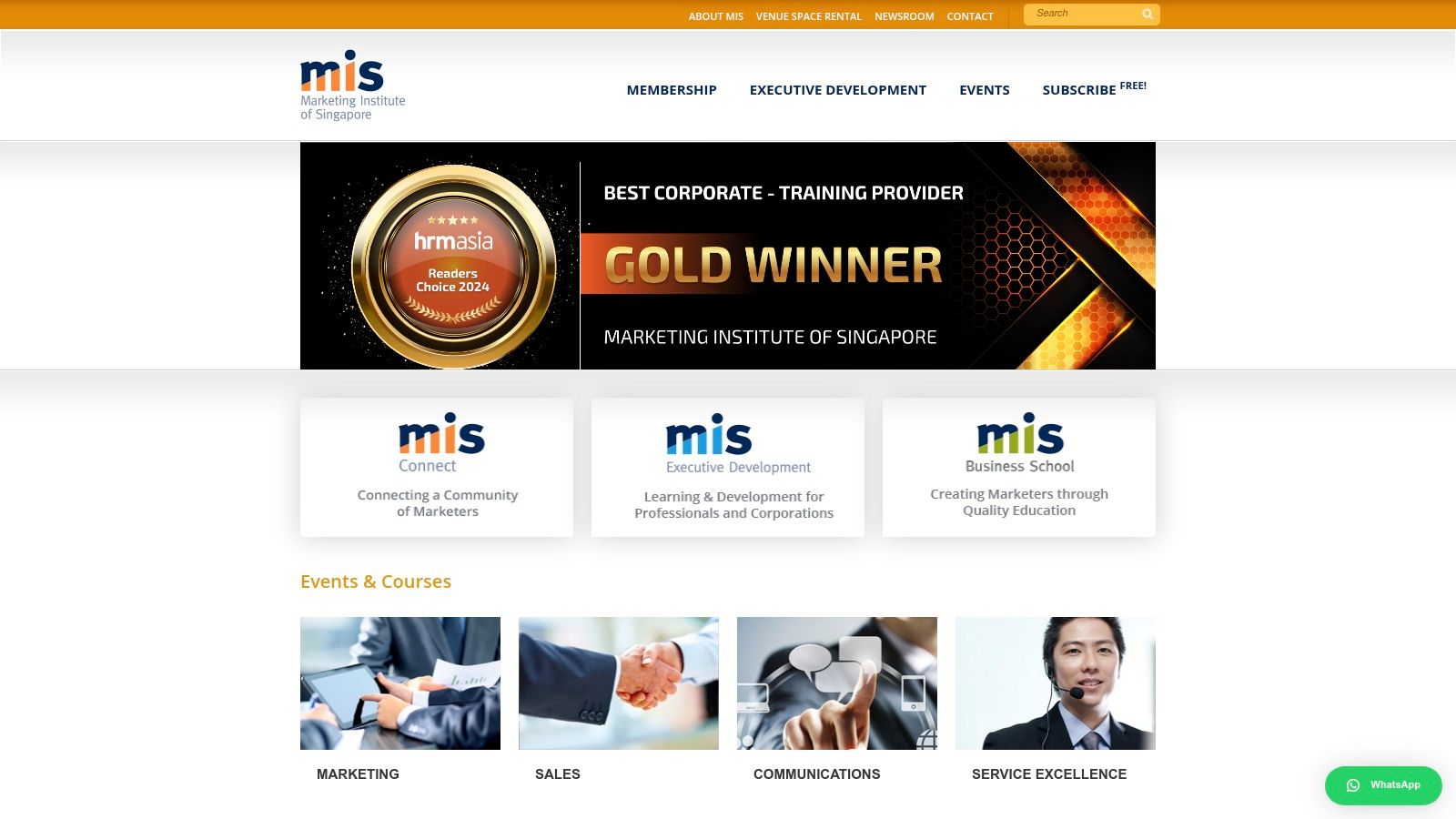
Unlike university programmes, MIS focuses on tactical, one-to-two-day courses like "Effective Negotiation Skills" or "Key Account Management." This model provides flexibility for both individuals and companies looking to plug specific skill gaps quickly. MIS also offers customised in-house corporate training, adapting their curriculum to an organisation's unique challenges, which is a key advantage for teams needing tailored sales training Singapore providers often struggle to deliver flexibly.
Who It's Best For
This is ideal for sales teams needing frequent, short-run training on specific topics, individual sales reps wanting to sharpen a single skill (like closing or prospecting), and managers looking for practical sales leadership courses. It's less suitable for those seeking a comprehensive, foundational qualification.
| Key Feature | Details |
|---|---|
| Delivery Format | In-person short courses (1-2 days) at their training centre; customised corporate training. |
| Key Programmes | Wide range of short courses on negotiation, closing, key account management, and sales leadership. |
| Pricing Model | Per-course public fees; member and group discounts available. Custom quotes for corporate runs. |
| Unique Selling Point | A wide variety of short, practical courses with frequent, publicly scheduled runs. |
Pros:
- High Flexibility: Easy to book short courses to address immediate skill gaps without a long commitment.
- Practical Focus: Curriculum is designed for immediate application of tactical sales skills.
- Customisation Available: Strong option for companies wanting in-house training tailored to their needs.
Cons:
- Variable Subsidies: Not all courses are SkillsFuture subsidised; eligibility must be checked per course.
- Limited Depth: The short duration may not be sufficient for mastering complex, strategic topics.
Website: www.mis.org.sg
3. SIM Academy (Singapore Institute of Management – Professional Development)
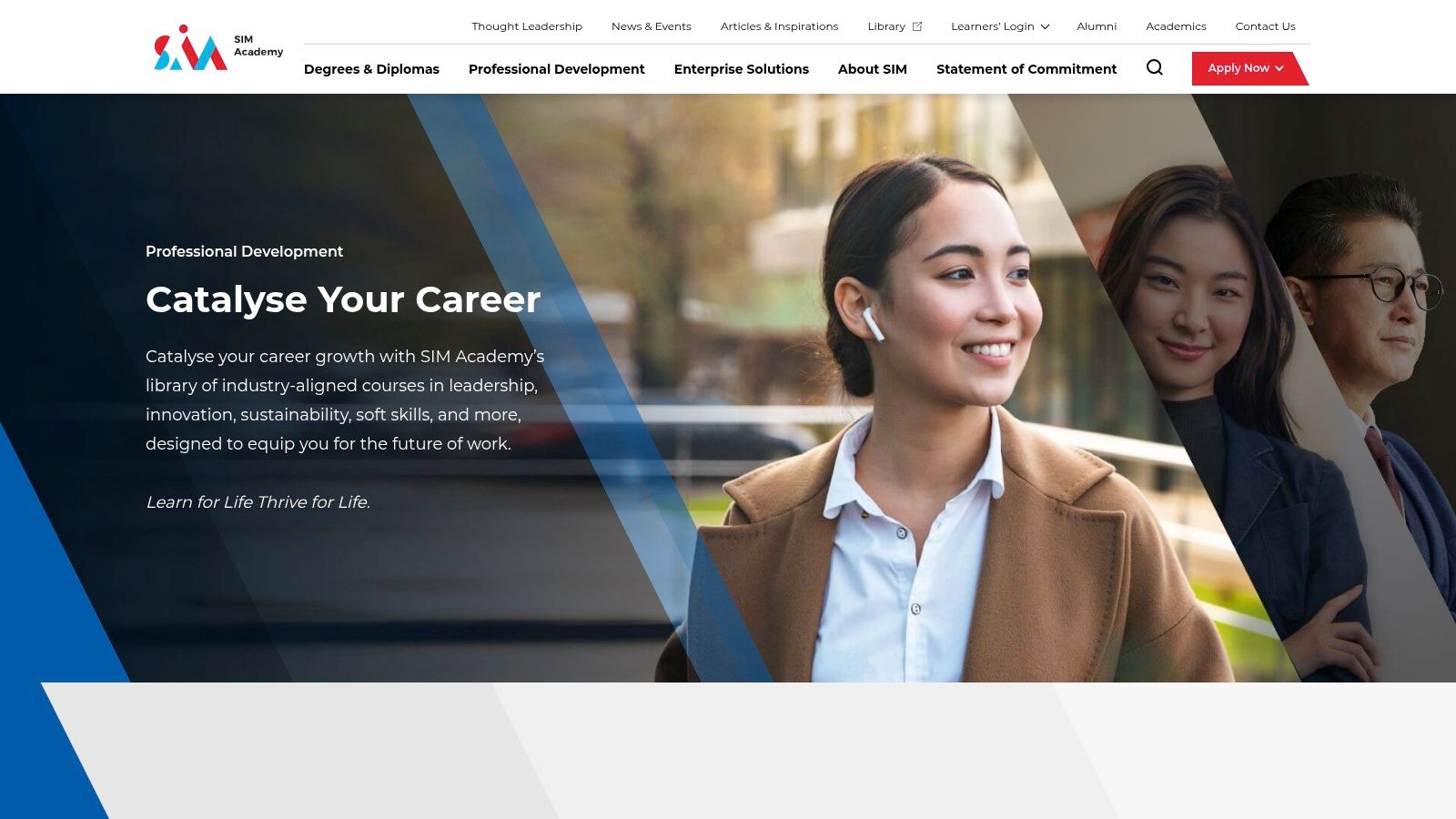
For those seeking reputable, instructor-led short courses, SIM Academy provides accessible professional development that complements core sales functions. While not a dedicated sales methodology trainer, SIM offers a valuable curriculum focused on the critical soft skills that underpin successful selling, such as influencing stakeholders, delivering persuasive presentations, and strategic communication. This makes it a strong choice for rounding out a salesperson's skill set.
Their repeated course schedules at SIM Management House offer predictability and convenience for busy professionals. The focus is less on rigid sales frameworks and more on the universal skills needed to build rapport, manage client relationships, and communicate value effectively. This approach to sales training Singapore professionals can use is ideal for enhancing existing technical sales knowledge with powerful interpersonal capabilities.
Who It's Best For
This is best suited for sales professionals at all levels who want to improve specific soft skills like public speaking, negotiation, or stakeholder management. It's also great for technical experts or account managers who need to enhance their client-facing communication skills, but may be less ideal for newcomers needing a comprehensive A-to-Z sales process education.
| Key Feature | Details |
|---|---|
| Delivery Format | Primarily in-person, instructor-led short courses with set run dates. |
| Key Programmes | Courses in Influencing Skills, Presentation Skills, Strategic Communication. |
| Pricing Model | Per-course fees; selected courses are eligible for SkillsFuture funding. |
| Unique Selling Point | Focus on crucial, universally applicable soft skills from a trusted brand. |
Many of the communication and influence techniques taught at SIM are deeply rooted in understanding your audience, a skill that is sharpened through effective customer profiling methodologies that help tailor your message.
Pros:
- Reputable Brand: SIM is a well-known and trusted institution for professional development in Singapore.
- Practical Skill Focus: Offers a good mix of tactical (presentations) and strategic (influence) topics.
- Predictable Schedules: Multiple course runs throughout the year make planning easy.
Cons:
- Funding Varies: Not all courses are subsidised; participants must verify SkillsFuture eligibility per listing.
- Not a Sales Specialist: Less focused on hardcore sales methodologies compared to dedicated providers.
Website: www.sim.edu.sg/professional-development
4. NTUC LearningHub (LHUB)
As Singapore's continuing education and training arm of the Labour Movement, NTUC LearningHub provides accessible and nationally recognised sales training Singapore professionals can leverage. LHUB focuses heavily on Workforce Skills Qualifications (WSQ) programmes, offering structured, subsidised pathways for individuals in retail, customer service, and frontline sales roles to gain certifiable skills. This makes it a go-to provider for foundational training and skill validation.
Beyond its traditional classroom courses, LHUB has embraced blended learning through its LXP (Learning Experience Platform). This subscription-based portal offers a library of micro-learning courses, including modules on sales and marketing, allowing for on-demand skill refreshment. This dual approach caters to both learners needing formal certification and those seeking flexible, self-paced upskilling, often with enhanced benefits for NTUC members.
Who It's Best For
NTUC LearningHub is ideal for frontline sales staff, retail associates, and entry-level professionals seeking government-recognised credentials to start their careers. It is also suitable for companies looking for scalable, subsidised training solutions for their customer-facing teams and individuals who prefer a mix of structured and on-demand learning.
| Key Feature | Details |
|---|---|
| Delivery Format | Blended: In-person classroom, virtual instructor-led training, and a self-paced online LXP. |
| Key Programmes | WSQ Certificate in Retail, various modules on sales management and customer service. |
| Pricing Model | Course-based fees for WSQ programmes (SkillsFuture eligible); subscription model for the LXP. |
| Unique Selling Point | Strong alignment with national skills frameworks (WSQ/SSG) and member benefits. |
Pros:
- Recognised Credentials: WSQ certifications are nationally recognised, boosting employability in retail and frontline sales.
- High Accessibility: Government subsidies (SkillsFuture, UTAP) make many courses highly affordable.
- Broad Entry Points: Offers courses ranging from foundational skills to supervisory sales topics.
Cons:
- Variable Quality: Course effectiveness can depend on the specific trainer; it's wise to review the syllabus.
- Generalist Focus: The LXP's content provides broad coverage but may lack the depth for complex B2B sales.
Website: www.ntuclearninghub.com
5. NUS Business School – Executive Education
For senior leaders and experienced professionals, mastering high-stakes negotiation is a critical differentiator. NUS Business School’s Executive Education programmes provide precisely this, offering a level of strategic depth in negotiation and conflict management that goes far beyond typical sales courses. This is the premier choice for those looking to refine their ability to navigate complex, high-value deals and lead critical client conversations.

Unlike foundational sales training Singapore programmes that cover the entire sales cycle, NUS homes in on the pinnacle of the process: negotiation. Their offerings, such as the flagship Negotiations & Conflict Management course, use a blended learning format combining online modules with intensive in-person sessions. The curriculum is built around experiential case studies and simulations, including cross-cultural negotiation scenarios vital for Singapore’s global business environment.
Who It's Best For
This is ideal for senior account executives, sales directors, business owners, and founders who are already proficient in sales but need to master sophisticated negotiation tactics for enterprise-level deals. It is not suitable for entry-level sales staff or those seeking a comprehensive, end-to-end sales methodology programme.
| Key Feature | Details |
|---|---|
| Delivery Format | Blended learning, combining self-paced online content with face-to-face experiential workshops. |
| Key Programmes | Negotiations & Conflict Management, various leadership and strategy modules. |
| Pricing Model | Premium programme-based fees; eligible for SSG/SkillsFuture funding for Singaporeans and PRs. |
| Unique Selling Point | An elite, university-backed specialisation in high-stakes negotiation with stackable micro-credits towards an MBA/EMBA. |
Pros:
- Prestigious Branding: A certificate from NUS Business School carries significant weight, signalling expertise to employers and clients.
- Deep Specialisation: Intense focus on advanced negotiation and conflict resolution, crucial for senior roles.
- Pathway to MBA/EMBA: Earn micro-credits that can be mapped to NUS's prestigious postgraduate degrees.
Cons:
- Premium Investment: High-end pricing reflects its executive focus, even with available subsidies.
- Narrow Focus: Does not cover general sales skills like prospecting or lead generation; it's a specialist course.
- Limited Intakes: Enrolment is competitive and requires advance planning to secure a spot.
Website: executive-education.nus.edu.sg
6. SIRS (NYP – Singapore Institute of Retail Studies)
For businesses and individuals in the fast-paced retail sector, SIRS provides highly specialised sales training Singapore requires to thrive in an omnichannel environment. As a CET (Continuing Education and Training) Centre appointed by SkillsFuture Singapore (SSG) and part of Nanyang Polytechnic, SIRS focuses on equipping frontline staff and retail managers with practical, immediately applicable skills. Their courses move beyond traditional sales techniques to address modern retail challenges.
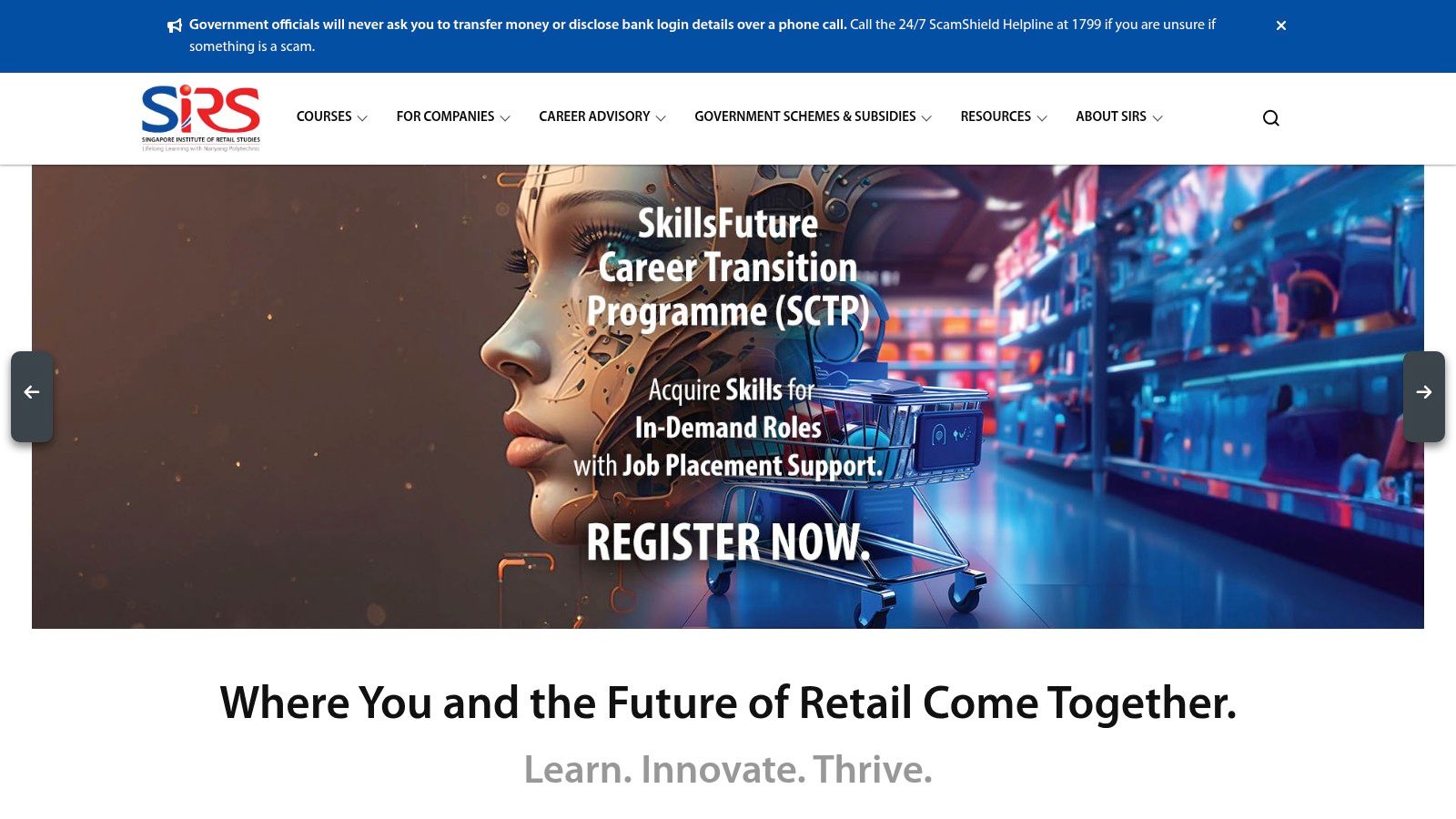
The curriculum is built around short, targeted workshops covering essentials like Sales Target Management, effective Sales Pitching, and adapting to e-commerce. This modular approach allows teams to upskill in specific areas without committing to a lengthy programme. The emphasis is on hands-on learning, ensuring participants can apply new strategies on the shop floor or online platform the very next day.
Who It's Best For
This training is perfectly suited for frontline retail staff, store managers, and e-commerce specialists looking to boost their performance. It's also ideal for retail business owners seeking to upskill their entire team with government-subsidised training. It is less relevant for those in complex B2B or enterprise sales roles.
| Key Feature | Details |
|---|---|
| Delivery Format | Primarily in-person workshops and blended learning options. |
| Key Programmes | Sales Target Management, Enhance the Customer Experience, Implement Sales Plans. |
| Pricing Model | Course-based fees; heavily subsidised by SkillsFuture for Singaporeans/PRs. |
| Unique Selling Point | Official SSG-appointed CET Centre with a deep specialisation in retail and e-commerce. |
Pros:
- Highly Subsidised: Strong government funding makes training highly affordable for eligible individuals and companies.
- Practical Focus: Content is designed for immediate application in a retail or e-commerce setting.
- Recognised Status: As a national institute, its certifications are well-regarded within the retail industry.
Cons:
- Niche Focus: Heavily retail-centric, making it less suitable for other sales domains like B2B tech or finance.
- Variable Schedules: Course availability and schedules can vary, requiring proactive planning.
Website: www.sirs.edu.sg
7. Dale Carnegie Training Singapore
For sales professionals who believe that strong relationships are the bedrock of sustainable success, Dale Carnegie offers some of the most respected sales training Singapore provides. As the local franchise of a global powerhouse, its programmes focus less on technical product features and more on the human dynamics of selling: influence, trust-building, and powerful communication. This approach is designed to create loyal customers, not just close one-time deals.
The organisation's globally standardised curriculum is delivered through in-person workshops and live online sessions. Their signature courses on sales, presentation skills, and leadership are not just theoretical lectures; they are highly interactive experiences that push participants to practise and refine their interpersonal skills in a coached environment. This emphasis on soft skills helps sellers build genuine rapport and guide clients through complex decisions with confidence.
Who It's Best For
This training is perfect for relationship-focused sellers in industries like financial services, high-value consulting, and enterprise account management. It also serves leaders looking to inspire their sales teams. It may be less suitable for high-velocity, transactional sales teams who prioritise CRM workflows and automation over deep relationship-building.
| Key Feature | Details |
|---|---|
| Delivery Format | In-person public courses and live-online workshops; customised corporate programmes. |
| Key Programmes | Dale Carnegie Sales Training: Winning with Relationship Selling, High Impact Presentations. |
| Pricing Model | Price upon enquiry for most corporate and public programmes. |
| Unique Selling Point | A century-old, globally recognised methodology focused on human relations and influence. |
While Dale Carnegie perfects the human element of sales, professionals can further enhance their efficiency by exploring the best AI tools for sales to manage administrative tasks and data analysis.
Pros:
- Strong Global Brand: The Dale Carnegie name carries significant prestige and is backed by a vast alumni network.
- Practical Soft Skills: Focuses on the often-overlooked communication and influence skills that drive performance.
- Proven Methodology: The core principles are time-tested and universally applicable across industries.
Cons:
- Opaque Pricing: Fees are not always listed publicly, requiring an enquiry for details.
- Less Tech-Focused: The curriculum places less emphasis on modern sales technology stacks and digital tools.
Website: dalecarnegie.com.sg
8. Sandler Training – JR Global Training Pte Ltd (Singapore)
For organisations seeking a globally recognised, process-driven methodology, Sandler Training stands out. Delivered in Singapore by authorised partner JR Global Training, this programme is less about one-off tactics and more about instilling a complete, repeatable system for prospecting, qualifying, and closing deals. It's a structured approach that aims to fundamentally change sales behaviours.
The core of the Sandler system is its focus on reinforcement. Unlike workshops where skills can fade, Sandler emphasises ongoing training to ensure the methodology becomes second nature. This makes it a powerful option for B2B and consultative sales teams needing a common language and a systematic way to control the sales process, moving away from traditional, often adversarial, sales interactions.
Who It's Best For
This is ideal for B2B sales teams in complex or consultative fields who need a unified, scalable sales process. It is particularly effective for leaders looking to create lasting behavioural change and a common sales culture, rather than just providing a temporary skills boost. It's less suited for individuals seeking a quick, self-paced online course or those operating in highly transactional B2C environments.
| Key Feature | Details |
|---|---|
| Delivery Format | Corporate in-house programmes, public workshops, and ongoing reinforcement training. |
| Key Programmes | Sandler Selling System, Sales Leadership, Strategic Customer Care. |
| Pricing Model | Customised quotes provided upon consultation; not publicly listed. |
| Unique Selling Point | A proven, global methodology focused on reinforcement for lasting behaviour change. |
Pros:
- Recognised Methodology: Sandler is a field-tested, global system known for its effectiveness in consultative selling.
- Team Cohesion: It creates a common sales language and process, improving team alignment and performance.
- Focus on Reinforcement: The model is built to drive lasting change, not just impart temporary knowledge.
Cons:
- Significant Commitment: Requires a long-term commitment to reinforcement for maximum effect.
- Opaque Pricing: Costs are not publicly available and require a consultation process.
- Not SkillsFuture Funded: This represents a direct corporate or personal investment.
Website: sandler.com/training-centers/jr-global-training-pte-ltd/
9. Korn Ferry (powered by Miller Heiman Group)
For enterprise-level organisations seeking to standardise and elevate their sales processes, Korn Ferry offers one of the most respected frameworks for sales training Singapore has available. Building on the powerhouse legacy of the Miller Heiman Group, they provide globally recognised methodologies like Strategic Selling and Conceptual Selling, designed for complex, high-value B2B environments. This isn't about individual workshops; it's about enterprise-wide sales transformation.
Their approach integrates advisory services with training, creating data-driven learning journeys that can be embedded directly into a company’s CRM. This ensures that the methodologies are not just taught but consistently applied. With delivery available across APAC in multiple languages, Korn Ferry is built for multinational corporations aiming to create a unified and highly effective sales culture across different markets.
Who It's Best For
This is the gold standard for mid-market and large enterprise sales organisations planning a significant transformation or looking to standardise their sales methodology globally. It's not designed for individuals seeking a one-off course or small businesses needing a quick training solution.
| Key Feature | Details |
|---|---|
| Delivery Format | Blended learning, including virtual instructor-led training (VILT), in-person workshops, and CRM integration. |
| Key Programmes | Strategic Selling with Perspective, Conceptual Selling, Large Account Management Process (LAMP). |
| Pricing Model | Enterprise-level, customised engagement contracts. Not suitable for individual seat purchases. |
| Unique Selling Point | A globally proven, structured sales methodology combined with deep advisory and change management services. |
Pros:
- Proven Methodology: The Miller Heiman methodologies are globally recognised and backed by decades of success.
- Scalable & Standardised: Ideal for creating a consistent sales language and process across large, diverse teams.
- Integrated Approach: Combines training with technology and advisory for lasting impact.
Cons:
- Significant Investment: Requires a substantial budget and commitment, geared towards large-scale corporate engagements.
- Not for Individuals: Their model does not accommodate single participants or small teams.
Website: www.kornferry.com/capabilities/leadership-professional-development/training-certification/sales
10. ODC Training (Singapore)
For small and medium-sized enterprises (SMEs) seeking rapid, targeted upskilling, ODC Training offers some of the most practical sales training Singapore can provide. Rather than broad, theoretical programmes, ODC focuses on high-impact public and in-house workshops that address specific, common sales challenges like negotiation and objection handling. Their approach is built on providing actionable frameworks and easy-to-use checklists that sales teams can implement immediately.

Their workshops, such as "Effective Sales Negotiation," are designed to be intensive and results-oriented. The firm prides itself on a local bench of experienced trainers who understand the Singaporean market context. This focus on practical application makes ODC a strong partner for businesses needing to solve immediate sales hurdles without committing to a lengthy, academic programme. They offer both public courses for individuals and customised corporate training for teams.
Who It's Best For
This is ideal for sales teams in SMEs, account managers needing to improve their negotiation skills, and business owners who want to equip their staff with immediately applicable sales tactics. It is less suited for individuals seeking a comprehensive, foundational sales education or a recognised formal certificate.
| Key Feature | Details |
|---|---|
| Delivery Format | In-person public workshops and customised in-house corporate training. |
| Key Programmes | Effective Sales Negotiation, Objection Handling, Value-Based Selling. |
| Pricing Model | Per-workshop or customised project fees; pricing is typically available on request. |
| Unique Selling Point | Highly practical, checklist-driven frameworks for immediate application. |
Pros:
- Actionable Content: Focuses on practical checklists and tools for real-world scenarios.
- SME-Friendly: Tailored for the needs and budgets of smaller businesses needing fast results.
- Targeted Workshops: Addresses specific pain points like pricing pressure and objections effectively.
Cons:
- Limited Breadth: The catalogue of courses is less extensive than larger training institutions.
- Less Transparency: Pricing and public schedules are often not published online, requiring direct enquiry.
Website: www.odctraining.com.sg
11. Singapore Institute of Estate Agents (SIEA) – CPD Sales Courses
For professionals in the real estate sector, the Singapore Institute of Estate Agents (SIEA) offers highly specialised sales training Singapore property agents can leverage to meet their Continuing Professional Development (CPD) requirements. These courses are not generic sales programmes; they are built from the ground up with property-specific scenarios, terminologies, and challenges in mind.
SIEA’s modules, such as "Mastering Sales Negotiation for Property Transactions" and "Consultative Selling for Property Advisors," are designed as short, intensive sessions, often lasting just three hours. This format allows busy agents to gain actionable insights and frameworks, like the proprietary ROADMAP method, without a significant time commitment. The focus is squarely on improving persuasion, negotiation, and client advisory skills within the unique context of the property sales cycle.
Who It's Best For
This is the ideal training solution for new and experienced real estate agents, property advisors, and realtors in Singapore who need to fulfil their CPD obligations while sharpening their sales skills. It is not suitable for sales professionals outside the property industry due to its highly specialised curriculum.
| Key Feature | Details |
|---|---|
| Delivery Format | Short, in-person or virtual instructor-led classes (typically 3 hours). |
| Key Programmes | CPD-eligible modules on negotiation, consultative selling, and persuasion for property sales. |
| Pricing Model | Per-course fees for members and non-members; no government funding available. |
| Unique Selling Point | Highly targeted, CPD-approved training designed exclusively for real estate professionals. |
Pros:
- Directly Relevant: Content is tailored specifically to property sales cycles and meets CPD requirements.
- Low Time Commitment: Short-format courses are perfect for quick skills refreshers for busy agents.
- Industry-Specific Frameworks: Teaches practical models applicable to real-world property negotiations.
Cons:
- No Funding Available: These specific CPD courses are not eligible for SkillsFuture subsidies.
- Narrow Scope: The curriculum is too niche for sales professionals in other industries.
Website: www.siea.org.sg
12. HubSpot Academy
For individuals and teams seeking foundational knowledge in modern sales methodologies without the financial commitment, HubSpot Academy provides some of the most accessible sales training Singapore professionals can access. Its extensive library of free, on-demand courses focuses on inbound sales, sales enablement, and leveraging CRM technology to drive efficiency and revenue. It is an invaluable resource for self-starters and companies building their sales processes from the ground up.

The platform’s strength lies in its practicality and direct application to real-world tools. Courses like "Inbound Sales" and "Sales Management" are broken down into bite-sized video lessons, making learning manageable for busy professionals. The content is particularly beneficial for those already using or considering the HubSpot CRM, as it provides a clear roadmap for optimising workflows, from lead management to sales reporting. The industry-recognised certifications add a valuable credential to any sales professional's profile.
Who It's Best For
HubSpot Academy is perfect for sales development representatives (SDRs), new account executives, founders, and small business owners who need to quickly learn modern, tech-driven sales techniques. It’s also a great resource for sales leaders looking to standardise their team's understanding of inbound sales principles and CRM best practices at no cost.
| Key Feature | Details |
|---|---|
| Delivery Format | 100% online, self-paced video lessons and certification exams. |
| Key Programmes | Inbound Sales, Sales Enablement, and Sales Management certifications. |
| Pricing Model | Completely free; no charges for courses or certifications. |
| Unique Selling Point | High-quality, practical sales education with recognised certifications at zero cost. |
Pros:
- Zero Cost: Instantly accessible for self-paced upskilling without any financial investment.
- Practical CRM Skills: Excellent for teams already using HubSpot or a similar CRM platform.
- Flexible Learning: On-demand format allows learning to fit around any work schedule.
Cons:
- Not Singapore-Specific: Content is global and lacks local market context or government subsidies.
- Not an Academic Credential: The certifications are industry-recognised but do not replace formal qualifications.
Website: academy.hubspot.com
Singapore Sales Training — 12-Provider Comparison
| Provider | Target audience | Core offering & delivery | Unique selling points | Price / Funding & accessibility |
|---|---|---|---|---|
| SMU Academy (Singapore Management University) | Tech & B2B sales professionals, career learners | University-backed professional certificates, stackable modules, on‑campus with set intakes | Recognised academic credential, structured learning paths tailored to B2B tech sales | Higher fees, SkillsFuture credit/subsidies available for eligible learners |
| Marketing Institute of Singapore (MIS) | Sales pros and organisations needing short practical upskilling | Frequent 1–2 day public courses, customised in‑house runs | Wide catalogue, published schedules and clear fees, member/group discounts | Transparent fees for many courses; some courses not subsidised |
| SIM Academy (SIM – Professional Development) | Professionals seeking influence, presentations and stakeholder skills | Instructor‑led short courses with multiple run dates | Reputable local brand, blend of tactical and strategic topics | Selected courses SkillsFuture‑eligible; fees vary by listing |
| NTUC LearningHub (LHUB) | Retail/frontline staff, enterprises and individuals | WSQ/SSG‑aligned courses, Statements of Attainment, LXP micro‑courses | Recognised credentials for retail roles, NTUC/UTAP promotions, subscription LXP | Mix of funded WSQ courses and paid LXP subscription options |
| NUS Business School – Executive Education | Senior AEs, sales leaders, founders | Executive blended programs (negotiation, conflict), experiential cases | Strong brand value, deep negotiation focus, micro‑credits toward MBA/EMBA | Premium pricing, limited intakes; SkillsFuture/SSG tiers for eligible participants |
| SIRS (NYP – Singapore Institute of Retail Studies) | Frontline retail teams and e‑commerce sellers | Short targeted workshops on omnichannel selling, practical labs | CET centre recognition, hands‑on sessions with workplace application | Many courses SSG/SkillsFuture‑funded; schedules/fees vary |
| Dale Carnegie Training Singapore | Sellers focused on relationship/soft skills and leadership | In‑person and live‑online courses, public and customised programs | Global curriculum and alumni network, emphasis on trust and influence | Fees typically on enquiry, fewer publicly listed prices |
| Sandler Training – JR Global Training Pte Ltd | B2B and consultative sales teams | Structured, process‑driven methodology with reinforcement and certification | Field‑tested sales system, drives behaviour change and common sales language | Pricing by consultation, not SkillsFuture‑funded; time commitment for reinforcement |
| Korn Ferry (Miller Heiman Group) | Mid‑market and enterprise sales organisations | Enterprise methodologies, enablement tech, advisory and CRM integration | Data‑driven learning journeys, global case experience, scalable transformation | Higher investment, tailored engagements — not for one‑off individual seats |
| ODC Training (Singapore) | SMEs and teams needing fast, actionable upskilling | Practical public workshops and customised corporate programs | Actionable frameworks, checklists for negotiation and objections | Pricing on request, smaller catalogue but pragmatic delivery |
| SIEA – CPD Sales Courses | Real estate agents and property advisors | Short CPD‑eligible modules (3‑hr classes) on persuasion, negotiation | Sector‑specific scenarios and frameworks tuned to property sales | No funding available for CPD courses, low time commitment |
| HubSpot Academy | SDRs, account execs, founders using CRM workflows | Free, on‑demand certifications and bite‑sized lessons | Zero cost, practical CRM and inbound sales skills, industry‑recognised certs | Free access globally; no Singapore subsidies or academic credential |
Beyond the Classroom: Making Your Sales Training Stick
Navigating the landscape of sales training in Singapore can feel overwhelming, but as we've explored, the city-state offers a rich tapestry of options tailored to every conceivable need. From the academic rigor of SMU Academy and NUS Business School to the globally recognised methodologies of Sandler and Dale Carnegie, and industry-specific training from providers like SIRS and SIEA, the perfect foundational programme is within reach. Whether you are a solo entrepreneur, a financial advisor, or leading an enterprise sales team, the right course exists to sharpen your skills.
However, selecting a provider is only the first, and arguably the easiest, step. The real challenge lies in what happens after the workshop ends. The most common point of failure for any training investment is the "forgetting curve" - where new knowledge evaporates without consistent reinforcement and real-world application. The ultimate goal isn't just to learn sales theory; it's to change behaviour and drive measurable results. This is where the bridge between the classroom and the customer conversation must be built.
From Theory to Action: The Reinforcement Imperative
The most effective sales enablement strategies recognise that formal training is a catalyst, not a complete solution. To truly internalise new frameworks for negotiation, objection handling, or consultative selling, salespeople need ongoing support. This is why many of the top programmes we've discussed integrate coaching and follow-up sessions.
Beyond traditional classroom settings, incorporating experiential learning through methods like role-playing and simulations can significantly boost retention and application of new sales skills. But how do you apply these nuanced skills with precision during a live, high-stakes customer call? The pressure of the moment can cause even the best-trained reps to revert to old habits. The key is to embed the training directly into the daily sales workflow with modern, intelligent tools.
Augmenting Your Training with AI-Powered Insight
This is where technology becomes a powerful ally in making your sales training in Singapore truly stick. Imagine your sales team has just completed a sophisticated course on value-based selling. They understand the concepts, but now they face a diverse range of client personalities. A one-size-fits-all approach to applying their new skills will inevitably fall flat.
This is the gap that tools like Mindreader are designed to fill. Mindreader acts as a real-time "co-pilot," analysing communication patterns to identify a prospect's core archetype: the data-driven Knight, the visionary Explorer, the relationship-focused Healer, or the innovative Wizard.
By providing this immediate insight, it transforms abstract training concepts into actionable, personalised strategies.
- For the Knight: Your team can apply their negotiation training by leading with data, ROI, and a clear, logical business case - just as they were taught.
- For the Explorer: They can leverage their consultative selling skills to co-create a vision for the future, focusing on big-picture ideas and innovation.
- For the Healer: The training on building rapport and trust becomes hyper-effective as they focus on security, consensus, and demonstrating genuine care.
- For the Wizard: They can put their advanced product knowledge into practice by framing solutions as novel, groundbreaking, and transformative.
This synergy ensures that the significant investment made in a Singapore sales training programme isn't lost. It empowers your team to adapt their approach with surgical precision, turning classroom knowledge into consistent, revenue-generating conversations. A holistic enablement strategy combines world-class formal education with the daily-use tools that make those lessons practical, repeatable, and effective.
Ready to ensure your training investment pays dividends? Mindreader provides the real-time insights your team needs to apply their skills and close more deals. See how our AI-powered archetype analysis can transform your sales conversations by visiting Mindreader today.