A Guide to Insurance Agency Software for Modern Teams
Think of trying to run an orchestra without a conductor. Every musician could be a virtuoso, but the result would be pure chaos—missed cues, clashing rhythms, and a performance that falls flat. For a long time, this was exactly what running an insurance agency felt like. It was a constant battle against messy data, clunky workflows, and the ever-present risk of a costly mistake.
What Is Insurance Agency Software Really
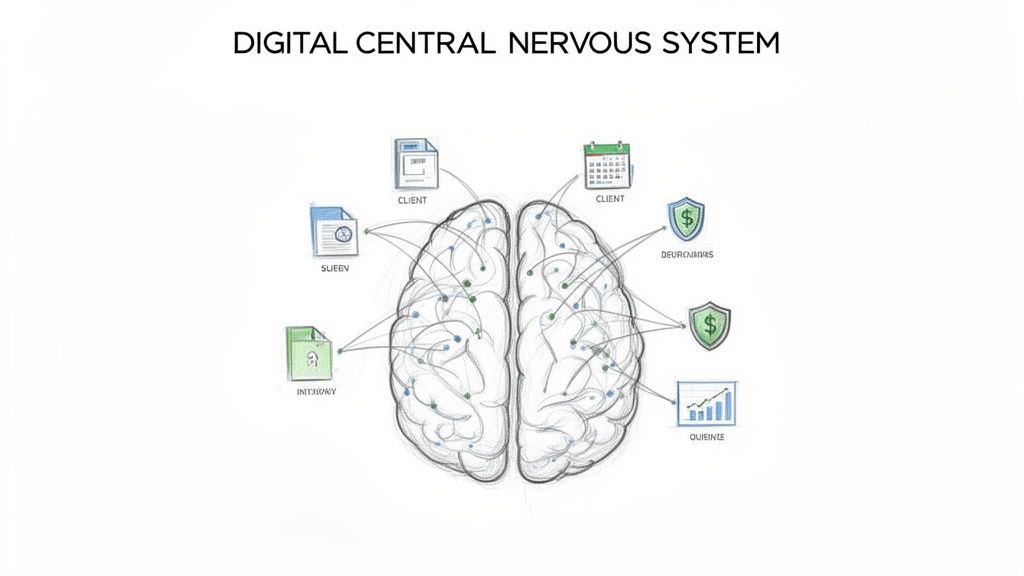
An insurance agency software platform is that conductor for your business. It doesn't just hold information; it orchestrates every part of your operation. Client data, policy renewals, commission tracking, and compliance all start working in harmony. You can think of it as your agency’s digital central nervous system.
The Problem It Solves
Before these kinds of platforms were widely available, the day-to-day of an agency was bogged down by administrative friction. Advisors were forced to piece together information from all over the place:
- Client details lived in one spreadsheet.
- Policy expiration dates were stuck in a separate calendar.
- Commission statements were tucked away in physical filing cabinets.
- Follow-up reminders were scribbled on sticky notes that had a habit of disappearing.
This scattered approach creates information silos, making a clear, 360-degree view of the business practically impossible. Advisors end up burning hours on low-value admin tasks instead of what they do best: building relationships and driving revenue. The potential for human error is massive, and crucial opportunities fall through the cracks all the time.
A Digital Command Centre
Good insurance agency software cuts through this chaos by creating a unified command centre. It pulls all your essential functions into one accessible hub, transforming a fragmented process into a smooth, connected workflow.
This centralisation is the real game-changer. It’s not just about getting digital tools; it’s about making them work together seamlessly to give you a single, reliable source of truth for every part of your agency.
For instance, when a client calls with a query, an advisor can instantly see their entire history—every policy, past conversation, and claim status—without digging through different files or interrupting colleagues. This immediate access to information completely elevates the client experience and builds a ton of trust.
On top of that, these systems automate the repetitive tasks that eat up an advisor's day. Renewal reminders go out on their own, commission payments are tracked without manual data entry, and compliance reports can be generated in just a few clicks. This frees up an incredible amount of time, letting your team concentrate on what actually moves the needle: providing expert advice and growing the business. At the end of the day, this software is the foundation for a more organised, efficient, and profitable agency.
Getting to Know the Core Modules of Your Digital Agency
To really get a feel for what insurance agency software can do, you have to look under the bonnet. It’s more than just a slick dashboard; it’s a collection of powerful, interconnected modules, each built to handle a critical piece of your agency's daily grind. Think of it like a high-performance engine, where every single part works in harmony to drive your business forward.
Let's pull apart these core modules one by one. We won't just look at what they do, but how they make a real difference to your daily tasks and your bottom line.
Policy Management: Your Digital Filing Cabinet
At the end of the day, an insurance agency is all about policies. The Policy Management module is your intelligent, digital filing cabinet, bringing a sense of calm and order to this foundational work. Forget digging through physical folders or wrestling with messy spreadsheets; this system puts the entire policy lifecycle on autopilot.
It keeps a meticulous record of every policy sold—carrier details, effective dates, premiums, you name it. But here’s the real game-changer: it automatically flags upcoming renewals, giving both your team and your clients a timely heads-up. This proactive nudge prevents policies from lapsing, locks in renewal revenue, and cements your reputation as an advisor who's always on the ball.
Client Relationship Management: The Relationship Engine
The Client Relationship Management (CRM) module is so much more than a glorified address book. It’s a relationship engine, built to capture and organise every single touchpoint you have with a client. It logs calls, emails, and meeting notes, creating a complete history that anyone on your team can pull up in seconds.
The CRM module turns client data into client intelligence. It empowers you to move from reactive service to proactive advising, building deeper, more profitable relationships over time.
For instance, a good CRM tracks important life events—birthdays, anniversaries, or even a client’s business milestones. This opens the door for genuine, personalised outreach that builds real rapport. When you understand a client’s full story, it’s far easier to spot opportunities to cross-sell or up-sell coverage that actually fits their changing needs. If you want to dig deeper into how this works, take a look at our detailed guide on CRM software systems in Singapore.
Billing, Invoicing, and Claims Management
Manually creating invoices is a slow, soul-crushing task that’s just begging for errors. The Billing and Invoicing module automates the entire circus. It generates spot-on invoices, tracks payments, and handles agency and producer commissions without anyone touching a calculator. This has an immediate impact on your cash flow and frees up countless administrative hours.
In the same vein, the Claims Management module brings structure to what is often a client's most stressful moment. It lets you log claim details, monitor progress with carriers, and keep your clients in the loop every step of the way. This isn't just about efficiency; it's about building unbreakable trust when it matters most.
This move to digital isn't just a trend; it's an acceleration. In fact, Singapore's insurance agency management software market sales revenue is set to jump from $43.702 million in 2025 to $61.463 million by 2026. That's a massive 40.6% leap in a single year, highlighting just how critical these tools have become for staying competitive. You can dive into the numbers in this market analysis of the insurance software industry.
Reporting and Analytics: Your Business Dashboard
Finally, the Reporting and Analytics module is your agency's command centre. It pulls data from all the other modules and translates it into simple, actionable insights.
With just a few clicks, you can generate reports on:
- Sales Performance: See who’s selling what and which products are hitting the mark.
- Client Retention: Keep an eye on renewal rates and spot clients who might be at risk of leaving.
- Financial Health: Get a crystal-clear picture of your commissions, revenue, and overall profitability.
This kind of data-driven visibility lets you make sharp, strategic decisions. You can double down on your most profitable client segments and fix operational weak spots before they become major problems. It’s how you turn raw data into a clear roadmap for growth.
To give you a clearer picture, here’s how these essential components fit together.
Core Modules of Insurance Agency Software at a Glance
| Core Module | Primary Function | Key Benefit for an Agency |
|---|---|---|
| Policy Management | Centralises and automates the entire policy lifecycle, from quoting to renewal. | Ensures no renewals are missed, securing revenue and boosting client retention. |
| Client Relationship Management (CRM) | Tracks all client interactions, communications, and important life events. | Turns client data into insights for personalised service and cross-selling. |
| Billing & Invoicing | Automates invoice generation, payment tracking, and commission calculations. | Improves cash flow, reduces administrative errors, and saves time. |
| Claims Management | Provides a structured workflow for logging, tracking, and communicating claim status. | Builds client trust during critical moments and improves operational efficiency. |
| Reporting & Analytics | Gathers data from all modules to create performance and financial dashboards. | Offers data-driven insights to make smarter strategic business decisions. |
Each module is powerful on its own, but when they work together, they create a seamless system that empowers your entire agency to operate more effectively.
The Strategic Benefits of Adopting Insurance Software
Knowing the individual modules of insurance agency software is one thing. Connecting them to real-world business outcomes is where you start to see the real magic. Bringing this kind of technology into your agency isn't just about getting new tools; it’s about fundamentally changing how your agency operates, competes, and grows.
It’s the difference between being reactive—constantly putting out fires—and becoming truly strategic in your approach. This shift transforms an agency from a collection of manual tasks into an intelligent, connected operation where the benefits ripple across every part of your business, from daily efficiency to long-term client loyalty.
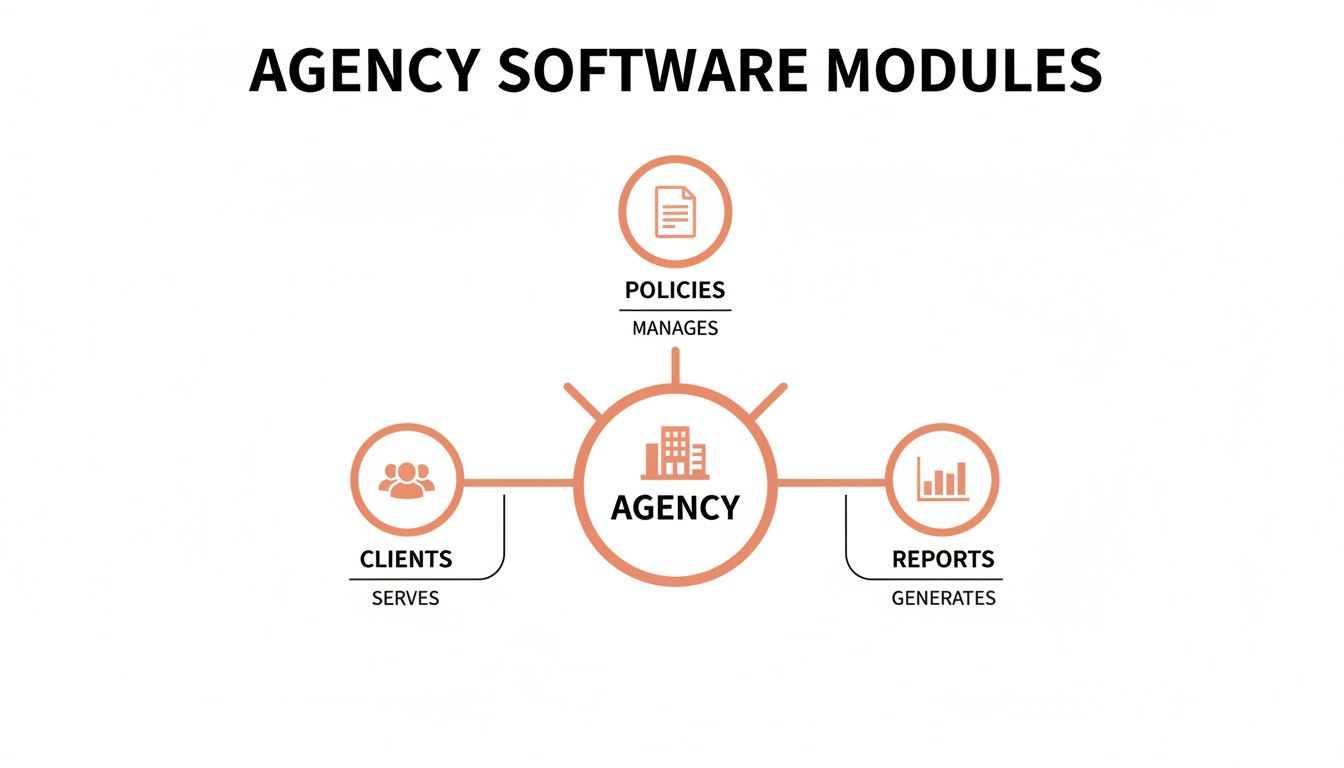
This conceptual map shows how a central agency system connects policies, clients, and reports to create a single, unified operational hub.
As you can see, the agency itself becomes the command centre. The software is the engine that lets you manage policies, serve clients, and pull actionable reports, all from one source of truth.
Boost Operational Efficiency Through Automation
Let’s be honest, the most immediate win you’ll feel from adopting insurance agency software is a massive boost in operational efficiency. Administrative tasks like manual data entry, chasing renewals, and calculating commissions are notorious time-sinks. Automation takes these repetitive, soul-crushing duties off your team's plate.
Imagine reclaiming dozens of hours every single month. Instead of being buried in paperwork, your advisors can pour that time into high-value, revenue-generating activities—things like prospecting, sitting down with clients, and strengthening carrier relationships. That's a shift that directly impacts your bottom line.
Elevate Client Relationships from Transactional to Advisory
In a crowded market, your relationships are your most valuable currency. Good insurance software gives you a complete, 360-degree view of every client, pulling their policies, communication history, and personal details into one clean, accessible record.
This rich context allows you to move beyond simply processing transactions. When you can see a client’s entire picture at a glance, you can start offering proactive advice, anticipating their future needs, and personalising every single interaction.
This depth of insight is what builds unbreakable loyalty. Clients no longer see you as just a policy provider but as a trusted advisor who genuinely understands and protects their interests.
This proactive approach naturally leads to higher retention rates and opens the door for cross-selling opportunities that are actually helpful to the client, not just another sales pitch.
Strengthen Compliance and Fortify Security
Compliance is a non-negotiable, and frankly, a stressful part of the insurance game. A centralised software system makes navigating these complex requirements so much simpler. It creates a clear, auditable trail of all activities, which takes the pain out of compliance checks and dramatically reduces the risk of costly errors and omissions (E&O).
Even more critical is protecting sensitive client data. Modern insurance platforms are built with robust security protocols to guard that information against cyber threats. By storing data in a secure, centralised system—instead of scattered across vulnerable spreadsheets and local hard drives—you significantly strengthen your agency's security posture and build the kind of trust that keeps clients for life.
Unlock Data-Driven Strategic Decisions
Finally, insurance agency software turns your business data from a bunch of numbers into your most powerful strategic asset. Integrated reporting and analytics dashboards translate raw data into clear, actionable insights you can actually use.
This means you can make informed decisions with confidence:
- Identify Profitable Niches: Pinpoint which client segments or policy types are driving the most revenue.
- Optimise Your Sales Funnel: Analyse conversion rates to find and fix the bottlenecks in your sales process.
- Spot Cross-Selling Opportunities: Use client data to identify logical opportunities for additional coverage.
This data-driven approach is quickly becoming essential for survival, let alone growth. The global insurance platform market is projected to grow from USD 116.16 billion in 2025 to USD 207.52 billion by 2030, a surge driven by new customer expectations. As more than 60% of insurance strategists accelerate their digital adoption, using data effectively is no longer optional. You can explore more about these trends in this detailed insurance market report.
Ultimately, the right software empowers your agency to stop guessing and start making strategic moves based on hard evidence.
How to Choose the Right Insurance Agency Software
Picking the right insurance agency software can feel like a massive decision. Get it right, and your agency runs like a well-oiled machine. Get it wrong, and you're stuck with a clumsy tool that creates more problems than it solves. The key is to stop looking for a magic bullet and instead follow a clear process. Think of it as finding a true partner for your business, not just buying another piece of tech.
The first move? Look in the mirror. You have to get brutally honest about what your agency actually needs. Are you a one-person shop desperate for efficiency, or a growing team that needs tools for collaboration and different user access levels? Map out your daily workflows—from that first client call to tracking commissions—to build a crystal-clear picture of what you need the software to do.
This internal audit is non-negotiable. Without it, every software demo will look shiny and impressive. You’ll have no way to separate the “nice-to-have” bells and whistles from the features that are absolutely essential to your bottom line.
Building Your Evaluation Framework
Once you know exactly what problems you're trying to solve, you can start vetting potential vendors. This shouldn't be a random process. You need a methodical way to compare platforms on an apples-to-apples basis, moving from the big-picture features down to the nitty-gritty of security and support.
Start by creating a checklist of your non-negotiable features. This list should come directly from the pain points you identified in your internal audit.
- Commission Tracking: Can the system handle complex commission splits and give your producers clear, easy-to-read reports?
- Automated Workflows: Can you set up custom triggers for essential tasks like renewal reminders or birthday follow-ups without needing a developer?
- Document Management: Is there a single, secure hub for policies, applications, and client emails so nothing ever gets lost?
- Reporting Capabilities: How easily can you pull reports on sales performance, client retention, and your agency's overall financial health?
A great software platform should feel like it was built just for you. If a vendor can't show you exactly how their system solves your top three operational headaches, they’re probably not the one.
This simple checklist will act as a powerful filter, helping you quickly weed out the vendors that don't meet your core needs so you can focus on the real contenders.
Assessing Technical and Long-Term Viability
Beyond the day-to-day features, you have to look under the hood. The technical side of the software determines whether it will play nicely with your other tools and if it can scale with you as your agency grows. When you think about how to choose a CRM, many of the same principles apply here, since a good CRM is often the heart of agency software.
Here's a practical checklist to guide you as you compare different software vendors. It will help you ask the right questions and ensure you're making a choice that serves your agency both today and in the future.
Software Evaluation Checklist for Insurance Agencies
| Evaluation Criteria | Key Questions to Ask | Importance (High/Medium/Low) |
|---|---|---|
| Core Functionality | Does it automate commission tracking accurately? Can we create custom workflows for renewals and follow-ups? Is document management centralised and secure? | High |
| Integration Capabilities | Does it have an open API? Are there pre-built integrations for our email marketing, accounting, and communication tools? | High |
| Security & Compliance | How is our client data encrypted? What access controls are in place? Does the vendor comply with industry regulations like PDPA? | High |
| User Experience (UX) | Is the interface intuitive for non-technical users? How many clicks does it take to complete common tasks? Can we get a trial account to test it? | Medium |
| Scalability & Pricing | What is the pricing model (per user, per policy)? Are there hidden fees? Will the cost become prohibitive as we add clients and team members? | Medium |
| Implementation & Support | What does the data migration process look like? Is hands-on training provided? What are the support hours and typical response times? | High |
Asking these pointed questions during demos will reveal a lot about the software and the company behind it. A smooth onboarding process and reliable support can make all the difference, ensuring your team actually uses the new tool and you get a return on your investment from day one. By following this roadmap, you can move forward confidently and choose a platform that truly empowers your agency's success.
Unlocking Sales Potential with Integrated AI Tools
Your insurance agency software is fantastic at keeping your client data organised. But its real magic happens when you plug it into smart communication tools. This creates a powerful link between the rich client information tucked away in your system and the real-world conversations that actually drive sales. Suddenly, your internal data becomes a high-octane engine for every client interaction.

The secret is using artificial intelligence to analyse the prospect data already sitting in your CRM to pull out deep communication insights. This goes way beyond simply knowing a client's policy renewal date. We're talking about understanding how they think and what truly motivates them to make a decision.
This is where technology gives the all-important human touch in sales a serious upgrade, rather than trying to replace it. It hands advisors the tools to connect more genuinely and effectively right from the first hello.
From Data Points to Personality Insights
Modern AI communication tools can instantly scan a prospect's digital footprint to give you a surprisingly clear picture of their personality type and how they prefer to communicate.
Picture an advisor getting ready for a call. Before they even dial the number, they could know if the prospect is a data-hungry "Wizard" who needs the cold, hard facts, or a relationship-driven "Healer" who values trust and a personal connection above everything else.
This kind of prep work is a total game-changer. An advisor can frame their proposal in a way that builds instant trust and heads off potential objections before they even surface. It's all about speaking the client's language from the get-go.
Knowing how to communicate is just as important as knowing what to communicate. AI gives you the 'how,' turning a standard pitch into a resonant conversation that feels natural and builds genuine rapport.
To really get the most out of this, agencies should be leaning into sophisticated data-driven lead nurturing strategies. This approach uses client information not just for targeting, but for customising the entire communication journey.
A Practical Scenario in Action
Let's walk through how this looks in the real world. An insurance advisor, Sarah, has a meeting with a new high-value prospect, Mr. Tan, to go over a complex life insurance and investment portfolio.
Initial Analysis: Sarah fires up an AI tool like Mindreader, which is linked to her CRM. By looking at Mr. Tan’s professional profile and email history, the AI tags him as an "Explorer" archetype—someone decisive, focused on results, and who doesn't like to waste time.
Strategic Preparation: The AI gives Sarah a specific playbook. It tells her to skip the long-winded small talk, lead with a clear agenda, and get straight to the bottom-line benefits of her proposal. It even suggests a few key phrases that will click with his direct communication style.
Tailored Communication: In the meeting, Sarah follows the AI's advice. She presents three distinct options with a straightforward comparison of their ROI. She keeps her presentation punchy and laser-focused on how her solutions will help Mr. Tan hit his financial goals faster.
Closing the Deal: Mr. Tan is impressed. Sarah's directness and clarity show she respects his time. Because she adapted her approach to his personality, she built trust quickly and closed a major deal that might have slipped away with a more generic, one-size-fits-all pitch.
The Broader Impact of AI Integration
This kind of smart integration is quickly becoming the new standard. InsurTech stats show that over 82% of insurance companies around the world are now using AI and machine learning, with Singapore becoming a major hub for adoption. When set up right, AI-powered analytics can slash processing times by 50-70% and cut operational costs by as much as 30%.
When you pair these intelligent tools with your core insurance agency software, you create a powerful feedback loop. Every interaction feeds new data back into the system, sharpening your understanding of the client and making every future conversation even more effective. For teams looking to sharpen their edge, our guide on how AI can empower sales teams offers more great strategies.
This is how you build an unstoppable sales engine—by marrying great data with an even better human connection.
Measuring Your Software ROI and Proving Its Value
Investing in new insurance agency software is a big move. But once the ink is dry, how do you prove it was the right one? To justify the cost, you need a clear way to measure its return on investment (ROI) that goes beyond just a gut feeling.
This means looking at tangible metrics that show the software is actively making your agency more efficient and profitable. The goal is to connect the software's features directly to real business outcomes. It’s not just about the monthly subscription cost; it’s about the value you gain in saved time, secured revenue, and new business.
Key Metrics to Track
To calculate a meaningful ROI, you have to track the right data points before and after you make the switch. This simple before-and-after comparison will show you exactly what impact the software is having on your bottom line.
Focus your attention on these critical areas:
- Time Spent on Administrative Tasks: How many hours is your team sinking into manual data entry, pulling reports, and tracking commissions each week? A significant drop here is a direct cost saving you can take to the bank.
- Policy Renewal Rate: A good system automates renewal reminders and gives you insights into which clients might be unhappy. Every point your renewal rate goes up is pure profit added to your bottom line.
- Client Satisfaction Scores: Use simple surveys to get a read on client happiness. You’ll almost always find that better scores lead to higher retention and more word-of-mouth referrals.
- New Business and Cross-Sell Revenue: Keep a close eye on how many new policies are sold and how often existing clients add more coverage. Your software’s CRM capabilities should make spotting these opportunities almost effortless.
Real-World Success Stories
Sometimes, the best way to see what’s possible is to look at how others have done it. These quick examples show the direct financial impact of getting the right software in place.
Case Study 1: An Advisor Boosts Client Retention by 15% An independent financial advisor was watching his client churn rate creep up. He brought in software with a strong CRM, letting him automate personalised birthday messages and six-month policy reviews. This proactive touch made his clients feel valued. Within a year, his retention rate jumped by 15%, directly protecting thousands in recurring commission.
Case Study 2: A Sales Team Increases Cross-Selling by 20% A small agency’s sales team used their new software's reporting tools to find every client with home insurance but no auto policy. They launched a targeted campaign based on the platform’s data. The result? A 20% spike in cross-sell revenue in just one quarter, proving how powerful integrated data can be.
If you’re looking for more ways to make this happen, our guide to sales and marketing automation offers some great strategies.
Frequently Asked Questions
Jumping into insurance agency software for the first time? You're not alone. It's a big step, and it's natural to have questions. Here are a few of the most common ones we hear from agency owners and advisors, answered straight up.
How Long Does Implementation Take?
There's no magic number here—it really depends on your agency's situation. For a smaller team with well-organised data, you could be up and running in just a few weeks. But for larger firms tangled in complex, older systems, the process might take a few months to get just right.
A few things will dictate your timeline:
- Data Migration: Getting your existing client and policy data moved over is the biggest piece of the puzzle. The cleaner your data, the faster this goes.
- Customisation: If you need to tweak workflows and reports to fit your agency's unique way of doing things, that will add some time to the setup.
- Team Training: You can have the best system in the world, but it's useless if your team doesn't know how to use it. Proper onboarding is non-negotiable for success.
Is This Software Suited for Small Agencies?
Absolutely. The idea that this kind of powerful software is only for the big players is a thing of the past. Today, many platforms are built specifically for small agencies and even solo advisors, offering scalable, cloud-based solutions that won't break the bank.
These modern systems deliver the same core advantages—smarter client management, major efficiency boosts, and iron-clad compliance—without the massive price tag or complicated setup of legacy software. They’re designed to grow right alongside you, so you can add features and users as your agency expands.
Cloud vs On-Premise: What Is Better?
For most agencies today, the debate between cloud-based and on-premise software is pretty much settled. The cloud has won, and for good reason.
A cloud-based platform gives you more flexibility, costs less to get started, and handles all the security updates for you. It frees you up to focus on what you do best: serving your clients.
Going the on-premise route means you’re on the hook for managing servers, security, and updates yourself. That can be a huge drain on time and money, especially for a small or medium-sized agency. Cloud software takes all of that off your plate and gives you secure access from anywhere with an internet connection—a must-have for the modern, mobile advisor.
Ready to transform your client conversations and close more deals? Discover how Mindreader uses communication AI to give you the insights you need to connect with any prospect. Visit https://www.themindreader.ai to learn more.