
A customer profile is essentially a detailed portrait of your ideal buyer. It's built from real data and goes way beyond just their job title, digging into their motivations, what keeps them up at night, and even how they like to communicate.
Think of it as the difference between a skeleton key and a high-tech keycard. One is generic and gets you nowhere; the other is custom-cut to grant you access. This is what a good customer profile does—it transforms your generic outreach into a precise, personal strategy that opens doors.
What Is a Customer Profile and Why It Matters Now
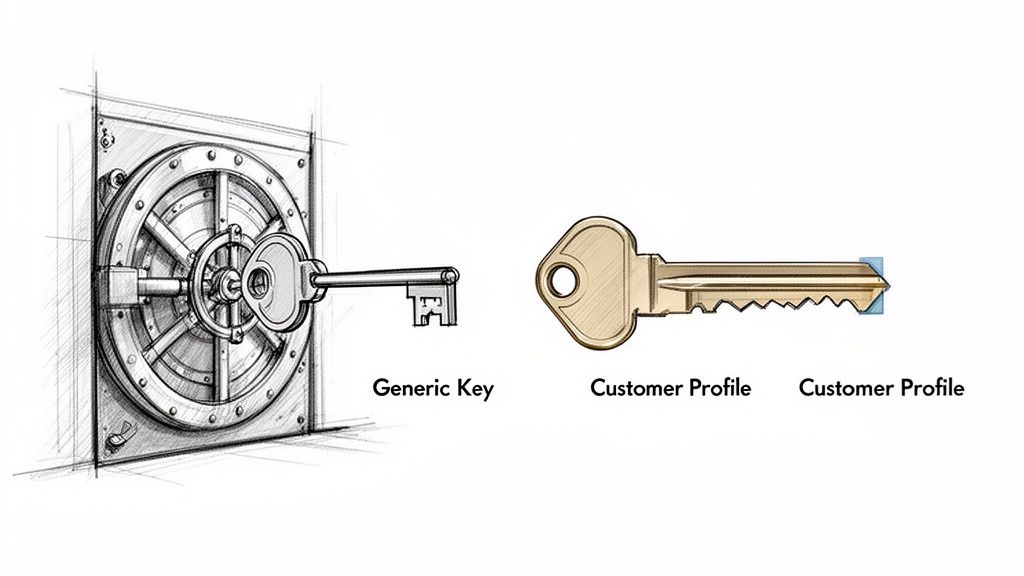
Imagine trying to unlock a modern, high-tech vault with a rusty old skeleton key. You'd fail every single time. That’s what B2B outreach feels like when you don't have a sharp, insightful customer profile. The days of simply relying on surface-level data like company size or job titles are long gone.
We're all drowning in a sea of generic messages. Because of this, personalisation isn't just a nice-to-have anymore; it's the absolute baseline for even getting a response.
A well-crafted customer profile is your strategic guide to understanding the person behind the professional title. It’s about moving past basic demographics to uncover the core drivers behind their decisions.
This deeper understanding is a game-changer because it completely reframes your sales process. Instead of playing a frustrating numbers game focused on sheer volume, selling becomes a series of meaningful, strategic conversations. Every interaction, from that first cold email to the final negotiation, is shaped by a genuine understanding of what truly matters to your prospect.
Moving Beyond Simple Demographics
Traditionally, sales teams built profiles using basic firmographic and demographic data. That information is still useful, but it only scratches the surface. An effective customer profile today has to answer much more nuanced questions:
- What are their biggest professional goals right now? Are they under pressure to drive revenue, slash costs, or innovate within their department?
- What specific pain points are keeping them up at night? Knowing their real challenges allows you to position your solution as the answer they’ve been looking for.
- How do they prefer to communicate? Do they want direct, data-driven conversations, or do they respond better to a collaborative, relationship-focused approach?
- What does their digital footprint tell you? The content they share, comment on, and engage with online is a goldmine of clues about their priorities and mindset.
Answering these questions gives you a multi-dimensional view of your buyer, helping you tailor every single touchpoint with uncanny relevance. When you know what actually motivates someone, you can align your pitch directly with their objectives. Your solution stops feeling like just another product and starts feeling like a true partnership.
If you want to dive deeper into the basics, you might be interested in our guide on the ideal customer profile.
A customer profile isn't just a document; it's a strategic lens that brings your ideal buyer into sharp focus, revealing the path to earning their trust and winning their business.
This shift from broad targeting to individualised engagement is where today's sales battles are won. It’s the difference between being another unread email in an overflowing inbox and becoming a trusted advisor. By investing the time to build accurate profiles, you're setting the stage for more productive conversations, shorter sales cycles, and ultimately, much higher conversion rates.
The Four Pillars of an Actionable Customers Profile
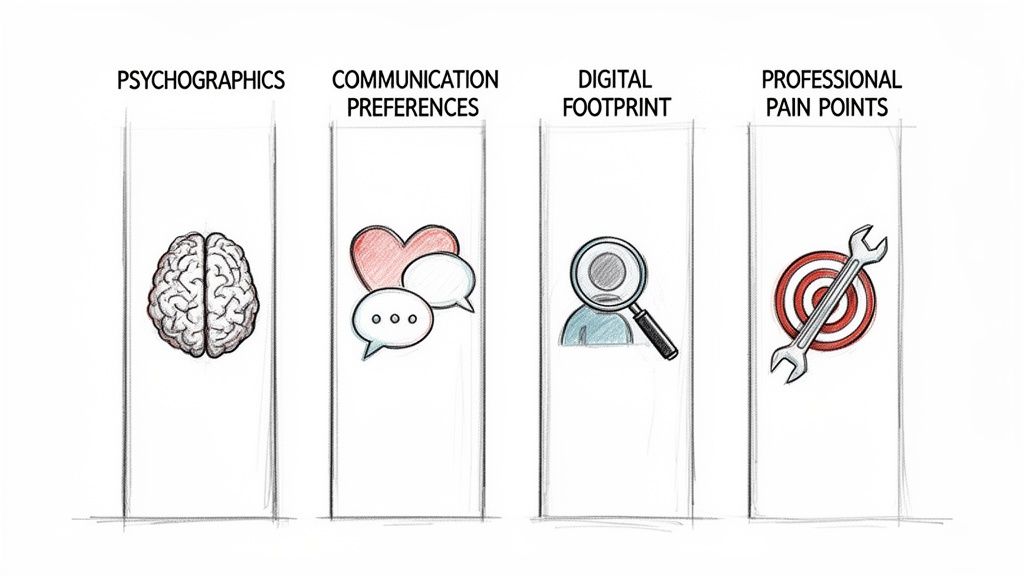
A truly powerful customers profile goes way beyond a job title and a company name. You need to build a complete picture of the person you want to connect with—understanding not just what they do, but why they do it.
To really nail this, your profile needs to stand on four essential pillars. Think of these as the foundation that turns abstract data into a practical, conversation-starting tool for every single interaction.
Uncovering Motivations with Psychographics
The first and most important pillar is psychographics. This is where you dig into your prospect's inner world—their mindset, their values, and what they’re trying to achieve in their career. Demographics tell you who they are on paper; psychographics reveal what actually drives them.
In short, you’re figuring out their professional "why." Are they chasing innovation and industry recognition, or do they play it safe, prioritising stability and minimising risk? Knowing this helps you frame your solution in a way that clicks with their deepest motivations.
For instance, if a prospect is constantly sharing articles about market disruption on LinkedIn, they’re likely driven by a desire to be seen as a forward-thinking leader. Your outreach should lean into that—talk about future trends and competitive edges, not just bottom-line efficiencies.
Decoding Their Communication Preferences
How someone likes to receive information is a massive tell. The second pillar, communication preferences, is all about figuring out if they’re a straight-to-the-point, data-driven type or someone who prefers a more collaborative, relationship-building chat. Getting this wrong can kill a conversation before it even gets going.
A prospect who fires off concise, bullet-pointed emails probably values efficiency and clear, hard numbers. On the other hand, someone who asks open-ended questions and tries to get everyone on the same page in meetings likely values partnership and genuine understanding.
A great customers profile doesn't just list facts; it tells a story about the person's professional world. It reveals their pressures, their aspirations, and the language they speak, giving you the script for a successful conversation.
Mirroring their style builds instant rapport. You might send a data-packed, one-page summary to the first person, but you'd schedule a more exploratory, open-ended call with the second. It’s a simple adjustment that shows you respect their time and how they work.
Analysing Their Digital Footprint
In today's world, a person's professional online activity is a goldmine of intel. The third pillar is their digital footprint, which means looking at what their public activity says about their priorities and personality.
This is more than just glancing at their job title. You need to look closer:
- Content Engagement: What articles are they sharing or commenting on? This is a direct window into their current interests and biggest headaches.
- Group Memberships: Which industry groups do they hang out in? This tells you where they go for information and who they trust.
- Personal Tone: Is their language formal and authoritative, or more casual and collaborative? This gives you major clues about how to approach them.
A prospect who often engages with posts about team-building exercises, for example, might be a more relationship-focused "Healer" type who would respond well to collaborative solutions.
Identifying Professional Pain Points
Finally, the fourth pillar is all about spotting their professional pain points. This is the art of figuring out the specific, nagging business problems they are literally paid to solve. Your product is only relevant if it fixes a real issue they're grappling with right now.
This information is often hiding in plain sight. You can find clues in company annual reports, recent press releases, or even in the way they phrase their LinkedIn posts. Are they obsessed with cutting operational costs, grabbing more market share, or boosting team productivity?
In Singapore's dynamic business scene, for example, a huge customer segment is the tech-savvy working population, with the 25-39 age bracket topping 1.7 million people. With internet penetration at 95.8% and 92% of them active on social media, their digital footprint provides a wealth of data for pinpointing professional pains and building sharp, accurate profiles. You can discover more insights about the Singapore digital audience from Meltwater.
Each pillar adds another layer of understanding. When you bring them all together, you create a robust and genuinely actionable customers profile that lets you connect with relevance and authenticity.
A Step-By-Step Guide to Building Your Customers Profile
Alright, let’s move from theory to practice. Building a genuinely insightful customers profile isn’t about guesswork; it's a structured process for turning bits and pieces of information into a seriously powerful sales tool. I’ll break it down into three clear stages to help you build a profile from the ground up that gives you a real strategic edge.
Think of yourself as a detective putting together clues. Each piece of data is just one part of a bigger story. Your job is to assemble them until a complete picture of your ideal buyer emerges.
Stage 1: Gather Your Data
First things first, you need to collect the raw materials. This means pulling information from different places to get a full view of your prospect, moving way beyond just their LinkedIn title to understand their professional world. A crucial first step, even before outreach, is creating a detailed Ideal Customer Profile.
Start with what you already have. Your CRM is often a goldmine, holding a history of past interactions and key company details.
From there, expand your search to their digital footprint. Get on professional networks like LinkedIn and see what they’re up to. What kind of content do they share? Who are they following? The language they use in their posts and comments gives you huge clues about their communication style and what’s important to them. AI-powered tools can also give you a leg up here, spotting patterns in public data that you might otherwise miss.
Stage 2: Analyse and Synthesise
Once you've got your data, it’s time to connect the dots. This is where you shift from collecting facts to finding real meaning. Raw data alone won't get you far; you need to find the patterns that reveal what truly drives your prospect and what keeps them up at night.
Start by organising your findings into the four key pillars: psychographics, communication preferences, digital footprint, and professional pain points. Look for themes that keep popping up. For example, does your prospect constantly share articles about operational efficiency? That’s a massive sign of a pain point you can help solve.
A great customers profile is built on synthesis. It’s the art of seeing how a prospect’s preference for data-driven reports connects to their goal of reducing departmental spending, giving you a clear path for your conversation.
Synthesis is all about asking "why?" Why do they engage with certain topics? Why do they communicate the way they do? Answering these questions is how you move from just observing to truly understanding. This forms the heart of your profile. For more on how to apply this data in practice, you can learn more about different approaches to customer profiling in our related article.
Stage 3: Map to an Archetype
This final stage makes your profile instantly usable. After synthesising all that data, you can map your prospect to a simple framework, like an archetype. This step turns your complex analysis into a simple, memorable persona that makes guiding your communication strategy a breeze.
For instance, if your analysis shows a prospect who is direct, fixated on ROI, and communicates in sharp bullet points, you can confidently map them to a Knight. If another is endlessly curious, asks a ton of questions, and loves digging into new data, they’re a classic Explorer. This mapping gives your entire team a mental shortcut to understanding the client.
To help you organise your findings, here is a straightforward template you can follow.
Customer Profile Building Template
This template will guide you through collecting and analysing the data needed to create a complete and actionable customers profile.
| Profile Component | Key Questions to Answer | Example Data Point (For a Financial Advisor Prospect) |
|---|---|---|
| Psychographics | What are their primary professional goals and values? | "Shares articles on legacy planning and wealth preservation. Values security over high-risk growth." |
| Communication | How do they prefer to receive information? | "Responds best to emails with clear agendas. Prefers scheduled calls over spontaneous check-ins." |
| Digital Footprint | What does their online activity reveal? | "Active in private wealth management forums. Comments focus on long-term client relationships." |
| Pain Points | What challenges are they trying to solve? | "Expressed concern about navigating complex regulatory changes for their high-net-worth clients." |
| Archetype | Which archetype best fits their profile? | "Healer - Prioritises trust, relationships, and providing security for clients." |
Following this structured process ensures your customers profile becomes a genuine strategic asset, not just a folder of data. It arms you for every single interaction with a clear understanding of who you’re talking to and what they actually care about.
Unlocking Sales with Four B2B Customer Archetypes
Gathering data to build a customers profile is a massive step forward. But let's be honest—raw data is tough to recall, and even tougher to apply when you're in the middle of a high-stakes sales call. This is where archetypes come in. They’re the secret to turning your detailed analysis into a simple, actionable framework.
When you map your findings to a clear persona, you're essentially creating a mental shortcut for you and your team. Abstract data points suddenly transform into a memorable character. This allows you to instantly adapt your communication style, tone, and messaging to what will actually connect with the person on the other end of the line.
This simple, three-step journey takes you from raw data to a practical archetype you can use every day.
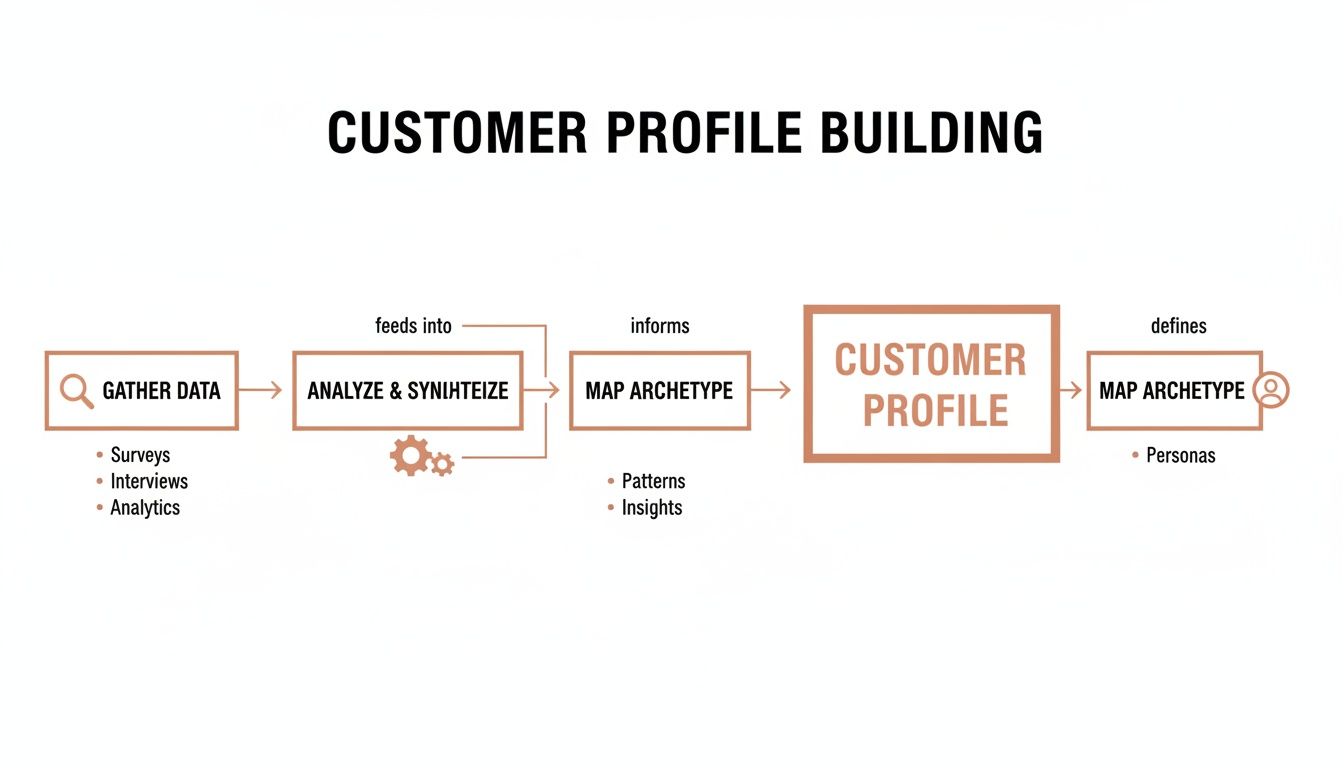
The whole idea is to move from scattered information, to synthesising it for meaning, and finally, to mapping it onto a memorable persona that makes your sales conversations intuitive.
The Knight: The Decisive Driver
First up is The Knight. This archetype is direct, decisive, and laser-focused on results. They view business through a lens of clear wins and losses and have very little time for ambiguity or chit-chat. Knights are all about achieving measurable outcomes—think ROI, efficiency gains, and smashing targets.
When you're talking to a Knight, just get straight to the point. They value clarity and brevity above all else.
- Core Motivation: Nailing tangible results and demonstrating success.
- Communication Style: Direct, concise, and data-driven. They prefer bullet points to long-winded stories.
- What They Value: Hard proof of performance, a clear ROI, and a straightforward path to getting things done.
Forget vague promises. Instead, arm yourself with hard numbers, compelling case studies, and a confident action plan. Show them exactly how your solution helps them win, and you'll have their attention.
The Explorer: The Curious Analyst
Next, let's meet The Explorer. This person is fuelled by curiosity, data, and a deep-seated need to understand exactly how things work. They are meticulous researchers who want to examine every angle and weigh all the options before committing. Explorers are naturally wary of a hard sell and much prefer to discover the best solution on their own terms.
To connect with an Explorer, you need to be a source of valuable information, not just another salesperson.
Archetypes are not rigid boxes; they are flexible guides. A single prospect might show traits of multiple archetypes, but they will almost always have a dominant style that shapes their decision-making process.
They love detailed white papers, in-depth product demos, and thorough answers to their (many) questions. Your job is to facilitate their discovery process. Give them all the data they need to feel confident and fully informed. To learn more about spotting these traits, check out our guide on the four client classes in sales.
The Healer: The Relationship Builder
Our third archetype is The Healer. Healers are all about building trust, fostering strong relationships, and making sure the whole team is in harmony. Their decisions are based on how a solution will impact their people and the overall health of the organisation. To a Healer, a vendor isn't just a supplier—they're a long-term partner.
Building genuine rapport isn't just a tactic with a Healer; it's non-negotiable.
They value empathy, reliability, and a collaborative spirit. Show them you truly understand their team's struggles and are genuinely committed to helping them succeed. Testimonials from happy clients and a focus on partnership will get you much further than any aggressive sales pitch.
The Wizard: The Visionary Innovator
Finally, we have The Wizard. This archetype is the forward-thinker, always focused on the big picture and what's coming next. Wizards get excited by innovation, fresh ideas, and the potential for groundbreaking change. They're less concerned with the minor details and more interested in how a solution can transform their industry or give them a serious competitive edge.
To grab a Wizard's attention, you have to spark their imagination.
- Core Motivation: Driving innovation and shaping the future.
- Communication Style: Visionary and conceptual. They love brainstorming "what if" scenarios.
- What They Value: Bold ideas, long-term potential, and a partner who gets where the future is heading.
Don't get bogged down in technical specs. Instead, paint a compelling picture of what's possible. Talk about future trends, share your boldest vision, and position your solution as the key to unlocking a new frontier for their business. This approach is especially powerful in a hyper-connected B2B world. For instance, Singapore's digital audience shows a social media penetration of 88.2%, with users active on an average of 7.2 platforms monthly. With WhatsApp usage at 80.1% and 48.5% using social media for family connections, it's clear that building that personal rapport is critical for engaging Healer and Explorer archetypes effectively. You can find more insights about Singapore's digital B2B landscape from DataReportal.
How to Personalise Outreach for Each Archetype
Knowing the four archetypes is one thing. Turning that knowledge into actual conversations that close deals? That's where the magic really happens. A generic, one-size-fits-all email just doesn’t cut it anymore. Real personalisation means tweaking your entire message—from the subject line down to the call-to-action—to connect with what truly drives your prospect.
This is where your detailed customer profile becomes your sales playbook. It tells you exactly how to frame your value proposition so you get a nod of agreement, not a quick delete.
Let's break down four distinct, ready-to-use outreach templates, each designed for a specific archetype. I’ll explain not just what to say, but why it works, connecting every word back to the core motivations we’ve been exploring.
Template for The Knight
The Knight is all about efficiency, results, and a clear return on investment. Your approach has to be direct, sharp, and focused on outcomes. No fluff. Get straight to the point.
Subject: A Clear Path to [Specific, Measurable Outcome]
Hi [Prospect Name],
My research shows you’re focused on [Their Goal, e.g., reducing operational costs by 15%].
We helped [Similar Company] achieve [Specific Metric, e.g., a 22% reduction in X] in [Timeframe, e.g., six months] using our [Solution Name].
I have a three-point plan on how we could replicate this success for you. Are you free for a 15-minute call next Tuesday to discuss it?
Best regards,
[Your Name]
Why It Works:
- Direct Subject Line: It speaks the Knight's language by promising a clear result from the very start.
- Concise Body: The email is incredibly short and respects their time. Every word serves a purpose.
- Data-Driven Proof: Using a hard number like a 22% reduction builds instant credibility and shows tangible ROI.
- Action-Oriented CTA: The call-to-action is specific ("15-minute call"), time-bound, and offers a clear agenda ("three-point plan").
Template for The Explorer
The Explorer is moved by curiosity, data, and a deep need to understand all their options. Your goal isn't to sell; it's to help them in their discovery process by offering up valuable, in-depth information.
Subject: A New Perspective on [Their Area of Interest]
Hi [Prospect Name],
I noticed your recent article on [Topic] and was impressed by your insights on [Specific Point].
It reminded me of some fascinating data we've compiled on [Related Subject], which suggests a trend that most are overlooking. Our findings show that companies leveraging this see a 30% improvement in [Relevant KPI].
Would you be open to a deeper discussion? I'd be happy to walk you through our report and explore how these insights might apply to your work at [Their Company].
Best,
[Your Name]
Why It Works:
- Intriguing Subject Line: It sparks their curiosity with the promise of new information, not a sales pitch.
- Builds on Their Work: Referencing something they've created shows you've done your homework and respect their expertise.
- Offers Data: Mentioning a "report" and "fascinating data" is like catnip for their analytical mind.
- Collaborative CTA: Words like "deeper discussion" and "explore insights" frame the next step as a low-pressure exchange of ideas—exactly what an Explorer is looking for.
Personalisation is more than just using a prospect's name. It's about demonstrating that you understand their professional world and can speak their language, turning a cold outreach into a relevant conversation.
Template for The Healer
The Healer places immense value on trust, relationships, and the well-being of their team. Your outreach needs to be warm, empathetic, and centred on partnership and support.
Subject: A Thought on Your Team at [Their Company]
Hi [Prospect Name],
I've been following [Their Company]'s journey and truly admire the culture of collaboration you've built.
Many leaders I speak with in your position are currently navigating the challenge of [Common Team Pain Point, e.g., preventing team burnout]. We've found that providing the right support structure can make all the difference.
I have a few ideas on how to lighten the load for your team that have worked well for others. Would you be open to a brief, informal chat to see if they might be helpful?
Warmly,
[Your Name]
Why It Works:
- Empathetic Subject Line: It immediately puts their people at the centre of the conversation, not your product.
- Genuine Compliment: Acknowledging their company culture helps build immediate rapport and trust.
- Focus on Partnership: The language revolves around "support" and "helping," positioning you as an ally.
- Low-Stakes CTA: Phrases like "informal chat" and "see if they might be helpful" remove all pressure and frame the call as a friendly, supportive conversation.
Template for The Wizard
The Wizard is a visionary, always excited by bold ideas and future-focused concepts. Your job is to spark their imagination and show them how your solution is a key to unlocking what's next.
Subject: Is [Their Industry] Ready for This?
Hi [Prospect Name],
Given your work in [Their Field], I believe you are one of the few people who will immediately grasp the potential of a new approach to [Area of Innovation].
What if you could [Describe a Bold Future State, e.g., predict market shifts three months before they happen]?
This isn't just theoretical. We're developing a framework to make it a reality, and I'd be keen to get your perspective as a leader in the space.
Are you open to exploring what the future of [Their Industry] could look like?
Best regards,
[Your Name]
Why It Works:
- Provocative Subject Line: It creates intrigue and challenges the norm, which Wizards love.
- Appeals to Their Ego: It positions them as a forward-thinker ("one of the few people who will grasp..."), making them more receptive.
- Visionary Language: The "What if..." question opens up a big-picture dialogue about possibilities, not just features.
- Collaborative & Future-Focused CTA: It’s an invitation to co-create a vision ("get your perspective"), not just listen to a pitch.
Here's the rewritten section, designed to sound like an experienced human expert, following the provided style guide and examples.
Making Customer Profiles Part of Your Sales Workflow
Creating a detailed customer profile is a great start, but its real power is unlocked when it stops being a static document and becomes the lifeblood of your daily sales operations. To see real results, you need to weave these insights directly into your team's workflow. This is how you turn a one-off exercise into a systematic, scalable process for closing more deals.
Think of it like a pilot's pre-flight checklist. You don’t just do it once and forget about it; it’s an essential, repeatable process that makes sure every flight—or in this case, every sales call—is set up for success. This integration is what moves profiling from theory into a practical tool that actually wins business.
The first step is to get this data right into your CRM. This creates a single source of truth, giving everyone on your team instant visibility into a prospect's archetype, what drives them, and how they prefer to communicate. When everyone is looking at the same rich picture, your entire organisation can deliver a consistent, personalised experience every single time.
Systematising Your Approach
Making customer profiles a core part of your workflow isn’t just about technology; it’s about building the right habits. You need to give your team the structure and training to apply these insights consistently until it becomes second nature.
Start by training your sales team to think in terms of archetypes when they're prepping for calls or planning their strategy. Get them into the habit of asking, "Am I talking to a Knight or a Healer?" This simple mental shift reframes their entire preparation process around the prospect's personality, not just their own sales script.
You can also use automation to keep enriching your contact data. Tools can be set up to pull in new information from a prospect’s online activity, keeping your customer profiles up-to-date without anyone lifting a finger. This ensures your data stays fresh and accurate, giving you a real-time advantage.
Integrating profiles into your workflow isn't just about efficiency; it's about building an organisational muscle for empathy. It teaches your entire team to see the world through the customer's eyes, leading to more authentic and effective engagement.
Maintaining Trust Through Ethical Data Use
As you embed this data into your sales process, trust has to be your top priority. Using data ethically isn't just a legal checkbox; it's the very foundation of a healthy customer relationship. Always be transparent about the information you collect and how you’re using it to create a better experience for them.
Focus on using publicly available information and insights you gather from direct conversations. The goal here is to understand your customer so you can serve them better—not to be intrusive. This privacy-first approach is what builds and maintains trust, which is by far your most valuable asset.
By systematically integrating profiles, training your team, and sticking to ethical practices, you turn a simple project into a sustainable engine for growth that delivers consistent wins across your entire organisation.
Your Customer Profile Questions, Answered
As you start building and using customer profiles, a few questions will naturally pop up. Let's tackle some of the most common ones to help you sharpen your strategy and get the most out of this process.
How Often Should I Update Customer Profiles?
Think of your customer profiles as living documents, not something you create once and file away. People change jobs, companies pivot, and new challenges pop up all the time.
A good rule of thumb is to review and refresh them at least quarterly. This keeps your outreach razor-sharp and ensures you're always speaking to their current reality, not an old one.
What Is the Difference Between a B2B and B2C Profile?
While both are about understanding the buyer, their focus is worlds apart. A B2C profile zooms in on an individual consumer—think demographics, personal hobbies, and what drives their shopping habits.
A B2B customers profile, on the other hand, is all about their professional life. You're looking at their role, the specific business problems they're trying to solve, and how much clout they have when it comes to making purchasing decisions for their company.
How Can I Justify the Time Investment to My Team?
Show, don't just tell. The best way to get buy-in is with cold, hard proof.
Start small. Build out profiles for a handful of high-value prospects and track everything—engagement, reply rates, meeting conversions. When your team sees that a personalised approach built on a solid profile leads to better conversations and closes deals faster, the value becomes impossible to ignore. That data is your best argument.
Ready to stop guessing and start connecting with precision? Mindreader translates complex buyer signals into actionable sales strategies. Discover how our AI-powered archetypes can help you understand every prospect and close more deals at https://www.themindreader.ai.