
So, what exactly is a colour personality test? At its core, it’s a simple framework that links specific colours—like an assertive Red or a thoughtful Blue—to common personality traits and how people prefer to communicate.
Think of it as a quick-start guide to human behaviour. It gives you a baseline for understanding where a prospect might be coming from, long before you even pick up the phone.
Unlocking Potential with the Colour Personality Test
Ever wished you had a shortcut to getting inside a client's head? A way to know if they want the bottom-line results upfront or a detailed, step-by-step breakdown? That’s the fundamental promise of a colour personality test.
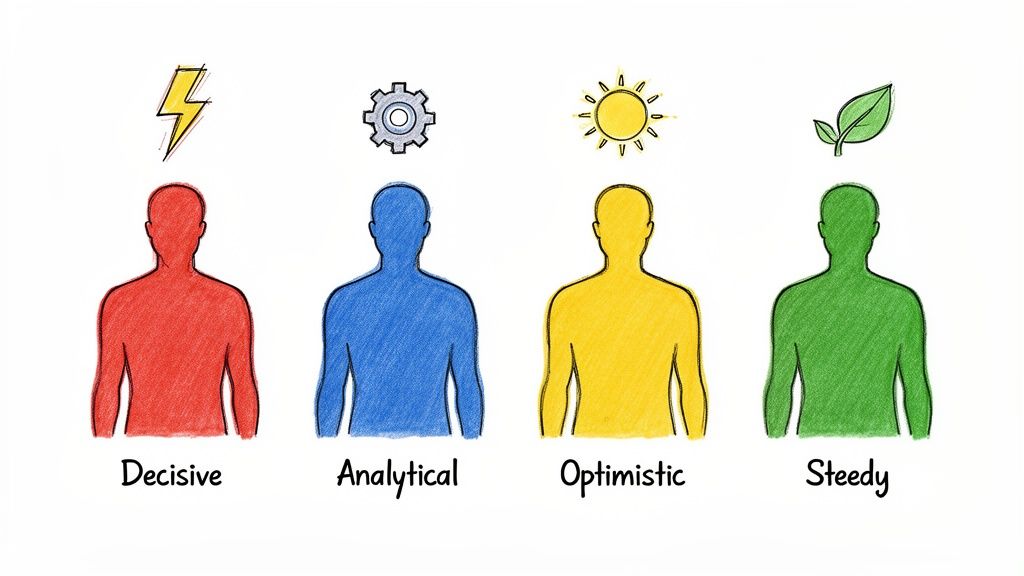
These frameworks sort human behaviour into a few distinct archetypes, with each one represented by a colour. While there are a few different models out there, they often share common ground, tying certain hues to specific motivations and interaction styles.
The goal isn't to stick rigid labels on people. It's about gaining an intuitive edge in how you communicate.
The Four Primary Archetypes
At the heart of most colour-based systems, you'll find four foundational personality types. Getting a handle on these gives you a practical mental model for adapting your approach on the fly.
- Decisive Red: These are your direct, assertive, results-driven people. They're often motivated by getting things done and having control, so they value efficiency and quick decisions.
- Analytical Blue: This group is logical, detail-focused, and systematic. They need to see the facts and evidence before making a commitment because accuracy and data are what they trust.
- Optimistic Yellow: Social, expressive, and full of enthusiasm, Yellow personalities are energised by interaction and creativity. Fun and social recognition are big motivators for them.
- Steady Green: Often seen as calm, supportive, and reliable, Greens value harmony and stability above all else. They build trust through genuine connection and prefer a collaborative, steady pace.
This simple breakdown is your starting point. For instance, knowing you're talking to a "Red" personality suggests you should lead with the conclusion. But if you’re meeting with a "Blue," you’ll need a more methodical, data-heavy presentation to win them over.
"Life is all about relationships. Our main goal... is to help people understand themselves and others on a deeper level so they can improve both their personal and professional relationships."
A Practical Tool for Sales Professionals
More than just a quirky online quiz, a colour personality test offers real, tangible benefits for anyone in sales. It’s a framework for anticipating what a prospect needs and tweaking your communication style to match.
And let’s be clear: this isn't about manipulation. It's about connection.
When you can speak a client's "language," you immediately reduce friction and build rapport far more effectively. That initial understanding can be the difference between a stalled conversation and a productive partnership. A high-energy, story-filled pitch that gets a Yellow personality excited might completely overwhelm a more reserved Green.
Ultimately, these tests offer a simplified map to navigate human behaviour. While they aren't a definitive diagnostic tool, they provide a valuable baseline for steering through the complexities of high-stakes sales conversations.
The critical question, then, is how do you turn these colour insights into a real advantage that helps you connect with clients and close more deals? That's exactly what this guide will explore.
So, What’s the Real Science Behind Personality and Colour?
Let's be honest. When you first hear about a "colour personality test," it sounds a bit like a magazine quiz, right? It seems almost too simple to be true. So, is there any real data connecting our personalities to the colours we like, or is it all just pop psychology?
The answer is a little more nuanced than a simple yes or no. The core idea is rooted in a field called colour psychology, which has decades of research showing that colours consistently trigger predictable emotional and even physical reactions in people.
Think about it. The colour red can actually speed up your heart rate a little, creating a feeling of urgency. Blue, on the other hand, often has a calming, stabilising effect. These aren't just random cultural ideas; they’re deep-seated responses that give the principles behind a colour test a surprisingly firm foundation.
This connection isn't a coincidence. Our feelings about colours are built from a mix of universal human experiences (like the calming blue of the sky and ocean) and the cultural meanings we’ve learned over time. When these principles are applied to personality, they tap into a recognised framework for understanding why we do what we do.
Connecting Colours to The Big Five Personality Traits
To move beyond vague feelings and into real science, we can see how colour preferences line up with validated psychological models. The gold standard for measuring personality is the "Big Five" model, which looks at every individual across five core dimensions.
- Openness: This is all about your curiosity, creativity, and how much you enjoy new experiences.
- Conscientiousness: Think of this as your "get it done" trait. It's about being organised, disciplined, and reliable.
- Extraversion: This one’s pretty straightforward—it measures how outgoing, sociable, and energetic you are.
- Agreeableness: This trait reflects how compassionate, cooperative, and trusting you tend to be.
- Neuroticism: This dimension is about emotional stability. Higher scores mean you're more sensitive and prone to nervousness.
Unlike the four or five broad buckets you get from a simple online test, the Big Five gives you a much more detailed and scientifically sound personality profile. And here’s the crucial link: study after study has shown real correlations between these five traits and specific colour preferences. This adds serious weight to the idea that the colours we’re drawn to reveal something meaningful about us.
Evidence from Regional Research
This isn't just a Western concept, either. The link between personality and colour holds up across different cultures, including right here in the SG region.
A fascinating 2022 study in Seoul, Republic of Korea, dug into these exact connections among 854 Koreans between the ages of 20 and 60. The researchers used a standard personality test (the TIPI) to measure the Big Five traits and then compared the results to the participants' colour choices.
The findings were pretty striking. All five personality types showed distinct colour associations. For instance, extraverted people had a strong preference for vibrant reds and oranges—colours we associate with energy and sociability. The data even showed that their colour choices could predict their personality traits at a statistically significant level. You can check out the full research published in Frontiers in Psychology.
Research like this is so important because it moves the conversation from abstract theory to hard data. It proves that while a basic colour personality test has its limits, the psychology underneath it is a solid starting point for more advanced tools that can genuinely help a sales professional.
The science confirms the core idea: our preferences aren't random. They're outward expressions of deeper psychological patterns. A simple quiz might oversimplify things, but it’s pointing toward a fundamental truth that more advanced systems can explore with far greater accuracy. You can learn more about the scientific validation of personality prediction and its applications.
What This Means for You
So, what's the bottom line here? The science tells us that using colour-based frameworks to understand people isn't just guesswork. It's rooted in the very real ways our brains are wired to react to the world around us.
Knowing this scientific backing is key. It helps you see a colour personality test not as some mystical quiz, but as a simplified entry point into a much deeper field of human behaviour. The principles are sound, even if the free online test is a bit basic.
This understanding gives you the confidence to use these insights as a starting point for building rapport. The real magic happens when you move beyond a simple label and use the underlying psychological principles to adapt your communication with more skill and precision—and that's where more advanced tools can make all the difference.
How to Adapt Your Pitch to Each Colour Archetype
Knowing the theory behind a colour personality test is one thing, but the real magic happens when you put it into practice. Once you have a good idea of a prospect's likely archetype, you can stop guessing and start connecting with genuine intention. Think of this as your playbook for adapting your pitch on the fly.
Even small shifts in your language, pacing, and focus can make a world of difference in building rapport. A pitch that wows one personality might completely fall flat with another. When you tailor your approach, you’re not just selling; you're showing you understand your client’s world, and that’s the bedrock of trust.
This diagram helps visualise how simple colour preferences are often an accessible entry point into deeper, scientifically-backed personality models.
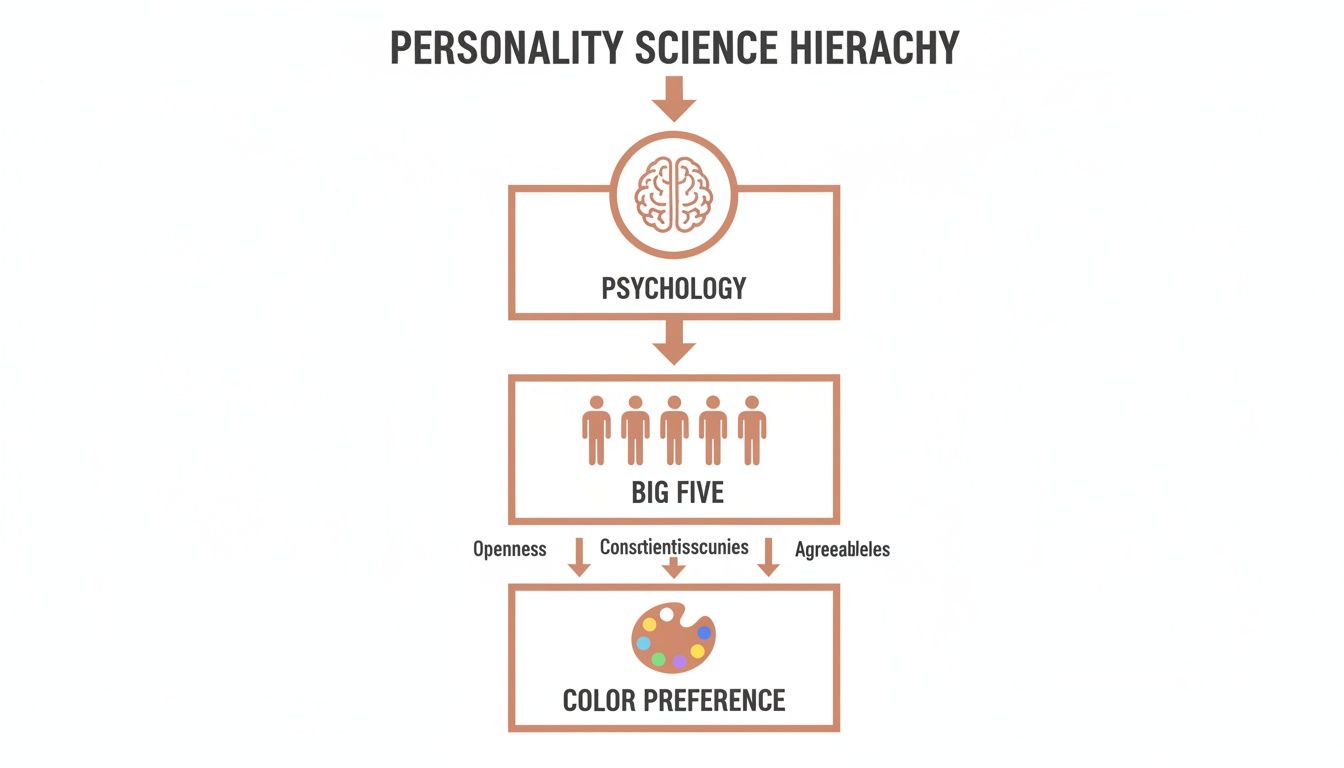
It shows that while colour is an intuitive starting point, it connects to established psychological frameworks like the Big Five, giving it a solid foundation.
Communicating with Different Colour Personalities
The following table breaks down how to fine-tune your sales approach for each of the four primary colour archetypes. It’s a quick guide to what motivates them, how they prefer to communicate, and what you should absolutely avoid doing if you want to close the deal.
| Color Archetype | Core Traits | How to Communicate | What to Avoid |
|---|---|---|---|
| Decisive Red | Goal-oriented, direct, confident | Be brief and get straight to the bottom line. Focus on results, ROI, and competitive advantage. Use strong, decisive language. | Small talk, long-winded stories, getting lost in minor details, or showing any hesitation. |
| Analytical Blue | Systematic, precise, logical | Present a structured, data-backed case. Provide evidence, facts, and figures. Allow them time to process without pressure. | Vague claims, emotional appeals, rushing their decision, or being unprepared for detailed questions. |
| Optimistic Yellow | Enthusiastic, social, visionary | Use storytelling and testimonials. Be energetic and focus on the big picture and exciting possibilities. Keep it interactive. | A rigid agenda, overly technical jargon, a monotonous tone, or drowning them in data sheets. |
| Steady Green | Supportive, reliable, relationship-focused | Build rapport and trust first. Use a calm, reassuring tone. Emphasise partnership, security, and long-term support. | High-pressure tactics, sudden changes, aggressive closing techniques, or rushing the relationship-building process. |
By keeping these styles in mind, you can create a connection that feels natural and respectful to your prospect, dramatically increasing your chances of success.
Pitching to the Decisive Red
When you’re in front of a Red personality, efficiency is king. They are driven by results and control, so your pitch needs to be direct, confident, and laser-focused on the bottom line. Wasting their time with pleasantries or drowning them in backstory is the fastest way to lose them.
Lead with your conclusion. Start with the single most powerful benefit they stand to gain.
- Do This: Present clear, bulleted takeaways that scream ROI.
- Do This: Focus on how your solution saves time, increases their control, or crushes the competition.
- Avoid This: Overloading them with technical specs or a lengthy company history.
Reds respect confidence. They expect you to be decisive, so have concise, powerful answers ready for their direct questions. They’re looking for a partner who gets things done, not a new best friend.
Engaging the Analytical Blue
For the Blue archetype, credibility is everything, and it’s built on a foundation of data and logic. They are motivated by accuracy and need to understand the "how" and "why" behind every claim you make. A pitch full of emotional appeals or vague promises will set off their alarm bells immediately.
Structure your presentation methodically. Give them the evidence—case studies, spec sheets, third-party data—that they can verify on their own time. Their decision-making is careful and deliberate, so arm them with the resources they need to feel secure.
The key is to appeal to their need for correctness. Show them the logic, prove your points with facts, and give them space to process the information without pressure. Rushing a Blue is a critical mistake.
Be prepared for in-depth questions and don’t be afraid of the details. They appreciate a well-organised, systematic approach because it demonstrates that you’re an expert who has done their homework.
Connecting with the Optimistic Yellow
A Yellow personality is all about energy, social connection, and big ideas. They’re motivated by fun and recognition, so your pitch should feel less like a presentation and more like an exciting conversation. Unlike Reds or Blues, they’re far less concerned with spreadsheets and more interested in the human element.
Use storytelling, testimonials from happy clients, and vivid examples to bring your solution to life. They want to feel good about their decisions and are heavily influenced by your enthusiasm and social proof. A flat, monotonous delivery is a deal-killer.
- Do This: Emphasise innovation, collaboration, and how working with you will make them look great.
- Do This: Keep the conversation interactive and light, leaving room for brainstorming.
- Avoid This: Getting bogged down in minute details or sticking to a rigid, formal agenda.
Building a genuine personal connection is vital here. Show real interest in them and their vision, and you’ll find they are incredibly receptive to your ideas.
Building Trust with the Steady Green
Greens are driven by security, stability, and authentic relationships. For them, trust is the only currency that matters. Your pitch should feel less like a sale and more like a supportive, collaborative dialogue. They are naturally risk-averse and need to feel, deep down, that you have their best interests at heart.
Take your time. Build rapport before you even think about diving into business. Use a calm, steady tone and frame your solution around partnership, reliability, and long-term support. They need to be reassured that you’ll still be there for them long after the ink is dry.
Sudden changes or high-pressure tactics will only make them retreat. Instead, present your solution as a safe, proven choice that will bring harmony and predictability to their world. To go even deeper on these concepts, check out our guide on personality-based sales strategies, which offers more detailed insights for crafting your message.
Navigating Cultural Nuances in Colour Psychology
While the four-colour archetype model is a fantastic starting point, taking a one-size-fits-all approach to colour psychology can quickly trip you up in a diverse global market. When you're selling in a region as vibrant and varied as SG, understanding cultural context isn't just a nice-to-have—it's absolutely essential for building genuine connections.
The meaning of a colour is anything but universal. What signals decisiveness in one culture might be a warning sign or even represent mourning in another. Think about it: in many Western cultures, white is all about purity and weddings. But in parts of Asia, it's traditionally the colour of funerals. A simple colour personality test that ignores these deep-seated associations is just asking for a misunderstanding.
Beyond Western Colour Meanings
Relying solely on a Western-centric colour model is like trying to navigate Tokyo with a map of London. Sure, the basic principles of getting from A to B are the same, but the landmarks, street names, and local customs are completely different. To have any real effect, you've got to localise your understanding.
This means truly grasping that a colour's emotional impact is shaped by history, religion, and social norms. In sales, showing you get this demonstrates respect and cultural intelligence—two cornerstones of trust. If you ignore it, your approach can feel tone-deaf and transactional, completely undermining any rapport you’re trying to build.
Insights from Southeast Asian Markets
The SG region, with its rich tapestry of cultures, is the perfect case study for why this nuance is so important. Preferences and associations can shift dramatically as you move from Singapore to Thailand to Vietnam. Research shows these regional dynamics directly influence how personality is expressed and, by extension, what colours symbolise.
Let’s look at a fascinating 2018 economic study on rural Thailand, which analysed Big Five personality traits across 3,170 respondents. The research found that Thai participants scored with very low variance for Openness, Conscientiousness, and Agreeableness. This uniformity mirrors what’s seen in colour personality tests, where Thais overwhelmingly prefer harmonious earth tones—like greens and yellows—which reflect the stability influenced by Buddhist values. In fact, in follow-up surveys, a massive 72% associated 'calm' personalities with the colour green. When compared to Vietnam, Thais reported 22% lower Neuroticism, which aligns perfectly with their aversion to intense reds. You can read the full research on Thai personality traits and their implications.
This data is a powerful reminder of how cultural values directly shape colour preferences, making localised knowledge a true competitive edge.
Practical Steps for Cultural Adaptation
So, how do you apply these insights without having to become an expert in anthropology overnight? The key is to trade a rigid framework for an observant mindset.
- Listen and Observe: Pay close attention to the colours your prospect uses in their branding, office decor, or even what they wear. These choices are often subtle clues about their cultural and personal values.
- Ask Open-Ended Questions: Instead of making assumptions, ask questions that get them talking about what’s important to them. Asking about company culture, team collaboration, or their long-term vision can reveal whether they lean towards harmony (Green) or disruption (Red).
- Prioritise Relationship Over Framework: Treat the colour archetypes as a hypothesis, not a diagnosis. Your main goal is to understand the individual in front of you, not to neatly fit them into a box.
Ultimately, navigating cultural nuances in colour psychology is about moving beyond stereotypes. It’s about using these frameworks as a tool to become more curious, more observant, and more adaptable in your sales conversations.
By embracing this mindset, you’ll sidestep costly cultural mistakes and show a level of respect and awareness that builds lasting trust, no matter where in the world you're doing business. This thoughtful approach is the hallmark of a truly effective modern sales professional.
From Simple Colours to AI-Powered Insights
A basic colour personality test is a bit like a paper map. It’s handy for getting a general sense of direction, but its value drops off a cliff the moment you need to navigate a complex, real-time conversation. It gives you a starting point, sure, but it completely lacks the detail needed for high-stakes interactions where precision is everything.
This is where the next evolution of personality insight comes into play. Think of AI-driven platforms as your sales GPS. They don’t just give you broad categories; they provide dynamic, turn-by-turn guidance that helps you adapt with accuracy and confidence on the fly.
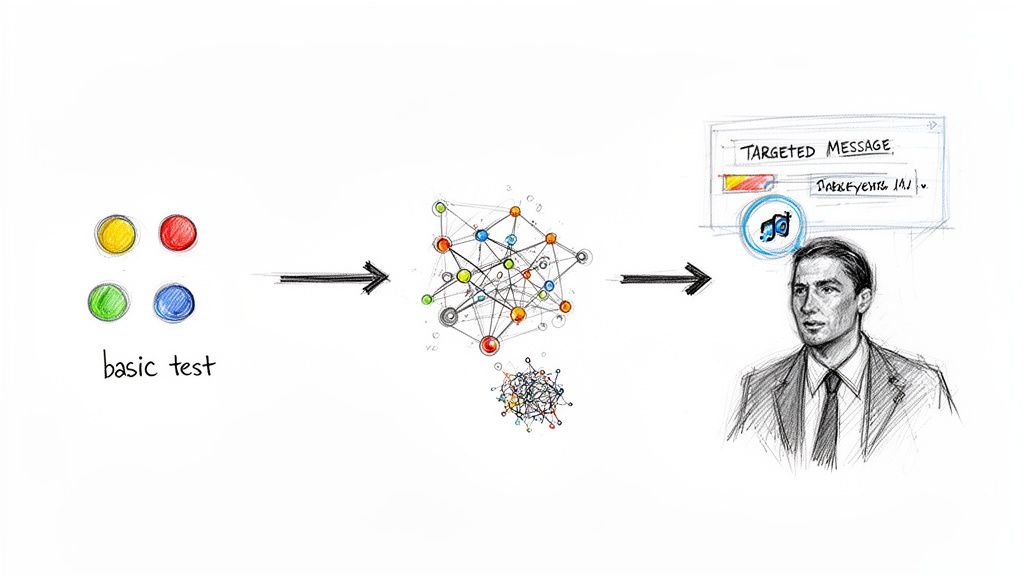
This leap from a simple quiz to an AI-powered system isn't just about getting more data; it's about getting better, more actionable intelligence. It bridges the gap between a fun, speculative insight and a professional tool built for results.
Beyond a Single Data Point
A huge limitation of any simple colour quiz is that it relies on a single, often self-reported, data point. This one-dimensional view just can't capture the full spectrum of a person's communication style, which is often layered and changes with the situation. To truly understand someone, you need a much richer dataset.
Modern AI systems, like the Human Intelligence System (HIS) that powers Mindreader, analyse multiple streams of information at once. This creates a far more nuanced and reliable profile than a simple colour label ever could.
These data streams can include:
- Facial Cues: Micro-expressions and other non-verbal signals that give away underlying emotional states and personality traits.
- Text Signals: The specific language, tone, and sentence structure used in emails or messages, offering clues about how a person thinks and communicates.
- Digital Footprints: Publicly available information that helps build a more complete picture of a prospect's interests and professional background.
By putting all these pieces together, AI moves beyond a basic archetype like 'Blue' or 'Red'. It gives you a detailed, multi-faceted profile that reflects the real complexity of human interaction.
The Power of Data-Driven Playbooks
This deeper level of analysis is also backed by empirical research connecting observable traits to personality. Take, for instance, a pivotal investigation into college students' clothing colour preferences, published in the International Journal of Engineering Research & Technology. The study found that extroverted students preferred saturated reds and yellows by 28% over introverts, who leaned towards muted blues and greens. These findings help form the data backbone for AI systems that build precise, evidence-based playbooks for professionals in dynamic markets like SG.
This scientific foundation allows AI platforms to deliver something far more valuable than a generic label. Instead of just telling you a prospect is "analytical," an AI tool provides concrete, actionable guidance.
An AI-powered system doesn't just identify a personality type; it translates that insight into a specific sales playbook. It offers concrete messaging points, pacing suggestions, and meeting tactics tailored to that individual.
This takes the guesswork out of communication. You no longer have to wonder if you should open with small talk or get straight to business. The system gives you clear recommendations, equipping you to walk into any conversation with surgical precision. To explore this topic further, you might be interested in our guide on how AI-powered sales intelligence is changing the game.
When implementing AI for personality insights, understanding the AI speed accuracy trade-off is critical for designing systems that deliver timely yet reliable results. The best tools find the right balance, giving you accurate guidance without slowing you down. Ultimately, moving from simple colours to AI-powered insights means trading your paper map for a sophisticated GPS. It’s about equipping yourself with the nuanced, data-driven intelligence needed to navigate modern sales and build stronger, more authentic connections that actually close deals.
Using Personality Insights Ethically and Effectively
With great power comes great responsibility, right? As we move beyond a simple colour personality test into more sophisticated profiling, we have to ground everything we do in solid ethics. The goal is never to pigeonhole, stereotype, or manipulate a prospect.
These insights are purely a tool to serve your clients better. Think of it as a way to build genuine rapport, smooth out communication bumps, and truly get what makes a person tick. The focus always has to be on creating a win-win by seeing the individual in front of you, not just a potential sale.
Principles for Responsible Use
Using personality insights the right way means sticking to a few core principles. This is what separates professional advisors from pushy salespeople and ensures you build trust instead of breaking it.
- Adapt, Don't Assume: Use archetypes as a guide to tweak your communication style, not as a rigid label. People are far too complex for that, and your approach needs to be just as flexible.
- Serve, Don't Manipulate: The whole point of understanding someone's personality is to meet their needs more effectively. It’s about presenting your solution in a way that’s crystal clear for them.
- Seek Understanding, Not Control: Real influence comes from authentic connection. Focus on building bridges of understanding, not trying to gain an upper hand.
This mindset is what elevates your approach from purely transactional to truly professional.
The Path to Better Communication
At the end of the day, a colour personality test is just a doorway. It introduces the foundational idea that different people need different approaches, a concept that science backs up by showing clear links between personality and preferences.
The real magic happens when you use these tools to become a better listener and a more empathetic communicator. It’s about shifting your mindset from, "How do I sell this?" to "How can I help this person understand?"
Modern AI tools like Mindreader take this concept to a professional level. They provide nuanced, actionable guidance that goes leagues beyond basic colour codes, equipping you to adapt with precision and respect.
By embracing a more sophisticated and ethical approach, you don’t just improve your sales numbers. You build stronger, more lasting professional relationships built on real trust.
Got Questions About Colour Personality Tests? We’ve Got Answers.
Jumping into any new personality framework is bound to bring up some questions. It's one thing to understand the theory, but another to see how it works in the real world of sales. Here are some straightforward answers to the questions we hear most often.
Are Colour Personality Tests Actually Scientific?
It’s a fair question. While many of the free quizzes you find online are just for fun, the core idea—that our colour preferences are linked to our personality—isn't just made up. Several studies have found real correlations between the Big Five personality traits and specific colour choices, giving the concept a legitimate foundation.
However, think of these tests as a starting point. They're great for getting a general feel for someone's communication style, but they’re not a definitive psychological diagnosis. When you're in a professional sales environment where every detail matters, you'll always get more reliable and deeper insights from advanced systems that look at multiple data points, not just one.
How Can I Use This on a Phone Call or Email?
This is where the art of sales comes in. You can’t see the person, so you have to become a great listener and observer. You’re looking for clues in their language, tone, and even how they structure their emails to form a hypothesis about their likely archetype.
- For a suspected 'Red' (direct, decisive): Keep your email short, sharp, and focused on the bottom line. On a call, skip the small talk and get straight to business. They’ll appreciate the efficiency.
- For a suspected 'Green' (collaborative, relational): Use a warmer, more personal tone in your emails. On the phone, take a few minutes to build rapport before diving into your pitch. Relationships matter to them.
- For a suspected 'Blue' (analytical, detailed): Structure your email with clear logic, data, and maybe even a few bullet points. On a call, come armed with facts, figures, and be ready to answer detailed questions.
The goal isn't to be a mind reader—it's to match your communication style to their inferred personality. When you do that, you build trust and rapport much faster.
How Is an AI Tool Different from a Simple Test?
The difference is like comparing a photograph to a live video stream. A simple colour personality test gives you a single, static snapshot. It usually relies on one piece of information—like a favourite colour—to slot someone into a broad category. It's one-dimensional.
An AI-powered platform like Mindreader's Human Intelligence System (HIS) is in a completely different league. It's dynamic and multi-faceted, analysing thousands of signals in real-time. We're talking facial landmarks, subtle text cues, and digital footprint data all coming together to build a rich, detailed profile.
Instead of a basic label like 'Blue,' an AI system gives you specific, sales-focused archetypes. It comes with actionable playbooks, talking points, and meeting tactics tailored to that individual. You move from a general guess to a dynamic, data-driven guide for every single conversation. It takes the guesswork out and puts precision in.
Ready to move beyond basic quizzes and give your sales team the actionable, AI-driven insights they need? See how Mindreader can help you connect with clients on a deeper level and close more deals. Learn more at https://www.themindreader.ai.