An Introverted Extrovert: Your Hidden Sales Edge

Ever felt like a social chameleon? One moment, you're the life of a client dinner, effortlessly building rapport. The next, you're craving a quiet evening alone, feeling completely drained by the very interactions that seemed to energise you.
If that sounds familiar, you might just be an introverted extrovert.
Your Secret Weapon in Sales: The Introverted Extrovert
This isn't a personality flaw or a contradiction. In sales, it’s a strategic advantage. It means you have the unique ability to connect deeply with others and the self-awareness to know when you need to pull back and recharge.
Think of your social energy like a high-performance battery. Pure extroverts seem to have an endless power supply, leaving social events more energised than when they arrived. Classic introverts start with a full charge that steadily depletes with each interaction.
But the introverted extrovert? You have a massive-capacity battery. You can go full-throttle, performing brilliantly for long stretches, but eventually, you must retreat to a quiet space to plug in and recharge.
The Power of Balance
This unique blend of traits is what makes you so powerful in building client trust and closing deals. You have the introvert's natural ability to listen actively, process complex information on a deeper level, and come up with truly thoughtful solutions.
At the same time, you can tap into the extrovert's confidence to present those ideas with conviction, build momentum in a meeting, and guide a prospect toward a final decision. You can seamlessly switch between deep listening and confident leading.
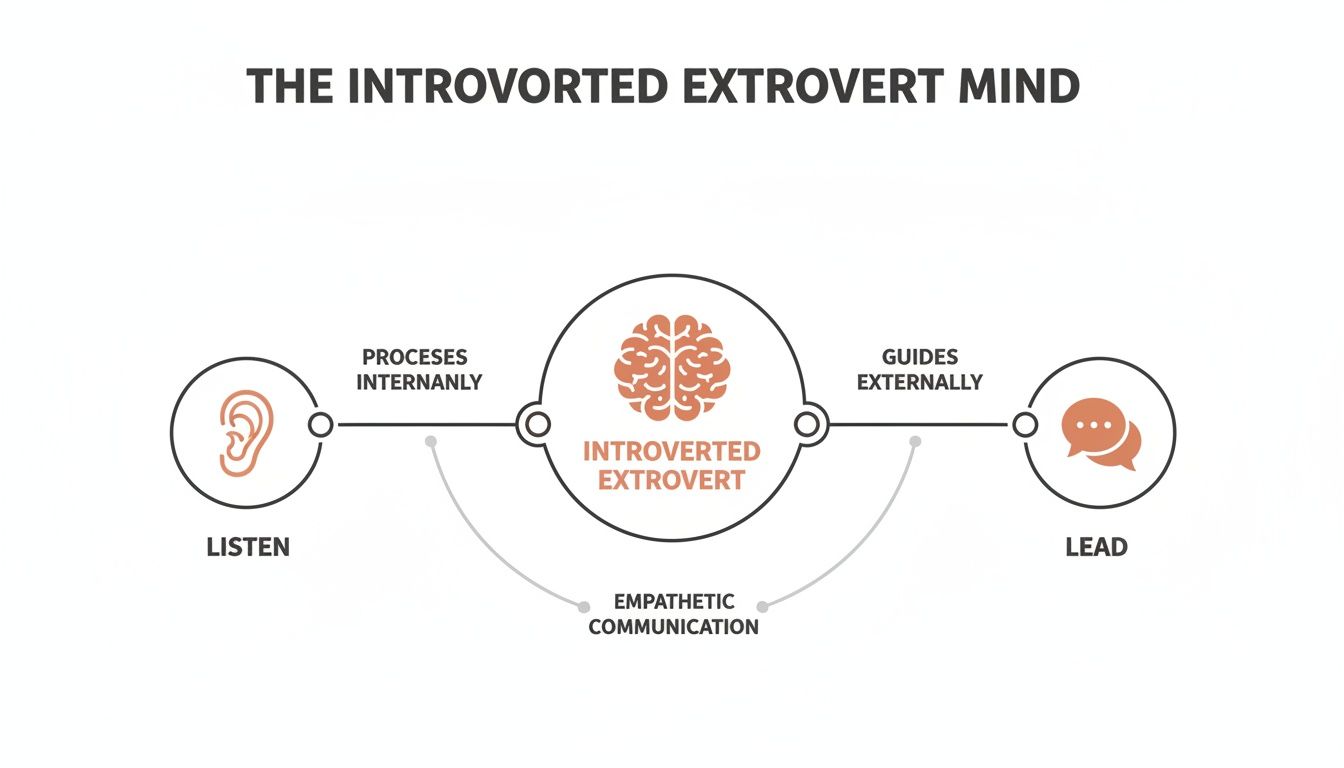
This balanced approach is a perfect fit for Singapore's competitive business culture. Research shows that while Singaporeans lean slightly more introverted (+4.70%), a surprising 47% of top executives and senior managers identify as extraverted.
What does this tell us? It suggests that those who can bridge both worlds—the introverted extroverts—are perfectly positioned to connect with a diverse range of decision-makers and thrive in high-stakes B2B sales at Mindreader. You can find more data on Singapore's personality profiles here.
Understanding this dynamic is your first step. When you can spot this trait in yourself and, more importantly, in your prospects, you move beyond simple labels. You start using genuine human insight as a tangible sales advantage.
Introverted Extrovert Trait Identifier
Use this table to quickly spot the core traits of an introverted extrovert in yourself or your prospects, contrasting them with stereotypical introvert and extrovert behaviours.
| Trait | Classic Introvert | Classic Extrovert | The Introverted Extrovert |
|---|---|---|---|
| Energy Source | Recharges with solitude. | Recharges with social interaction. | Needs a mix of social time and solitude to recharge. |
| Social Style | Prefers one-on-one or small groups. | Thrives in large groups and parties. | Can excel in large groups but prefers meaningful, deep conversations. |
| Communication | Listens more than they speak. | Speaks more than they listen. | Balances active listening with articulate, confident speaking. |
| Decision Making | Processes information internally before sharing. | Thinks out loud, processing externally. | Thinks and processes internally, then discusses externally to validate. |
| Work Preference | Enjoys focused, independent work. | Excels in collaborative, team-based settings. | Works well independently but also thrives in collaborative brainstorming sessions. |
Recognising these nuanced behaviours is key. It helps you tailor your approach, ensuring you connect with your prospect in a way that feels natural and builds trust, rather than just pushing for a sale.
How To Identify An Introverted Extrovert Prospect
Spotting an introverted extrovert in the wild—long before you hit 'send' on that first email—is actually easier than you might think. It’s all about looking beyond the surface-level stuff and learning to read the subtle duality in their professional persona. You’re not just taking a wild guess; you’re connecting the dots scattered across their digital footprint.
Think of their LinkedIn profile as your first clue. An introverted extrovert often has a profile that screams deep, specialised expertise. You'll see detailed project descriptions or published articles, which points to their introverted side’s need for focus and mastery.
At the same time, you'll probably notice a pretty robust and active network. They're engaging on others' posts and have endorsements from a wide mix of colleagues. That’s their extroverted side coming out to play, showing they’re influential and comfortable collaborating.

Reading The Digital Tea Leaves
The way they write in emails or messages is another dead giveaway. Their communication is often this interesting blend of thoughtful, deep analysis and a genuine collaborative spirit. For really effective customer profiling, keep an eye out for messages that are structured and detailed, yet finish with open-ended questions that genuinely invite your input.
Here’s what that looks like in practice:
- Introverted Signal: "I've reviewed the proposal and analysed the data points. My initial thoughts are..."
- Extroverted Signal: "...What does your team think about this approach? I'm keen to hear your perspective."
That combination right there? It tells you this is someone who processes things internally before seeking external feedback—a classic hallmark of an introverted extrovert.
Cues In Virtual Meetings
Once you get them on a call, their body language and how they participate will tell you even more. They won't be the one dominating the conversation like a pure extrovert, but they'll drop insightful, perfectly timed points when they do speak.
They listen, and I mean really listen, often pausing for a beat before they talk. That's not hesitation. It's the sign of someone processing information deeply before crafting a response. You’ll notice they make strong eye contact and look engaged, even when they’re quiet.
This balanced approach is becoming more common, especially among Singapore's sales leaders. In fact, demographic trends are pointing towards a rise in this exact personality blend. Singapore's population is projected to hit 6.11 million by June 2025, and there's been a noticeable increase in singles among younger professionals. This trend lines up with personality data showing Singaporeans are +4.70% more introverted, preferring deep, selective connections over just broad networking—a behaviour that perfectly defines the introverted extrovert.
Learning to spot these cues is a game-changer. It shifts your approach from one based on assumption to one based on careful observation. You end up with a practical toolkit that lets you accurately nail down your prospect’s communication style, paving the way for a much more meaningful and effective conversation.
Crafting Outreach That Actually Gets A Reply
Trying to connect with an introverted extrovert requires a different playbook altogether. Your standard, high-energy sales pitch? It’s probably going to fall flat because it only speaks to half of who they are.
To craft outreach that genuinely resonates, you have to appeal to both their thoughtful, analytical side and their engaging, collaborative nature. The trick is to do it all in that crucial first message.
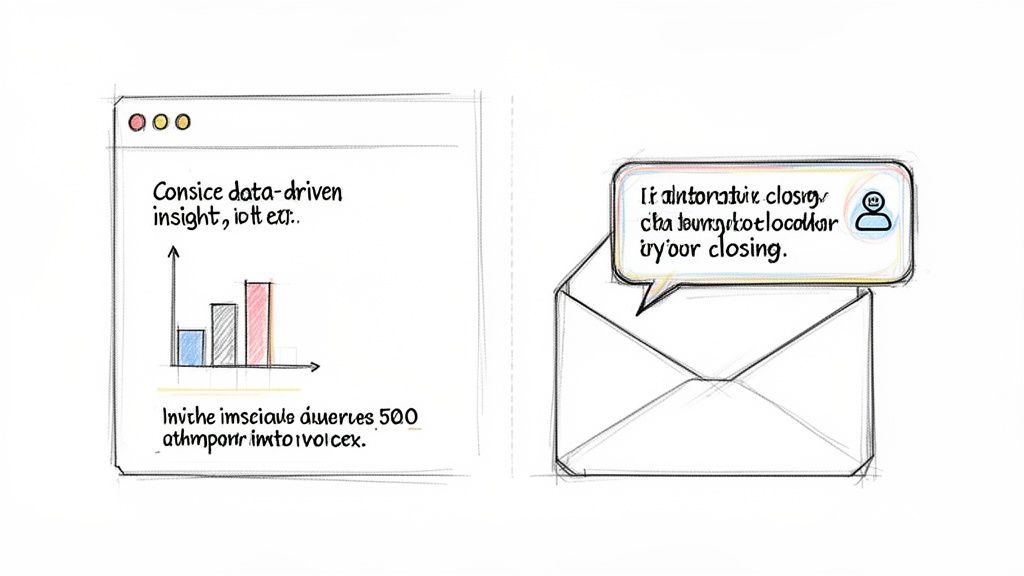
The secret lies in how you structure your outreach. You need to lead with a sharp, data-driven insight that proves you’ve done your homework. This immediately taps into their introverted appreciation for substance and thoughtful analysis. Ditch the generic flattery. Instead, bring a specific, relevant observation about their company or industry to the table.
This approach builds instant credibility and shows you value their time. Once you've laid that groundwork, you can smoothly transition to an open-ended, collaborative question. This is your invitation for their extroverted side to step up and engage. You’re not just pitching them; you’re starting a real conversation.
The Anatomy of an Effective Email
Let’s break down exactly how to structure your message. A great email or LinkedIn message to an introverted extrovert should feel less like a demand for a meeting and more like an invitation to a thoughtful discussion.
Here’s a simple, powerful structure you can follow:
- Lead with an Insight: Open with a specific, well-researched observation. Something like, "I noticed your team recently launched X, and our data shows similar initiatives see a 25% boost in Y when Z is implemented."
- Connect it to Them: Briefly explain why this insight is directly relevant to their role or company goals.
- Ask a Collaborative Question: Finish with a question that genuinely invites their opinion. "How are you thinking about this challenge for the upcoming quarter?"
This structure respects their intelligence while inviting them to participate. It's a potent combination that dramatically increases your chances of getting a reply.
Before and After Real-World Examples
To really see this in action, let's look at a common outreach message and see how a few small tweaks can make all the difference.
Before (Generic and Ineffective):
"Hi [Name], I'm with ABC Corp and we help companies like yours boost efficiency. Do you have 15 minutes to chat this week?"
This message is all about the sender. It's bland, self-serving, and will almost certainly be deleted on sight.
After (Targeted and Effective):
"Hi [Name], I saw your recent article on supply chain optimisation and was impressed by your point on last-mile delivery. Our internal research shows that companies focusing on this see a 15% reduction in costs. What's the biggest barrier you’re currently seeing in that area?"
See the difference? This revised message works because it leads with specific recognition (appealing to their thoughtful side) and ends with a genuine question that invites them to share their expertise (engaging their collaborative side). As you work on your own outreach, using powerful cold email templates can be a fantastic starting point for building this kind of structured, effective messaging.
Going a layer deeper, understanding a prospect’s cognitive style is also a game-changer. You can learn more about how to spot whether someone is more focused on concrete facts versus abstract possibilities in our guide on Sensing vs. Intuitive personality traits. This knowledge helps you fine-tune your outreach even further, ensuring your message lands perfectly every single time.
Running Meetings That Build Momentum, Not Drain Energy
For an introverted extrovert, the sales meeting is where the conversation either clicks into place or falls apart completely. They need a session that feels both productive and engaging—not a chaotic free-for-all that leaves their social battery on empty.
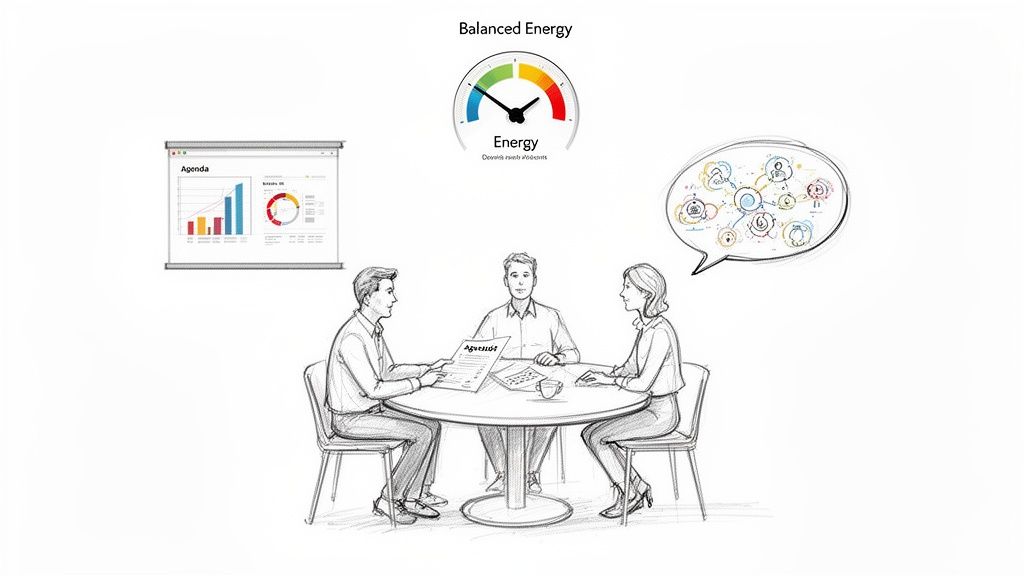
The key is preparation. Plain and simple. This personality type thrives on structure and really dislikes being caught off guard. Sending a clear, well-organised agenda at least 24 hours ahead of time isn't just a nice-to-have; it's non-negotiable.
This simple act respects their need to process information on their own before talking it through. It lets their reflective, introverted side feel prepared and in control, while also setting a collaborative tone that appeals to their engaging, extroverted side. You're showing them you value their time and are serious about getting things done.
Mastering Conversational Pacing
Once you're in the meeting, your most powerful tool is conversational pacing. This is all about knowing when to dive deep into the technical weeds and when to pull back for a more collaborative, big-picture brainstorm. Think of it as controlling the energy in the room.
If you just hit them with a relentless barrage of data-heavy slides, you’ll overwhelm their introverted need to process. But if the meeting is all high-level fluff with no real substance, you won't earn their intellectual respect.
Your goal is to find the perfect rhythm. Present a key piece of data or a complex feature, then immediately hit pause. Ask an open-ended question. This simple technique creates the space they need to reflect internally, then contribute their thoughts—activating both sides of their personality.
A well-paced meeting should feel like a perfectly balanced dialogue. You provide the structured insights (for their inner analyst) and then create openings for them to share their perspectives (for their outer collaborator).
Structuring Your Meeting For Success
To keep your prospect energised, you need to structure your meeting with intentional breaks for them to jump in. Don't save all your questions for a Q&A at the very end. Instead, build checkpoints right into your presentation to make it a continuous dialogue.
Here’s a practical framework:
- The 70/30 Rule: When you're presenting new information, you should be doing about 70% of the talking. But when you shift into discussion or Q&A, the roles should flip—aim for them to speak 70% of the time.
- Visual and Verbal Balance: Mix it up. Follow a dense data slide with something simple and visual, like a clean diagram or even just a single, powerful question on the screen. It gives their brain a much-needed break from information overload.
- Actionable Next Steps: Never end a meeting without co-creating what happens next. Ask them directly, "Based on our discussion, what feels like the most logical next step to you?" This reinforces the feeling of a collaborative partnership.
When you run meetings this way, every interaction feels purposeful and respectful of their unique communication style. This approach doesn't just prevent you from getting ghosted after a meeting; it actively builds the trust and momentum you need to move the deal forward.
How To Handle Objections Without The Hard Sell
When an introverted extrovert brings up an objection, it's almost never a hard "no." Think of it as a signal that they're genuinely processing what you’ve shared. They have a built-in allergy to high-pressure sales tactics, so the old-school, aggressive rebuttal will make them shut down on the spot.
The trick is to turn their objection from a roadblock into a real conversation. This isn't about pushing back; it's about leaning in with authentic curiosity, showing them you see their concern as a valid point worth exploring together.
From Confrontation To Collaboration
The big shift here is moving from defending your pitch to exploring their perspective. An introverted extrovert needs to feel heard and respected before they'll ever be persuaded. When you validate their concern, you completely disarm that classic sales tension and start building trust.
This approach works perfectly with their dual nature. It satisfies their reflective, introverted side by acknowledging their deep thinking. At the same time, it invites their collaborative, extroverted side to join you in a problem-solving session. You stop being a salesperson and start being a trusted advisor—a distinction that means everything to them.
Practical Scripts For Reframing Objections
The best way to handle these objections is to apply proven frameworks for handling sales objections with a collaborative twist. Instead of just following a script, you’re using a structure to guide your curiosity and keep the dialogue productive.
To make this crystal clear, I’ve put together a table contrasting the pushy, traditional responses with the kind of collaborative approach that actually works with this personality type.
Objection Handling Scripts For The Introverted Extrovert
| Common Objection | Traditional Response (Avoid) | Introverted Extrovert Response (Use) |
|---|---|---|
| "Your price is too high." | "We're actually priced competitively for the value we offer." | "That’s a completely fair point to raise. To help me understand better, could you walk me through how you’re currently evaluating the budget for this?" |
| "We’re already working with someone else." | "But our solution has features they don’t." | "I appreciate that. It sounds like you have a system in place. I'm curious, what’s one thing you wish that partnership did a little differently?" |
| "I need more time to think about it." | "What's holding you back?" | "Of course. That makes perfect sense. To ensure you have everything you need, what specific area would be most helpful for me to provide more detail on?" |
This kind of empathetic inquiry shows you respect their thought process. By asking clarifying questions instead of launching into a defense, you keep the conversation going and uncover the real issue hiding behind the initial objection. As you’ll find when exploring the hidden power of words in overcoming client objections, the right phrasing can make all the difference.
By turning objections into collaborative discussions, you’re not just trying to win the argument; you’re building a stronger, more resilient business relationship. You demonstrate that you are a partner invested in their success, not just your own commission.
Ultimately, this method keeps the conversation moving forward without creating friction. It allows the prospect to feel in control while you guide them toward a solution, making it the single most effective way to handle objections with this powerful personality.
Got Questions About The Introverted Extrovert? We’ve Got Answers.
Figuring out the nuances of different personalities in sales can feel like guesswork, but getting a handle on the introverted extrovert gives you a serious edge. Let's break down the most common questions and give you some clear, actionable answers you can start using right away.
What Exactly Is an Introverted Extrovert?
At its core, an introverted extrovert is someone who shines in social settings but absolutely needs downtime alone to recharge. It’s not like a classic extrovert who feeds off social energy, or a pure introvert who finds it draining. Think of it as having a "social battery" with a huge capacity but a very clear limit.
Here’s an analogy: a pure extrovert is a marathon runner, built for the long haul of social interaction. An introverted extrovert is more like a world-class sprinter. They can turn on incredible bursts of energy, charisma, and engagement, but they need to recover between races. They aren't shy; they’re just strategic with their energy.
Can Someone Go From Being an Introvert to an Introverted Extrovert?
While core personality traits tend to be pretty stable, behaviours are much more adaptable. An introvert isn't likely to fundamentally change their need for solitude. However, they can definitely build skills and strategies to be more effective in social situations, making them appear more like an introverted extrovert.
This isn't about faking it. It's about an introvert learning how to manage their energy so they can tap into extroverted behaviours when it counts—like during a crucial client presentation—without hitting a wall. It’s a learned skill, not a personality transplant.
How Can I Tell if I’m Selling to One?
Spotting this personality in a prospect comes down to looking for a mix of deep preparation and a genuine desire to collaborate. A few tell-tale signs pop up again and again:
- Detailed Yet Collaborative Emails: Their messages are often well-thought-out and packed with detail, but they’ll almost always end with an open question that invites your perspective.
- Active Listening in Meetings: You'll notice they listen more than they talk. They’ll pause to really process what you’re saying before coming back with sharp, insightful questions.
- A Balanced Digital Footprint: Their professional profile often shows a blend of solo expertise (like in-depth articles or detailed projects) and a strong, active network (seen through their engagement and endorsements).
What’s the Biggest Mistake to Avoid When Selling to Them?
Hands down, the single biggest mistake is resorting to high-pressure, "hard sell" tactics. This personality type thrives on deep thinking and authentic connection. Pushing them for a quick decision feels disrespectful and will instantly trigger their defences.
Instead of trying to rush the close, shift your focus to building a genuine partnership. Ask thoughtful questions, show that you understand their concerns, and give them the space they need to think things through. This approach builds trust, which is far more powerful to an introverted extrovert than any urgent sales pitch. When you respect their need for both interaction and reflection, the whole process feels less like a sale and more like a collaboration.
Ready to stop guessing and start connecting with every prospect on a deeper level? Mindreader uses advanced AI to analyse communication styles and give you the exact playbook to build trust, handle objections, and close deals faster.
Discover how you can adapt like water and win more deals today.