Your Ultimate Guide to an AI Sales Assistant
Think of an AI sales assistant as a smart co-pilot for your sales team. Its whole job is to take over the repetitive, time-sucking tasks and surface the kind of data-driven insights that help salespeople focus on what they do best: building relationships and closing deals.
What an AI Sales Assistant Really Is
Imagine starting your day and instantly knowing which leads are hot, having follow-up emails already drafted, and getting key talking points teed up for your next call. This isn't about working harder; it’s about having a dedicated partner helping you work smarter.
This is where an AI sales assistant completely differs from a standard CRM. A CRM is essentially a passive database—think of it as a digital filing cabinet for all your customer information. An AI assistant, on the other hand, is an active intelligence layer that works on top of that data. It doesn't just store information; it analyses it to give you actionable guidance.
Beyond Basic Automation
The real magic here is the ability to move way beyond simple, robotic automation. To really get it, it helps to understand what things like CRM automation can do, as AI often builds on top of those systems. But an AI assistant takes it to a whole new level by adding predictive and deep analytical capabilities.
So, instead of just scheduling an email to go out, it can suggest the best time to send it. It might even help you craft the message based on the recipient's likely communication style. This is a massive shift from gut-feel, intuition-based selling to a much more precise, data-backed approach.
Your Proactive Sales Partner
Ultimately, you should see an AI sales assistant as a proactive partner that anticipates your needs and clears away the administrative junk that gets in your way. Its core purpose is to augment the skills of a great salesperson, not to replace them.
Here’s how it gets that done:
- Automating the Grind: It takes over tasks like data entry, logging activities, and doing that first pass at lead qualification—the kind of stuff that research shows can eat up a huge chunk of a salesperson's day.
- Providing Timely Insights: The assistant can analyse call transcripts, pick up on the sentiment in emails, and track a prospect’s behaviour to give you real-time advice on how to steer a conversation.
- Dialing Up the Personalisation: By understanding a prospect’s unique needs and communication patterns, it helps you tailor every single piece of outreach for maximum impact. Every interaction feels more relevant.
By taking over the tedious, time-consuming parts of the job, an AI sales assistant gives sales professionals back their most valuable asset: time. Time to build genuine connections and strategically close deals. It empowers you to focus on the human side of selling, armed with the best intelligence possible.
How an AI Sales Assistant Actually Drives Growth
Think of an AI sales assistant not just as a data filing cabinet, but as the engine powering your entire sales strategy. It’s the difference between reacting to opportunities and proactively creating them. The real magic happens when the AI takes over the critical, high-volume tasks with speed and intelligence, freeing you up to do what humans do best: build relationships and close complex deals.
Instead of your team manually digging through a mountain of leads, an AI assistant brings your best prospects straight to the top. It uses intelligent lead scoring, analysing everything from website clicks and email opens to social media chatter, to figure out who is genuinely ready to talk. This simple shift ensures your team’s energy is always focused on the most promising conversations, which naturally shortens the sales cycle.
This focus extends right into your outreach. The system handles automated communication at scale, so a warm lead never goes cold simply because someone got busy. It can draft and send initial emails or follow-ups that feel personal because they are personal—based on that prospect's specific interests and digital body language.
Unlocking a Deeper Read on Your Customers
One of the most powerful things an AI sales assistant does is perform sentiment analysis. It’s like having a superpower that lets you read between the lines of every email, call transcript, and chat message to understand a client's true feelings. Are they hesitant? Excited? Worried about a specific feature?
Knowing the emotional subtext allows you to tailor your response with surgical precision. For instance, if the AI flags uncertainty about pricing in an email, it can arm you with talking points about value and ROI for your next call. Communication stops being a guessing game and becomes a strategic dialogue. You can explore these techniques in more detail in our guide on AI-powered sales intelligence.
This concept map breaks down how an AI sales assistant’s functions connect directly to core business results.
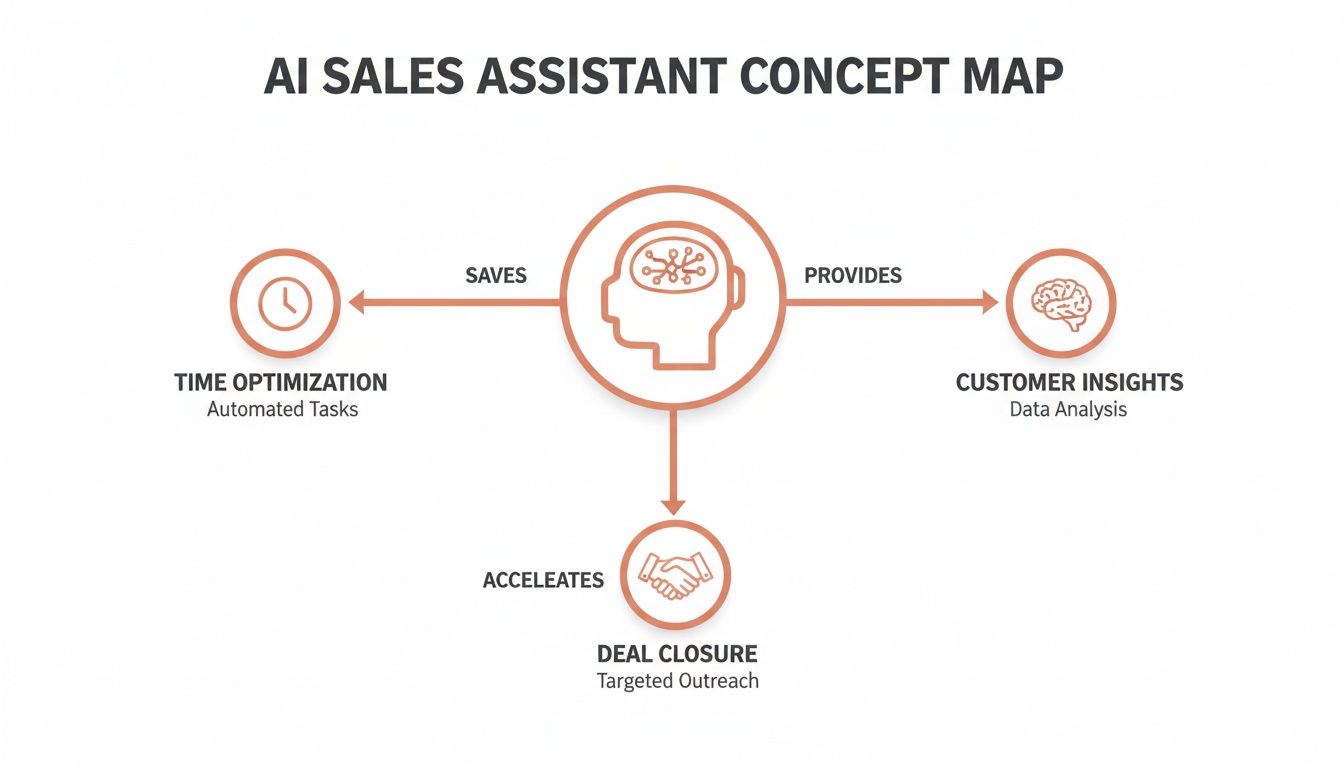
As you can see, there’s a clear line from intelligent automation to healthier revenue.
AI Sales Assistant Features vs Traditional CRM
It's easy to confuse an AI sales assistant with a standard CRM, but they operate on completely different levels. A CRM stores data; an AI assistant interprets and acts on it.
| Capability | Traditional CRM | AI Sales Assistant |
|---|---|---|
| Lead Management | Manual data entry and sorting | Intelligent lead scoring and automated prioritisation |
| Outreach | Basic email templates | Personalised, automated outreach at scale |
| Customer Insights | Stores interaction history | Performs sentiment analysis on communications |
| Sales Focus | Reactive data logging | Proactive opportunity generation |
| Efficiency | Supports manual processes | Automates repetitive tasks to free up reps |
Ultimately, a traditional CRM is a passive tool that requires significant human effort to be useful. An AI sales assistant is an active partner, constantly working in the background to surface insights and drive the sales process forward.
Quantifying the Impact on Your Pipeline
This isn’t just a passing trend; it’s a major market shift backed by serious numbers. In Singapore alone, the AI market—which includes these sales technologies—hit roughly US$765 million in 2023 and is on track to reach US$4 billion by 2030. That kind of growth is fuelled by real-world results, with SMEs already using AI to slash manual lead qualification time by up to 50%.
These aren't just vanity metrics. The efficiencies lead directly to measurable gains that every sales leader cares about.
- Higher Reply Rates: Personalised outreach crafted by AI consistently outperforms generic, templated messages.
- Increased Conversion Lift: When reps are focused on the hottest leads and armed with genuine insights, conversion rates climb.
- Shorter Sales Cycles: Automating follow-ups and prioritising the right people pushes prospects through the pipeline faster.
An effective AI sales assistant doesn't just do tasks. It connects its actions to tangible business goals, drawing a straight line from its capabilities to your bottom line.
By handling the heavy analytical lifting, an AI sales assistant provides the intelligence needed for a smarter, more human-centric sales approach. It allows your team to build stronger relationships, understand what customers truly need, and close more deals with confidence. To see how this fits into the bigger picture, you can explore various AI applications in marketing and sales being put into practice today.
The Mindreader Advantage: Human Intelligence
Let's be honest, not all AI sales assistants are created equal. Most are great at the grunt work—automating tasks, tracking metrics, and telling you the what and when of your sales pipeline. But they often completely miss the most important part of the equation: the how and why behind human connection.
This is where so many deals fall apart. Standard AI assistants are brilliant at organising your data, but they can leave you flying blind in those high-stakes conversations where nuance, trust, and genuine rapport make all the difference. That’s precisely the gap Mindreader was built to fill with our proprietary Human Intelligence System (HIS).
Beyond Data: A Deeper Understanding of People
Think of the Human Intelligence System as a framework that translates the complex, often unspoken, rules of human communication into a practical sales playbook. Instead of just scanning for keywords or logging email open rates, it decodes the subtle signals in how a person thinks, communicates, and ultimately makes decisions.
This allows you to stop guessing and start adapting your approach with surgical precision. You build rapport faster because you’re speaking their language from the very first interaction.
At the core of the HIS is our powerful archetype profiling. Mindreader analyses a prospect's digital footprint and communication patterns to pinpoint their dominant communication style, giving you an instant guide on how to best engage them.
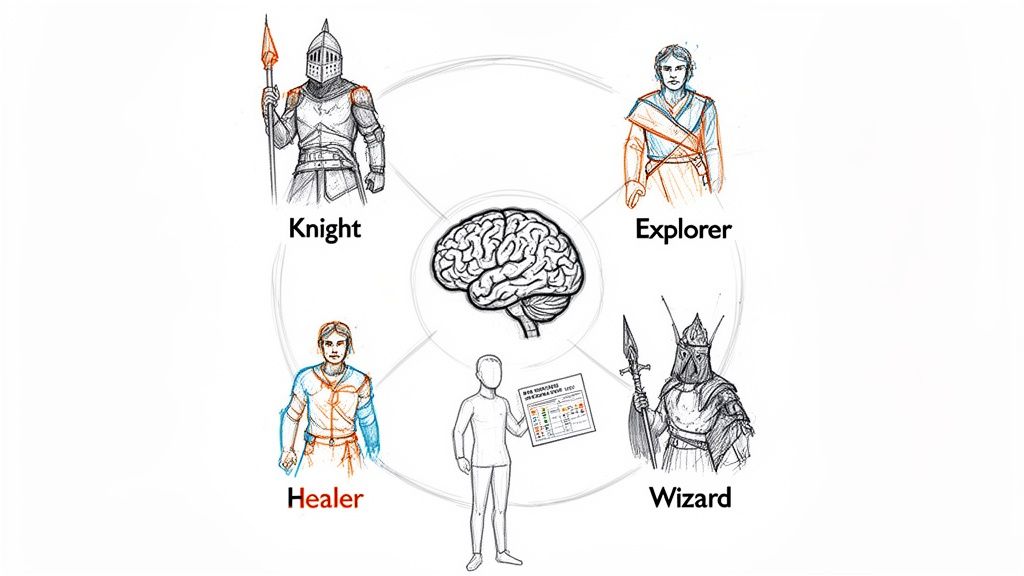
We’ve organised these styles into four intuitive archetypes:
- The Knight: Direct, decisive, and all about the bottom line. They value efficiency and want a clear path to their goals. No fluff.
- The Explorer: Innovative, curious, and future-focused. They get energised by new ideas, possibilities, and what could be.
- The Healer: Empathetic, relationship-driven, and built on trust. They care deeply about the human impact and making sure everyone feels heard.
- The Wizard: Analytical, logical, and detail-obsessed. They need the data, the evidence, and a rock-solid case before they’ll even consider moving forward.
Knowing whether you’re talking to a Knight or a Healer changes everything. It dictates how you frame your value, handle objections, and even structure your meetings. It’s like having a translator for human behaviour, taking the guesswork out of building real, authentic connections.
From Insight to Actionable Sales Strategy
An AI sales assistant running on HIS does more than just slap a label on a prospect. It delivers a concrete, strategic playbook tailored to that specific person, turning abstract psychological insights into tangible sales tactics. This is miles beyond generic personality tests or the limited data in your CRM.
Instead of just tracking what a prospect does, Mindreader helps you understand how they think. This simple shift transforms your outreach from a monologue into a dialogue, dramatically reducing your chances of being ignored or ghosted.
The system analyses signals across the entire sales cycle to give you specific, actionable guidance when you need it most.
Your Personalised Communication Playbook
Based on the archetype, Mindreader gives you a clear set of recommendations designed to resonate on a deeper level.
- Messaging Tactics: Get specific suggestions on the exact language to use. For a Wizard, you’ll lead with data points and specs. For an Explorer, you’ll highlight innovation and future potential.
- Pacing Recommendations: Learn the ideal tempo for your conversations. A Knight wants a fast-paced, direct chat, while a Healer responds far better to a measured, thoughtful approach that builds trust over time.
- Meeting Strategies: Receive guidance on structuring your calls and presentations. You'll know whether to start with the big-picture vision or dive straight into the nitty-gritty details, ensuring your agenda aligns perfectly with their thinking style.
By equipping you with this level of insight, Mindreader helps you communicate like water—clear, relevant, and fundamentally human. The goal isn’t to manipulate; it’s to connect in the way your prospect is most receptive to hearing. This is how you build authentic trust, the bedrock of every great business relationship. It turns the art of sales into a science of connection.
See AI Sales Assistants in Action
It’s one thing to talk about benefits in theory, but seeing an AI sales assistant work in the real world is where its power really comes alive. Let’s move past the concepts and look at some concrete examples of how professionals across key Singaporean sectors are using this technology to get ahead. These aren't just hypotheticals; they are mini-stories of success.
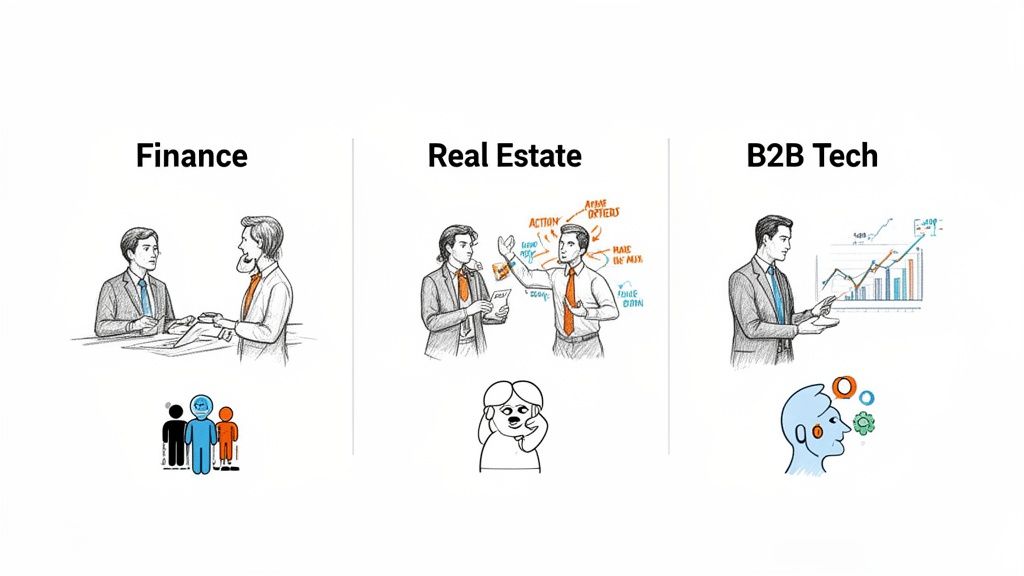
Think of a financial advisor in Raffles Place about to meet a new client. Her objective is to introduce a fairly complex long-term investment product. In the old days, she’d have pulled up a standard pitch deck and hoped for the best.
Today, she uses Mindreader. The AI scans the prospect’s public digital footprint and communication patterns, pegging them as a ‘Healer’ archetype. Healers are driven by relationships, they’re cautious, and they need to feel a deep sense of trust before they’ll commit to anything.
With this single piece of insight, the advisor completely reshapes her strategy. The AI-generated playbook suggests she should:
- Open the conversation by focusing on the client’s long-term family security, not just ROI figures.
- Use analogies about nurturing and growth instead of aggressive market performance.
- Slow down the pace, leaving plenty of room for questions to build a personal connection.
The result? The client feels understood, not cornered. The advisor lands the deal not by pushing a product, but by building a foundation of trust—a connection made possible by deep human intelligence.
Tailoring the Experience in High-Stakes Sectors
Now, let's switch gears. Picture a real estate agent showing a luxury condo near Orchard Road. The potential buyer is a busy executive who values efficiency and clear results. Mindreader profiles him as a ‘Knight’ archetype—decisive, action-oriented, and laser-focused on the bottom line.
The agent’s AI sales assistant provides a playbook that scraps the usual leisurely tour. It recommends a direct, high-impact presentation instead.
- She immediately highlights the property’s investment potential and projected rental yield.
- She focuses on features that save time and add convenience, like smart home automation and its proximity to the CBD.
- She keeps the tour concise, hitting the key value points without any fluff.
This targeted approach respects the Knight’s time and aligns perfectly with his decision-making style. He appreciates the no-nonsense efficiency, which allows the agent to steer the conversation toward an offer much faster than a generic tour ever could.
Navigating Complexity in B2B and Luxury Sales
The same principles work wonders when you’re dealing with highly analytical clients. Imagine a B2B tech founder pitching a new SaaS solution to a CTO, who has been profiled as a ‘Wizard’. She knows she needs to bring the data. Wizards are logical, detail-obsessed, and need to understand every technical angle before they’ll even consider signing on.
Her AI assistant helps her prepare by:
- Prioritising technical specifications and security protocols in the pitch deck.
- Anticipating deep-dive questions about integration, data processing, and system architecture.
- Suggesting she arm herself with a full case study packed with hard numbers and proven metrics.
This level of preparation lets her meet the Wizard on his own turf, confidently fielding technical objections with facts and evidence. It turns a potentially gruelling technical grilling into a productive, collaborative discussion. The ability to prepare for different client types is a true game-changer, and you can sharpen these skills by exploring how to master a roleplaying feature to improve client interactions.
An AI sales assistant powered by human intelligence doesn't just automate tasks. It gives you a strategic map to navigate complex human interactions, closing the gap between what you want to say and what your client actually needs to hear.
This shift is already creating tangible results. In Singapore, where the AI market was valued at over US$765 million in 2023, sales teams are using these tools to lift conversion rates by double digits. With the APAC AI agents market growing at a staggering 48.5% CAGR, the ability for an AI sales assistant to analyse cues in real-time is cutting prep time from hours to seconds. It's also helping prevent the 30-40% of deals that go cold simply due to poor pacing and misaligned communication.
Integrating Your New AI Co-Pilot
Bringing an AI sales assistant onto your team isn't like flipping a switch. It's more like onboarding a new, highly capable team member. A smooth integration means your team doesn't just use the tool—they learn to trust it as a co-pilot for their most important conversations.
The whole process is designed to be straightforward, focusing on getting connected, properly trained, and setting clear goals right from the start.
Connecting to Your Existing Workflow
The best tech feels invisible. The goal here is to make the AI a natural extension of your sales process, not another tab you have to remember to open. This starts by aligning the assistant with your team's specific day-to-day reality.
- CRM Integration: This is the first handshake. By linking to systems like Salesforce or HubSpot, the AI instantly gets context. It can pull contact histories and interaction data, which is what fuels its ability to generate truly personalised outreach.
- Data Synchronisation: Once connected, the assistant starts learning from historical data—past emails, meeting notes, call transcripts. It builds a foundational understanding of your client interactions so it's not starting from scratch.
- Customisation: You're still in the driver's seat. You can set the initial ground rules, telling the AI which types of leads to prioritise or which sales plays to support.
This initial setup creates a single source of truth, ending the frustrating routine of jumping between platforms just to piece together a client's story.
Onboarding Your Team for Success
Adoption lives or dies based on your team's confidence in the technology. It's crucial to frame the AI sales assistant not as a replacement, but as a force multiplier—a tool that handles the grunt work so they can focus on strategy and building relationships.
Good onboarding should be practical. Forget boring feature walkthroughs. Instead, focus on real-world scenarios. Show them how to prep for a call with a specific client archetype or generate a follow-up email that actually captures the nuances of the conversation. Our guide to sales and marketing automation offers deeper insights into how these systems work together to build a more powerful workflow.
The core message during onboarding is simple: This tool makes you better at your job; it doesn’t do your job for you. It’s here to take away the guesswork and admin overload so you can focus on the art of selling.
Setting Ethical Guardrails and Building Trust
Trust is the currency of sales, and that applies to the tech you use, too. Bringing an AI into the mix means putting data privacy and transparency first, right from day one.
Platforms like Mindreader are built with privacy at their core. The system is designed to analyse communication signals to find powerful insights without hoarding sensitive personal data. It's vital to be upfront with your team about what data the AI sees and how it comes up with its recommendations. This ethical foundation lets you use these insights with confidence, knowing you’re respecting client privacy.
This transparency also helps tackle the elephant in the room: job security. When the team sees the AI as a tool designed to make them smarter and more empathetic, they're far more likely to embrace it. By addressing these concerns head-on, you build the internal trust you need to unlock the real value of your new co-pilot.
Proving the Value: What’s the Real ROI?
Bringing an AI sales assistant into your workflow isn't just an upgrade; it’s a strategic bet on the future of your sales career. But to make that bet pay off, you have to be able to measure its impact. It’s time to move past gut feelings and anecdotal wins and focus on the hard metrics that prove a clear return on investment.
Think about it. Are your reply rates to initial outreach emails climbing? Is the time between that first meeting and a closed deal getting shorter? These are the real, tangible signs that the AI’s insights are sharpening the quality and speed of your interactions.
The Metrics That Matter
To truly quantify the value your AI co-pilot brings to the table, you need to zero in on a few critical areas:
- Sales Velocity: This is all about speed. How quickly are deals moving through your pipeline from the first "hello" to the final handshake? A faster velocity means more revenue, plain and simple.
- Meeting-to-Close Ratio: Keep a close eye on how many of your initial meetings actually turn into closed deals. If this number is going up, it’s a strong signal you’re walking into conversations better prepared and perfectly aligned with what your prospect actually needs.
- Reply and Engagement Rates: How often are prospects actually responding to your outreach? Higher engagement doesn’t happen by accident—it’s the direct result of more personalised and relevant communication.
The ultimate measure of success isn't just about doing things faster; it's about doing them better. An AI sales assistant proves its worth when it helps you build stronger relationships that lead to bigger, faster, and more consistent wins.
Looking ahead, the next evolution of the AI sales assistant will lean even more into human-centric selling. The technology is getting smarter, learning to pick up on emotional nuances and anticipate communication needs, which will make your interactions feel more natural and intuitive than ever. The goal was never just automation; it's about smarter, more empathetic engagement.
The future of sales belongs to those who use technology not to replace human connection, but to make it deeper and more meaningful. By embracing this shift, you're not just getting a new tool—you're redefining what’s possible, building unbreakable client relationships, and securing your place at the forefront of the new world of intelligent selling.
Frequently Asked Questions
Jumping into the world of AI can spark a lot of questions. We get it. Let’s tackle some of the most common ones we hear about bringing an AI sales assistant on board, with clear, straight-up answers to show you what this tech looks like in the real world.
How Is an AI Sales Assistant Different From a Standard CRM?
Think of your CRM as a really organised digital filing cabinet. It’s brilliant for storing customer details, logging calls, and keeping an eye on deal stages—but only after you’ve put all the information in yourself. It’s a system of record, telling you what already happened.
An AI sales assistant, on the other hand, is like an intelligence officer working with the files in that cabinet. It doesn't just hold the data; it actively analyses it to tell you what your best next move should be.
It handles things like lead scoring, reads the sentiment in emails, and even gives you a read on a prospect's personality. In short, a CRM is your rearview mirror, while an AI sales assistant is your GPS, helping you navigate the road ahead.
Will an AI Sales Assistant Replace Human Sales Professionals?
Absolutely not. The whole point is to make human talent better, not to replace it. The goal is to get rid of all the tedious, soul-crushing admin that eats up a salesperson's day—stuff like manual data entry, scheduling back-and-forth, and the initial sift-through of leads.
This frees up your team to focus on the high-value work that only a person can do: building real rapport, untangling complex client problems, and skillfully navigating a negotiation. Think of it as a co-pilot, feeding your team's intuition with smart, data-backed insights to make them more strategic and effective, not obsolete.
Is It Difficult to Integrate an AI Sales Assistant Into My Workflow?
Not at all. Modern AI sales assistants are designed to slot right into your existing setup. The best platforms have dead-simple onboarding and connect easily with the tools your team already lives in, whether that’s Salesforce, HubSpot, or just your inbox.
The process usually breaks down into a few simple steps:
- Hook Up Your Data: Just link your current CRM and email to give the AI the context it needs to be helpful.
- Set Your Rules: Tweak a few settings to make sure the AI prioritises things the way your sales team does.
- Quick Team Huddle: A short training session that skips the jargon and focuses on how to use it to close the next deal.
The aim is to boost what you’re already doing with almost no disruption. A great system should feel like a natural part of your process, not another clunky piece of software you have to wrestle with.
Ready to stop guessing and start connecting on a deeper level? Discover how Mindreader uses its Human Intelligence System to give you the playbook for every sales conversation. Start closing more deals today.