Relationship Selling: The Complete Guide
Relationship selling isn't just another sales tactic to add to your playbook; it’s a fundamental shift in philosophy. The whole idea is to build a deep, trusting, and mutually beneficial partnership with a client, where their long-term success is prioritised over any single transaction.
Simply put, you're moving from just closing a deal to opening a partnership.
What Is Relationship Selling Really About?
Think about the difference between a cashier at a supermarket and a trusted financial advisor. One person processes your payment and sends you on your way. The other gets to know your life goals and guides your financial future with genuinely personalised advice.
Relationship selling is all about being that trusted advisor. It turns sales professionals into consultants who are there to solve real problems and create lasting value. This is a world away from the traditional, transactional model that’s obsessed with the product, the price, and the speed of a one-time exchange.
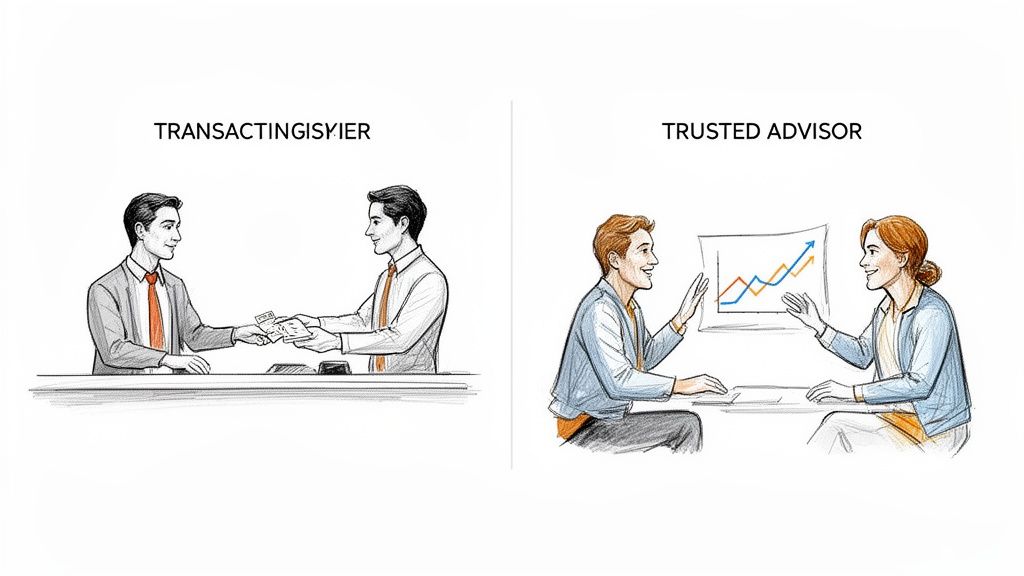
The ultimate goal is to make the buyer feel truly seen, heard, and understood. When a salesperson invests genuine time and effort into building that connection, the entire dynamic changes. It stops feeling like a sale and starts feeling like a strategic alliance built on mutual respect. That's a competitive advantage that a lower price can never beat.
The Shift from Vendor to Partner
In more and more industries, buyers aren’t just looking for vendors anymore. They're searching for partners who actually get their world. This is especially true in sectors where sales cycles are long, deals are high-value, and the solutions are complex.
Just look at these high-trust industries where relationship selling is non-negotiable:
- Enterprise Software: Buyers need to know you'll be there to support them through implementation, training, and whatever comes next.
- Financial Services: Clients are literally entrusting advisors with their financial security. That decision is built almost entirely on credibility and trust.
- Consulting: Success is impossible without a deep, nuanced understanding of a client's internal challenges and strategic vision.
In these fields, a purely transactional "sign here, please" approach is doomed to fail. The buyer's risk is simply too high. They need a partner who is just as invested in their success as they are.
Relationship selling embodies the principle that business is a marathon, not a sprint. The time and authentic energy a sales professional invests in making a real human connection will yield far greater returns over time.
To really nail this down, let’s look at the two approaches side-by-side.
Transactional Selling vs Relationship Selling at a Glance
This table breaks down the core differences in mindset, goals, and outcomes between the two philosophies.
| Attribute | Transactional Selling | Relationship Selling |
|---|---|---|
| Primary Focus | The product and the immediate sale. | The customer and their long-term needs. |
| Main Goal | Close the deal as quickly as possible. | Build a lasting, trust-based partnership. |
| Salesperson Role | Product pusher or order taker. | Trusted advisor and problem-solver. |
| Communication | One-way pitch, focused on features. | Two-way dialogue, focused on value and goals. |
| Time Horizon | Short-term, single transaction. | Long-term, focused on customer lifetime value. |
| Success Metric | Number of deals closed, sales volume. | Customer retention, loyalty, referrals, and satisfaction. |
As you can see, it’s a complete reversal of priorities. One chases the quarter, the other builds the future.
Why This Mindset Matters for Growth
Adopting a relationship selling mindset isn't just a feel-good strategy; it fundamentally changes your business outcomes. Consider that nearly 70% of B2B buyers admit to abandoning a brand if they don't feel genuinely cared for. A human-centric approach has never been more critical.
This philosophy turns one-off customers into loyal advocates for your brand. A client who feels valued and understood is far more likely to send referrals your way, provide glowing testimonials, and—most importantly—expand their business with you down the road.
This creates a sustainable cycle of growth built on a solid foundation of trust. It’s how you stop chasing leads and start building an unshakeable business.
Why Building Trust Is Your Greatest Sales Advantage
In a market flooded with automated pitches and copy-paste outreach, genuine trust has become the most valuable currency in sales. It’s the one thing that separates a quick, forgettable transaction from a lasting partnership. When you put trust first, you stop talking about features and start connecting with the human on the other side of the screen.
This simple shift changes the entire sales dynamic. Instead of pushing a product onto a sceptical buyer, you’re suddenly working together to solve problems with an engaged partner. At its heart, relationship selling is about empowering business growth through retention, sales, and relationship building, which makes trust your ultimate advantage.
When you invest the time to really understand a client’s world, you build a foundation that a competitor’s low price can never break. This isn't just a "nice-to-have"—it's a critical driver for your business.
The Psychology Behind a Trust-Based Approach
Relationship selling isn't magic; it works because it taps into basic human psychology. People are wired to do business with those they know, like, and trust. This approach systematically lowers a buyer’s natural defences and opens the door for real, productive conversations.
Think of it this way: a transactional sale is like asking a stranger for a huge favour. A relationship sale is like asking a friend for help. Which one do you think works better? The second one, because a foundation of respect and goodwill is already there.
Two key psychological principles make this happen:
- Reciprocity: When you consistently offer value—whether it’s insights, helpful resources, or just solid advice—without immediately asking for something back, you trigger a natural desire in people to return the favour. This isn’t about manipulation; it's the start of a healthy, give-and-take partnership.
- Social Proof: Sharing relevant success stories or connecting a prospect with a happy client is powerful. It provides concrete evidence that other people trust you, which dramatically lowers the perceived risk for a new buyer and makes them feel safer saying "yes."
From Active Listening to Unspoken Needs
Real relationship selling goes way beyond small talk. It demands empathy and active listening—the skills that let you hear what isn't being said. You need to uncover the unspoken needs and professional anxieties that are the true drivers behind a purchase.
A buyer might say they need new software. What they often mean is they're scared of falling behind the competition or fed up with their team's clunky, inefficient workflow.
A salesperson's greatest tool isn't their pitch deck; it's their ability to listen. By understanding a client’s professional fears and aspirations, you stop selling a product and start delivering peace of mind.
This deep level of understanding becomes your competitive moat. Anyone can drop their price, but very few can compete on genuine insight and empathy. When you know a client's world, you transform from a vendor into an indispensable advisor. This is a vital part of building trust with clients.
The Tangible Business Case for Relationships
Don't mistake this for a "soft" approach. Investing in relationships delivers hard financial results. In Singapore's competitive B2B market, a staggering 44% of consumers will jump to a competitor after just one bad service experience. This stat alone highlights how crucial relationship selling is for loyalty.
The link between trust and revenue shows up clearly in a few key areas:
- Higher Customer Lifetime Value (CLV): Clients who trust you stay longer, buy more, and are far more receptive to upsells. They see you as a partner who’s genuinely invested in their success.
- More (and Better) Referrals: Happy, loyal customers become your best marketing channel. They’ll gladly recommend you to their network, bringing you warm leads that are already primed to trust you.
- Unwavering Loyalty: When a competitor shows up with a tempting discount, a client who trusts you won't be easily swayed. The value of your relationship and deep understanding of their business is worth more than a few dollars off the price tag.
Ultimately, building trust isn't just one step in the sales process—it’s the entire framework.
The Four Pillars of an Unbreakable Client Relationship
Let's be real, turning abstract ideas like "trust" and "rapport" into something you can actually do every day is the heart of relationship selling. It’s not just about having good intentions. You need a solid framework.
This framework is built on four essential pillars. When you bring them together, you stop just running a sales process and start building a durable, unbreakable client partnership.
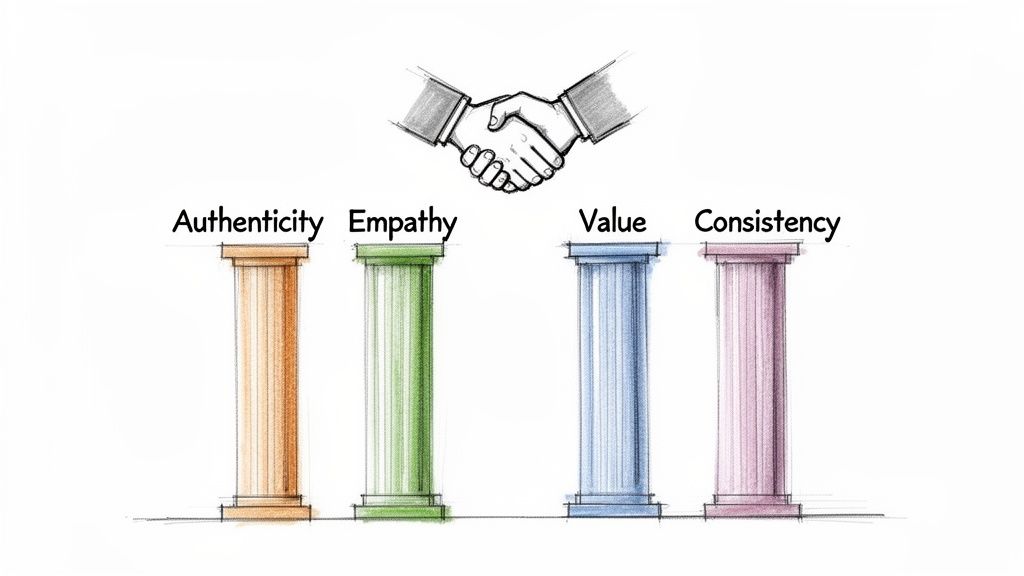
Think of Authenticity, Empathy, Value, and Consistency as your roadmap. They're the active ingredients that build loyalty and turn clients into your biggest fans.
Pillar 1: Authenticity
Authenticity is simply about showing up as yourself, not some sales caricature reciting a script. Buyers have a sixth sense for insincerity. A forced or generic persona puts up a wall of distrust almost immediately.
When you let your actual personality show and speak in your own voice, you invite a real human connection.
This isn't about being unprofessional; it's about being real. For instance, admitting you don't know the answer to a technical question but promising to find out builds far more credibility than bluffing your way through it. That little bit of vulnerability shows you're a human partner, not just a vendor pushing a product.
Pillar 2: Empathy
While authenticity is about you, empathy is all about them. It’s the ability to truly get a client's challenges, pressures, and goals—from their perspective. This goes way beyond "active listening" to understanding the unspoken emotions driving their decisions.
Imagine your client is stressed about a huge board presentation. Empathetic selling isn't just about offering a solution to their business problem. It's about acknowledging their personal stake in the outcome.
You might say, "It sounds like a lot is riding on this presentation for you personally. Let's make sure you have everything you need to feel confident." See the difference?
This level of understanding requires genuine curiosity. It positions you as an ally who’s invested in their individual success, not just their company's budget.
Empathy is the ability to see with the eyes of another, to listen with the ears of another, and to feel with the heart of another. It’s the engine of any strong relationship, professional or personal.
A huge part of practical empathy is understanding different communication styles. This is where tools like Mindreader can give you an edge, identifying a client's communication archetype so you know how to frame your message for maximum impact. Knowing you're speaking to a direct, data-driven "Knight" versus a collaborative, big-picture "Explorer" helps you connect on their terms from the get-go.
For a deeper look, check out our guide on the four client classes and how to approach them.
Pillar 3: Value
Value is the currency of trust. In relationship selling, you have to provide value long before a contract is even on the table. This means acting like a resource and an advisor, constantly offering insights and ideas that help your client, whether there's an immediate payoff for you or not.
Providing value can take many forms:
- Sharing Relevant Insights: Sending a link to a new industry report with a note saying, "Saw this and thought of your team's goal to expand into the APAC market."
- Making Strategic Introductions: Connecting them with someone in your network who could help solve a separate problem they mentioned offhand.
- Offering Proactive Advice: Spotting a potential pitfall in their current strategy and offering a suggestion based on what you've seen work for similar companies.
This approach proves your primary goal is their success. Every valuable interaction is a deposit into the trust account, building a foundation strong enough to support a long-term partnership.
Pillar 4: Consistency
Consistency is the glue that holds the other three pillars together. One authentic chat or one valuable email is great, but it's not enough. Trust is built through a pattern of reliable, predictable, and positive behaviour over time.
Consistency shows you are a dependable long-term partner, not just a contact who disappears after the sales cycle ends.
This means following through on every promise, no matter how small. It means checking in after the sale not to upsell, but just to make sure they're getting the results they wanted. When clients know they can count on you time and time again, your relationship becomes an indispensable asset to their business.
Your Practical Playbook for Building Client Relationships
Theory is one thing, but action is what closes deals. This is where the big ideas of relationship selling get broken down into a practical, daily workflow. A solid playbook helps you shift from knowing what to do to consistently doing it, ensuring every single interaction builds on the last.
Think of this framework less like a rigid script and more like a guide for weaving a relationship-first mindset into your entire sales process. From the first bit of research to the final follow-up, these steps ensure you’re always leading with genuine curiosity and value.
Stage 1: The Research and Preparation Phase
Long before you type that first email or pick up the phone, the real work begins. This stage is all about becoming a student of your prospect’s world. Your goal isn't just to scrape surface-level data, but to understand the human being behind the business title.
You're looking for clues about their communication style, their professional headaches, and their recent wins. A tool like Mindreader is brilliant here, as it can analyse a prospect's digital footprint to map their communication archetype. Knowing if you're about to connect with a direct, data-loving "Knight" or a big-picture, collaborative "Explorer" lets you frame your first words to resonate immediately.
Actionable steps for this phase include:
- Go Beyond LinkedIn: Check out company press releases, recent interviews, or articles they’ve shared. What are they fired up about?
- Identify Pain Points: Look for signs of friction or ambition. Are they hiring for a brand-new department? Did a competitor just launch something big?
- Map the Human Element: Use tools to get a feel for their communication preferences. This insight helps you nail the tone from the very first hello.
Stage 2: The Initial Connection
Your first interaction is everything. It sets the tone for the entire relationship. A transactional seller leads with a pitch. A relationship seller leads with a sharp insight or a thoughtful question. Your homework from Stage 1 is what makes this possible.
Instead of a generic, "I'd love to tell you about our product," you can be hyper-specific. For example: "I saw your company's recent announcement about expanding into Southeast Asia and noticed a potential challenge with regional data compliance. I have a resource that helped another client navigate this—thought it might be useful."
This approach instantly shows three critical things:
- You’ve actually done your homework.
- You understand their world.
- You’re here to help, not just to sell.
This first touchpoint is your golden opportunity to prove you are a resource, not just another salesperson in their inbox.
Stage 3: Nurturing Through Value-Driven Dialogue
Once you've made that connection, the focus shifts to nurturing the relationship with an ongoing, valuable conversation. This is a marathon, not a sprint. The goal of every single chat is to learn more about their needs and offer insights that help them, whether or not a sale is on the immediate horizon.
During these conversations, your main job is to listen. Top performers talk less and listen more, which allows them to uncover the real motivations hidden behind a buyer's words.
The most powerful sales conversations aren't about showcasing your product; they're about proving you understand the client's problem. When they feel truly seen and understood, the sale becomes a natural, logical next step.
Throughout this stage, consistently offer value without asking for anything in return. Share relevant articles, offer a bit of strategic advice, or connect them with someone helpful in your network. Each small act of generosity builds another layer of trust.
Stage 4: Handling Objections with Empathy
Objections are going to happen. It's just part of the game. A transactional seller sees an objection as a wall to knock down. A relationship seller, however, sees it as an invitation to understand the prospect better and deepen the connection.
When a client raises a concern, it's actually a good sign—it means they're engaged and thinking critically. Your response should validate their concern, not brush it aside. Instead of getting defensive, get curious. Ask questions to dig into the root of their hesitation.
This turns a potential conflict into a collaborative problem-solving session. The table below shows how you can reframe common objections with a relationship-first mindset, turning them from roadblocks into trust-building moments.
Handling Objections with a Relationship-First Approach
| Common Objection | Transactional Response | Relationship-Building Response |
|---|---|---|
| "Your price is too high." | "We're actually priced competitively, and our features justify the cost. Let me show you the ROI calculator." | "I appreciate you being transparent about that. Help me understand what a comfortable budget looks like for you so I can see if there’s a way to align the value with your expectations." |
| "We're happy with our current vendor." | "But our solution offers X, Y, and Z features that they don't have. You'll be missing out on these benefits." | "That's great to hear that you have a strong partnership. I'm not here to disrupt that. Could you share what you value most in that relationship so I can learn from it?" |
| "I need to think about it." | "What is there to think about? This offer is only available for a limited time." | "Of course, that's a sensible step for a big decision. To help you think it through, what specific questions or concerns are top of mind for you right now?" |
| "Now is not the right time." | "If you wait, you'll miss out on the opportunity to solve this problem now. Let’s get you started." | "I understand that timing is everything. So I can be a better resource for you, could you give me a sense of what your priorities look like over the next quarter?" |
Responding with genuine empathy and curiosity reinforces that you're on their side. You're working with them to find the best possible outcome for their business, not just trying to push your own agenda.
Measuring the Metrics That Actually Matter
Let’s be honest: in relationship selling, the old-school scoreboard of dials made and emails sent is completely obsolete. Success isn't about the sheer volume of activity anymore. It's about the depth and quality of the partnerships you build.
To figure out if a relationship-first approach is actually working, you need to ditch the vanity metrics and focus on what reflects long-term health, loyalty, and trust. These are the Key Performance Indicators (KPIs) that give you a clear, holistic view of how well you're turning prospects into lasting partners. They look beyond the immediate sale to measure the enduring value you create.
This simple process is the foundation for building the client relationships that these metrics will ultimately measure.
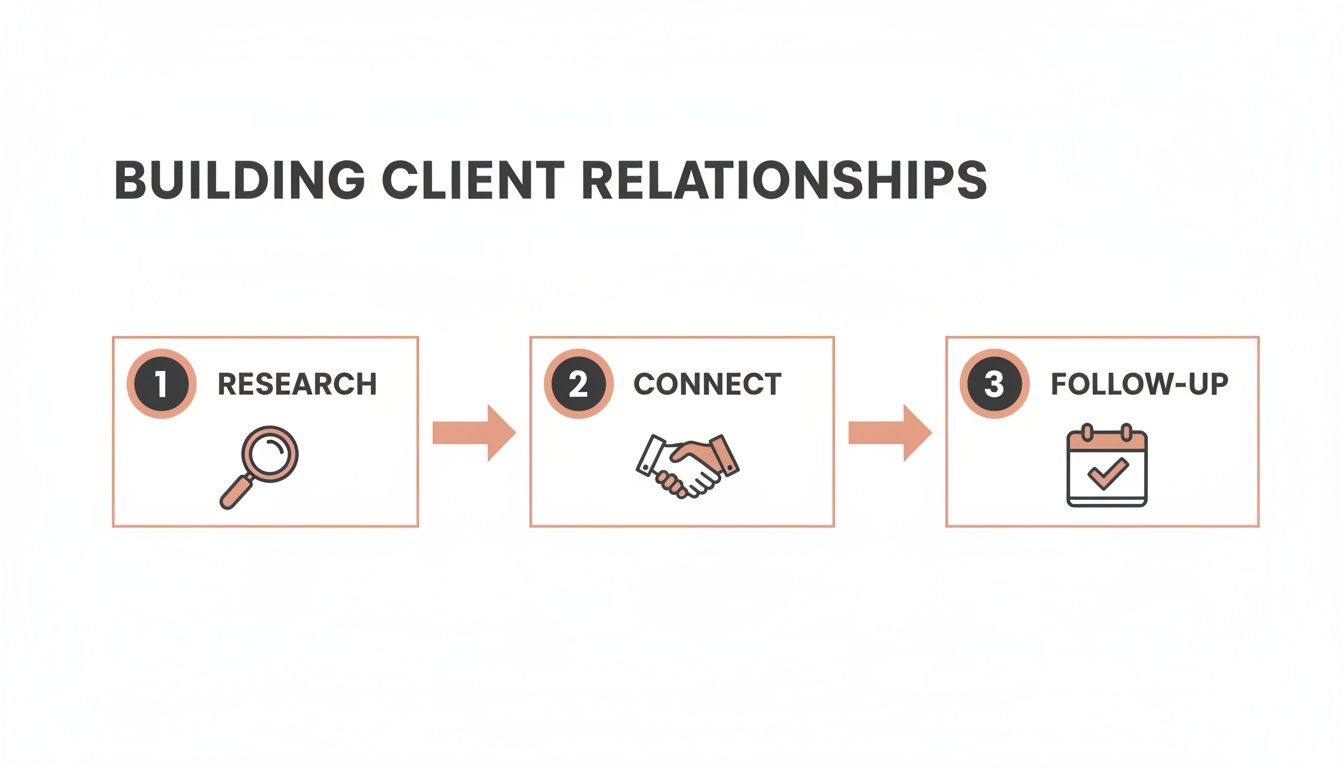
As you can see, a successful relationship starts long before a deal is ever signed. It begins with diligent research, moves through a genuine connection, and is sustained by consistent follow-up—all of which drive the positive KPI results we’re about to cover.
Moving Beyond Transactional KPIs
Traditional sales metrics often reward speed and quantity. The problem? That can push reps into behaviours that actually damage relationships. In contrast, relationship-centric KPIs focus on outcomes that signal a healthy, growing partnership.
Here are the big ones to track:
Customer Lifetime Value (CLV): This is the holy grail for relationship selling. CLV predicts the total revenue a client will generate throughout their entire time with your company. A high CLV is direct proof that your investment in building trust is paying off in long-term, sustainable growth.
Referral Rate: This KPI tracks the percentage of new business that comes directly from your existing clients. A high referral rate is a huge win—it means your clients trust you enough to put their own reputation on the line by recommending you.
Customer Retention and Churn Rates: Retention measures how many clients you keep, while churn measures how many you lose. Strong relationships are the bedrock of high retention, proving that clients feel valued and supported long after the ink on the contract has dried.
Gauging the Health of the Relationship
Beyond the hard numbers, you need to understand the sentiment behind the partnership. Qualitative metrics are essential for getting a pulse on how your clients feel about working with you.
This isn't just a "nice-to-have." For instance, trust in sellers influences 41% of Singapore shoppers' platform choices, and more than half are willing to spend more for reliable service. This makes relationship selling a cornerstone of B2B success in the region and shows why measuring that trust is so critical. You can discover more insights about the future of e-commerce in Singapore on mili.eu.
The goal of relationship selling isn't just to get a signature on a contract; it's to earn a permanent place as a trusted advisor in your client's world. The right metrics help you measure how well you're achieving that goal.
You'll also want to keep an eye on these sentiment-based metrics:
Net Promoter Score (NPS): This measures loyalty by asking one simple question: "On a scale of 0-10, how likely are you to recommend us?" It gives you a clear, quantitative snapshot of client satisfaction and advocacy.
Upsell and Cross-sell Rates: Tracking how often existing clients buy more from you is a massive indicator of deep trust. When clients expand their business with you, it shows they see you as a valuable partner who can solve more of their problems.
By tracking this blend of metrics, you can prove the tangible business impact of relationship selling. You're not just closing deals; you're building a foundation for long-term growth and unwavering client loyalty.
How AI Can Enhance the Human Side of Sales
Many sellers worry that technology will strip the human touch right out of their process, but the right tools can actually do the opposite—they can amplify it. Instead of trying to automate a relationship, artificial intelligence (AI) gives you the deep insights needed to build more meaningful, human-centric connections, and do it at scale.
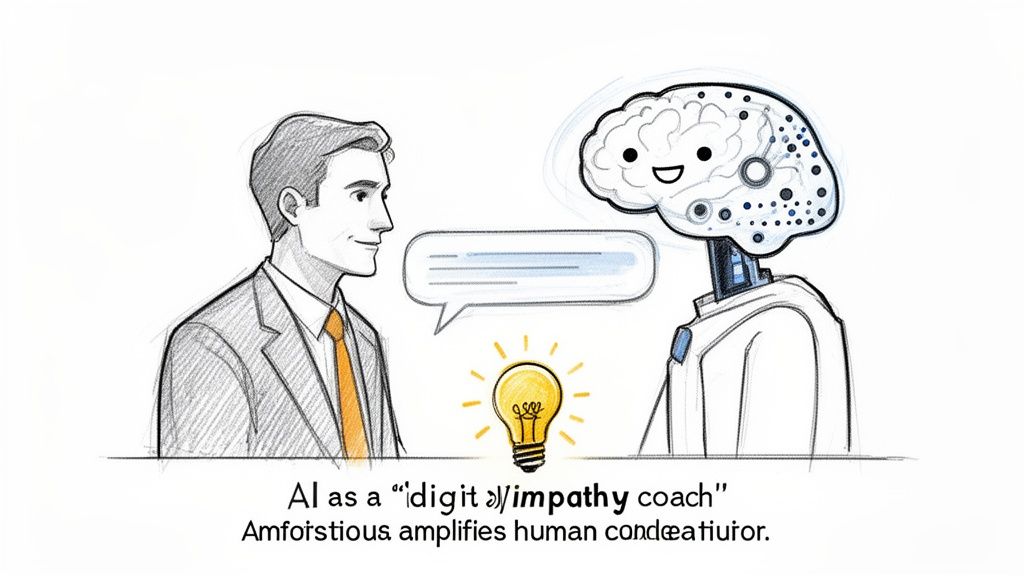
Think of an AI-powered platform like Mindreader as your "digital empathy coach." It analyses a prospect’s communication style before you even walk into a meeting, arming you with data-driven insights to completely tailor your message. This preparation takes the guesswork out of relationship selling, letting you connect on a much deeper level from the very first hello.
Turning Data Into Authentic Connection
Let's put this into a real-world scenario. Imagine you're about to meet a high-value prospect, a CEO known for being direct and laser-focused on data. Instead of going in with a generic, one-size-fits-all pitch, you use an AI tool to analyse their recent online activity, like LinkedIn posts and interviews.
The analysis flags them as a "Knight" communication archetype—someone who values efficiency, hard data, and bottom-line results above all else.
Armed with this insight, you can strategically adjust your entire approach:
- Your Message: You’ll lead with key performance indicators and a clear ROI instead of a long, story-based intro.
- Your Pacing: You’ll keep the conversation tight and focused, avoiding any tangents that might lose their interest.
- Handling Objections: You'll anticipate their need for solid proof and come prepared with specific case studies that validate every claim you make.
This isn't about manipulation; it's about speaking their language. By adapting to their communication style, you show respect for their time and instantly establish credibility. The prospect feels understood, and that feeling is the foundation of any strong relationship. If you're looking for more ways to use these tools, check out our insights on AI for sales teams.
AI's true power in sales isn't replacing human intuition, but augmenting it. It provides the intelligence needed to practice empathy more effectively, turning good sellers into trusted advisors.
AI as Your Relationship Co-Pilot
Ultimately, the role of AI in relationship selling is to handle the heavy analytical lifting. This frees you up to focus on what really matters—the human connection. It helps you prepare smarter, listen more intently, and adapt in real-time. By giving you the intelligence to understand your buyer's world, AI empowers you to build the authentic, trust-based partnerships that drive long-term success.
For a deeper dive into how AI can transform your support operations, which in turn bolsters your sales efforts, explore this comprehensive guide on AI-powered customer service. This approach allows you to dedicate more of your energy to the core principles of relationship selling, knowing you have the data to back up your intuition.
Common Questions About Relationship Selling
Even when the benefits seem obvious, shifting to a relationship-first mindset can feel… complicated. It’s easy to wonder how you’re supposed to build deep connections when you’re staring down aggressive sales targets. Is this even realistic in a market that moves at lightning speed?
Let's tackle some of the real-world questions that pop up when you decide to put relationships at the centre of your sales strategy.
Is Relationship Selling Too Slow for My Sales Cycle?
It’s a fair question. While this approach does ask for more investment upfront, it often speeds up the back half of the sales process. The trust you build early on dissolves the usual friction that comes with negotiation and closing.
For shorter cycles, the principles don't change—you just condense them. Your goal is to deliver massive value and razor-sharp insight from the very first conversation. Make every single interaction count.
The point isn’t to drag out your sales cycle. It's to make every moment within it more meaningful. A strong relationship can turn a "maybe later" into a "yes, now" simply because that foundation of trust is already in place.
How Can I Justify the Time Investment to My Manager?
This is where you need to speak their language: metrics. Shift the conversation away from call volume and activity logs and focus on the outcomes that truly matter to the business.
Here’s what to highlight:
- Higher Customer Lifetime Value (CLV): Frame it this way: "These aren't just one-off deals. The clients we build relationships with stay longer and spend more over time."
- Increased Referral Rates: Show them how happy, loyal clients become your best source of warm, high-converting leads. It's a sales pipeline that builds itself.
- Lower Churn: Nothing proves the value of loyalty like stability. Strong relationships create a stickiness that quotas and discounts just can't replicate.
Can This Approach Feel Inauthentic or Fake?
If it feels fake, you're doing it wrong. Authenticity isn't just a part of relationship selling—it's the entire engine.
This strategy falls apart the second it’s treated as just another tactic to manipulate someone into a deal. It has to come from a place of genuine curiosity about your client's world and their challenges. It’s about listening more than you talk and truly wanting them to succeed.
When your primary motive is to help, your efforts will feel real to both you and your client. You’re not an actor playing a part; you’re a trusted advisor building a real connection.
Ready to stop guessing and start connecting with clients on a deeper level? Mindreader gives you the AI-powered insights to understand any prospect's communication style in seconds. Prepare smarter, build trust faster, and close more deals by adapting your message to how your clients think. Learn more and see how it works.