10 Proven Methods of Closing the Sale to Win More Deals in 2026

The final moments of a sales conversation are where deals are won or lost. While many focus on generating leads and delivering pitches, the ability to confidently and effectively guide a prospect towards a decision is the ultimate differentiator. This isn't about manipulation; it's about clarification, confidence, and making it easy for your prospect to say yes to a solution that genuinely solves their problem. In the high-stakes world of sales, getting this final step right separates top performers from the rest of the pack.
This guide moves beyond generic advice to provide a comprehensive roundup of ten battle-tested methods of closing the sale. For each technique, we will explore:
- When to Use It: Pinpointing the ideal scenarios for maximum impact.
- Step-by-Step Execution: Clear, actionable frameworks you can implement immediately.
- Objection-Handling Scripts: Practical responses to common pushback.
- Archetype-Specific Variations: How to adapt your close for different buyer personalities.
We'll break down proven techniques like the Assumptive Close, the Summary Close, and the more nuanced Takeaway Close. You will learn not just what these methods are, but precisely how to deploy them with tactical precision. By understanding these frameworks, you can transform your final conversations from nerve-wracking hurdles into masterful, organised processes. This article provides the strategic toolkit needed to approach any closing scenario with the right strategy, helping you secure commitment and drive revenue with greater consistency. Prepare to move from hoping for a "yes" to strategically leading your prospect to it.
1. The Assumptive Close
The assumptive close is one of the most powerful methods of closing the sale, built on a foundation of confidence. It operates on the premise that the prospect has already decided to buy. Rather than asking if they want to move forward, you proceed with language and actions that presume their agreement, transitioning smoothly into the logistical next steps.
This technique capitalises on the prospect's positive buying signals. When you've effectively addressed all their concerns and they’ve shown clear interest, the assumptive close removes the final moment of hesitation. It makes saying "yes" feel like the natural, inevitable conclusion to a productive conversation.
When to Use This Close
This close is best reserved for situations where the prospect has given strong, undeniable buying signals. Look for verbal cues like "This looks great" or "That feature would solve our problem", and non-verbal cues like positive body language and high engagement. Using it too early can come across as pushy and damage rapport.
How to Execute It: Step-by-Step
- Confirm Alignment: Verbally summarise the key value points and ensure the prospect agrees. "So, we're aligned that this will streamline your workflow and reduce overheads, correct?"
- Pivot to Logistics: Immediately transition into the next step using assumptive language.
- Present a Choice: Frame the next step as a minor choice between two options. This shifts the focus from "yes or no" to "which one?"
Real-World Scripts:
- SaaS: "Great. To get your account set up, which team member should I designate as the primary admin?"
- Real Estate: "Excellent. Shall we schedule the property inspection for Tuesday morning or would Thursday afternoon work better for you?"
- Consulting: "Let's get our kick-off session in the diary. Is your team's availability better in the first or second week of next month?"
Customising Your Approach
Adapt your delivery based on the buyer's personality. A direct, no-nonsense "Knight" archetype will appreciate the efficiency, while a relationship-focused "Healer" may need more reassurance first. Understanding these nuances is key. You can learn more about adapting your style to different personality types to make your approach even more effective.
2. The Alternative Close (Either/Or)
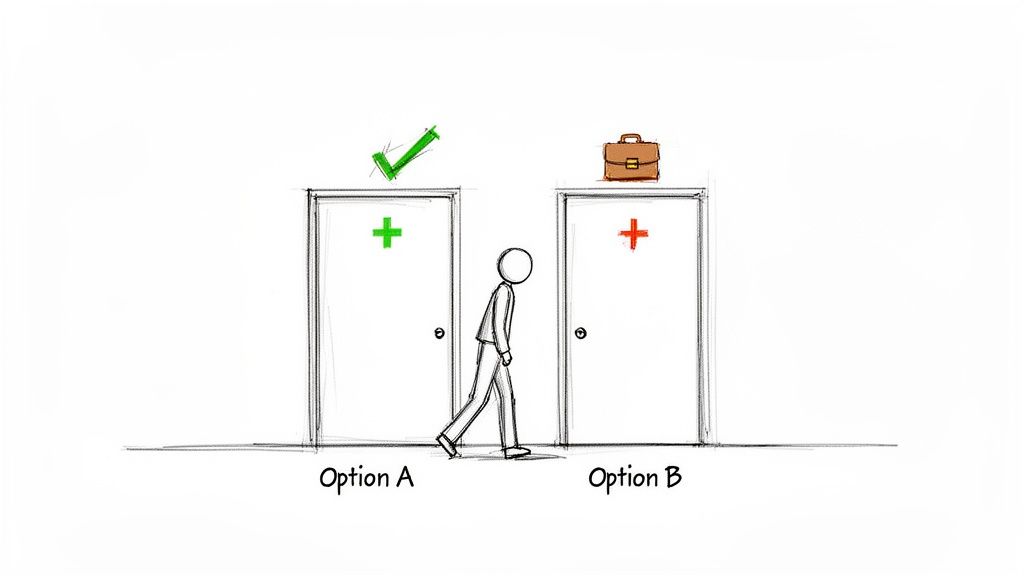
The alternative close, also known as the either/or close, is a powerful psychological technique that guides a prospect towards a "yes" by presenting two favourable options. Instead of asking a direct yes/no question like "Do you want to proceed?", you present a choice between two alternatives, both of which confirm the sale. This method simplifies the decision-making process for the buyer.
This approach is one of the most effective methods of closing the sale because it shifts the prospect's focus from the major decision of buying to the minor decision of how they will buy. It operates on the principle of choice architecture, making the desired outcome feel like the prospect's own well-reasoned selection and creating a smooth, low-pressure path to commitment.
When to Use This Close
The alternative close is exceptionally versatile and can be used in most sales scenarios, especially after you've established value and received positive feedback. It works best when the prospect seems agreeable but may be hesitant to make the final commitment. It's a great way to gently nudge them forward without appearing aggressive.
How to Execute It: Step-by-Step
- Confirm Understanding: Briefly recap the main benefits to ensure you are on the same page. "It sounds like we agree this is the right solution for your team."
- Pivot to a Choice: Immediately follow up by presenting two distinct, pre-approved options that lead to a sale.
- Frame the Options: Present the choice clearly and concisely. The options should be about implementation details like timing, configuration, or payment.
Real-World Scripts:
- Financial Advisory: "Based on your goals, we can start with either a quarterly portfolio review or move to monthly check-ins. Which cadence feels more comfortable for you?"
- Consulting: "To get started, should we begin our discovery phase with your operations team or would the sales department be a better first step?"
- Luxury Sales: "This timepiece is stunning. Would you prefer it with the classic titanium finish or the elegant rose gold?"
Customising Your Approach
Tailor the options to the buyer's personality. An "Explorer" archetype will want to compare the details of each option, so be prepared to elaborate. In contrast, a "Healer" will need reassurance that either choice is a secure and reliable path forward. Frame the alternatives around the values you've identified throughout the sales process, not just product specifications, to make the decision more meaningful.
3. The Summary Close
The summary close is a logical and collaborative method of closing the sale that reinforces the value established during your conversation. It involves methodically recapping the key points, benefits, and agreements made, essentially building an undeniable case for moving forward based on the prospect's own words and affirmations.
This technique transforms the final ask from a leap of faith into a logical next step. By summarising the journey you've taken together, you remind the prospect of their initial pains, the solutions discussed, and how your offer perfectly aligns with their stated needs. It builds confidence and momentum, making the final commitment feel like a natural conclusion.
When to Use This Close
This close is highly effective in complex sales cycles with multiple decision points or when a significant amount of information has been covered. It's ideal after a long discovery call, a product demonstration, or a proposal review. Use it when you need to bring clarity and focus back to the core value proposition before asking for the business.
How to Execute It: Step-by-Step
- Signal the Recap: Let the prospect know you're about to summarise. "Before we discuss next steps, let's quickly review what we've covered to ensure we're on the same page."
- Summarise Key Points: Concisely list the main challenges, agreed-upon solutions, and key benefits. Use the prospect's own language wherever possible.
- Gain Micro-Confirmations: After each key point or a small group of points, pause and seek confirmation. "Does that sound right so far?" or "Have I captured that correctly?"
- Bridge to the Close: Once you have their agreement on the summary, transition smoothly to the close. "Since we've confirmed this addresses all your key requirements, the next step is..."
Real-World Scripts:
- Enterprise Software: "So to recap, you need to automate your approval process, you want mobile access for your field team, and you've confirmed the budget is approved for Q2. Does that capture the essentials?"
- Insurance: "We've identified the three main coverage gaps in your current policy, you're comfortable with the S$2M liability limit, and the monthly premium fits well within your budget. Shall we proceed with getting the paperwork started?"
- Consulting: "You're focused on improving team retention, we've outlined a three-phase engagement to address it, and you can see a clear path to ROI within six months. Based on that, are you ready to kick this off?"
Customising Your Approach
Tailor your summary to resonate with the buyer's archetype. A data-driven "Wizard" will appreciate a logical, point-by-point recap of features and ROI. In contrast, a relationship-focused "Healer" will respond better to a summary that validates the emotional impact of the solution, such as "This will bring your team peace of mind and reduce their after-hours workload."
4. The Urgency/Scarcity Close
The urgency/scarcity close is a powerful method of closing the sale that leverages time-sensitive opportunities or limited availability to encourage a prospect to make a decision. This technique introduces a genuine reason for the buyer to act now, such as a promotional price ending, limited stock, or an exclusive offer expiring. It helps overcome decision paralysis by creating a legitimate and compelling reason to move forward sooner rather than later.
Used ethically, this close frames the decision not as a high-pressure tactic, but as a helpful heads-up to prevent the prospect from missing out. It taps into the psychological principles of loss aversion, where the fear of losing an opportunity is often a stronger motivator than the prospect of gaining one.

When to Use This Close
This close is most effective when the scarcity or urgency is real and verifiable. It is ideal for situations involving limited-edition products, seasonal promotions, expiring regulatory windows, or dwindling inventory. Using it without a factual basis will destroy credibility and can be perceived as manipulative, so it should be deployed with complete transparency.
How to Execute It: Step-by-Step
- Reconfirm Value: Ensure the prospect is already convinced of the product's value. "We're agreed that this is the right solution for your team, correct?"
- Introduce the Constraint: Clearly and honestly state the time-based or quantity-based limitation.
- Propose Action: Connect the constraint to the immediate next step, prompting a decision to secure the benefit.
Real-World Scripts:
- SaaS: "The 20% discount for annual pre-payment is part of our end-of-quarter promotion, which officially ends this Friday. To lock in that rate, we'd need to get the paperwork signed by then."
- Real Estate: "The seller has just informed me they've received another strong offer. If you'd like to proceed, we should submit our best offer by 5 p.m. today to ensure you're in consideration."
- Luxury Sales: "This is one of only five pieces being allocated to the region, and three have already been reserved. Would you like me to place your name on one of the remaining two?"
Customising Your Approach
Always verify scarcity claims before presenting them. Document deadlines and limitations in your CRM to maintain credibility across your team. Knights and Explorers often respond well to the competitive nature of scarcity, while Healers and Wizards need reassurance that the urgency is a genuine factor and not just a sales tactic. Following up with a written confirmation of the timeline can reinforce your transparency and professionalism.
5. The Takeaway Close
The takeaway close is a sophisticated method of closing the sale that leverages the powerful psychological principle of loss aversion. Instead of pushing for a "yes", you subtly suggest withdrawing the offer, positioning your solution as an exclusive opportunity that might not be available if the prospect hesitates.
This technique reverses the traditional sales dynamic. Rather than pursuing the buyer, you create a scenario where they must qualify themselves and act decisively to secure the deal. It communicates immense value and confidence, making the prospect fear missing out on a valuable solution more than they desire the gain itself.
When to Use This Close
This advanced close is best suited for high-value deals where your offering is genuinely unique or in high demand. Use it with confident, decisive prospects who respect directness and exclusivity. It's particularly effective when you sense a prospect is on the fence but needs a nudge, or when dealing with buyers who are accustomed to being chased by salespeople. Avoid it with hesitant or relationship-focused buyers, as it can be perceived as rejection.
How to Execute It: Step-by-Step
- Establish High Value: Throughout the sales process, consistently reinforce the unique value and desirability of your offering.
- Identify Hesitation: When the prospect is clearly interested but fails to commit after you've addressed all their concerns, it's time to act.
- Introduce the 'Takeaway': Calmly and professionally, introduce a reason why the offer may no longer be available. This must be a credible reason, like limited capacity or another interested party.
- Shift the Frame: The focus is now on the prospect needing to secure the opportunity, not on you needing to make the sale.
Real-World Scripts:
- Executive Consulting: "Based on our conversation, I'm not entirely convinced this is the right priority for your team right now. We only take on clients who are fully committed to transformation, so perhaps we should revisit this next quarter."
- Luxury Real Estate: "I have another qualified buyer making an offer this afternoon. I'd much prefer to work with you, but I need a firm commitment by noon to present your offer first."
- High-End Advisory: "My practice is currently at capacity. I'm only considering partners who align perfectly with our strategic goals. If you're not ready to move forward, I understand and will have to offer the spot to the next firm on my waiting list."
Customising Your Approach
Your delivery must be adapted to the buyer's personality. A direct "Knight" or analytical "Wizard" will respect the strength and logic of this approach. However, a relationship-focused "Healer" may feel pressured or rejected. For them, soften the delivery by framing it around mutual fit rather than scarcity. Understanding these dynamics is crucial for success. You can learn more about adapting your style to different personality types to execute this technique flawlessly.
6. The Pain/Problem Close
The pain/problem close is a highly effective, consultative method of closing the sale that centres on the prospect’s core challenges. It reframes the conversation away from your product’s features and brings it back to the specific struggles and pain points the prospect shared during discovery. The technique positions your offering not just as a good idea, but as the essential, targeted remedy for their problem.
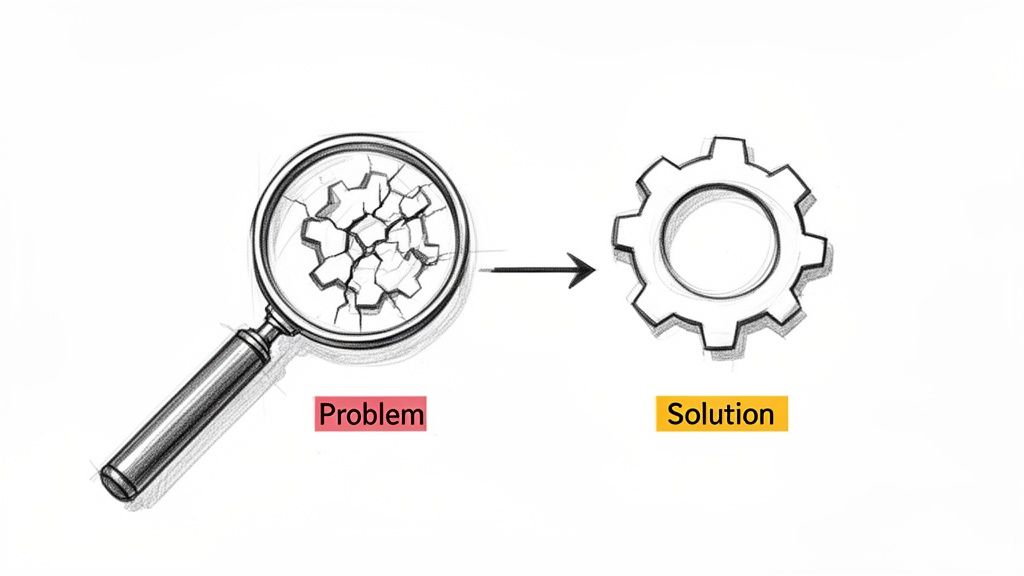
This approach reminds the prospect of the significant cost of inaction, making the decision to purchase feel logical and necessary. By connecting your solution directly to their pain, you transform the purchase from a discretionary expense into a strategic investment in solving a critical business or personal issue. It's built on a foundation of excellent listening and genuine understanding.
When to Use This Close
Use this close when you have conducted a thorough discovery process and have a crystal-clear, quantified understanding of the prospect's primary challenges. It's particularly powerful in complex B2B sales, consulting, or any situation where the solution solves a significant, costly problem. It is less effective if the pain point is minor or not well-defined.
How to Execute It: Step-by-Step
- Recall the Pain: Use the prospect's own words to remind them of the problem they described. "Earlier, you mentioned that..."
- Quantify the Impact: Attach a tangible cost (time, money, resources, or stress) to the problem to make it concrete.
- Position Your Solution: Directly connect your solution as the specific antidote to that quantified pain, demonstrating a clear cause-and-effect resolution.
Real-World Scripts:
- Enterprise Software: "You mentioned your approval process currently takes eight days and costs your team valuable resources. Our system cuts that to same-day approval, directly addressing that bottleneck and saving you thousands monthly."
- Financial Advisory: "You said you're worried about market volatility eroding your retirement savings. Let me show how our diversification strategy is specifically designed to protect against the downturns you're concerned about."
- Consulting: "The high team turnover you identified is a major drain on institutional knowledge. Our leadership programme directly addresses the root cause you pointed to: a lack of manager coaching."
Customising Your Approach
Tailor the delivery to the prospect’s personality. A data-driven "Wizard" will respond best to the quantified impact and ROI. A relationship-focused "Healer" will connect with the validation of their emotional pain ("You mentioned how stressful this has been..."). A direct "Knight" wants to hear the problem and the immediate solution, while an "Explorer" will appreciate understanding how the solution fixes the root cause.
7. The Puppy Dog Close
The puppy dog close is a powerful method of closing the sale that revolves around a simple, low-risk proposition: "try it before you buy it". It gets its name from the classic scenario of a family taking a puppy home for the weekend; once the emotional connection is made, they can't imagine giving it back. This technique leverages the same psychology by letting the prospect experience your solution's value firsthand.
By offering a free trial, a pilot programme, or a demo, you lower the barrier to entry and shift the conversation from a hypothetical benefit to a tangible result. Once a prospect uses your product or service and sees the positive impact it has, the fear of making the wrong decision dissipates. The focus moves from the risk of purchase to the pain of losing the newfound benefits, making the sale a natural next step.
When to Use This Close
This close is ideal for complex or high-consideration products where the value is best demonstrated through experience rather than explanation. It works exceptionally well when prospects are interested but hesitant due to the perceived risk, cost, or implementation effort. It is less effective for simple, transactional sales where a trial period would be impractical.
How to Execute It: Step-by-Step
- Position the Offer: Frame the trial not as a sales tactic, but as a risk-free way for them to validate the solution's fit for their specific needs.
- Define Clear Parameters: Set a clear start and end date, establish specific success metrics, and outline what happens when the trial concludes. This prevents ambiguity.
- Schedule the Follow-up: Book the "decision" meeting before the trial period ends to ensure momentum is not lost.
Real-World Scripts:
- SaaS: "Let's set up a two-week pilot with your team. You'll see the time savings firsthand, and if it's not a fit, we part ways with no obligation."
- Consulting: "I'll conduct a complimentary diagnostic review of your top three pain points. Once you see the root causes, you'll be in a better position to decide on engagement."
- Financial Advisory: "Let's run a complimentary portfolio analysis using our methodology. You'll see specifically how we'd propose to manage your assets differently."
Customising Your Approach
Tailor the trial's success metrics to the prospect's personality. A data-driven "Explorer" will want to see clear performance data, while a "Knight" will be focused on achieving a quick, decisive win. A relationship-focused "Healer" will value the hands-on support during the trial, and a detail-oriented "Wizard" will appreciate a comprehensive onboarding process. Ensuring the trial speaks to their core values significantly increases conversion rates.
8. The Emotional/Values-Based Close
The emotional or values-based close is one of the most profound methods of closing the sale because it connects your solution to the prospect's deepest motivations. It moves beyond features, benefits, and even ROI to appeal to their core values, identity, and personal vision. This technique frames the purchase not as a transaction, but as a step towards becoming who they want to be or creating the future they desire.
This approach hinges on understanding what truly drives the buyer. By aligning your solution with their aspirations for legacy, security, innovation, or impact, you transform the conversation from a logical decision into an emotional commitment. It makes saying "yes" feel like a decision that is authentic to their principles and goals.
When to Use This Close
This close is particularly powerful in high-ticket, complex, or transformational sales where the emotional stakes are significant. It is ideal when the decision isn't just about solving a problem, but about achieving a larger vision. Use it after a deep discovery process where the prospect has shared their personal or organisational values and long-term aspirations.
How to Execute It: Step-by-Step
- Listen and Identify Core Values: During discovery, pay close attention to the language the prospect uses to describe their goals. Listen for words related to legacy, culture, impact, freedom, or security.
- Reference Their Own Words: During the close, connect your solution directly to their stated values using their exact phrasing.
- Frame the Decision as a Value Statement: Position the "yes" as an affirmation of their core beliefs. Ask a question that links the purchase to their identity.
Real-World Scripts:
- Financial Planning: "You said your primary goal is to provide your children with lasting financial security. Let's finalise this strategy today, as it's the most direct path to fulfilling that promise."
- Executive Coaching: "You want to be a leader your team trusts completely. Is this programme the right step toward building that legacy of trust and mentorship?"
- Consulting: "You mentioned wanting to build a company culture of true innovation. Our transformation framework is designed specifically to foster that breakthrough thinking. Shall we begin?"
Customising Your Approach
Your approach must be tailored to the buyer's archetype. A values-driven "Healer" will respond strongly to this close, while a visionary "Wizard" connects when you align the solution with their grand ideas. "Knights" see value through the lens of achievement, so frame it as achieving a noble goal. You can discover more about how to appeal to different buyers by understanding how emotions shape buying decisions and adapting your messaging accordingly.
9. The Objection-As-Close Technique
The objection-as-close is a sophisticated method of closing the sale that reframes a prospect's hesitation as the final question before they commit. Instead of viewing an objection as a roadblock, this technique treats it as a buying signal and uses the prospect's concern as the direct pathway to a close. It transforms resistance into a clear, solvable condition for moving forward.
This approach demonstrates high-level listening and problem-solving skills. By turning "I can't because of X" into "So if we solve X, we can proceed?", you show the prospect that you are focused on their success, not just on overcoming their resistance. This builds trust and positions the sale as a collaborative effort.
When to Use This Close
This technique is most effective when you receive a specific, well-defined objection late in the sales process, after value has already been established. It works perfectly for prospects who are logically minded but risk-averse, as it directly addresses their final barrier. Avoid using it for vague, non-committal brush-offs, as it requires a concrete problem to solve.
How to Execute It: Step-by-Step
- Acknowledge and Validate: Listen carefully to the objection and show you understand its importance. "I hear you, ensuring a seamless integration is a critical concern."
- Isolate the Objection: Confirm that this is the only remaining issue. "Just to be clear, if we can guarantee a smooth data migration, is there anything else that would hold you back?"
- Propose a Conditional Solution: Frame your solution as the key to moving forward. "If I can bring in our top integration specialist to map out the entire process with your team, would you be ready to sign the agreement this week?"
Real-World Scripts:
- Price Objection: "Budget is a valid concern. If we can structure the payments quarterly to align with your cash flow, does that make it feasible for you to approve today?"
- Timing Objection: "I understand the timing needs to be right. If we set a start date for the next quarter but lock in this pricing now, would you be prepared to move forward with the paperwork?"
- Authority Objection: "It's crucial your CFO is on board. Let's work together to build a business case focused on the ROI metrics she values most. If she approves, are we ready to begin?"
Customising Your Approach
Adapt your response to the prospect’s personality archetype. A data-driven "Explorer" will need a detailed, evidence-based solution, while a relationship-focused "Healer" will respond better to reassurance and support. Truly effective objection handling techniques require you to listen more than you speak, ensuring you're solving the right problem, not just pushing a sale.
10. The Commitment/Contingency Close
The commitment/contingency close is a strategic method for overcoming a final, specific hurdle. It works by isolating the prospect's single remaining objection and framing it as the only thing preventing the deal from moving forward. You then secure a firm commitment that if you can resolve that one specific issue, they will sign the agreement.
This technique is powerful because it transforms a potential deal-breaker into a clear, actionable roadmap. Instead of letting an objection stall momentum, you use it as a lever to gain conditional agreement, creating a collaborative path to a final "yes". It forces clarity and holds both parties accountable for the next steps.
When to Use This Close
This is one of the best methods of closing the sale when the prospect has voiced a single, significant, and legitimate final concern. It's ideal for complex deals where a final sign-off is needed from another department like finance, IT, or legal. Using it when multiple objections are still on the table will fail, as it relies on isolating one key contingency.
How to Execute It: Step-by-Step
- Isolate the Contingency: Use active listening to identify and confirm the single remaining roadblock. "So, if I'm hearing you correctly, the only thing holding us back is getting the green light from your security team?"
- Gain a Conditional Commitment: Get an explicit "yes" that resolving this issue guarantees the deal. "To be clear, if our team can satisfy their requirements, are we ready to proceed?"
- Define and Execute the Action Plan: Immediately propose the next step to resolve the contingency. "Excellent. I'll schedule a call between my security lead and yours for this week. What's their availability?"
Real-World Scripts:
- Enterprise SaaS: "So, the final piece is the legal review. If I can get our counsel to provide a redline addressing your team's specific concerns by Friday, do we have your commitment to sign next week?"
- Real Estate: "It sounds like your only hesitation is the home inspection. If the report comes back clean with no major issues, are you prepared to make a formal offer?"
- Consulting: "The only hurdle is your finance department's budget review. If I can provide a detailed ROI projection that meets their criteria, do we move forward with the project kick-off?"
Customising Your Approach
Adapt your approach based on the buyer's archetype. A data-driven "Wizard" will want to see a comprehensive plan detailing every step of the contingency resolution. A relationship-focused "Healer" will need reassurance that you'll support their internal conversations warmly and collaboratively. Recognising these needs ensures your close feels helpful, not high-pressure. You can learn more about adapting your style to different personality types to perfect this approach.
Comparison of 10 Sales Closing Techniques
| Technique | Implementation complexity | Resource requirements | Expected outcomes | Ideal use cases | Key advantages | Key risks / cons |
|---|---|---|---|---|---|---|
| The Assumptive Close | Moderate — needs confident delivery and accurate signal reading | Low — mainly salesperson skill | Faster closes, reduced negotiation | Prospects showing clear buying signals and high engagement | Creates momentum, minimizes friction | Can feel presumptuous, backfires if prospect not ready |
| The Alternative Close (Either/Or) | Easy — simple to learn and deploy | Low — pre-planned viable options | Higher close rates by reframing decision as preference | Choice-driven decisions, email/call/meeting contexts | Removes binary no, gives prospect control | Can seem manipulative; prospect may reject both options |
| The Summary Close | Moderate — requires organized note-taking and concise delivery | Low–Moderate — time to document and confirm points | Greater alignment, fewer post-sale objections | Complex B2B, detail-oriented or analytical buyers | Reinforces logic and agreed points, eases paperwork | Can be lengthy, may surface misalignments or new objections |
| The Urgency/Scarcity Close | Moderate — requires ethical judgment and verification | Low — relies on genuine scarcity or deadlines | Accelerated decision-making, shorter sales cycles | Limited inventory, promotions, competitive markets | Creates legitimate FOMO, overcomes procrastination | Ethical risk if fabricated; damages trust if false |
| The Takeaway Close | High — needs strong emotional intelligence and timing | Low — depends on salesperson credibility and alternatives | Can flip leverage to seller and prompt commitment | High-value, selective buyers (luxury, executive sales) | Triggers loss aversion, increases perceived exclusivity | Can alienate or offend; damages relationships if misused |
| The Pain/Problem Close | Moderate — requires thorough discovery and quantification | Moderate — time to uncover and quantify pain | Strong alignment to ROI, persuasive business case | Consultative B2B, cost-saving or process-improvement deals | Shows you listened, ties solution to real impact | Can feel confrontational; ineffective if pain deprioritized |
| The Puppy Dog Close | Moderate–High — needs operational capability to run trials | High — resource-intensive trial/pilot delivery and support | Higher conversion post-trial, lowers perceived risk | SaaS, professional services, product demos, pilots | Empirical proof of value, behavioral momentum | Resource-heavy, delays revenue, risk of competitor comparison |
| The Emotional / Values-Based Close | High — requires deep discovery and authentic storytelling | Moderate — time to personalize and build rapport | Strong emotional commitment, long-term loyalty | High-ticket transformational sales, coaching, advisory | Motivates beyond price, drives loyalty and upsell | Can feel manipulative if inauthentic; hard to scale |
| The Objection-As-Close Technique | High — advanced reframing and objection-handling skills | Moderate — training and objection playbooks needed | Faster resolution of barriers, accelerated closes | Complex deals with multiple objections or stakeholders | Turns objections into buying signals, builds credibility | Feels pressuring if mishandled; requires extensive training |
| The Commitment / Contingency Close | Moderate — needs clarity on single blocking condition | Low–Moderate — documentation and coordination for next steps | Clear roadmap, reduced stalling, better pipeline visibility | Multi-stakeholder B2B deals, approval-dependent processes | Secures conditional agreement, clarifies blockers | Contingency may be unresolvable; prospect may add new conditions |
From Closing Techniques to Conversational Mastery
You have now explored ten distinct and powerful methods of closing the sale, from the straightforward Assumptive Close to the strategic Objection-As-Close. Each technique represents a specialised tool, designed for a specific situation, a particular buyer archetype, and a unique point in the sales conversation. The true takeaway, however, is not simply to memorise these scripts but to internalise the principles that make them effective.
Mastering the art of the close is less about applying a formula and more about developing profound situational fluency. It's the ability to read the room, listen actively to what is said (and unsaid), and adapt your approach with precision and empathy. The techniques we've covered are your tactical playbook, but your strategic advantage comes from understanding why a particular close works. It works because it aligns with the buyer's needs, reduces their perceived risk, or clarifies the value in a way that resonates with their core motivations.
Synthesising Your Toolkit for Maximum Impact
Think of these closing methods not as isolated tactics, but as interconnected parts of a larger conversational framework. The Summary Close, for instance, is often the perfect foundation upon which to build an Urgency/Scarcity Close. Similarly, a Trial Close (a key component of the Puppy Dog method) can give you the green light needed to confidently deploy an Assumptive Close. The goal is to move fluidly between them, guided by your prospect's feedback.
The most critical insights to carry forward from this guide are:
- Adaptability is Your Greatest Asset: The one-size-fits-all approach is obsolete. The ability to pivot from a Takeaway Close for a skeptical "Knight" to an Emotional/Values-Based Close for a relationship-driven "Healer" is what separates top performers from the rest.
- Focus on Principles, Not Just Tactics: Every successful close is built on trust, demonstrated value, and reduced friction. Whether you're using a complex Contingency Close or a simple Alternative Close, these foundational pillars must be in place.
- Listen More Than You Talk: The signals that tell you which closing method to use are always present in the buyer's language, questions, and objections. The best closers are master listeners who diagnose the situation before prescribing a solution.
Your Actionable Path to Closing Mastery
Knowledge without action is merely potential. To transform these concepts into consistent results, you must consciously integrate them into your sales process. Start by selecting two or three methods that feel most natural to your style and relevant to your typical customer. Before your next sales call, intentionally plan which technique you might use and identify the potential triggers for it.
Beyond specific closing techniques, mastering the broader sales conversation often involves utilising compelling sales collateral. Powerful storytelling can bridge the gap between interest and commitment, and learning how to Craft a High-Impact Narrative That Closes More Deals through well-structured case studies can provide the social proof needed to make any close more effective.
Ultimately, the journey from learning methods of closing the sale to achieving conversational mastery is a continuous loop of practice, analysis, and refinement. Record your calls, review your performance, and ask yourself: Did I choose the right moment? Was the delivery confident? Did I truly understand the buyer's perspective? This commitment to self-improvement is the ultimate secret to not just closing deals, but building lasting, profitable client relationships that form the bedrock of a successful career.
Ready to stop guessing and start knowing exactly how to adapt your close to any buyer's personality? Mindreader analyses your prospect's communication style in real-time, giving you the precise insights needed to choose the perfect closing method and deliver it with confidence. Stop selling in the dark and start closing with intelligence by visiting Mindreader today.