A Guide to Insurance Software Solutions for Modern Agencies

Insurance software solutions are specialised digital tools built to run the complex, behind-the-scenes operations of an insurance agency or carrier. Think of them as the central nervous system for your business, connecting everything from policy administration and claims processing to client relationships and data analysis. They’re designed to replace the messy web of disjointed spreadsheets and manual paperwork for good.
Decoding Insurance Software Solutions
Picture an orchestra where your sales team, underwriters, and claims processors are all brilliant musicians. Without a conductor, each one might play from a different sheet of music, leading to absolute chaos. Insurance software acts as that conductor, getting every department on the same page and playing from a single, harmonious score.

This kind of technology is no longer a "nice-to-have"; it’s the essential backbone for any agency serious about competing and growing.
These platforms have come a long way from being simple digital filing cabinets. Modern solutions are smart hubs that automate mind-numbing tasks, help you manage intricate client relationships, and deliver the kind of data insights that actually drive smart business decisions. They are engineered from the ground up to handle the unique, often convoluted, workflows of the insurance world.
The Core Purpose of This Technology
At its heart, insurance software is built to solve three fundamental headaches that every single agency deals with. By tackling these key areas, it lays a solid foundation for real efficiency and scalability.
- Centralising Information: It demolishes data silos by creating a single source of truth for all client details, policy information, and communication history. This means any authorised person on your team can get up-to-date info in seconds.
- Automating Repetitive Workflows: From sending out policy renewal reminders to processing initial claim reports, these systems put routine tasks on autopilot. That frees up your people to focus on high-value work, like advising clients and building real relationships.
- Providing Actionable Insights: By gathering and crunching the numbers, these platforms reveal trends in sales, client retention, and profitability. This lets leadership make informed decisions based on solid data instead of just gut feelings.
From Manual Processes to Intelligent Operations
The jump from manual, paper-based systems to integrated software is about more than just convenience. It’s a fundamental shift in how an agency operates—moving from reactive problem-solving to proactive, strategic action. For example, instead of manually chasing follow-ups, a system can automatically schedule tasks and pop up reminders, making sure no client opportunity ever slips through the cracks. You can learn more about how a robust CRM software system in Singapore helps organise these crucial client interactions.
An agency running on modern software can process claims 40% faster and improve policyholder retention by flagging at-risk clients before they even think about leaving. This isn't just about organising data; it’s about turning that data into a real competitive advantage that hits the bottom line.
Ultimately, insurance software solutions bring order, intelligence, and speed to an industry that lives and dies by the details. They give agencies the power to deliver the exceptional, personalised service that today's clients demand, all while boosting operational efficiency and driving sustainable growth. This is the foundational technology that turns a collection of individual players into a fully coordinated, high-performing team.
The Core Types of Insurance Software Explained
Trying to make sense of insurance software can feel like staring at a map written in a dozen different languages. With a whole sea of acronyms and features that seem to bleed into one another, it’s all too easy to get lost.
The best way to get your bearings is to stop thinking of these platforms as a single, all-in-one tool. Instead, picture them as a team of specialists, each with a very distinct and important role to play. Getting to know these core categories is the first step to figuring out which insurance software solutions will actually solve your agency's biggest headaches.
Agency Management Systems: The Digital Headquarters
The Agency Management System (AMS) is the absolute heart of an insurance agency. Think of it as your digital headquarters—the central command where all your most critical operational data lives and breathes. It’s the ultimate system of record for everything tied to your clients, their policies, and your internal workflows.
An AMS is built to bring a sense of order to what can otherwise be chaos. It tracks every bit of client information, policy details, commission statements, and communication logs in one single, unified place. This stops crucial data from getting scattered across random spreadsheets, sticky notes, and personal inboxes, making sure everyone on your team is working from the same accurate information.
So, when a client calls with a question, any agent can pull up their entire history in just a few seconds. These systems are the real workhorses of day-to-day agency life.
- Policy Management: Automatically keeps track of renewals, endorsements, and cancellations so nothing falls through the cracks.
- Commission Tracking: Calculates and reports on agent commissions without anyone needing to touch a calculator.
- Document Storage: A secure vault for all client-related documents, from the initial application to the final claim form.
Customer Relationship Management: The Client Playbook
While an AMS is busy managing the operational side of things, a Customer Relationship Management (CRM) system is laser-focused on the entire client journey. If the AMS is your headquarters, the CRM is the detailed playbook for building and strengthening those vital client relationships. It’s all about sales, marketing, and top-notch service.
A good CRM helps you track every single interaction you have with leads and clients, from that very first introductory email to the latest annual policy review. This kind of visibility allows your team to offer a much more personal and proactive service, often anticipating what a client needs before they even think to ask. This focus on engagement is becoming non-negotiable as the market gets more crowded.
Singapore’s online insurance market is projected to see double-digit compound annual growth between 2021 and 2026. This surge is fuelled by insurtech innovations that are making the customer experience simpler and more intuitive. With sky-high internet penetration and a growing demand for digital-first services, the pressure is on for agencies to deliver seamless, tech-driven interactions.
Claims Management: The Command Centre
The moment an incident occurs, the claims management software steps into the spotlight. This is the command centre for navigating the entire claims lifecycle, from the initial notice of loss right through to the final settlement. Its whole purpose is to make a complicated and often stressful process as efficient and transparent as it can possibly be.
These platforms are designed to streamline the back-and-forth between the policyholder, the agency, and the carrier. They automate task assignments, keep an eye on deadlines, and manage all the associated paperwork. For a real-world example of this in action, platforms like CCC ONE claims valuation software are great at streamlining the process and ensuring valuations are spot-on.
Underwriting and Rating Tools: The Risk Engine
Underwriting software is the powerful analytical engine that helps insurers assess risk and figure out the right pricing. These tools use sophisticated algorithms and massive datasets to evaluate the risk that comes with a potential policyholder, analysing far more factors than any human could process manually. This leads to underwriting decisions that are more accurate and, just as importantly, more consistent.
A rating engine is usually paired up with the underwriting software to calculate the premium based on that assessed level of risk. This automation ensures pricing is both competitive and profitable. It takes the guesswork out of the equation and standardises the quoting process, empowering agents to generate precise quotes for clients in minutes, not hours.
Comparison of Core Insurance Software Types
To help you see exactly how these systems fit together (and where they differ), this table breaks down their core functions and benefits.
| Software Type | Primary Function | Ideal User | Key Benefit |
|---|---|---|---|
| Agency Management System (AMS) | Manages daily operations, policies, and commissions. | Agency Owners, Agents | Operational efficiency and a single source of truth. |
| CRM | Manages client interactions, sales, and marketing. | Sales and Service Teams | Improved client retention and lead conversion. |
| Claims Management | Processes claims from start to finish. | Claims Adjusters, Processors | Faster claims resolution and reduced manual work. |
| Underwriting Tools | Assesses risk and calculates premiums. | Underwriters, Actuaries | Accurate risk assessment and consistent pricing. |
Once you understand these distinct roles, you’re in a much better position to diagnose your agency’s specific needs and pinpoint the insurance software solutions that will truly move the needle for your business.
What Every Modern Insurance Platform Actually Needs
Alright, you’ve figured out which category of insurance software fits your business. That’s a great first step. But now comes the real work: peeling back the layers to see what's under the hood.
Think of it like buying a car. Knowing you need an SUV is a good start, but the decision really comes down to the details. What are the safety features? How’s the fuel efficiency? Does the navigation system actually work? For insurance software solutions, these details are the tools that will either supercharge your team or bog them down in busywork. A modern platform needs to do more than just store information; it has to actively help your agency run smoother, serve clients better, and hit your growth targets.
The best systems are built on a few core pillars that work together seamlessly, connecting management with CRM, claims, and underwriting.
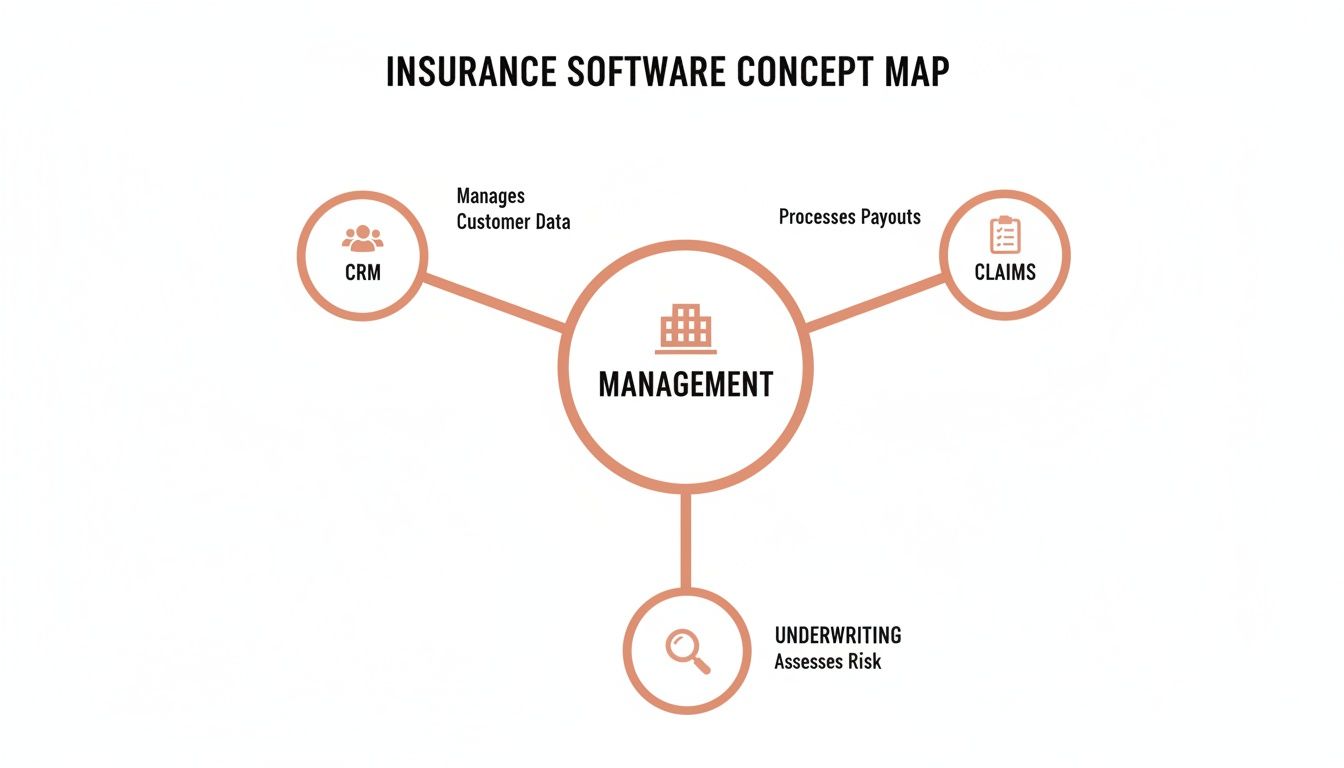
This map shows how a central management system acts as the hub, tying all the specialised functions together into one cohesive machine.
Workflow Automation and Task Management
If there’s one feature that delivers an immediate impact, it’s automation. Your team’s time is their most valuable asset, and it’s wasted on repetitive, manual tasks that a machine could handle without breaking a sweat.
Good workflow automation is like having a digital assistant who never sleeps and never makes a mistake. You can set it up to manage a ton of different tasks, which not only ensures consistency but also frees up your people to focus on what humans do best: building relationships and closing deals.
Here are a few key automation capabilities to look for:
- Automated Renewals: The system should automatically flag policies nearing renewal, ping both the agent and the client with reminders, and even generate the necessary paperwork.
- Client Follow-ups: It can schedule and assign follow-up tasks right after a client call or meeting, making sure no lead ever falls through the cracks.
- Data Entry: Look for tools that can pull information directly from forms and applications into the right fields. This slashes manual entry time and pretty much eliminates human error.
Analytics and Reporting Dashboards
Data is just a bunch of numbers until you can make sense of it. A top-tier insurance platform takes that raw data and turns it into clear, actionable insights through easy-to-read dashboards. It's like having a business analyst on your team, constantly keeping an eye on performance and pointing out where you can improve.
A well-designed analytics dashboard gives you a real-time pulse on your agency's health. It should clearly display key performance indicators (KPIs) like client retention rates, new policies written, sales pipeline velocity, and team productivity. This lets you make decisions based on facts, not guesswork.
This shift to data-driven operations is happening everywhere. In Singapore, for instance, the Insurtech market is expected to jump from $167.20 million in 2026 to $252.30 million by 2030. This growth is being driven by small and medium-sized businesses adopting these kinds of digital tools, with a reported 97% deployment rate in 2024—a massive leap from 85% in 2023.
Core Operational Must-Haves
Beyond the fancy stuff like automation and analytics, there are a few foundational features that are simply non-negotiable for any modern agency. These are the nuts and bolts that support everything you do day-to-day. It's worth digging into the Key Features That Elevate Insurance Agency Software to understand what separates the good from the great.
At a minimum, a strong platform must include:
- Integrated Communication Tools: The ability to send emails, log calls, and track every single piece of client correspondence directly within the platform is crucial. It creates a single, unified record of every interaction, so anyone on the team can get up to speed in seconds.
- Secure Document Management: Your software needs to be a fortress for all client documents, policies, and claim forms. A secure, centralised repository isn't just about convenience; it's about compliance and having critical information at your fingertips when you need it most.
- Mobile Accessibility: Your agents aren't chained to their desks, and your software shouldn't be either. A platform with a solid mobile app or a responsive web design means your team can access client info and manage tasks from anywhere.
How to Choose the Right Insurance Software Solution
Picking a new software solution is a massive commitment of both time and money. Nail this decision, and you can supercharge your agency’s growth. Get it wrong, and you’re looking at years of headaches and missed opportunities. The whole process needs to be about more than just comparing feature lists and pricing tables.
You’re not just buying a tool; you’re bringing on a long-term technology partner. That calls for a deliberate approach, one that carefully weighs how any solution fits with your agency’s distinct needs, workflows, and long-term goals.
Define Your Core Needs and Pain Points
Before you even glance at a single demo, you need to look inward. What specific problems are you actually trying to solve? A fuzzy goal like “improving efficiency” isn’t going to cut it. You need to get granular and pinpoint the exact bottlenecks holding your team back.
Start by mapping your current processes for critical tasks like quoting, issuing policies, client onboarding, and managing claims. Where do things grind to a halt? Where are mistakes most likely to creep in? This clarity is the single most important step in finding the right insurance software solutions.
From there, create a prioritised list of must-haves versus nice-to-haves. For instance, if your agents are burning hours manually punching in data from applications, then automated data capture is a non-negotiable.
Evaluate Scalability and Future-Proofing
One of the costliest mistakes an agency can make is picking a solution that only solves today's problems. Your business is going to grow. New agents will come on board, your client list will get longer, and your services might even expand. Your software has to be able to keep up.
Ask potential vendors direct questions about how their system scales. How does it handle a surge in users and data? What does it take to add new features or modules down the road? Choosing a platform that can’t grow with you just means you'll be stuck doing this all over again in a few years.
A scalable software solution is like a flexible architectural blueprint. It provides a solid foundation for your current operations but has the structural integrity to support future expansions without needing to be completely rebuilt. Avoid platforms that lock you into a rigid structure.
This forward-thinking approach is essential, especially as the market itself evolves. The Singapore Insurtech market, for example, hit $142.07 million in 2025 and is projected to swell to $252.30 million by 2030. That growth is being fuelled by AI and big data tools that are redefining risk and claims management, which makes it even more important to have software that can adapt. You can discover more insights about this rapidly growing market on datainsightsmarket.com.
Prioritise Integration and Security
Your new software won't be operating in a bubble. It needs to talk to the other tools your team uses every single day, from your email marketing platform to your accounting software. Lousy integration creates frustrating data silos and forces your team into clunky, manual workarounds.
Look for solutions with a solid API (Application Programming Interface) or, even better, pre-built connectors for the tools you already rely on. A tightly integrated system means data flows freely and accurately across your entire tech stack, giving you a single source of truth for your agency.
Just as critical is data security. You're responsible for highly sensitive client information, and a data breach could be devastating to your reputation and bottom line. Go through a vendor's security protocols with a fine-tooth comb.
- Data Encryption: Make sure data is encrypted both when it’s stored (at rest) and when it’s being sent (in transit).
- Compliance Certifications: Check that the vendor meets relevant data protection regulations, like GDPR.
- Access Controls: The software must let you set specific permissions so team members can only see the information they absolutely need to do their jobs.
Choosing the right partner means getting deep into these technical and strategic details. For a closer look at how different tools can work in harmony, you might find our guide on sales enablement software tools useful, as they often complement core agency systems.
Maximizing ROI with Smarter Sales Tools
Dropping a big investment on a new agency management system is a huge move, but let's be honest—it’s only half the battle. The best insurance software solutions are only as good as the sales they help you close. This brings up a tough question that most agencies skip: how do you make sure that software spend actually shows up as real, measurable growth?
The secret isn’t just in the core platform itself. It’s about pairing it with intelligent sales tools that act as a true growth engine for your business.

This approach turns your software from a simple filing cabinet into a strategic weapon that directly boosts conversions and gives you a much better return on your investment.
Moving Beyond Organisation to Persuasion
Your core software is fantastic at keeping data organised, tracking policies, and managing workflows. No argument there. But it does next to nothing to help your agents with the most human part of their job: building rapport, figuring out what truly motivates a client, and handling objections with genuine empathy.
This is exactly where smarter sales tools change the game. Picture an AI platform that can analyse a prospect’s communication style just from their LinkedIn profile or a few old emails. It could tip off your agent that this client prefers a straight-to-the-point, data-heavy chat versus a more personal, story-driven conversation.
That kind of insight makes every single conversation better. It gives your team the intel they need to connect with clients on their own terms, turning a routine call into a real chance to build trust.
How Intelligent Sales Tools Amplify Your Core Software
When you pair your main insurance platform with a specialised sales AI, they work together beautifully. Your core system holds the "what"—all the client data, policy history, and contact details. The sales tool provides the "how"—the specific tactics to communicate that information in a way that actually persuades someone.
This integration delivers concrete results where it matters most:
- Smarter Prospecting: When agents know a lead’s personality before the first call, they can craft an opening line that clicks instantly.
- Effective Objection Handling: AI insights can predict the kinds of objections a prospect might have based on their communication style, letting agents walk into the conversation prepared and confident.
- Increased Conversion Rates: It’s simple, really. When agents can adapt their communication to match a client’s preferences, the conversation just flows better, which naturally leads to more closed deals.
Equipping your team with tools that help them understand and connect with clients on a human level is the final, crucial step in maximising software ROI. It bridges the gap between efficient operations and effective sales, ensuring your technology investment directly fuels business growth.
The Financial Impact of Better Conversations
The link between better communication and your bottom line is direct and powerful. When agents build stronger rapport, they don’t just close more new business—they improve client retention, which is the bedrock of long-term profitability.
Better conversations smooth out the bumps in the sales cycle. For example, an agent who knows a client has an analytical mind can show up with a data-rich proposal that speaks their language, shortening the time it takes for them to make a decision.
Multiply that efficiency gain across your entire team, and the impact adds up fast. It means more policies written in less time and a sales team that feels empowered, not burnt out. For anyone wanting to dig deeper, getting familiar with the world of modern sales AI tools can give you a serious edge.
Ultimately, the smartest way to invest in insurance software is with a two-part strategy. First, get a rock-solid platform to organise your agency. Second, layer on intelligent sales tools that teach your team how to persuade, connect, and convert within that new system. This complete approach ensures your tech doesn't just make you more efficient; it makes you more profitable.
So, What’s Your Next Move?
You’ve made it this far, which means you now have a solid map for navigating the world of insurance software. We’ve broken down what these platforms are, explored the main types, flagged the must-have features, and laid out a clear process for picking the right one for your agency.
But a map is only useful if you start the journey. Now, it’s all about action.
Bringing new technology into your agency is so much more than a simple tech upgrade. Think of it as a strategic decision to build a business that can handle whatever the market throws at it. The key is to stop seeing this as an expense and start seeing it for what it is: a critical investment in your future.
An investment in the right software is really an investment in your agency’s biggest assets: how efficiently you run, how strong your client relationships are, and your ability to grow for the long haul. It gives your team the power to deliver amazing service while making the business more profitable.
Charting Your Course Forward
First things first, get a small, dedicated team together to spearhead this. Their first job? A brutally honest look at your current workflows. Where are the bottlenecks? What are the biggest time-sinks? This groundwork ensures that whatever software you choose is a direct solution to your real-world problems.
Next, use the criteria we’ve talked about—scalability, integration, security, and vendor support—to build a shortlist of potential partners. Don't just watch a generic demo. Arrange structured run-throughs where your team can see exactly how the software would handle your specific, day-to-day scenarios. Ask the tough questions. Don't settle for vague answers.
Your digital transformation isn't a final destination; it's a continuous process of improvement. By taking these deliberate next steps, you’re setting your agency up to not just keep up, but to lead. The tools are out there—your next move is to put them to work.
Got Questions? We've Got Answers
Stepping into the world of insurance software solutions always kicks up a few questions, especially around what happens after you buy. It’s one thing to see a great demo, but it’s another to picture how it will actually work day-to-day in your agency. Getting these things straight is key to making a decision you feel good about.
Let's tackle some of the most common queries we hear.
How Long Does It Take to Get New Insurance Software Up and Running?
This really depends on what you’re installing. A simple, standalone CRM might only take a few weeks to get humming. But if you're looking at a full-blown Agency Management System (AMS) that touches every part of your business, you're more likely looking at a two to four-month journey for a complete rollout.
The process isn't just a flick of a switch. It involves moving all your data from the old system, tweaking the new software to fit your specific workflows, and—most importantly—getting your team comfortable using it. A good vendor won’t just sell you the software and disappear; they’ll give you a realistic timeline and be there to walk you through every stage.
Will This New Software Play Nicely with My Existing Tools?
It absolutely has to. In today's world, no software can afford to be an island. Most modern insurance platforms are built with integration as a top priority. You'll want to look for solutions with a solid API (Application Programming Interface) or, even better, ready-made connections to the tools your team already relies on every day.
Think about your email marketing platform, your accounting software, or where you get your leads from. Before signing anything, get a clear confirmation from the vendor about what integrates and how. Making sure the new platform slots right into your existing tech stack is the only way to avoid creating messy data silos and frustrating manual work.
The ability to integrate new software isn't just a nice-to-have feature—it's essential. It stops the soul-crushing task of manual data entry, cuts down on errors, and creates a single source of truth. When information flows freely, your team gets a complete picture of every client interaction and how the agency is truly performing.
How Do You Make Sure My Agency and Client Data Is Safe?
In the insurance game, data security isn’t just important; it's everything. Any software provider worth their salt will have multiple layers of defence to protect your agency’s and your clients' highly sensitive information. It all starts with the basics done right.
Here's what that protection should look like:
- Data Encryption: Your data needs to be locked down, both when it's sitting on a server (at rest) and when it's moving across networks (in transit).
- Secure Cloud Hosting: They should be using well-known, trusted cloud providers who have a reputation for iron-clad security.
- Strict Access Controls: You need the power to decide who sees what. This means setting permissions so team members can only access the information they absolutely need to do their jobs.
Always ask if a vendor complies with key regulations like GDPR and make them show you the documentation on their security protocols. When it comes to your data, you can't afford to take any chances.
Ready to transform your sales conversations and get the most out of your new software? Mindreader gives your team the communication insights to connect with every client on their level.
Prepare for your next meeting and close more deals with Mindreader