Top 10 Closing Methods in Sales to Master in 2026

Closing a sale isn't a single, dramatic moment; it's the natural conclusion to a conversation where value has been clearly established and understood. Yet, many sales professionals falter at this final step, either by being too passive or too aggressive. The difference between a stalled pipeline and a signed contract often comes down to choosing the right tool for the job. This is where mastering a diverse toolkit of closing methods in sales becomes a superpower, transforming ambiguity into commitment.
In this comprehensive guide, we move beyond generic advice to give you actionable scripts, real-world examples, and a strategic framework for 10 proven closing techniques. You'll learn not just what to say, but precisely when and why to say it. We'll explore how to tailor your approach to different buyer archetypes: the decisive Knight, the analytical Explorer, the relationship-focused Healer, and the strategic Wizard.
To truly master this, modern sales professionals can leverage advanced analytics tools. For instance, platforms providing Conversation Intelligence offer deeper insights into interactions, helping you refine your technique with data-backed feedback. By the end of this article, you'll be equipped not just with tactics, but with the situational awareness to close deals with greater confidence and authenticity, ensuring you always make the right move at the right time.
1. The Assumptive Close
The Assumptive Close is one of the most powerful closing methods in sales, built on a foundation of confidence. It operates on the principle that the sale is already a done deal. Instead of asking if the prospect wants to buy, you proceed with language that assumes they have already decided to move forward, shifting the conversation to implementation details.
This technique subtly reframes the decision-making process from a 'yes/no' question to a 'how/when' discussion. It works best when you have built strong rapport, thoroughly addressed all objections, and received clear buying signals. By acting as if the decision is made, you create psychological momentum that guides the prospect across the finish line.
How It Works: Micro-Script Examples
- Software Sales: "To get started, I just need to know which of your departments we should prioritise for the initial rollout. Will it be Marketing or Operations?"
- Real Estate: "So, we'll schedule the property inspection for next week to keep things moving. Does Tuesday afternoon or Wednesday morning work better for your schedule?"
- Financial Advisory: "Based on our discussion, let's start structuring your portfolio. Do you prefer we set up your review meetings on a monthly or quarterly basis?"
When to Use This Close
The Assumptive Close is most effective after a comprehensive discovery and solution presentation. You should have a clear understanding of the prospect's needs and be confident your solution is the right fit. It's particularly potent in high-ticket closing scenarios where the relationship is strong and the value proposition is undeniable. For a deeper dive into this area, you can learn more about high-ticket closing strategies and how to build the necessary confidence.
Key Insight: The power of the Assumptive Close lies in its ability to transfer your confidence to the prospect, making the final decision feel like a natural, logical next step rather than a high-pressure commitment.
Prospect Archetype Suitability
- Knight: Highly effective. Knights appreciate directness and a clear path forward.
- Explorer: Effective. Explorers value a partner who can confidently lead them to the next step once they've gathered enough information.
- Healer: Use with caution. Healers may find it too forward; soften the language to be more collaborative, e.g., "When we get this set up for your team..."
- Wizard: Requires finesse. Wizards need to feel they made the decision independently. Frame it around data-driven next steps they've already validated.
2. The Alternative Close (Either/Or Close)
The Alternative Close, also known as the Either/Or Close, is a classic and effective sales technique that guides the prospect toward a decision by presenting them with two favourable choices. Instead of asking a 'yes' or 'no' question like "Do you want to proceed?", you frame the question around a choice between two positive outcomes, both of which result in a sale.
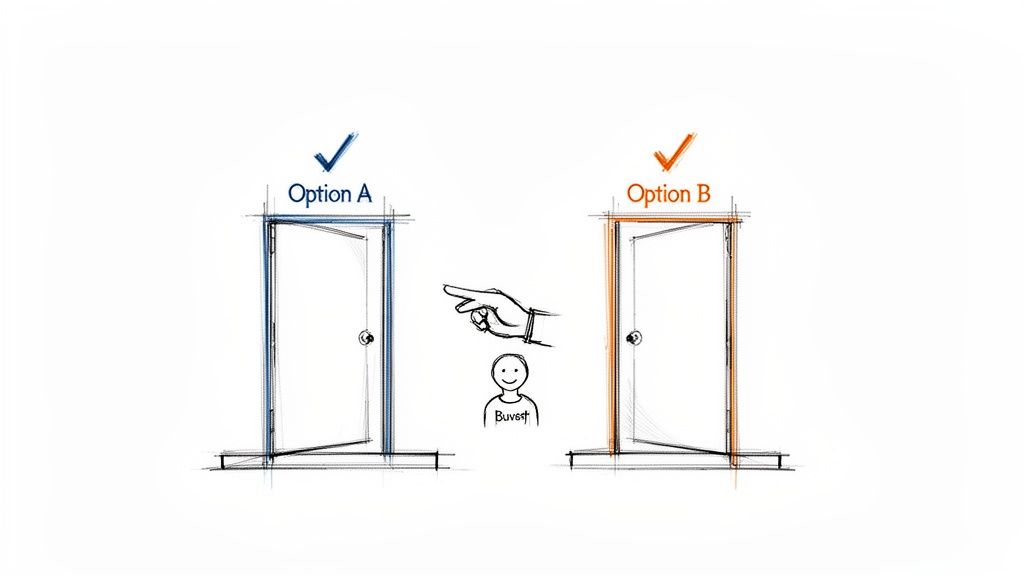
This method simplifies the final decision and shifts the focus from if they will buy to how they will buy. By providing a limited set of options, you reduce decision fatigue and empower the prospect, making them feel in control of the final choice. It’s a subtle yet powerful way to steer the conversation toward a commitment.
How It Works: Micro-Script Examples
- SaaS Sales: "To ensure your team is set up for success, would you prefer to start with our Core plan or go directly to the Pro plan with full onboarding support?"
- Consulting: "We can structure this engagement as a three-month intensive or a six-month strategic programme. Which timeline aligns better with your immediate goals?"
- Luxury Goods: "The timepiece is stunning. Would you like the classic white gold or the modern rose gold finish? Both are available for immediate delivery."
When to Use This Close
This is one of the most versatile closing methods in sales, ideal for situations where the prospect shows clear interest but may be hesitant to make the final leap. It works best after you've established value and are moving into the final stages of the discussion. Ensure both options presented are genuinely appealing and lead to a clear next step. Avoid presenting one strong option and one weak one, as this can feel manipulative.
Key Insight: The Alternative Close works by giving the prospect a sense of autonomy. By framing the decision as a choice between two good options, you transform the close from a moment of pressure into an act of empowerment.
Prospect Archetype Suitability
- Knight: Highly effective. Knights appreciate clear choices that lead to decisive action.
- Explorer: Effective. Offering choices appeals to their desire to consider different paths, but limit them to two to avoid analysis paralysis.
- Healer: Very effective. It feels collaborative and less confrontational, allowing them to choose a path that feels best for their team.
- Wizard: Highly effective. Wizards value control and making their own data-driven decisions. Presenting two well-reasoned options respects their analytical nature.
3. The Urgency/Scarcity Close
The Urgency/Scarcity Close is one of the most effective closing methods in sales when used ethically. It leverages time constraints or limited availability to motivate immediate action. This technique creates a perception that the opportunity is fleeting, catalysing a decision by tapping into powerful psychological principles like loss aversion and FOMO (fear of missing out).
This close works by highlighting what the prospect stands to lose if they delay their decision, whether it's special pricing, a unique product edition, or a time-sensitive opportunity. It is crucial that the scarcity or urgency is genuine; fabricating constraints can severely damage trust and your professional reputation. When applied correctly, it frames the decision not as a high-pressure tactic but as a helpful advisory to prevent a negative outcome.

How It Works: Micro-Script Examples
- SaaS Sales: "I want to be transparent about the timeline. This discounted annual pricing is part of our Q4 promotion and is only valid until 31st December. After that, we transition to the new pricing structure."
- Luxury Goods: "This particular model is a limited edition of only 50 units worldwide. With 37 already allocated, we are genuinely down to the last few available."
- Real Estate: "The seller has received two other offers this afternoon. To ensure your offer is considered, we should aim to submit it before the end of the business day."
When to Use This Close
This technique is most potent when the prospect is showing strong buying signals but is hesitating to commit. It is critical that the source of urgency or scarcity is real and clearly communicated. Explain why the offer is limited (e.g., end-of-quarter promotion, limited production run, upcoming policy change) to maintain transparency and build trust. Combining this close with social proof, such as mentioning other interested parties, can amplify its effect.
Key Insight: True scarcity isn't a sales tactic; it's a market reality. Presenting it as such transforms the conversation from a pressure-filled close into a strategic consultation, helping the prospect secure a valuable but fleeting opportunity.
Prospect Archetype Suitability
- Knight: Highly effective. Knights are competitive and respond well to the challenge of securing a limited opportunity before others do.
- Explorer: Effective. Explorers need a logical reason for the deadline. Frame it around data-driven scarcity, like an expiring beta programme.
- Healer: Use with caution. Healers dislike pressure. Focus on the benefit they might lose, such as a special guarantee or bonus feature for early adopters.
- Wizard: Requires finesse. Wizards need to see the logic. Present the scarcity with clear, verifiable data and transparent reasoning.
4. The Summary Close (Recap Close)
The Summary Close, also known as the Recap Close, is one of the most effective and ethical closing methods in sales. It involves systematically recapping the key points, benefits, and agreements established throughout the sales conversation before asking for the final commitment. This technique reinforces the value proposition and ensures complete alignment between you and the prospect.
By summarising what has been mutually agreed upon, you reduce buyer anxiety and demonstrate that you have been actively listening. This method transforms the final ask from a high-pressure moment into a logical confirmation of a shared understanding, making it a powerful tool for building trust and closing complex deals with clarity and confidence.
How It Works: Micro-Script Examples
- SaaS Implementation: "So to confirm, you're investing in the Pro plan with a 12-month commitment. We'll organise a two-week onboarding for your team, and the go-live is targeted for March 15th. Does that align with what we discussed?"
- Financial Advisory: "Based on our conversation, we're creating a diversified portfolio with 60% equities and 40% fixed income, rebalancing quarterly. You're comfortable with that approach, correct?"
- Consulting Engagement: "We've outlined a four-month engagement focusing on process optimisation and team training. Your CFO will be the primary stakeholder, and we'll deliver a final report and recommendations. Have I captured that correctly?"
When to Use This Close
The Summary Close is exceptionally versatile but is most potent in complex B2B sales cycles, consulting engagements, or any sale with multiple components, terms, or stakeholders. It is the ideal technique to use when you need to ensure every detail has been understood and agreed upon before signing. Use it to solidify the value proposition in the prospect's mind one last time, making the path to 'yes' clear and logical.
Key Insight: The Summary Close builds a final bridge of logic and trust. By restating agreed-upon points in the prospect's own language, you are not just selling a solution; you are co-creating and confirming a partnership.
Prospect Archetype Suitability
- Knight: Highly effective. Knights value clarity, efficiency, and a summary of the bottom-line results and terms.
- Explorer: Highly effective. A logical recap provides the structure and confirmation an Explorer needs to feel secure in their decision.
- Healer: Very effective. The collaborative nature of a recap reassures Healers that their needs have been heard and are being met.
- Wizard: Crucial. Wizards demand precision and detail. A thorough summary validates their data-driven decision-making process and confirms you've understood their complex requirements.
5. The Takeaway Close (Puppy Dog Close Variant)
The Takeaway Close is a counterintuitive yet powerful technique that leverages the psychological principle of reactance. Instead of pushing for the sale, you subtly pull back, suggesting that maybe it isn't the right time or fit. This action introduces genuine uncertainty and scarcity, often motivating the prospect to argue for the sale and commit to avoid losing the opportunity.
This method reframes the dynamic, positioning you as a trusted advisor focused on the prospect's best interests rather than a salesperson chasing a commission. It works by making the prospect fear losing out on the value you've demonstrated. By suggesting they wait or reconsider, you prompt them to vocalise their own reasons for moving forward, effectively closing themselves.
How It Works: Micro-Script Examples
- SaaS Sales: "You know, after listening to your team's resource constraints, I'm not entirely sure this is the right time for you. Perhaps we should revisit this next quarter when you have more capacity to implement it properly."
- Real Estate: "Honestly, there will be other properties on the market. If you're not 100% certain this is your forever home, it's better to wait. What's the main thing causing you to hesitate?"
- Consulting: "The engagement will only succeed if you're fully ready to execute on our recommendations. Given your current strategic review, maybe it's wiser to pause until that's complete. Does that sound reasonable?"
When to Use This Close
The Takeaway Close is most effective late in the sales process when you have built significant value and rapport, but the prospect is showing signs of hesitation or "cold feet". It is an excellent strategy for demonstrating confidence and integrity. You must be genuinely willing to walk away from the deal for it to be authentic, as this sincerity is what makes the technique work.
Key Insight: The Takeaway Close succeeds by shifting the sales pressure from you to the prospect. By making the solution seem less attainable, you increase its perceived value and trigger their desire to secure it.
Prospect Archetype Suitability
- Knight: Highly effective. Knights respect a confident peer who isn't desperate and will be prompted to prove they are ready to act.
- Explorer: Effective. This approach gives them the space and control they value, often leading them to reaffirm their own conclusions.
- Healer: Very effective. They appreciate the low-pressure, consultative approach that prioritises their organisation's well-being over a quick sale.
- Wizard: Highly effective. Wizards respect the logic of your concern and will feel compelled to correct your "misunderstanding" with data-backed reasons why now is the perfect time.
6. The Question Close (Ben Franklin Close)
The Question Close is a highly consultative technique that guides the prospect to their own conclusion to buy. Instead of telling them why they should purchase, you ask a series of strategic questions that lead them to realise the value for themselves. This Socratic approach is powerful because people are far more committed to ideas they believe they originated.
This method transforms the sales conversation into a collaborative problem-solving session. By asking insightful, open-ended questions about their challenges, goals, and the implications of inaction, you help the prospect build their own business case for your solution. The focus shifts from you selling to them discovering the right path forward, making the final decision feel natural and self-directed.
How It Works: Micro-Script Examples
- SaaS Sales: "If we could cut your manual reporting time by 5 hours per week, what would your team prioritise instead? How much is that worth annually to the business?"
- Real Estate: "When you picture your family in this home five years from now, what does that life look like? How well does this property support that vision for you?"
- Financial Advisory: "What happens to your family's financial security if the market fluctuates significantly without a plan? How would a diversified strategy address that specific concern?"
When to Use This Close
This close is exceptionally effective in complex B2B sales cycles or any consultative selling environment where understanding deep-seated needs is critical. It works best when you need the prospect to articulate the value proposition in their own words, creating strong buy-in. To master this, it's essential to understand the art of asking powerful questions. You can discover advanced discovery questioning techniques to build a solid foundation for this closing method.
Key Insight: The Question Close empowers the prospect. When they answer questions that highlight the cost of their problem and the benefits of your solution, they are essentially selling to themselves.
Prospect Archetype Suitability
- Knight: Effective. Use questions focused on ROI and strategic advantage, e.g., "How will this solution give you a competitive edge over the next 12 months?"
- Explorer: Highly effective. Explorers love to analyse and reach their own conclusions. Data-driven questions work best.
- Healer: Highly effective. Healers respond well to questions about team impact, morale, and well-being.
- Wizard: The ideal close. Wizards need to feel they are in control and are the ones making the brilliant strategic decision. This method facilitates that perfectly.
7. The Now or Never Close (Last Chance Close)
The Now or Never Close, also known as the Last Chance Close, is a powerful technique that leverages genuine scarcity to prompt a decision. It explicitly states that a specific offer, price, or opportunity will expire at a defined moment, creating immediate and compelling reasons for the prospect to act. The choice becomes binary: decide now or lose the opportunity forever.
This method taps directly into the psychological principle of loss aversion, where the fear of missing out on a benefit is often a stronger motivator than the desire to gain it. Unlike creating false urgency, this close is grounded in real business constraints. Its power lies in its transparency and finality, but it must be used with integrity, as failure to honour the deadline will permanently damage your credibility.
How It Works: Micro-Script Examples
- SaaS Sales: "Our current annual pricing is locked until 31 December. After that, we are implementing our new tiered pricing structure. To lock in the current rates for the next year, we would need your signature by the end of this week."
- Consulting: "Our Q4 project slots are nearly full. If you want to kick off the implementation before year-end to align with your tax objectives, we need to finalise our engagement agreement by Friday."
- Real Estate: "The sellers have informed us they will be reviewing all submissions and making a decision by 5 PM tomorrow. If we want to be in consideration, our offer needs to be submitted before that deadline."
When to Use This Close
This is one of the more high-stakes closing methods in sales and should be reserved for situations with genuine, verifiable deadlines. It is most effective when a prospect is highly interested but hesitant or procrastinating. You must be prepared to walk away if the deadline passes, as its entire power rests on the authenticity of the constraint. Use it when you can clearly explain why the deadline exists, such as a price increase, a limited-time promotion, or resource availability.
Key Insight: The Now or Never Close transforms hesitation into decision by shifting the focus from 'if' to 'now'. Its effectiveness is directly tied to your willingness to honour the stated deadline, making it a powerful tool of integrity.
Prospect Archetype Suitability
- Knight: Highly effective. Knights are decisive and respond well to clear, logical deadlines that require action.
- Explorer: Effective. Once they have sufficient data, a firm deadline can provide the final push an Explorer needs to commit.
- Healer: Use with caution. The direct pressure can feel confrontational. Frame it as a helpful "heads-up" so they don't miss out on an opportunity for their team.
- Wizard: Effective, if justified. Wizards respect data and logic. Clearly explain the business reason for the deadline, and they will see it as a logical parameter for their decision.
8. The Value Justification Close
The Value Justification Close is a powerful technique grounded in logic and financial reasoning. It moves beyond features and benefits to explicitly articulate the return on investment (ROI) for the prospect. Instead of leaving the value proposition implied, this method connects your solution directly to the prospect's key business metrics, making the financial case for the purchase impossible to ignore.
This closing method is about transforming your proposal from an expense into a strategic investment. By quantifying the impact on problems like lost productivity, high costs, or missed revenue, you frame the decision in the language of business outcomes. It’s one of the most effective closing methods in sales for B2B environments where decisions must be defended with hard numbers and clear financial justification.

How It Works: Micro-Script Examples
- SaaS Sales: "You mentioned manual data entry is costing your team about $180,000 annually. Our solution automates 80% of that, which means your payback period is under four months. After that, you are adding $144,000 in savings directly to your bottom line each year."
- Consulting Engagement: "We've identified process inefficiencies costing you $500,000 a year. Our $75,000 engagement is designed to recover 70% of that, delivering a net gain of $275,000 in the first year alone. That's a 4.7x return on your investment with us."
- Financial Advisory: "Your current tax strategy is resulting in an estimated $80,000 in unnecessary liability. Our proposed plan will save you $60,000 in the first year. The $15,000 advisory fee essentially pays for itself four times over."
When to Use This Close
This close is tailor-made for B2B sales cycles, particularly when selling to CFOs, operations leaders, or any stakeholder scrutinising the budget. It is essential when the purchase price is significant and requires justification to a committee or executive board. You must use it after a thorough discovery phase where you have gathered the specific metrics needed to build a credible ROI case.
Key Insight: The Value Justification Close shifts the conversation from "Can we afford this?" to "Can we afford not to do this?" by clearly demonstrating that the cost of inaction is greater than the cost of your solution.
Prospect Archetype Suitability
- Knight: Highly effective. Knights are results-driven and respond strongly to clear, bottom-line financial impact.
- Explorer: Effective. Explorers appreciate the transparent methodology and how the value calculation was derived.
- Healer: Use with caution. Frame the value in terms of team benefits and reduced stress, e.g., "This frees up your team's time from tedious work, which our numbers show is worth $X."
- Wizard: Highly effective. Wizards demand data-driven proof. A detailed, transparent financial model is precisely what they need to validate their decision.
9. The Objection Conversion Close
The Objection Conversion Close is an advanced technique that transforms a prospect's final point of resistance into the very reason they should buy. Instead of sidestepping or simply countering an objection, this method directly acknowledges the concern and reframes it as a compelling justification for moving forward. It’s a powerful, consultative approach that demonstrates deep listening and understanding.
This close works by pivoting the conversation from a point of friction to a point of value. When a prospect says, "It's too expensive," you don't argue on price; you reframe the discussion around the cost of inaction. This technique builds trust by validating their concern while simultaneously showing how your solution is the answer to the underlying problem that caused the objection in the first place.
How It Works: Micro-Script Examples
- Objection - Cost: "Your solution is too expensive." Close: "I understand the investment is significant, and that's precisely why it's so critical. Your current system's inefficiency is costing you $200K annually in lost time. You can't afford not to make this investment."
- Objection - Timing: "We're not ready to implement yet." Close: "That's the exact problem we need to solve. Every month you delay implementation, you're leaving $15K in productivity gains on the table. Let's start now so you can benefit immediately."
- Objection - Team Approval: "I need to talk to my team first." Close: "Absolutely, and that's a smart step. To help you build the business case, we've identified that your team will save 8 hours per week each, translating to $60K in recovered capacity. Let's get that in front of them."
When to Use This Close
This is one of the most effective closing methods in sales for late-stage conversations when a final, specific objection is presented. It is ideal when you have quantifiable data to support your reframe, such as ROI calculations, efficiency metrics, or opportunity cost figures. This technique requires confidence and a deep understanding of the prospect's business pains. To sharpen these skills, you can explore more strategies for mastering objection handling and turn any concern into a closing opportunity.
Key Insight: This close isn't about arguing; it's about agreeing with the concern's importance and then connecting your solution's value directly to it, making the purchase a logical resolution to their stated problem.
Prospect Archetype Suitability
- Knight: Highly effective. Knights respect data-driven rebuttals that reframe objections around ROI and strategic advantage.
- Explorer: Highly effective. Explorers appreciate a logical reframe that connects their process-oriented concerns to a clear, beneficial outcome.
- Healer: Use with caution. The directness can feel confrontational. Soften it by focusing on how the reframe supports their team's well-being and reduces their stress.
- Wizard: Highly effective. Wizards value a strategic perspective. Reframing their objection to align with the bigger picture or a key metric they value will resonate strongly.
10. The Soft Close (Trial Close)
The Soft Close, often called a Trial Close, is a low-pressure technique designed to gauge a prospect's buying temperature without directly asking for the sale. It uses subtle, exploratory questions to test the waters, uncover hidden objections, and assess readiness. Instead of forcing a "yes or no" decision, it invites a conversation about the prospect's feelings and confidence level regarding the solution.
This method is one of the most relationship-centric closing methods in sales. It allows you to check the prospect's position and, if you encounter resistance, gracefully pivot back to addressing their concerns without derailing the sale. By asking "how" and "what if" questions, you transform the close into a collaborative step, ensuring the prospect feels understood and in control, which is crucial for building long-term trust.
How It Works: Micro-Script Examples
- SaaS Sales: "Based on the demo, how do you feel about this solution addressing your team's workflow challenges? Does this direction feel right for you?"
- Consulting Services: "Does the strategic framework we've outlined here seem like the right approach to achieve your growth targets? Are there any parts that don't quite align with your vision?"
- Real Estate: "Can you envision your family living in this home? Is there anything about the property that gives you pause or that we haven't discussed?"
- B2B Services: "From what we've covered, does this feel like a strong partnership fit? What would need to happen for you to be fully confident in moving forward together?"
When to Use This Close
The Soft Close is exceptionally versatile and can be used multiple times throughout the sales process, not just at the end. It is ideal for complex, high-touch sales cycles where building rapport is paramount. Use it when you sense hesitation or want to confirm you're on the right track before moving to a final, more direct close. It is particularly effective in consultative selling environments where a hard sell would damage the relationship.
Key Insight: The Soft Close isn't about securing the final signature; it's about securing small agreements and confirmations along the way. It builds momentum by making the final decision feel like a small, logical conclusion rather than a giant leap.
Prospect Archetype Suitability
- Knight: Use as a checkpoint. Knights like clarity, so frame it as a final confirmation: "Does this solution tick all the boxes we agreed were critical?"
- Explorer: Highly effective. Explorers appreciate the chance to process and articulate their thoughts. This gives them space to validate their own logic.
- Healer: The perfect close. Healers respond positively to its collaborative, non-threatening nature. It reassures them that their feelings and concerns are a priority.
- Wizard: Very effective. Wizards want to ensure all data points align. Frame it as a final logic check: "Does this data support the conclusion we've reached?"
10 Sales Closing Methods Comparison
| Technique | Implementation complexity | Resource requirements | Expected outcomes | Ideal use cases | Key advantages | Main risks |
|---|---|---|---|---|---|---|
| The Assumptive Close | Low–Medium — needs correct timing and rapport reading | Low — salesperson skill and situational awareness | Accelerated close; momentum toward commitment | Later-stage conversations with strong rapport; time-sensitive deals | Moves conversation forward confidently; reduces hesitation | Can appear pushy or alienate unready prospects; misreads harm credibility |
| The Alternative Close (Either/Or) | Low — present two clear options | Low — preparation of two meaningful choices | Faster decision by shifting to preference | Tiered pricing, product variants, mid–high value deals | Reduces anxiety; gives buyer perceived control | May be rejected if options unclear or feel manipulative; less for analytical buyers |
| The Urgency/Scarcity Close | Medium — must align with genuine constraints | Medium — coordination with inventory/pricing/marketing | Rapid decisions; converts fence‑sitters | Limited inventory, promotions, competitive markets | Strong conversion engine when truthful; shortens sales cycle | Destroys trust if scarcity is false; overuse creates cynicism |
| The Summary Close (Recap Close) | Medium — requires detailed note‑taking and structure | Medium — preparation and clear documentation | Clear alignment; reduced buyer's remorse; smoother handoff | Complex B2B deals, high‑value or multi‑stakeholder sales | Ethical, consultative; confirms mutual understanding | Time-consuming; may surface last-minute objections; can sound robotic |
| The Takeaway Close (Puppy Dog Variant) | Medium — needs authentic, confident delivery | Low–Medium — situational judgment and timing | Re‑engages stalled prospects; increases desire via reactance | Independent or contrarian buyers; stalled high‑commitment deals | Reverses pressure dynamics; feels consultative if genuine | Can lead prospect to actually step back; must not seem manipulative |
| The Question Close (Ben Franklin) | High — strong questioning skills and sequencing | Medium — prep of discovery questions and listening | Prospect-driven internal commitment; clearer business case | Complex consultative B2B, multi‑stakeholder decisions | Builds ownership of decision; reduces resistance | Time‑intensive; can reveal new objections; requires improvisation |
| The Now or Never Close (Last Chance) | Medium–High — must verify genuine deadlines and legal compliance | Medium — coordination with pricing, approvals, legal | Immediate decisions; significant deal velocity | Quarter/year‑end, promotional windows, limited slots | Forces decisive action; effective with procrastinators | Severe credibility risk if deadline is artificial; may damage relationships |
| The Value Justification Close | High — requires financial modeling and customization | High — data gathering, ROI calculations, one‑pagers | Strong stakeholder buy‑in; easier internal approval | B2B deals requiring CFO/finance approval; high‑value purchases | Provides defensible ROI and decision language for buyers | Relies on accurate data; assumptions can be challenged; requires financial skill |
| The Objection Conversion Close | Medium–High — diagnostic listening and reframing skill | Medium — evidence, case studies, tailored rebuttals | Converts stated objections into reasons to buy | Later stages when specific objections exist; consultative sales | Validates concern while closing it; builds trust | Risks sounding dismissive; may surface additional objections |
| The Soft Close (Trial Close) | Low–Medium — subtle, exploratory approach | Low — strong listening and follow‑up planning | Surfaces hidden objections; gradual momentum | High‑touch, relationship‑driven sales; early‑to‑mid stages | Low‑pressure; maintains rapport; reveals readiness | Can prolong cycles; may seem indecisive to direct buyers |
From Technique to Instinct: Choosing Your Next Move
We have journeyed through a comprehensive arsenal of ten powerful closing methods in sales, from the directness of the Assumptive Close to the subtle guidance of the Soft Close. Each technique, whether it's the logical Summary Close or the emotionally resonant Takeaway Close, offers a unique pathway to securing commitment. However, the true mastery of closing is not found in memorising scripts, but in developing profound situational awareness.
The most successful sales professionals operate like conversational grandmasters. They don't just see the current move; they anticipate the next several. They listen not just to what is said, but to what is left unsaid, diagnosing the prospect's underlying needs, fears, and motivations. This article was designed to be your playbook, a guide to help you recognise the specific scenarios and buyer archetypes that call for a particular strategy. A Knight, for instance, may respond well to a direct Value Justification Close, while a curious Explorer might be more engaged by a Question Close that allows them to co-create the solution.
The Art of Diagnosis Before Prescription
The critical takeaway is this: your closing technique is a prescription, and you cannot prescribe effectively without a proper diagnosis. Relying on a single, one-size-fits-all closing method is like a doctor prescribing the same medicine for every ailment. It may work occasionally, but it’s an inefficient and often ineffective approach.
Instead, the goal is to internalise these frameworks so they become part of your instinct. You’ll begin to notice the subtle cues:
- A prospect repeatedly mentioning a specific benefit is a signal for the Summary Close.
- Hesitation around price despite agreeing on value is a prime opportunity for the Value Justification Close.
- A buyer who seems intrigued but non-committal is the perfect candidate for a Soft Close to gauge their temperature.
The real power isn't in having ten different ways to ask for the sale; it's in knowing precisely why you are choosing a specific method for a specific person at a specific moment. This transforms the close from a moment of high pressure into a natural, logical, and helpful next step for your client. It’s the final, reassuring piece of the puzzle you’ve been building together throughout the sales process.
Your Action Plan for Closing Mastery
Knowledge without action is merely potential. To turn the insights from this guide into tangible results and truly elevate your command of closing methods in sales, you need a deliberate plan. Don't try to master all ten techniques at once. Instead, focus on incremental improvement.
- Select Your Starting Pair: Review the ten methods and choose two that align most closely with your natural communication style and the typical sales scenarios you face. Perhaps it’s the Alternative Close for its simplicity and the Question Close for its collaborative feel.
- Practise Deliberately: Before your next call, consciously decide which of your chosen techniques you will attempt to use. Role-play the setup and delivery. Anticipate potential objections and prepare your responses based on the frameworks we discussed.
- Review and Refine: After each sales interaction, dedicate five minutes to reflection. Did you use the closing technique? How did the prospect react? What worked well? What would you do differently next time? This feedback loop is where real growth happens.
- Expand Your Toolkit: Once you feel confident and are seeing success with your initial pair, add a third technique to your repertoire. Gradually build up your toolkit, ensuring each method is a well-honed instrument, not just a memorised line.
By transforming these techniques from abstract concepts into ingrained skills, you build more than just a higher closing rate. You build trust, confidence, and stronger client relationships, paving the way for long-term success and repeat business. The close becomes less of an event and more of a seamless, professional conclusion to a value-driven conversation.
Ready to move from instinct to intelligence? Mindreader analyses your sales calls to identify your prospect's buyer archetype, giving you the data-driven insight to select the perfect closing methods in sales every single time. Stop guessing and start closing with confidence by visiting Mindreader to see how it works.