Assertive vs Turbulent Selling How to Adapt Your Pitch
At the heart of it, the main difference between an assertive and a turbulent prospect boils down to how they handle pressure. Assertive individuals are self-assured and unflappable, making decisions with confidence while keeping their eyes on the prize. On the other hand, turbulent prospects are more cautious and detail-driven, needing reassurance and time to weigh every possible risk before they'll even think about signing on the dotted line.
Understanding the Assertive vs Turbulent Spectrum in Sales
In sales, figuring out where a prospect lands on the assertive-turbulent spectrum is a massive advantage. These aren't rigid personality boxes; think of them as two ends of a scale that dictates how someone manages stress, makes choices, and voices their needs. Getting a feel for this moves you from reciting generic scripts to having adaptive, meaningful conversations that actually close deals.
The assertive and turbulent traits come from personality models that look at how we react to the world around us. It's not about one being "good" and the other "bad"—it’s all about what drives them internally.
Assertive (-A) Prospects: These are your typically self-assured, emotionally steady people. They trust their gut, don't sweat criticism, and stay cool under pressure. In a sales meeting, they just want you to get to the point and show them the bottom-line results.
Turbulent (-T) Prospects: Often perfectionists, these individuals are highly driven but also much more sensitive to stress. They're prone to second-guessing themselves and can get hung up on the fear of making a mistake, which pushes them to dig for more data and validation from others.
Core Differences at a Glance
Spotting these fundamental differences is your first step to customising your pitch. An assertive buyer will appreciate a quick, confident proposal, but a turbulent one will respond far better to a detailed, reassuring presentation that methodically addresses every single one of their "what if" questions.
The key is to realise an assertive prospect is driven by confidence in a great outcome, while a turbulent prospect is motivated by the desire to avoid a bad one. Your entire message needs to align with that core driver.
This guide will walk you through how to identify these traits and tweak your strategy accordingly. The table below gives you a quick reference for the main distinctions between these two personality styles.
| Trait | Assertive Prospect (-A) | Turbulent Prospect (-T) |
|---|---|---|
| Primary Driver | Achieving goals and success | Avoiding risk and ensuring security |
| Decision-Making | Quick, confident, and decisive | Cautious, analytical, needs validation |
| Stress Response | Stays calm and resilient | Can become worried or stressed out |
| Communication Focus | Big-picture outcomes and benefits | Details, potential problems, and proof |
Identifying Key Behavioural Differences in Prospects
Knowing whether you’re talking to an Assertive or Turbulent prospect is a game-changer. You have to be able to spot the difference in real-time to adapt your sales approach on the fly. Their cues, from the words they choose to their body language, open a window straight into their decision-making mindset. If you pay close attention from the very first "hello," you can shape your strategy immediately.
Assertive types just carry themselves with a calm confidence. They speak in direct, declarative statements like, "Show me the ROI," or "We need this implemented by Q3." Their questions are sharp, focused on outcomes, and designed to cut through the fluff. They don't have time to waste.
Turbulent prospects, on the other hand, are much more cautious. They’ll use conditional language, asking things like, "What would happen if we needed to scale back?" or "Could you walk me through that integration one more time?" Their main goal is to eliminate risk, so they need to explore every possible pitfall before they’ll even think about committing.
This infographic breaks down key differences between assertive and turbulent sales prospects.
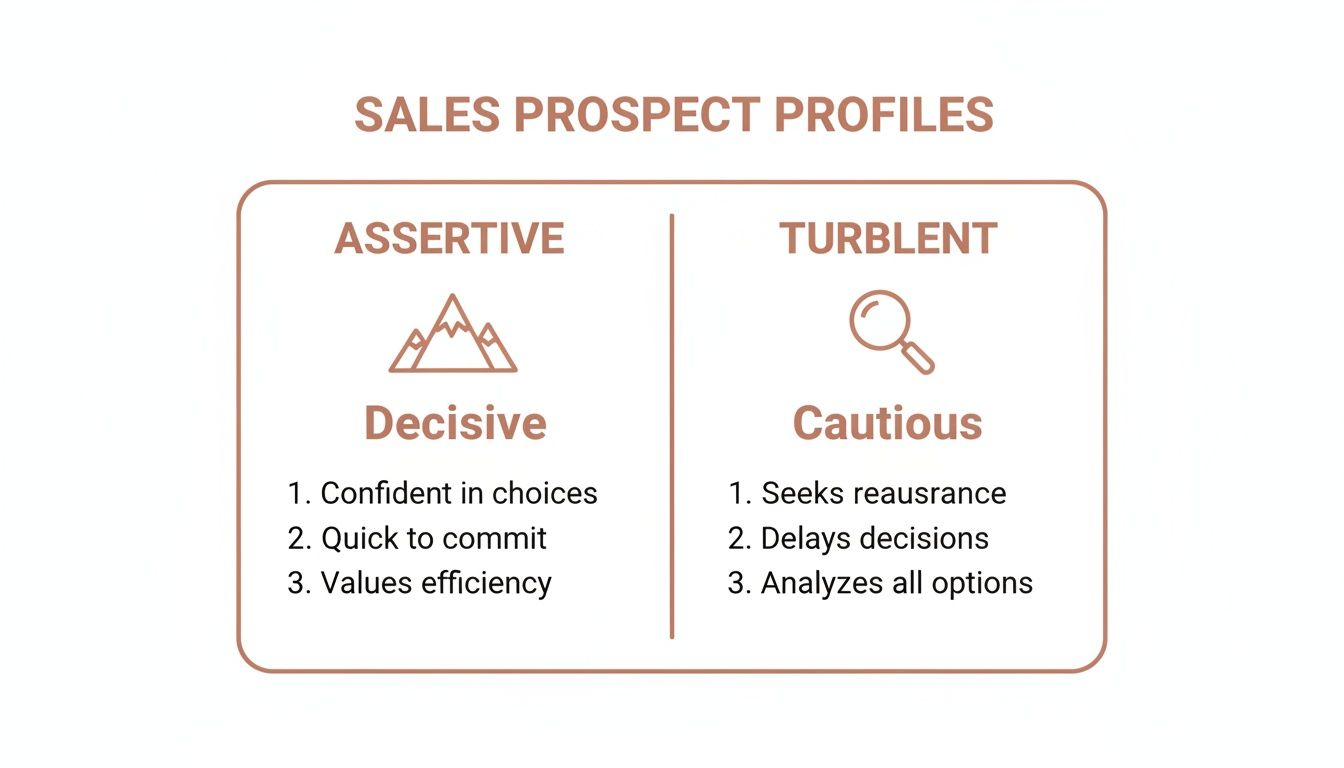
As you can see, it really boils down to this: Assertive individuals are driven by confident goal achievement, while Turbulent individuals are motivated by a deep-seated need for security and thoroughness.
Prospect Behaviour Comparison: Assertive vs. Turbulent
To really nail this down, it helps to see their behaviours side-by-side. The table below summarises how each type typically acts during a sales cycle, from their communication style to what really drives their final decision.
| Trait | Assertive Prospect (-A) | Turbulent Prospect (-T) |
|---|---|---|
| Communication Style | Direct, concise, and definitive. Uses declarative statements. | Inquisitive, detailed, and cautious. Asks "what if" questions. |
| Decision-Making | Quick and self-assured. Relies on their own judgement. | Deliberate and consensus-driven. Seeks reassurance and data. |
| Pacing | Prefers a fast pace. Wants to get to the bottom line quickly. | Prefers a slower, more methodical pace. Needs time to process. |
| Primary Motivation | Achieving goals, efficiency, and clear ROI. | Mitigating risk, ensuring security, and making the perfect choice. |
| Objection Handling | Objections are straightforward challenges to be met with facts. | Objections are often requests for more information and reassurance. |
Understanding these distinctions helps you anticipate their needs instead of just reacting to them. It’s the difference between a smooth conversation and a constant struggle.
Spotting Assertive Cues
If you can identify an Assertive prospect early, you can match their pace and seriously speed up the sales cycle. Keep an eye out for these signals:
- Decisive Language: They're not wishy-washy. They give you a straight "yes" or "no" and make their position clear.
- Focus on the Big Picture: They’ll gloss over the minor implementation details. What they really care about are the strategic benefits and the final result.
- Minimal Reassurance Seeking: They trust their gut. You won’t see them looking to you or their team for validation on every small point.
These prospects want a confident, benefit-driven pitch that respects their time and treats them like an equal. For a deeper dive into how different personality types mesh, this MBTI compatibility chart offers some fascinating insights into these dynamics.
Recognising Turbulent Cues
Turbulent prospects need a completely different approach—one that’s more about nurturing and building trust. Their behaviour is driven by a desire to get things perfect and a genuine fear of making the wrong call.
A key insight is that a Turbulent prospect's detailed questions are not objections; they are requests for the confidence you can provide. Answering them thoroughly builds the trust necessary to close the deal.
Look for these tell-tale signs:
- Frequent Clarifying Questions: They’ll keep digging for more detail, asking for data, or wanting proof to back up every claim you make.
- Voicing "What If" Scenarios: They’re constantly thinking about what could go wrong and will often bring up potential future problems or edge cases.
- Seeking Consensus: You might notice them checking in with colleagues during a call, looking for that group validation before they feel comfortable moving forward.
Mastering the assertive vs turbulent dynamic is all about recognising these patterns in the wild and tweaking your communication to address their underlying emotional and logical needs.
Reading Between the Lines: Analysing Digital and Text Signals
Long before you ever pick up the phone or jump on a Zoom call, your prospect is already telling you who they are. Their digital footprint—from emails and LinkedIn messages to their professional bio—is packed with clues. If you know how to read them, you can start to see whether you’re dealing with an Assertive or a Turbulent personality.
Think of this initial analysis as your secret weapon. It lets you walk into that first conversation armed with genuine insight, not just guesswork. You can anticipate their needs and structure your pitch in a way that resonates from the get-go. And honestly, the difference in how these two types write is often night and day.
An Assertive prospect’s digital trail is usually clean, direct, and efficient. Their emails get straight to the point, their requests are crystal clear, and they’re often the ones proposing the next concrete step.
You’ll see action-oriented language like, “Let’s connect Tuesday at 10 AM,” or “Send me the proposal by EOD.” This isn’t them being rude; it’s a clear signal of their confident, goal-focused mindset. They value brevity and decisiveness, and they expect you to as well.
On the flip side, a Turbulent prospect’s messages show a more cautious and analytical nature. Their communication style tends to be more detailed, and you'll notice more conditional or softer language.
Decoding Assertive Digital Cues
When you spot an Assertive prospect from their writing, you know you can match their directness right from the first reply. Keep an eye out for these patterns:
- Concise and To-the-Point: They skip the fluff and long preambles. They’re all about the purpose of the message.
- Action-Oriented Verbs: Their language is proactive. It’s filled with words that imply movement, decisions, and outcomes.
- Clear Asks and Timelines: They tell you exactly what they need and usually attach a specific timeframe to it. No ambiguity.
- Minimal Emotional Language: The conversation is centred on facts, logistics, and results, not how they feel about them.
These signals point to someone who lives by efficiency and will appreciate a sales process that respects their time. A practical guide to meeting transcription can be a great asset here, helping you convert call recordings into searchable text to find more of these data-rich personality insights.
Identifying Turbulent Text Patterns
A Turbulent prospect leaves a very different digital footprint. Theirs is a picture of careful consideration, which is your cue to take a more reassuring and detailed approach. Their caution isn’t a roadblock; it’s a request for confidence.
Recognising their style early allows you to build trust by giving them the depth of information they need to feel comfortable. Watch for these signals:
- Conditional Phrasing: You’ll see words like “perhaps,” “maybe,” or phrases such as “I was wondering if…” This suggests they need validation before they’re ready to commit.
- Detailed Questions: They often ask multiple, specific questions in a single message. They’re trying to cover all the angles and mitigate any potential risk.
- Longer Response Times: They might take a bit more time to get back to you. That’s because they’re carefully weighing their options and crafting a thorough reply.
Getting a handle on these linguistic patterns is a powerful first step. For those who want to dig even deeper, various AI tools for analyzing client communication styles can automate this process and pull out even richer insights. By interpreting these early signals in the assertive vs turbulent dynamic, you can prepare a much more personalised and effective outreach.
Adapting Your Sales Pitch and Meeting Strategy
Once you've got a read on whether you're dealing with an Assertive or Turbulent prospect, it's time to tweak your sales playbook. This isn't about a ground-up reinvention; think of it as making small but powerful adjustments to your messaging, pacing, and meeting flow. These subtle shifts show you get your prospect's core drivers, building the trust needed to push the conversation forward.
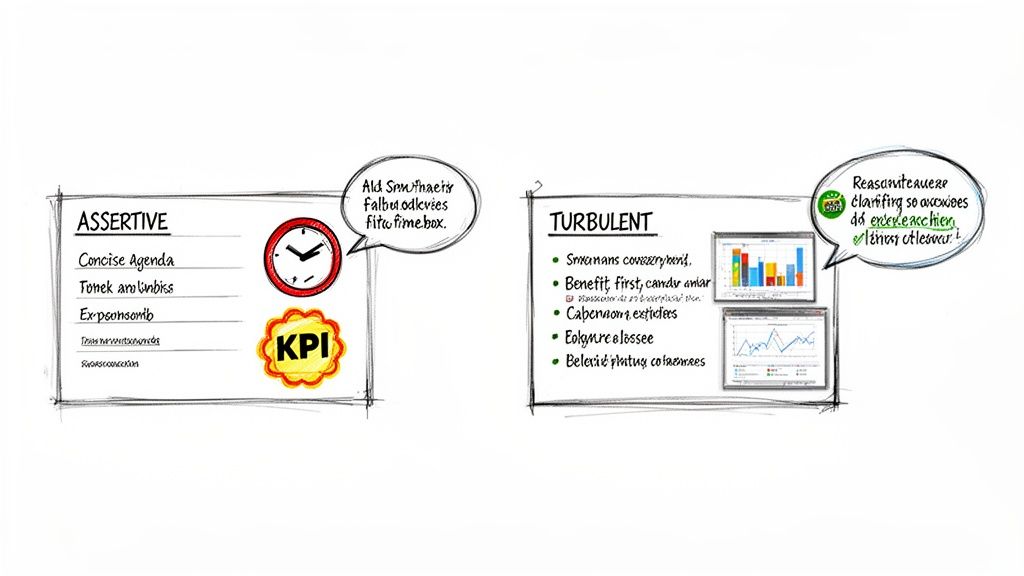
For an Assertive buyer, your whole game plan needs to revolve around confidence and efficiency. They treat time as a currency and respond to direct, benefit-first language. On the other hand, a Turbulent prospect needs a strategy built on reassurance and hard data, one that systematically calms their concerns and lowers their perceived risk.
Pitching to an Assertive Prospect
Engaging someone Assertive is all about matching their pace and cutting to the chase. They view sales meetings as a means to an end, so your job is to prove your value, fast.
- Email Subject Lines: Go for clear, action-oriented language. Think "Next Steps for [Project Name]" or "Proposal for [Goal]."
- Opening Lines: Ditch the fluff. A confident opener like, "Thanks for your time. Let's jump right into how we can achieve [specific outcome]" tells them you respect their schedule.
- Meeting Agenda: Frame the meeting around outcomes, not features. Stick to the big-picture benefits and the strategic ROI.
- Closing Asks: Be direct and firm. Use definitive language like, "Based on our talk, the next logical step is getting the contract signed. Are you ready to move forward?"
A key shift for Assertive types is framing everything in terms of gains and forward momentum. They're wired to win, so your pitch needs to sound like the clearest, fastest path to that victory.
Structuring Your Approach for a Turbulent Prospect
With Turbulent prospects, your strategy has to pivot from speed to security. They’re motivated by a deep-seated need to avoid mistakes, so your approach should be reassuring, data-heavy, and patient. Every touchpoint is a chance to build their confidence—in you and your solution.
This is especially true in certain markets. For instance, data from Singapore shows a significant lean towards the Turbulent identity, with respondents being 10.53% more Turbulent than Assertive. Knowing this regional tendency gives you a huge advantage in calibrating your approach. You can explore more of these regional insights over at 16Personalities.com.
Here's how to adjust your strategy for a Turbulent individual:
- Email Subject Lines: Use language that feels informative and low-pressure. "Following up on our call with more details" or "Information regarding [Topic]" works well.
- Opening Lines: Start by acknowledging their thoroughness. "I really appreciate you taking the time to dig into this. I've pulled together some data that addresses the questions you raised."
- Meeting Agenda: Send a detailed agenda well in advance. Block out plenty of time for Q&A and proactively bring up potential risks before they do.
- Closing Asks: Frame the close as a safe, logical next step. "Does this implementation plan give you the confidence to move forward?" lands much better than a high-pressure ask.
Beyond these personality cues, applying general client communication best practices will always strengthen your ability to build rapport. Mastering the Assertive vs. Turbulent dynamic is ultimately about making your prospect feel seen and understood, whether that means moving at lightning speed or providing layers of reassurance.
Of course. Here is the rewritten section, crafted to sound like it was written by an experienced human expert, following the specific style and tone from your examples.
How to Handle Objections From Each Personality
Objections are just part of the sales game, but they're not all created equal. The real difference between an objection from an Assertive prospect versus a Turbulent one boils down to motivation. One is a direct challenge to your value, while the other is a quiet plea for reassurance against risk.
When an Assertive prospect pushes back, they're testing your conviction and the real substance of your offer. If they say, “This is too expensive,” they aren't shutting you down. They're daring you to prove the ROI.
Turbulent prospects, on the other hand, object from a place of anxiety. A question like, “What if this doesn’t integrate with our current system?” isn't really about the technical nitty-gritty. It's their fear of making a massive, costly mistake talking.
Responding to Assertive Objections
To handle an objection from an Assertive prospect, you need to bring confidence and hard facts to the table. They respect strength and have no time for fluff, so your response has to mirror their directness. Ditch any defensive language and get straight to reinforcing the value.
Your job here is to shift the conversation from cost to investment. Use sharp, powerful statements that connect your solution directly to their biggest goals. This is your moment to prove you understand their strategy and have the authority to help them execute it.
Here’s a simple framework that works:
- Agree and Reframe: Acknowledge their point without giving ground. "I understand why you'd say that; many top performers in your industry felt the same way at first. Let's look at the ROI."
- Reinforce with Data: Hit them with a specific metric or a relevant case study. "Our clients typically see a 15% increase in efficiency within the first quarter, which more than covers the initial investment."
- Return to the Goal: Circle it all back to what they want. "To hit your goal of [their specific goal], this investment is your most direct path."
Calming Turbulent Objections
When a Turbulent prospect voices an objection, they're looking for security, not a sparring partner. Your main role is to de-risk the decision and build a solid foundation of trust. Just answering their question is only half the job; you have to soothe their underlying anxiety, too.
Turbulent objections are an opportunity disguised as a roadblock. They are actively inviting you to provide the social proof, guarantees, and detailed plans that will make them feel safe enough to say yes.
Adopt a patient, reassuring tone and lean on evidence that people just like them have succeeded with you before. You need to show them a clear, step-by-step path forward, making the unknown feel predictable and completely under control.
Follow these steps to build their confidence:
- Empathise and Validate: First, show them you hear their concern. "That’s a very valid question. It’s crucial that any new tool works seamlessly with what you already have."
- Provide Social Proof: Use testimonials or case studies from companies they can relate to. "Actually, [Similar Company] had the same concern. Here’s the simple three-step integration plan we used for them."
- Offer Guarantees: Remove the risk with a clear guarantee or a detailed support plan. "We also provide a dedicated onboarding specialist to manage the entire integration, which ensures a smooth transition at no extra cost to you."
Plugging Personality Insights Into Your CRM
Knowing how to read a prospect is one thing. Turning that skill into a scalable, team-wide advantage is another game entirely. The real goal is to move past one-off observations and build a system where everyone on your sales team can benefit. It's about operationalising the assertive vs turbulent framework so that adaptive selling becomes a consistent, measurable part of how you win.
The most direct way to get this done is by baking these insights right into your Customer Relationship Management (CRM) platform. Your CRM becomes the central brain for all this personality-driven data, getting smarter and more refined with every interaction.
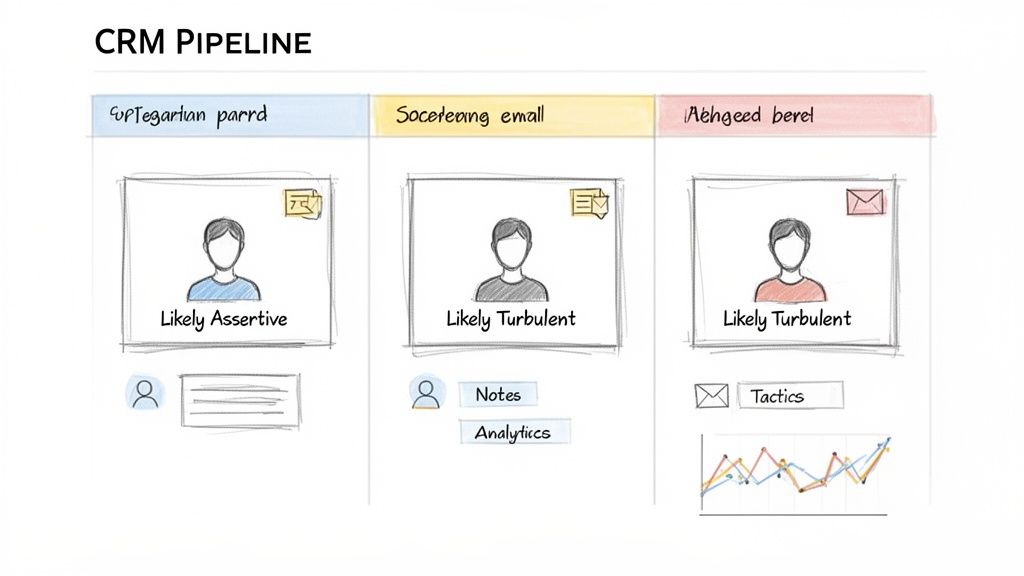
This doesn't have to be some complex, month-long integration project. You can start tracking and sharing valuable intel across your team almost immediately just by creating a few custom fields or tags.
A Practical CRM Workflow
Here’s a simple, three-step process you can roll out today to start building a powerful knowledge base right inside your existing sales tools.
Initial Assessment and Tagging: After your first call or email exchange, make a gut call. Slap a custom tag like
Likely AssertiveorLikely Turbulentonto the prospect's CRM profile. This simple act gives anyone who touches that lead an instant strategic snapshot.Log Communication Cues: In your activity notes, jot down quick examples of their communication style. Did they use clipped, goal-focused language? Note it down. Did they drill into the details and ask a ton of risk-related questions? Log it. This context is gold for the next person who picks up the conversation.
Record What Works: This is the most important part. When a specific tactic lands well, make a note of it. Did a direct, benefit-first closing ask get an immediate "yes"? Log it. Did sending over a detailed, step-by-step implementation plan finally get them over the line? Add that note.
Over time, this discipline builds an incredibly powerful internal playbook. New reps can get up to speed in days, not months, by seeing exactly which tactics resonate with different personalities. You're not just closing deals; you're building a library of what works.
This creates a powerful feedback loop where every interaction adds to your team's collective wisdom. You can go even deeper by exploring how AI-powered sales intelligence tools can automate a lot of this analysis, pulling insights you might have missed.
The main takeaway is to transform individual skill into a team-wide strategic asset. Every conversation should make the next one smarter.
Stop guessing and start connecting. With Mindreader, you can decode your prospect's communication style in seconds and adapt your pitch with precision. Turn every interaction into an opportunity to build trust and close deals faster. See how Mindreader works.