Using The Jungian Cognitive Functions Test To Boost Sales
A Jungian cognitive functions test isn't about slapping a simple label like 'introvert' or 'extrovert' on you. Instead, it’s a tool designed to pull back the curtain and show you how your mind actually works—how it prefers to process information and make decisions. This gives you much deeper insights into why you think and act the way you do.
Decoding Your Mental Toolkit
Picture your mind as a specialised toolkit. Inside, you have tools for gathering information and tools for making decisions based on what you’ve gathered. A Jungian cognitive functions test simply shows which of these tools you naturally grab first, which one you use as a backup, and so on.
It’s not about judging you; it's about understanding the internal operating system that runs quietly in the background of every conversation you have. This becomes incredibly powerful in a sales context, where understanding someone else's "OS" is half the battle.
This model gives you a much richer, more dynamic picture than many other assessments. While it's important to understand the limitations of static personality tests, cognitive functions offer a living blueprint of a person’s thought process. That's gold for building rapport and communicating in a way that truly lands.
The Two Core Jobs of Your Mind
At its core, the framework boils everything down to two fundamental jobs your mind performs: perceiving (how you take in information) and judging (how you make decisions). Everyone does both, but we all have our natural preferences.
- Perceiving Functions: These are your information-gathering tools. Do you instinctively focus on concrete, verifiable facts, or are you more attuned to abstract patterns and possibilities?
- Judging Functions: These are your decision-making tools. Do you lean on impartial logic, or do you prioritise personal values and the impact on people?
Just getting this basic split is the first step. It helps you see how your prospects and clients instinctively organise their world, allowing you to stop guessing and start adapting your approach to fit their style.
How Functions Work in Pairs
None of these mental tools work in isolation. They operate in balanced pairs, creating a dynamic push-and-pull in how we see and interact with the world. There are four of these foundational pairs.
The real magic here isn't just about finding a four-letter type. It's about grasping the dynamic interplay between these functions. It’s the difference between knowing a client is a "driver" versus understanding why they prioritise speed and efficiency when making a call.
The key pairs are:
- Sensing (S) vs. Intuition (N): These are your perceiving functions. Sensing is all about the tangible, present-moment data coming in through your five senses. Intuition, on the flip side, is about spotting patterns, exploring future possibilities, and connecting the dots. A Sensor wants to know "what is," while an Intuitive is always asking, "what could be?"
- Thinking (T) vs. Feeling (F): These are your judging functions. Thinking relies on impersonal logic and objective criteria to make decisions. Feeling uses personal values and the human impact to reach conclusions. A Thinker asks, "Is this logical?" A Feeler asks, "How will this affect everyone involved?"
Each of these functions can also be directed inwardly (introverted) or outwardly (extraverted), which gives us a total of eight distinct cognitive functions. A Jungian cognitive functions test maps out which of these eight "tools" are your strongest, giving you a clear guide to your default modes of thinking and behaving.
The 8 Cognitive Functions as a Sales Toolkit
Knowing the theory behind a Jungian cognitive functions test is one thing. Actually using it to close a deal? That's where the real magic happens. For a sales pro, the next step is to stop seeing these functions as abstract ideas and start seeing them for what they are: eight distinct styles of communication and decision-making you'll run into every single day.
When you can spot these patterns in your prospects, you can finally ditch the one-size-fits-all pitch. Instead, you start talking to them in the language their brain is already wired to understand. It’s all about meeting them on their turf. This isn’t about manipulation; it’s about sharp, effective communication that proves you're listening and that you genuinely get what they need.
Think of it like a mental toolkit. The functions branch out from two core processes: how we take in information (Perceiving) and how we make choices about it (Judging).
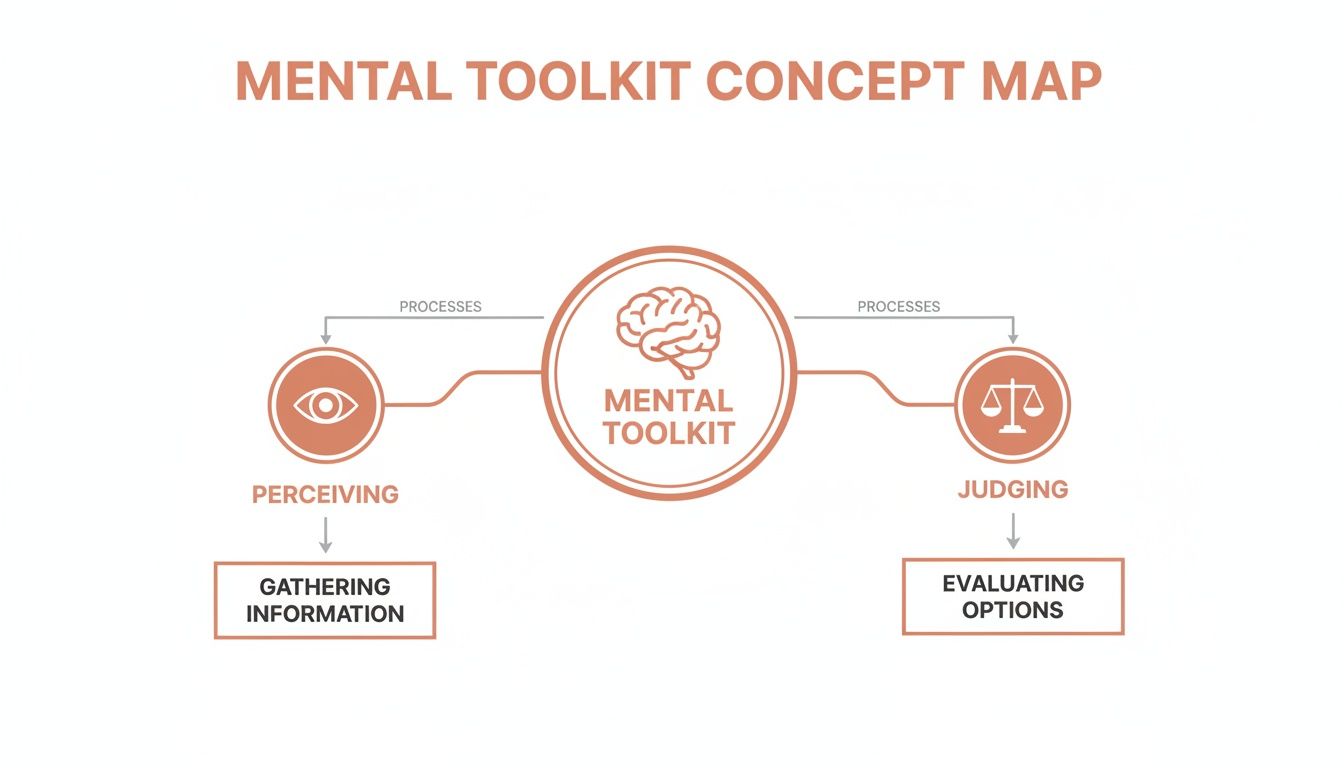
As you can see, every tool in our head starts with either gathering facts or weighing options—the two pillars of any buying decision.
The Four Perceiving Functions in Sales
Perceiving functions are all about how your prospect gathers information. Do they want cold, hard facts, or are they more interested in connecting the dots and seeing the big picture? Figuring this out tells you exactly how to present your evidence.
Extraverted Sensing (Se) Prospects who lead with Se are all about the here and now. They’re tuned into their immediate surroundings and want to see, touch, and experience things for themselves. Talk is cheap; tangible results and action are what get them excited.
- In a Meeting: They'll lean in during a live demo, want to hold a physical product, or ask to see a case study with brutally clear, real-world numbers. Long, theoretical chats will make them fidgety.
- How to Adapt: Drop the fluff. Show, don't just tell. Try saying, "Let me show you exactly how this works right now," or "Here's what another client in your industry actually did with this."
Introverted Sensing (Si) The Si-dominant prospect is a librarian of past experiences. They've built a massive internal database of what works and what doesn't, so they value consistency, reliability, and details. They are often methodical and hate taking unnecessary risks.
- In a Meeting: Expect requests for detailed spec sheets, historical performance data, and testimonials from customers who have been with you for years. They love a structured, step-by-step presentation.
- How to Adapt: Arm yourself with documentation and proof. Highlight your track record, the stability of your solution, and how it aligns with positive experiences they’ve had in the past.
Extraverted Intuition (Ne) These are your "what if" people. Their minds are constantly buzzing, connecting ideas that seem unrelated and exploring every possible future scenario. They get fired up by innovation, fresh concepts, and the promise of growth.
- In a Meeting: They’ll ask big, forward-looking questions and light up when you talk about the vision. Don't be surprised if they jump from topic to topic as new ideas pop into their head.
- How to Adapt: Lean into the potential. Frame your product not just as a tool for today, but as a gateway to what they could become tomorrow. Brainstorm with them.
Introverted Intuition (Ni) Prospects who favour Ni are the strategists. They aren't interested in brainstorming a dozen possibilities; they're focused on finding the one best path forward. They absorb complex information to form a clear, singular vision of the future.
- In a Meeting: They might be quiet and contemplative, taking everything in to see how it fits their grand plan. Their questions will be deep and strategic, focused on the long-term impact.
- How to Adapt: Give them that clear, compelling vision. Show them exactly how your solution connects to their biggest goals and lays out a direct path to getting there.
The Four Judging Functions in Sales
Judging functions reveal how your prospect makes a choice. Are they driven by objective logic or by human-centric values? Get this right, and you can frame your entire proposal around what matters most to them.
Extraverted Thinking (Te) The Te-dominant prospect is obsessed with three things: efficiency, logic, and results. They want the most effective way to hit a target, and they rely on external data, metrics, and proven systems to make a call. They're direct, decisive, and ready to get things done.
- In a Meeting: They'll cut right to the chase. Expect questions about ROI, efficiency gains, and a no-nonsense implementation plan.
- How to Adapt: Lead with the numbers. Use bullet points, charts, and hard metrics to build your case. Focus on how you save time, cut costs, or boost performance.
Introverted Thinking (Ti) Prospects who use Ti need everything to make perfect, logical sense internally. They will mentally take your argument apart, piece by piece, to check for inconsistencies. For them, it’s all about precision and understanding why something works the way it does.
- In a Meeting: They'll ask very specific, technical questions, probing for any cracks in your logic. They value knowing the mechanics behind the curtain.
- How to Adapt: Be ready for a deep dive. Make sure your logic is airtight and welcome their questions as a sign of genuine interest. Be totally transparent about how your system operates.
Extraverted Feeling (Fe) This prospect makes decisions based on shared values and what's best for the group. They are masters of reading the room and want to be sure that any decision fosters harmony and aligns with the company culture.
- In a Meeting: They’ll ask about team buy-in, customer support, and how a change might affect their colleagues. They’ll want to know everyone is on board.
- How to Adapt: Talk about team benefits. Use testimonials and case studies that highlight the positive human impact. Frame your solution as a tool that brings people together.
Introverted Feeling (Fi) The Fi-dominant prospect operates from a deeply personal set of internal values and ethics. Authenticity is everything. Before they buy, they need to feel that the decision is personally right and aligns with what they truly believe in.
A prospect leading with Introverted Feeling (Fi) won't be swayed by data alone. They are internally asking, "Does this feel right to me? Does this company align with what I believe in?" Building genuine, authentic rapport is non-negotiable.
- In a Meeting: They’ll be trying to get a read on you and your company's integrity. They’re moved by missions and values, not just features and functions.
- How to Adapt: Be yourself. Be genuine. Share your company's mission and connect your solution to a deeper purpose that will resonate with their personal sense of what’s important.
To make this even more practical, here’s a quick-reference table to help you spot these functions in the wild and adapt on the fly.
Cognitive Functions in a Sales Context
| Cognitive Function | What It Looks Like in a Prospect | How to Adapt Your Pitch |
|---|---|---|
| Se (Ext. Sensing) | Focuses on immediate, tangible reality. Asks, "How does this work right now?" Wants a demo or trial. | Show, don't tell. Provide live demos, physical samples, and case studies with concrete, immediate results. Keep it action-oriented. |
| Si (Int. Sensing) | Relies on past experience and facts. Asks for detailed specs and historical data. Values reliability and tradition. | Provide detailed documentation, testimonials from long-term clients, and proof of stability. Reference past successes. |
| Ne (Ext. Intuition) | Explores possibilities and "what if" scenarios. Brainstorms ideas and gets excited about future potential. | Focus on innovation and the big picture. Frame your solution as a gateway to future growth and new opportunities. |
| Ni (Int. Intuition) | Seeks a single, clear vision for the future. Asks deep, strategic questions about long-term impact. | Present a compelling, long-term vision. Show a clear path from their current state to their future goals using your solution. |
| Te (Ext. Thinking) | Cares about efficiency, logic, and measurable results. Asks for ROI, metrics, and a clear plan. | Lead with data and evidence. Use charts, bullet points, and efficiency metrics. Focus on outcomes like time and cost savings. |
| Ti (Int. Thinking) | Needs to understand the internal logic. Asks detailed, technical questions to find inconsistencies. | Be prepared for a deep dive. Ensure your arguments are logically sound and be transparent about how everything works. |
| Fe (Ext. Feeling) | Considers group harmony and shared values. Asks about team buy-in and impact on people. | Emphasise team benefits, testimonials about user experience, and how your solution fosters collaboration and morale. |
| Fi (Int. Feeling) | Guided by personal values and authenticity. Tries to gauge your integrity. Asks, "Does this feel right?" | Be genuine and transparent. Connect your solution to a mission or deeper purpose that aligns with their personal values. |
Think of this table as your cheat sheet. The more you practise spotting these cognitive cues, the more naturally you'll be able to shift your communication style, build stronger rapport, and ultimately, become a far more effective salesperson.
How Jungian Psychology Became a Go-To for Singapore's Top Sales Teams
It might seem like a stretch to connect abstract psychological theories with the hard-nosed world of B2B sales, but in Singapore, it's a well-trodden path. Sales leaders and enablement teams here aren't just dabbling in Jungian cognitive functions for intellectual curiosity. They're using these principles to build repeatable, effective communication strategies that cut through the noise in a fiercely competitive market.
This isn't some new fad. Commercial tools built on Jungian psychology, like the widely-known Myers-Briggs Type Indicator (MBTI), have been a fixture in Singaporean corporate training rooms since the 1990s. Their influence surged in the 2000s when global consultancies set up shop locally, embedding these frameworks deep into their leadership and sales development programmes.
Building a Sales Playbook That Actually Works
So, why the decades-long trust? A big part of it comes down to needing a stable, defensible foundation for sales strategies. When you’re tasked with creating messaging playbooks for a large B2B sales force, you need more than just good advice; you need a system.
The structured nature of cognitive functions provides exactly that. It gives sales leaders a concrete framework to explain why a data-heavy pitch clicks with one client, while a grand, vision-focused narrative wins over another. This elevates training from a collection of subjective tips to a structured system—one that can be taught, measured, and scaled across an entire organisation.
For Singapore's sales pros, understanding these cognitive patterns isn't an academic exercise; it's about gaining a strategic advantage. It allows them to anticipate how a client thinks and makes decisions, tailoring their approach before walking into a high-stakes meeting. That’s how you shift the odds in your favour.
The end goal is simple: create a shared language around communication styles. This empowers teams to be more agile, client-centric, and ultimately, more successful in their sales motions.
Just look at The Myers-Briggs Company, a major global provider of these tools. Their entire focus is on personal and professional development, which shows how these frameworks are positioned as serious instruments for organisational improvement, not just personality quizzes.
Is There Any Local Data to Back This Up?
The confidence in these frameworks isn't built on anecdotes alone; it's supported by both commercial data and local academic research. The Myers-Briggs Company, for example, publishes global data on the reliability of their assessments. They report that between 50% and 90% of people get the same result on three or four of the core preferences when they retake the test, which suggests a pretty stable underlying signal.
This perceived stability gets a further boost from local research. Singaporean educational studies, for instance, have used Jungian-style questionnaires to map out personality type distributions in local student populations. One thesis reported a split of 70.6% extraverts to 29.4% introverts in a specific high-school group. While that's just one sample, it shows how these metrics are actively collected and analysed right here in Singapore. If you're curious, you can see how Singaporean researchers apply these concepts in academia for yourself.
When you put it all together—commercial retest data and locally published distributions—you can see why HR and sales enablement vendors in Singapore feel they have a solid case. It gives them a practical foundation strong enough to build entire training programmes and targeted messaging playbooks designed for B2B sales teams who need to perform at their absolute best.
Adapting Your Pitch to Tech and Fintech Buyers
For any sales professional in Singapore, the tech and fintech industries aren't just growing—they're the main event. Knowing how to connect with buyers in these fields can be the difference between a signed contract and a dead end. This is exactly where insights from a Jungian cognitive functions test stop being theoretical and become a practical, strategic tool. It helps you move from guesswork to a data-backed approach.
When you're selling into these highly analytical sectors, you aren’t just pitching a product. You're offering a logical solution to a very complex problem. The buyers you meet are often wired to think in terms of efficiency, hard data, and clear strategic wins. Your pitch needs to reflect that mindset from the very first sentence.
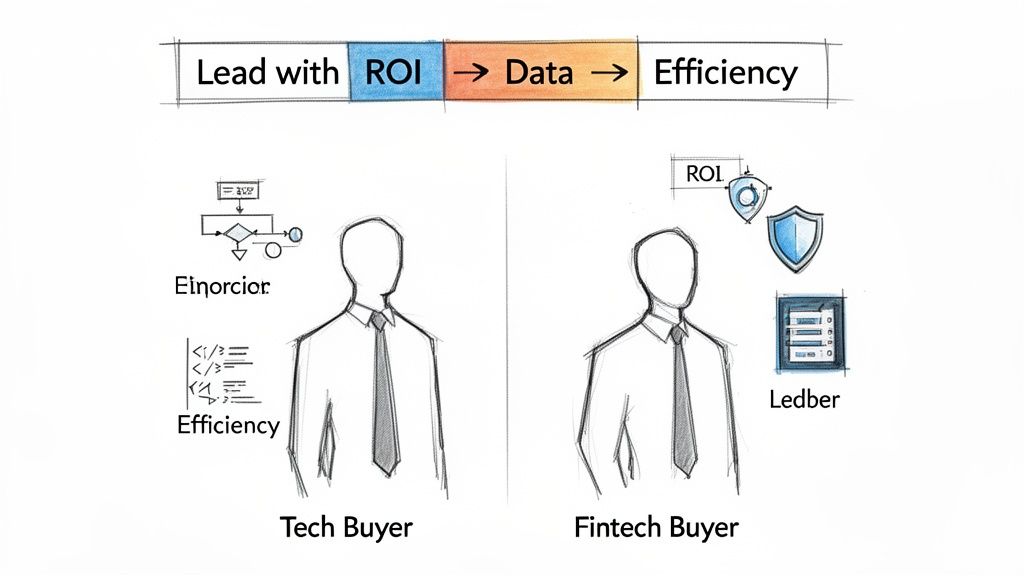
This isn't just a hunch; it's what the data shows. Studies digging into cognitive types across technology and computer-focused professions reveal a clear pattern. Types that favour strategic thinking and are task-oriented—like INTJ, ENTJ, INTP, and ENTP—are significantly overrepresented.
In fact, a massive meta-analysis that pooled data from over 18,000 people in tech roles confirmed this trend. What does this mean for you? Statistically speaking, you're far more likely to be sitting across from a buyer who leads with analytical and intuitive functions, especially in Singapore’s enterprise tech and fintech hubs.
Structuring Your Pitch for Analytical Minds
Understanding this statistical reality gives you an immediate advantage. Instead of opening with a feel-good story or talking about team harmony, you can tailor your communication to click with a more logical, task-focused mind. It’s all about changing how you build your argument and present your case.
Here are a few ways to put this into action:
- Lead with Data, Not Narrative: Kick off the conversation with a powerful statistic or a direct data point that puts a spotlight on the problem you solve. For these buyers, hard numbers build trust much faster than stories.
- Centre the Pitch on ROI and Efficiency: Frame your solution's value purely in terms of measurable outcomes. How much time will it save? What's the exact return on investment? Which specific processes will it streamline?
- Present Concise, Logical Arguments: Ditch the long, winding explanations. Build your case with clean, logical steps, connecting every feature directly to a concrete business benefit. Bullet points are your best friend here.
The core takeaway is simple: the odds are in favour of you meeting an analytical, intuition-oriented buyer. A pitch that gets straight to the data, ROI calculations, and logical arguments isn't just good practice—it's a statistically informed way to win in Singapore's tech and fintech markets.
Speaking the Language of Tech and Fintech
For those targeting the financial technology space, getting the nuances right when approaching Fintech SaaS companies is critical. These buyers bring a unique blend of the tech world's hunger for efficiency and the financial industry's absolute demand for security and compliance.
Your pitch needs to be a masterclass in precision. By adapting your communication style to match these cognitive leanings, you're showing them you get their world and respect their time. This is especially true in finance, where understanding a client's psychology is fundamental to building trust. To learn more, check out our guide on how AI-driven sales intelligence is transforming the finance industry.
At the end of the day, using cognitive function insights isn't about putting people in boxes. It’s about playing the statistical odds to give yourself the best possible chance of making a real connection. It allows you to build a communication strategy that truly resonates with the dominant thinking styles in Singapore's most vital sectors, helping you drive engagement and, ultimately, close more deals.
Ethical Use and Limitations in a Sales Context
While a Jungian cognitive functions test can give you a powerful lens for understanding your prospects, it's something you have to handle with care. In a high-stakes sales environment, it's tempting to take this information and slap a rigid label on someone. That’s not just ineffective—it’s a surefire way to break down the very trust you’re trying to build.
The goal is never, ever to put a client in a box. Think of it more like knowing their preferred communication channel. Do they want a detailed email they can digest in their own time, or would they rather have a quick, straight-to-the-point phone call? Using this knowledge respectfully helps you connect; using it to make lazy assumptions will only push them away.
True sales mastery isn’t about finding a "type" and then running a pre-written script. It's about staying present and observing how a person actually behaves in the moment. The insights from cognitive functions should be a starting point for genuine curiosity, not a final verdict.
A Tool for Communication, Not a Crystal Ball
It's vital to remember what these instruments are actually for. They aren't designed to be fortune-tellers predicting someone's behaviour or whether they'll be a top performer. They reveal preferences, not destiny. For sales leaders, this means using the insights to coach your team on building rapport and adapting communication styles—not as a harsh filter for hiring or performance reviews.
The most ethical way to use these insights is to dial up your empathy and adapt how you communicate. It’s about honouring the way your client processes information, not trying to outsmart them with a cheap psychological trick. Responsible use builds bridges; irresponsible use burns them.
This isn’t just a nice idea; the research backs it up. Study after study has shown that while Jungian-style tools are great for self-awareness and understanding team dynamics, their power to predict leadership success or on-the-job performance is modest, at best. For sales leaders here in Singapore, this really highlights the need for a multi-faceted approach to both team building and client analysis.
The Data on Predictive Validity
When you dig into the science, you find that many of the links between personality type and real-world outcomes are surprisingly small. A 2023 peer-reviewed analysis, for example, found an effect size of just 0.01 when comparing MBTI results to a leadership performance index. That’s a tiny number, and it led the researchers to urge caution.
What’s more, while the individual preference scales (like Thinking vs. Feeling) hold up reasonably well, the stability of the full four-letter type is a bit shakier. Retest data shows that only about 50% of people get the exact same four-letter result when they take the test again, though roughly 90% match on three of the four letters. You can explore the research on these psychometric properties yourself if you want to get into the details.
For Singaporean sales leaders, this data provides a clear path forward. Treat insights from a Jungian cognitive functions test as one piece of the puzzle. It should sit alongside—not replace—your essential tools like behavioural interviews, sales simulations, and hard performance numbers. By treating these insights as a guide for connection rather than a definitive label, you ensure they’re used responsibly and effectively, helping you foster better relationships and drive real, sustainable success.
Putting Cognitive Insights Into Action
So, understanding the theories behind a Jungian cognitive functions test gives you a powerful new lens to see your clients through. But let's get real—you can't exactly ask a busy prospect to fill out a questionnaire before a sales call. The real magic happens when you bridge the gap between this deep psychological insight and the fast-paced reality of your daily sales grind.
This is where the game changes. Instead of relying on static tests, the modern approach is all about decoding communication signals in real time. It means paying sharp attention to the language, the cues, and the behavioural breadcrumbs your prospects leave in every email, call, and meeting.
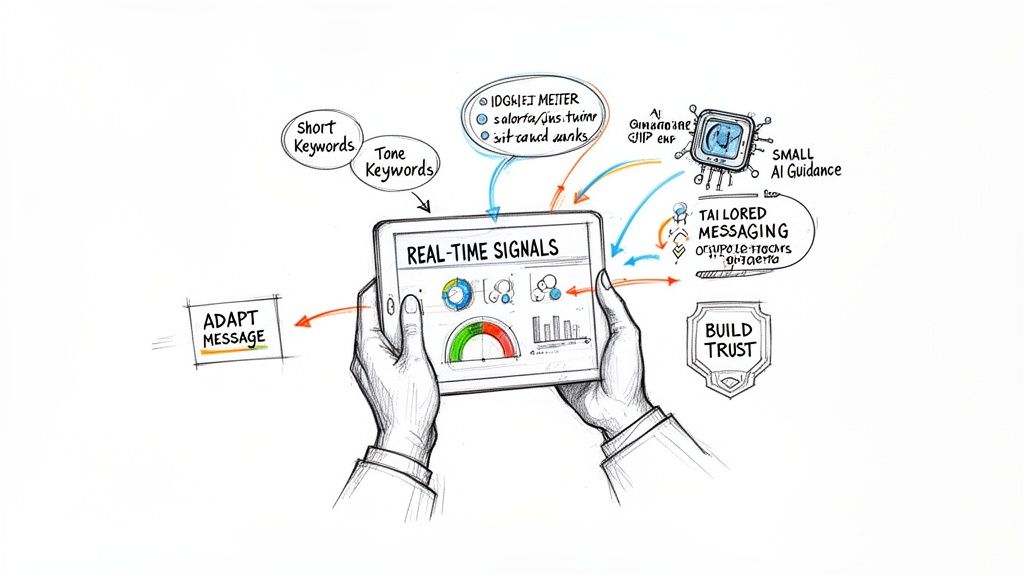
This method isn’t about slapping a fixed four-letter code on someone. It's about getting actionable guidance based on how your client is thinking and communicating right now. It’s a fluid strategy that helps you adapt your messaging, pacing, and meeting agenda on the fly.
From Theory to Tangible Tactics
The core idea is to translate these observable cognitive patterns into concrete sales actions. This shift empowers you to make immediate adjustments that build genuine trust and rapport. It’s the practical application of everything we've talked about so far.
Here’s how this dynamic approach actually works:
- Real-Time Signal Analysis: Modern sales tools can analyse a prospect's digital footprint and communication style to clue you into their likely cognitive preferences. This gives you a massive head start before you even pick up the phone.
- Actionable Messaging Guidance: Instead of a generic personality type, you get specific, practical advice. You might get a tip to lead with hard data for an analytical thinker, or to focus on the long-term vision for a more strategic one.
- Adaptive Meeting Strategies: These insights help you structure your meetings. You’ll know whether to get straight to the point with a clear agenda or to create space for a more open, exploratory conversation.
This isn't about boxing people in; it’s about connecting with them in the language they already speak. When you understand your client’s dominant way of thinking, you can frame your value proposition in a way that just clicks. You can dive deeper into how this works in our guide to personality-based sales strategies.
Ultimately, the goal is to move from static labels to dynamic adaptation. It’s about being able to listen, observe, and respond in a way that shows you truly understand the person on the other side of the conversation.
By applying these insights, you stop guessing and start connecting with precision. This leads to more meaningful conversations, stronger relationships, and, let's face it, more closed deals. You’re no longer just selling a product; you’re solving a problem in the exact way your client is wired to appreciate.
Frequently Asked Questions
When you start digging into how a Jungian cognitive functions test can actually work in a sales setting, a few key questions always pop up. Getting straight, practical answers is the only way to use these insights effectively—and ethically—to build real client relationships and sharpen your sales game. Let's tackle the most common ones.
How Accurate Is a Jungian Cognitive Functions Test?
The real question isn't about the test's accuracy, but how you use the results. Think of it this way: the concepts are brilliant for understanding different ways people process information. But a test result? That’s an indicator of a preference, not a permanent label tattooed on their forehead.
Good, reputable tests show solid consistency on individual scales, like whether someone leans more towards Thinking over Feeling. The full four-letter type, however, can sometimes shift if someone retakes a test. That's why their true power is in guiding your communication strategy and helping you build empathy, not making snap judgments about a prospect.
The real value isn't in a four-letter code but in recognising a client's preferred 'thought language'. Think of it as a guide to help you frame your message in a way that truly connects, rather than a rigid box to put someone in.
Can I Identify a Client's Cognitive Functions Without a Test?
Absolutely. In fact, in the fast-paced world of sales, this is the most practical skill you can develop. It all comes down to becoming a sharp observer of human behaviour.
Start paying close attention to how they communicate. Is their language loaded with data, logic, and facts, or do they talk more about values, impact, and how decisions affect people? Listen to the questions they ask. Are they drilling down into concrete details and past performance, or are they more curious about future possibilities and the big-picture vision? Spotting these cues in real-time is what allows you to adapt on the fly. For more generalised inquiries about interactive platforms, you might find answers in a comprehensive general frequently asked questions (FAQ) section.
What Is the Biggest Mistake Sales Teams Make With These Tests?
The single biggest—and most destructive—mistake is stereotyping. Taking a client's likely cognitive profile and treating it as a fixed, predictive label will kill rapport in an instant. For example, assuming an 'analytical' thinker is cold and doesn't care about building a trusted relationship is a rookie error that will cost you dearly.
These insights are meant to open doors, not slam them shut. The goal is never to label or pigeonhole someone. It's to understand their primary mode of thinking so you can present your solution in a language that they instinctively get. Use these insights as a starting point for genuine curiosity and connection, not as a final, unchangeable verdict.
Ready to stop guessing and start connecting? Mindreader translates complex personality insights into actionable sales tactics. Analyse your prospects, get tailored messaging guidance, and walk into every meeting prepared to speak your client's language. Close more deals by adapting the way your clients think. Discover how it works at TheMindreader.ai.