Signal-Based Follow-Up for High-Ticket Finance Sales
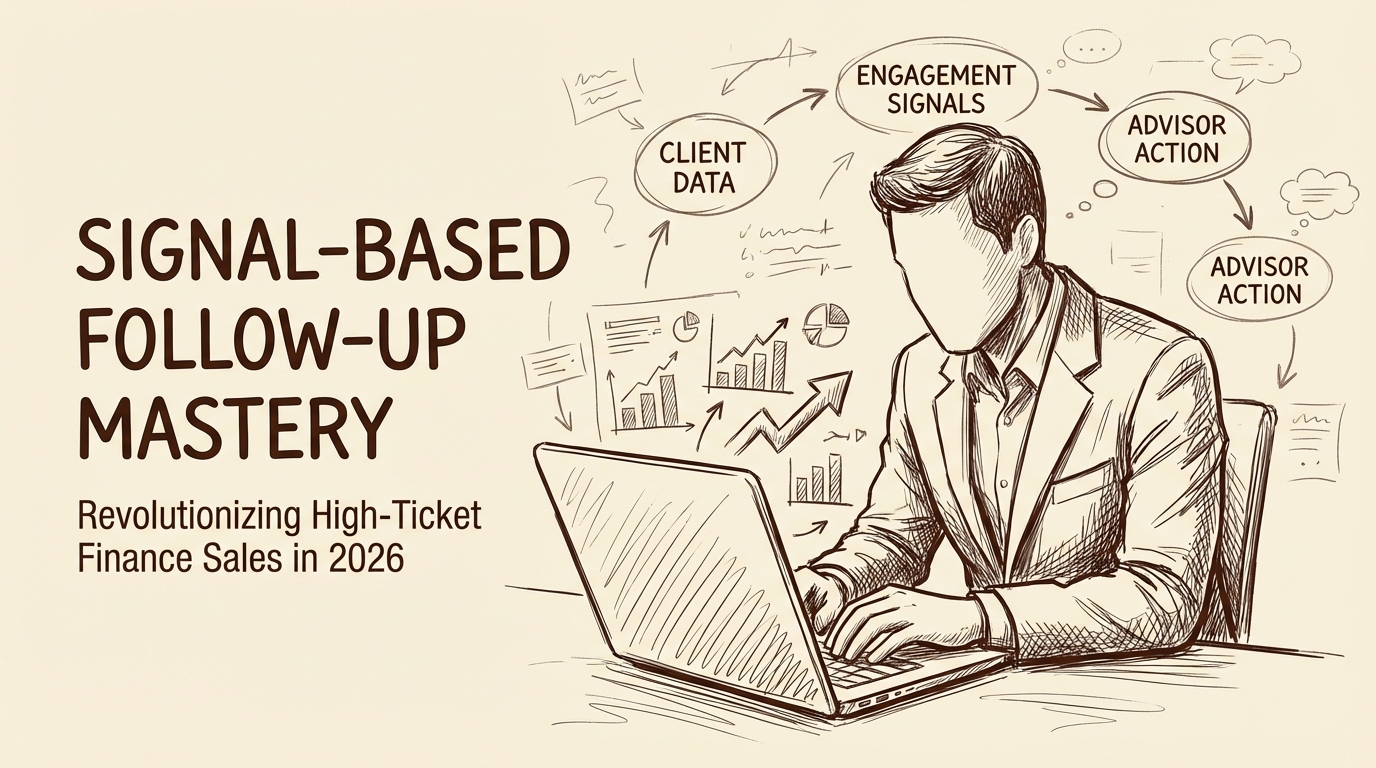
Imagine a prospect eyeing a $10,000 financial advisory package, hesitating at the price, but then deeply engaging with your email that breaks down financing options. What if you could instantly respond with a personalized 0% installment testimonial and an easy path to apply—right at the moment their interest peaks? In the high-stakes world of high-ticket finance sales, signal-based follow-up is transforming subtle engagement behaviors into consistent, closed deals.

The Rise of Signal-Based Follow-Up in High-Ticket Finance Sales
High-ticket sales in finance—premium investment plans, private wealth management services, enterprise financing solutions—demand precision in sales communication. Modern buyers expect consultative, advisory-led conversations that anticipate their needs, not generic pitches.
Signal-based follow-up leverages real-time engagement data—opens, clicks, time on page, scroll depth, video views, and replies—to dictate the next communication. Instead of guessing, your sales communication is orchestrated by what the prospect actually does.
This approach aligns perfectly with the explosive growth of consumer financing and Buy Now, Pay Later models. According to UCFS, U.S. BNPL transaction value is projected to surge from $316 billion in 2023 to $442.6 billion by 2027, as buyers increasingly demand flexible payment options for big-ticket purchases. Retailers and financial brands that integrate financing see higher conversion rates and increased average order values because flexible payment plans systematically remove affordability barriers.
In high-ticket finance sales, this effect is amplified. Prospects frequently signal intent and concern through behaviors such as viewing payment plan details, revisiting pricing pages, or replaying testimonial videos—moments that invite tailored follow-ups addressing affordability, risk, and trust head-on.
Why Engagement Signals Are Critical for Relationship Selling
Relationship selling thrives on understanding buyer psychology, especially in finance, where trust and perceived risk dominate decision-making. Traditional follow-up sequences guess at a prospect’s needs; signal-based strategies respond to visible behaviors.
For example, if a prospect clicks on a financing option but never replies, it strongly suggests a price or budget objection. That is the perfect moment to send case studies, payment breakdowns, or social proof demonstrating how similar clients used flexible payment plans to move forward comfortably. Guides such as Retail Insider show how high-approval-rate plans turn browsers into buyers by making affordability clear and low-friction.
In 2026, economic pressures like inflation and rising living costs continue to push consumers toward installment plans for big-ticket finance products. Younger generations, wary of revolving credit card debt, prefer transparent, mobile-first financing experiences embedded directly into consultative sales flows. Insights from UCFS highlight how these flexible options are becoming a default expectation, not a nice-to-have.
High-ticket deals now feature longer sales cycles and more stakeholders, but personalization via engagement signals consistently boosts win rates by aligning each communication with buyer intent and stage. As explained by SendTrumpet, sales teams that adapt messages to where the buyer is in the journey close complex deals faster and with stronger relationships.
This shift from generic nurturing emails to behavior-triggered sequences is the practical reality of modern consultative selling. Sales teams using digital tools to track engagement can nurture leads up to 3x more effectively, turning anonymous browsers into educated, confident buyers ready for high-value commitments.

Decoding Key Engagement Signals in Finance Sales
Engagement signals are behavioral breadcrumbs that reveal a prospect’s mindset. In high-ticket finance, categorizing and interpreting these signals allows you to sharpen sales communication and move deals forward with precision.
- High Interest (Hot Signals): Multiple email opens within a short window, repeated link clicks to pricing or case studies, calendar bookings, or demo requests. Recommended response: Accelerate the process with a custom proposal, a direct calendar link, or an invite to a live strategy call.
- Price Hesitation (Warm Signals): Extended time on financing pages, payment calculators, or FAQ sections without progressing to a call or application. These patterns are common in high-ticket scenarios where upfront costs feel risky. Recommended response: Send targeted content on 0% or low-interest installment plans, high-approval financing partners, and side-by-side comparisons that highlight cash-flow benefits, echoing approaches outlined by Retail Insider.
- Objection Surfacing (Cool Signals): Partial replies with questions about ROI, terms, risk, or contract length. These are prime consultative selling moments. Recommended response: Share testimonials, ROI calculators, scenario models, and clear timelines to de-risk the decision.
- Disengagement (Cold Signals): No opens or clicks after three or more touches, or dropped engagement after an initial burst of interest. Recommended response: Re-engage with value-add content such as market insights, regulatory updates, or strategy briefs, rather than hard pitches. Invite them to stay in your ecosystem until timing improves.
BNPL adoption data reinforces the urgency of getting this right: flexible payment options are now a major driver of sales growth across industries, with e-commerce and services businesses reporting higher conversions and basket sizes when financing is seamlessly integrated into the buying journey, as detailed by UCFS. Finance sellers must mirror this by proactively signaling affordability, not waiting for prospects to explicitly ask about price.
Practical Strategies: What to Send Next Based on Signals
Signal-based follow-up is not a theory—it is a repeatable system you can operationalize immediately in high-ticket finance sales pipelines.
Signal 1: Financing Page Click
Prospect behavior: Spends 2+ minutes on your payment plan or financing explainer page, perhaps returning to it multiple times over several days.
Interpretation: Budget concerns and affordability questions are clearly signaled.
Next send: An email titled “Your Custom Installment Breakdown” that includes:
- A simple, visual breakdown of monthly or quarterly installments at different term lengths.
- Clear 0% or low-interest options where possible, plus proof points such as approval-rate statistics sourced from high-approval partners described by Retail Insider.
- A one-click pre-filled application or soft credit-check link to minimize friction.
Signal 2: Testimonial Video View
Behavior: Watches at least 70–80% of a client success or case study video, often replaying sections or sharing it internally.
Interpretation: Trust-building and social proof are the primary needs; they want reassurance that others like them achieved meaningful results.
Next send: A short, personalized video or email that references their specific finance goal—for example, “How We Helped a Business Owner Achieve 15% Annual Returns with Flexible Terms”—plus one or two highly relevant testimonials and a clear next step (strategy call, assessment, or proposal review).
Signal 3: Objection Keyword in Reply
Behavior: The prospect replies using phrases like “too expensive,” “not in our budget right now,” or “ROI is unclear.”
Interpretation: This is a classic objection handling opportunity focused on price-to-value alignment.
Next send: An interactive or visually compelling PDF that:
- Compares full upfront payment versus installments side-by-side, including cash-flow impact.
- Highlights long-term ROI, retention, or upsell gains that clients experience after adopting financing, echoing loyalty and conversion improvements noted by UCFS.
- Includes a short client story or quote aligned with their specific objection (“We thought this was too expensive until…”).
To maximize results, integrate these plays across channels. Use email for depth, SMS for urgency in retail–finance hybrid offers, and secure portals or Digital Sales Rooms for multi-stakeholder deals—an approach advocated by SendTrumpet, which shows how centralized, trackable content spaces speed consensus.

3 Actionable Tips to Implement Signal-Based Follow-Up Today
Use these practical, finance-specific tactics to transform your follow-up from generic to hyper-relevant:
- Tip 1: Automate Tracking with CRM Integrations. Connect your CRM, email, and video platforms so that every open, click, and view updates a lead score in real time. Assign values (e.g., opens = 10 points, link clicks = 25 points, call bookings = 50 points) and trigger sequences when thresholds are hit. Segment finance prospects by signal strength and intent to enable consultative selling at scale. Benchmarks from high-performing teams often show 25–40% uplift in response rates once signal scoring is in place.
- Tip 2: Craft Objection-Handling Templates by Signal. Pre-build 5–7 modular templates mapped to your top objections. For example, one email dedicated to financing questions with BNPL-style visuals and installment breakdowns, another focused exclusively on ROI with calculators and outcome charts. Use dynamic fields and merge tags to personalize by industry, role, and goal so you maintain authenticity while scaling relationship selling.
- Tip 3: Test and Iterate with A/B Sequences. Don’t assume you know which asset will resonate most. For prospects signaling price sensitivity, let Variant A receive an installment-focused testimonial and Variant B receive a hard-numbers ROI case study. Track reply rates, call bookings, and closed revenue to refine your playbook. As UCFS notes, aligning offers with preferences for flexible, transparent payments can materially boost close rates on high-ticket deals.
Overcoming Challenges in Signal-Based High-Ticket Sales
High-ticket finance offers almost always require live conversations—strategy calls, discovery sessions, or consults—to clarify fit, expectations, and outcomes. As Evolved Finance points out, these deeper interactions are essential to qualify buyers and ensure long-term alignment.
Signal-based follow-up doesn’t replace these calls; it amplifies them. Pre-call, you can send signal-matched prep materials—such as a custom ROI model or tailored financing summary—so prospects arrive educated and ready to decide. During the longer cycles typical of six-figure or enterprise commitments, async check-ins through personalized portals and Digital Sales Rooms, as highlighted by SendTrumpet, keep stakeholders aligned without creating meeting fatigue.
Because finance is a highly regulated space, your signal-based communications must remain fully compliant. Be transparent with rates, terms, and eligibility criteria, and avoid overpromising results. Position your follow-ups as advisory and educational rather than pushy—this not only builds trust but also supports better long-term client satisfaction.
The Future: AI-Powered Signals in Consultative Selling
Looking ahead, sales trends for 2026 point to AI dramatically enhancing signal detection and “next best action” recommendations. According to monday.com, predictive analytics and intelligent automation are reshaping B2B and high-ticket sales by surfacing which leads to prioritize and which assets to send, and when.
In finance, this will look like real-time alerts such as, “Prospect signaled price objection—send financing nurture,” or “Decision-maker re-opened proposal—trigger executive summary video.” Paired with value-based and consultative selling frameworks, these AI-powered cues create a powerful combination: empathetic human advisors supported by precise, data-driven timing.
The risk of ignoring this shift is significant. With BNPL and consumer financing projected to reach $442.6 billion in transaction value by 2027, as underscored by UCFS, high-ticket finance teams that fail to respond to signals in a timely, personalized way will lose deals to more responsive competitors.
As you refine your approach, remember: mastering signal-based follow-up does more than close individual deals—it creates enduring client partnerships, predictable revenue, and a differentiated buyer experience. Start decoding behaviors today, build your signal-response library, and watch your conversions, client loyalty, and average contract values climb. For effortless implementation, consider using Mindreader software to automate these insights and elevate every stage of your high-ticket finance sales process.