
Staring at a dismal reply rate is one of the most frustrating parts of sales. You start to wonder if the problem is your product, but more often than not, it’s the pitch. A profile of the customer is your secret weapon here. It's a deep, detailed summary of your ideal buyer that goes way beyond basic data to truly capture their motivations, challenges, and even how they prefer to communicate. Think of it as the strategic tool that separates outreach that resonates from outreach that gets ignored.
Why Generic Outreach Is Costing You Deals
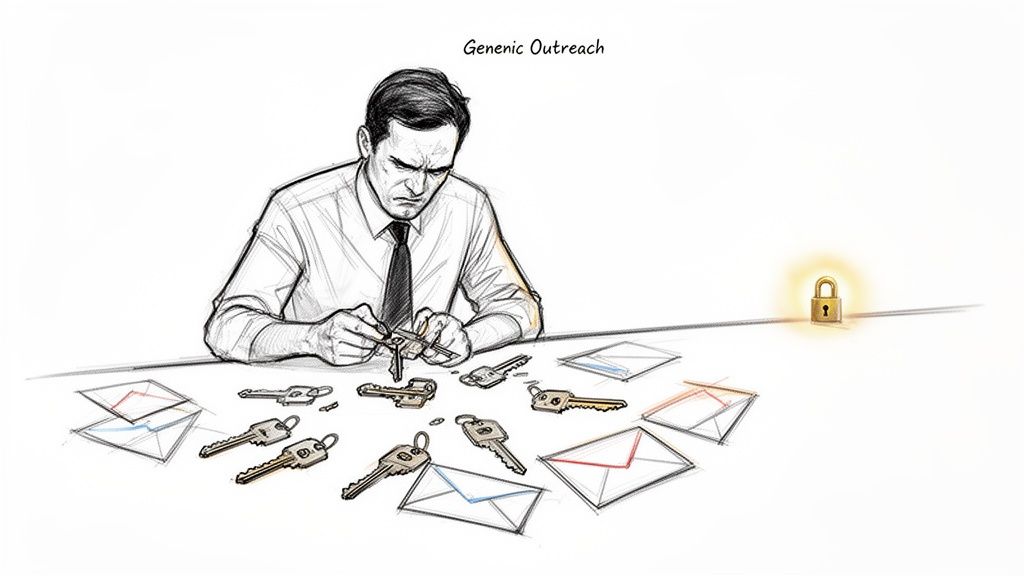
Sending the same message to every single prospect is like a locksmith trying to cut a key without ever seeing the lock. Sure, you might get lucky once in a while, but most of your attempts are going to fail spectacularly. This "spray and pray" approach burns through valuable leads and wastes precious time, ultimately costing you deals and chipping away at your brand's reputation.
In a world where 74% of consumers now expect personalised experiences, generic outreach just feels lazy and disconnected. When a message doesn’t speak directly to a prospect's specific challenges or goals, it’s immediately flagged as irrelevant and tossed in the digital bin. This leads directly to low reply rates, fewer meetings booked, and a sales cycle full of unnecessary friction.
The True Cost of Vague Targeting
The consequences of not deeply understanding your customer go far beyond just a few ignored emails. It creates a ripple effect of inefficiency that poisons your entire sales process.
- Wasted Effort: Your team spends hours crafting messages that never land, chasing down leads who were never a good fit to begin with.
- Missed Opportunities: Without a clear profile, you fail to recognise high-potential prospects who are ready to buy but need a message that connects with their unique situation.
- Lower Conversion Rates: Even if you manage to book a meeting, a generic pitch won't hit on the specific pain points of the person sitting across from you, making it that much harder to build trust and close the deal.
Generic approaches to finding new clients almost always fall flat. Instead, a strategic focus on something like effective real estate agent lead generation, informed by a strong customer profile, is what truly drives success. This principle holds true across every industry, from finance to tech.
A well-defined profile of the customer transforms your sales motion from a scattergun blast into a precision strike. It’s about knowing exactly who you're talking to, what they care about, and how to frame your solution as their ideal answer.
This guide will serve as your practical roadmap to move beyond static, useless documents. We'll introduce the profile of the customer as an intelligent, dynamic tool built for modern sales. By building profiles that actually connect with today's buyers, you can achieve higher reply rates, secure more meaningful meetings, and see your conversion rates climb. We’ll even introduce a powerful sales archetype framework to help you bring these profiles to life in every single conversation.
The Building Blocks of a Powerful Customer Profile
To really nail a customer profile, you have to go deeper than just a list of facts. Think of it like building a high-performance engine; every single part matters, and they all need to work together in perfect harmony. A truly powerful profile blends different layers of data to give you a multi-dimensional view of your buyer—showing you not just who they are, but what actually makes them tick.
The idea is to move from the broad, objective information down to the more nuanced, personal insights. By layering these building blocks, you turn a bunch of abstract data points into a concrete playbook for your sales strategy. This approach is a game-changer, whether you're on a B2B sales team, a financial advisor, or a luxury consultant.
Firmographics and Demographics: The Who and Where
This first layer gives you the foundational context. Firmographics are all about the company, while demographics describe the individual you’re talking to. These are the straightforward, easily identifiable facts that help you qualify an account and a contact right from the start.
- Firmographics: This data tells you if the company is even a good fit in the first place. You’re looking at things like company size, industry, annual revenue, and what tech they’re already using. A software company, for instance, isn't going to waste time on a business that’s already locked in with a direct competitor.
- Demographics: This zooms in on the person. It covers their job title, how senior they are, their years of experience, and where they’re located. Knowing you’re talking to a C-suite executive versus a junior manager completely changes the conversation.
Here in Singapore's fast-paced business world, for example, the sweet spot for many B2B sellers is the digitally-savvy 25-44 age group, who are leading online interactions and buying decisions. This demographic is the nation’s economic engine, with the 25-29 age bracket alone making up 599,000 people (10.2% of the population). These are the founders and consultants driving today’s high-value deals. You can explore more data on Singapore's population to sharpen your targeting.
Psychographics: The Why Behind the Buy
This is where your customer profile really starts to come alive. Psychographics dive into the internal world of your buyer—their motivations, goals, challenges, and values. It’s the data that tells you why they might desperately need what you’re selling.
Understanding a prospect's psychographics is like learning their language. It lets you frame your product not as a list of features, but as the direct answer to their biggest professional ambitions or personal dreams.
For a financial advisor, this means getting a feel for a client's risk tolerance and their vision for retirement. For a luxury consultant, it’s about knowing if a client is motivated by exclusivity, craftsmanship, or the status a brand brings.
Key psychographic components include:
- Professional Goals: What does a "win" look like in their role? Are they chasing a promotion, trying to make their team more efficient, or spearheading a big innovation project?
- Key Challenges: What’s getting in their way? It could be anything from tight budgets and outdated tech to stubborn internal resistance to change.
- Personal Values: What do they care about outside of their job title? Maybe they prioritise a healthy work-life balance, sustainability, or being on the forefront of new technology.
Behavioural Data: The What and How
Finally, behavioural data gives you the hard evidence of a prospect's interest and intent. It’s the digital trail they leave behind, offering clues about their priorities and where they are in their buying journey. This information is pure gold for timing your outreach and making sure your message lands perfectly.
A luxury car salesperson might see that a prospect has downloaded a brochure for a specific model and used the online configurator three times this week. That screams high intent. In the same way, a B2B sales rep can track if a prospect attended a webinar on a particular topic or engaged with a case study on LinkedIn. These actions tell a story about the problems they’re actively trying to solve, making your first conversation feel less like a cold call and more like a helpful consultation.
How to Build Your Customer Profile Step by Step
Building a customer profile isn't just some abstract marketing task; it's a structured process that pulls you out of the guesswork and gives you a reliable system for understanding who you're selling to. Think of it as moving from a blurry photograph to a high-definition portrait of your ideal buyer.
This isn't about reinventing the wheel. The journey starts with the people who already love what you do: your best customers. They're the living proof that your solution works, and they hold all the clues you need to find more people just like them.
Start With Your Best Current Customers
The most honest and reliable data you have is sitting right in your CRM. Look at your most successful, profitable, and genuinely happy clients—the ones who just get it. Your mission is to find the common threads that tie them all together.
Dig into your sales data. Are there patterns? Look for shared job titles, company sizes, industries, or even the specific headaches they were trying to solve when they came to you. These commonalities are the first brushstrokes of your customer profile.
Conduct Insightful Interviews and Surveys
Data tells you what is happening, but talking to people tells you why. Once you've identified your top customers, reach out and have a real conversation. A quick, insightful chat can uncover more gold than weeks spent staring at spreadsheets.
When you connect, ask open-ended questions that get them talking. Don't just look for confirmation of what you think you know. Your goal is to see the world through their eyes.
Effective Interview Questions to Ask:
- What was the exact moment you realised you needed something like our solution?
- Can you walk me through the other options you looked at and what made you choose us?
- What does a "win" look like for you now that you're using our product?
- How has our solution actually changed your day-to-day work or key business numbers?
These kinds of questions get past surface-level satisfaction and dig into their real motivations, their decision-making process, and the true value they get from you.
Leverage Digital Analytics and Social Listening
Your prospects and customers are constantly leaving a trail of digital breadcrumbs across the web. Tapping into this unfiltered information gives you a peek into what they do, not just what they say they do.
Tools like LinkedIn Sales Navigator are fantastic for this. You can see the content they engage with, the groups they join, and the topics that get them talking. You can also use social listening tools to monitor industry forums or social media for mentions of specific pain points or competitor products. This is real-time, on-the-ground intelligence about what your audience truly cares about.
A prospect’s digital footprint is an honest reflection of their priorities. By analysing their online behaviour, you can understand their challenges and interests before you even send the first email.
This is all about gathering the core data types you need to build a complete picture.
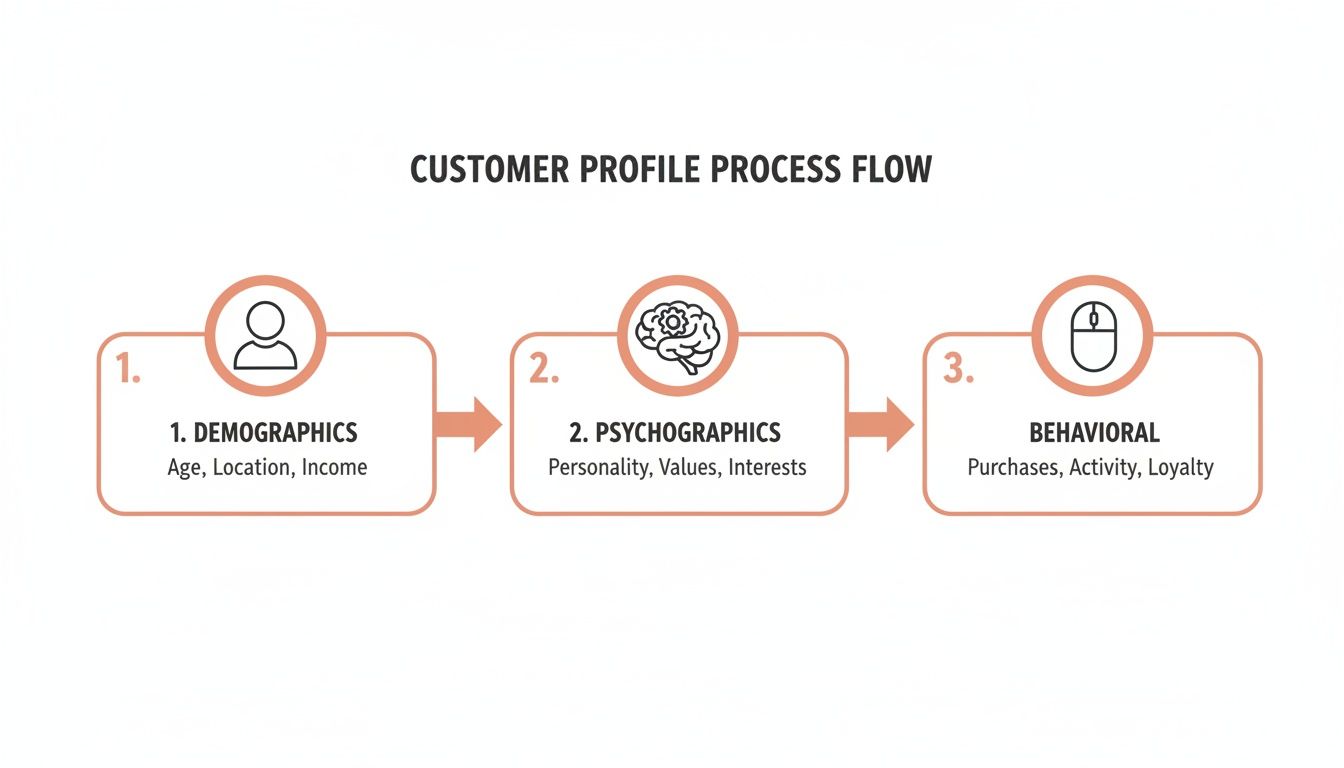
This process shows the flow from the basic demographic facts, to deeper psychographic motivations, and finally to the concrete behaviours they take.
Consolidate Data into a Clear Template
Once you've gathered all this fantastic information, you have to get it organised. A messy pile of notes and data points isn't an actionable sales tool. Consolidating everything into a simple, standardised template is crucial.
This makes the profile easy for your entire team to understand, share, and actually use. For a deeper dive, check out our guide on how to create an ideal customer profile that can become your team's single source of truth.
Validate and Refine Your Profile
Finally, and this is important, a customer profile is not a static document you create once and frame on the wall. Markets change, customer needs evolve, and your own product gets better. You have to treat your profile as a living, breathing guide that needs regular check-ups.
Put it to the test. Does the messaging you built from the profile actually resonate with new prospects? Are you seeing better engagement? Use the feedback from every sales call and email campaign to make small, smart adjustments. This keeps your understanding of your customer sharp, relevant, and incredibly effective.
Bringing Your Customer Profile to Life with Sales Archetypes
Having a data-rich profile of your customer is a massive step forward, but the numbers alone don't tell you how to connect with them. Data shows you a job title, not a personality. It points out pain points but doesn't reveal how someone thinks. This is where you bridge that gap between cold information and real human connection.
By grouping your customer profiles into sales archetypes, you move beyond the what and start understanding the how of their decision-making. These aren't rigid boxes to stuff people into. Think of them as fluid communication frameworks that help you adapt your approach. Instead of a one-size-fits-all pitch, you learn to speak their language.
Understanding the Four Core Sales Archetypes
Think of these archetypes as the different mindsets your prospects operate from. Each one has distinct goals, fears, and a preferred way of taking in information. When you recognise which archetype you're talking to, you can tailor your language, your meeting agenda, and even your follow-up style to make a much bigger impact.
These archetypes are based on observable patterns in how people communicate. To go deeper into the psychology behind these frameworks, it's worth exploring resources on DISC personality types and seeing how they play out in professional settings.
Let's meet the four core styles:
The Knight (Decisive & Results-Oriented): Knights are all about action and outcomes. They are direct, confident, and want to get straight to the point. What they care about is the bottom line, efficiency, and clear, measurable results.
The Explorer (Innovative & Big-Picture Thinker): Explorers are the visionaries. They get genuinely excited by new ideas and future possibilities. Being creative and forward-thinking, they love to brainstorm and care deeply about innovation, long-term potential, and staying ahead of the curve.
The Healer (Relationship-Focused & Empathetic): Healers put people first. They prioritise trust and collaboration above all else. As supportive and reliable individuals, they make decisions based on how they will impact the team. Building consensus, ensuring security, and fostering strong relationships are what matter most to them.
The Wizard (Data-Driven & Logical): Wizards are analytical thinkers who need facts, evidence, and a clear, logical process. Meticulous and detail-oriented, they value accuracy above everything else. Give them data, proven case studies, and a step-by-step breakdown of how something works, and you'll have their full attention.
Adapting Your Pitch to Each Archetype
Recognising an archetype is only half the battle; the real skill is in adapting your communication on the fly. A pitch that gets an Explorer fired up will completely overwhelm a detail-focused Wizard.
Let’s walk through how you’d handle two very different prospects.
Scenario A: Pitching to a Knight
Imagine you're selling a new project management software to a COO who is clearly a Knight. Your approach needs to be fast, direct, and laser-focused on the return on investment.
Your Pitch: "Thanks for your time, Alex. I know you're busy, so I'll be brief. Our software cuts project completion time by an average of 22%. I can show you exactly how in 15 minutes and then we can discuss pricing. Does that work?"
You lead with the result, show you respect their time, and end with a decisive call to action. No long stories, no fluff—just the tangible outcome.
Scenario B: Pitching to a Healer
Now, picture selling that exact same software to a Head of HR who fits the Healer archetype. Their number one concern isn't ROI; it's how this change will affect their team's morale and workload.
Your Pitch: "Hi Sarah, it's great to connect. I understand a big priority for you is making sure your team feels supported and not overwhelmed. I'd love to hear about your current workflow and then share how other teams like yours have used our tool to reduce stress and improve collaboration."
Here, the entire focus shifts to empathy, support, and team well-being. You open by listening, building trust before you even think about mentioning a feature.
This adaptability extends beyond your words to your choice of communication channels. In Singapore's B2B market, for example, a Healer might appreciate the personal touch of a quick check-in on WhatsApp. With 97% of Singapore's internet users on chat and messaging apps, and WhatsApp leading the charge, it’s a vital tool for real estate agents sharing visuals or financial advisors building rapport. For more on this, you can check out insights about digital trends in Singapore from wearesocial.com. Understanding these local nuances is key.
Ultimately, these archetypes give your profile of the customer a voice and a personality. They help you move from simply knowing about your buyer to truly understanding them.
Putting Your Customer Profile into Daily Action
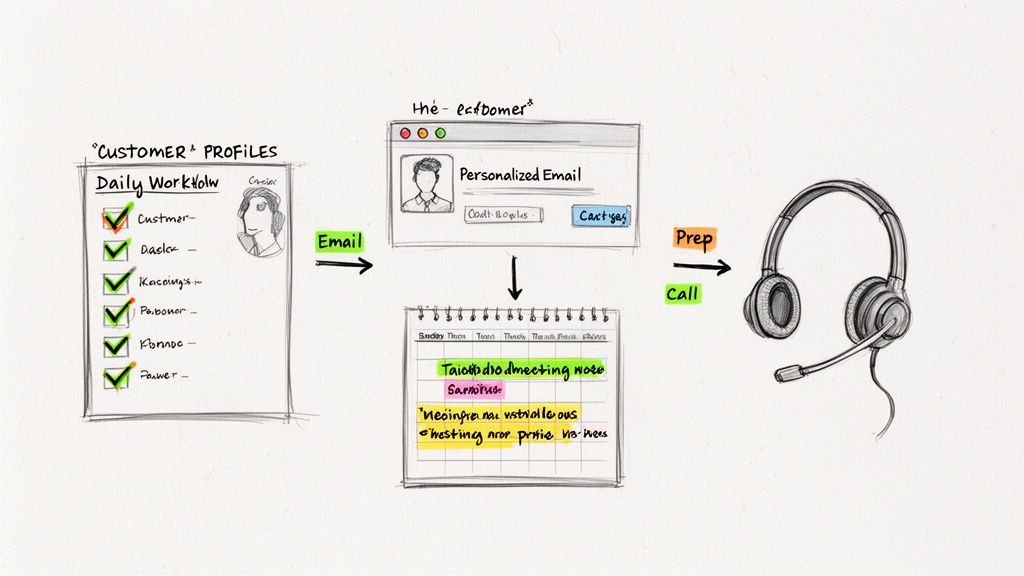
A solid customer profile isn't just a document you create once and file away. It’s a dynamic tool built for the front lines, designed to be used every single day. The real magic happens when you move from theory to application, turning those hard-won insights into revenue.
This is all about weaving your profiles into your daily sales motion. It should inform how you write, how you speak, and most importantly, how you listen. When you get this right, you build trust faster, prospects are less likely to ghost you, and you’ll see a direct impact on your numbers.
Crafting Hyper-Personalised Outreach
Your first email is your first impression. Generic messages land in the trash. Personalised ones start conversations. Using your customer profile, you can craft outreach that speaks directly to the person, not just their job title.
Let’s look at a quick before-and-after.
- Before (Generic): "Hi Alex, I saw you’re the VP of Operations at Acme Corp. Our software helps companies like yours improve efficiency. Can we chat for 15 minutes next week?"
- After (Profile-Informed): "Hi Alex, I noticed you recently shared an article on supply chain optimisation. Given your focus on results (a classic Knight trait), I thought you’d be interested in how we helped a similar firm cut their logistics costs by 18% in just one quarter. I have a three-point summary I can share. Would that be useful?"
See the difference? The second email references their activity, speaks their language (results-focused), and offers immediate value instead of asking for time. This profile-driven approach dramatically increases your chances of getting a reply. To learn more, check out how AI-powered sales intelligence can automatically surface these critical talking points for you.
Tailoring Discovery Calls and Demos
Once you’ve booked that meeting, the customer profile becomes your script for the conversation. It helps you prepare questions that dig deeper and allows you to tailor your demo to what truly matters to them.
Don't just present your product; solve their specific problem. Your customer profile tells you which problem to focus on.
Instead of a one-size-fits-all demo that bores everyone, you adapt based on their archetype.
- For a Wizard (Data-Driven): Come prepared with detailed dashboards, analytics, and ROI calculators. They need to see the logic.
- For an Explorer (Big-Picture): Kick things off with the future vision. Show them how your solution opens up new possibilities they haven't even considered.
This targeted approach makes the prospect feel heard and understood, transforming a rigid presentation into a collaborative problem-solving session.
Handling Objections with Precision
Objections are a normal part of any sales cycle, but a customer profile lets you see them coming. By understanding a prospect's core motivations and fears, you can prepare responses that address their underlying concerns, not just their surface-level questions.
For instance, a security-focused Healer’s objection to new software isn't just about features; it’s about protecting their team from disruption and risk. Your response should centre on robust security protocols, user training, and dedicated support—not just bells and whistles.
The affluent B2B buyer in Singapore offers a great local example of this in action. Here, urban professionals aged 25-54 are driving the deals. This digitally fluent group, with a median age of 36.2, represents stable, high-value clients. While many are on TikTok, WhatsApp is their go-to chat platform, with 80.1% monthly active users. This makes it a crucial channel for building trust and handling concerns. Knowing this allows you to tailor your follow-ups to the channels they actually use.
By pre-empting objections based on their profile, you demonstrate real expertise and build the confidence needed to move the deal forward.
From Profile to Profit: The Bottom Line
And there you have it. The journey from a fuzzy idea of your audience to a crystal-clear customer profile is the single most direct route to better sales results. But this isn't just a one-off task you can tick off a list; it’s a living, breathing strategy that needs to evolve right alongside your market and your clients.
Throughout this guide, we've pulled back the curtain on this essential sales tool. We started with the basic building blocks—demographics and, more importantly, the psychographics that reveal what truly drives a buyer. From there, we walked through a step-by-step framework for building your own profiles, starting with your best customers and then validating your assumptions through real conversations.
Embracing a Human-Centric Approach
But the real magic happens when you bring all that data to life. When you start mapping profiles to communication archetypes like the Knight or the Healer, you’re no longer just looking at data points. You’re translating raw information into a genuine human connection. This is how you weave these insights into your daily grind, from crafting emails that actually get a reply to navigating objections with real empathy.
A well-crafted customer profile isn't just another tool—it's your ultimate competitive advantage. It's the bridge between guesswork and a data-informed, human-centric sales approach that consistently turns potential into profit.
Ultimately, the message is simple: stop shouting into the void with generic outreach. Take the time to understand who you're really talking to, on a much deeper level.
For those looking to get there faster, AI-powered platforms can deliver the actionable insights needed to prepare for your next conversation in mere seconds. By truly understanding the profile of the customer, you give yourself the power to build trust, create value, and, yes, close more deals.
Even with a solid plan in hand, some questions always pop up when you start applying this stuff in the real world. Let's tackle a few of the most common ones that sales pros run into when building and using customer profiles.
How Often Should I Update Customer Profiles?
Think of your customer profiles as living, breathing documents. They’re not meant to be carved in stone and filed away. The best practice is to give them a major review at least once a year.
But you should also be making smaller tweaks quarterly, or anytime you stumble upon a significant new insight. For example, if a new product feature starts pulling in a totally different kind of user, or if a major shift happens in your industry—those are perfect triggers for a refresh. The goal is constant refinement, not a "set it and forget it" mindset. That's how you keep your outreach sharp and relevant.
What Is the Difference Between an ICP and a Buyer Persona?
This is a big one, and it trips a lot of people up. Your Ideal Customer Profile (ICP) is all about the company. It defines the perfect organisation for you to sell to, based on firmographics like industry, company size, and annual revenue. It answers the question, "What kind of company is our perfect match?"
A buyer persona, on the other hand, zooms in on the individuals inside those ideal companies. This is your customer profile. It gets into the nitty-gritty of their specific roles, their personal goals, what keeps them up at night professionally, and how they prefer to communicate. Simply put, your ICP tells you which doors to knock on, while your customer profile tells you how to talk to the person who answers.
Can I Create a Customer Profile with No Customers?
Absolutely. In fact, if you're just starting out, it's a non-negotiable first step. When you don't have any existing customers to analyse, you build what’s called a provisional or hypothetical profile. This isn't just guesswork; it's based on solid market research and educated assumptions.
Start by digging into your direct competitors. Who are their customers? See who's engaging with your early content on social media. Pinpoint the core problem your product solves and make a strong hypothesis about who feels that pain the most.
This initial profile becomes your north star for those crucial first outreach attempts and product decisions. From there, your main job is to validate and refine it with every single conversation you have with a real prospect, slowly turning your theories into hard facts.
Ready to stop guessing and start connecting? Mindreader translates complex buyer psychology into simple, actionable sales guidance. Discover your prospect's communication style in seconds and craft messages that build trust and close deals. Learn how it works at The Mindreader AI.