Mastering Consensus in High-Ticket Financial Sales
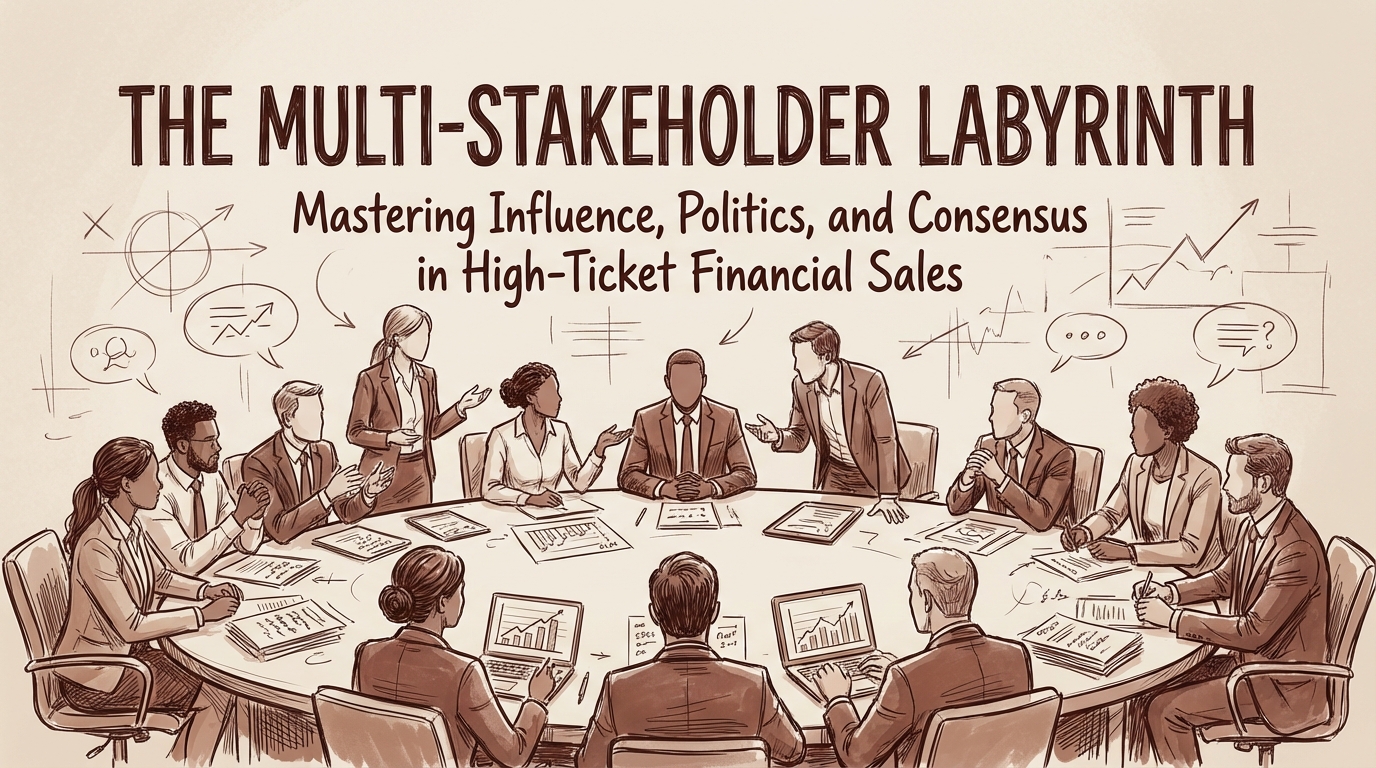
The landscape of high-ticket financial sales has fundamentally transformed. Seven-figure deals are no longer won with a single compelling pitch to one decisive executive. Today, complex B2B financial transactions typically involve 6 to 10 decision-makers, with buying committees often stretching to 10–11 people and even more for global deals, especially in an environment defined by larger deal sizes, longer cycles, and more stakeholders, as noted by Business Money. For financial services sales leaders, this shift demands a new playbook—one that treats consensus-building as equal parts art, science, and political navigation.

The New Reality: Committees, Not Kings
The buying committee has become the default structure for high-stakes financial deals. Research from Monday.com highlights how modern buying groups routinely span finance, technology, operations, and regulatory stakeholders, with committees averaging 10–11 members for complex solutions. In financial services, where every strategic decision carries regulatory, reputational, and operational risk, these committees expand further.
A single acquisition of a financial platform, wealth management system, or payment processing solution now touches treasury teams, compliance officers, IT and security leaders, business unit heads, risk managers, and C-suite executives—often anchored by the CFO. Each party brings a unique lens: capital allocation, regulatory scrutiny, cyber risk, user experience, and strategic alignment.
This democratization of decision-making reflects sound corporate governance. Large financial investments deserve scrutiny from multiple vantage points. For sales professionals, however, it introduces complexity that goes far beyond traditional objection handling. It requires decoding organizational politics, mapping influence networks, and orchestrating consensus across stakeholders with different incentives, risk appetites, and timelines.
Mapping the Invisible Architecture: Understanding Stakeholder Influence
Winning multi-stakeholder deals begins with abandoning the illusion that all decision-makers are equal. Titles suggest hierarchy; real influence flows through informal networks, historical credibility, and control over budgets or risk.
Consider a typical financial services acquisition. The CFO technically owns budget authority but may lean heavily on the CTO for technology viability and integration risk. The Chief Compliance Officer controls regulatory approval but may not own P&L outcomes. The business unit leader who first championed the solution understands user pain points but may lack enterprise-wide strategic power.
A truly consultative selling approach starts by understanding the success metrics, political capital, and vulnerabilities of each stakeholder. The question is not just “What does this person need to hear?” but “What will this person be held accountable for if this goes right—or wrong?”
Sales communication in this environment demands precision and personalization. The CFO focuses on ROI, cost of capital, capital efficiency, and downstream impact on valuation. The CTO evaluates integration complexity, technical debt, cybersecurity posture, and vendor lock-in. The compliance officer prioritizes regulatory alignment, audit trails, and documentation standards. Effective financial sales professionals develop stakeholder-specific value propositions for each role, grounded in research and tailored to individual objectives.
This is where relationship selling evolves beyond superficial networking. It becomes a disciplined, methodical practice: understanding formal organizational charts and informal power structures, decoding decision-making frameworks, and aligning with each stakeholder’s personal definition of success.

The Timeline Trap: Managing Extended Sales Cycles
Longer sales cycles are now the norm, not the exception. Data from SalesGlobe shows that the average B2B buying process lasts 11–12 months, with complex multinational deals taking up to 16 months and typically involving 6 to 10 decision-makers. In financial services, additional layers—regulatory review, infosec and vendor risk assessments, legal scrutiny, and integration planning—can stretch these timelines even further.
Extended cycles introduce new failure modes: stakeholder fatigue, internal reshuffles, budget reallocation, and shifting strategic priorities. Senior leaders get promoted, business units reorganize, and priorities pivot in response to market volatility. By the time a salesperson follows up eight months after an initial pitch, their original champion may have left, lost influence, or moved to a different mandate entirely.
Objection handling in this environment demands patience, context, and strategic persistence. Early objections are often surface-level signals of deeper hesitation. A CFO’s concern about pricing may mask uncertainty about executive sponsorship or future capital constraints. A compliance officer’s detailed questions about regulatory alignment may signal anxiety about personal accountability if a regulator later challenges the decision.
Top performers listen past the stated objection to uncover the underlying fear, incentive, or political constraint. They adapt their communication to address both the rational business case and the emotional or political realities driving resistance.
Building Consensus: Three Essential Strategies
1. Establish a Sponsor Coalition, Not a Single Champion
In high-ticket financial deals, over-reliance on a single executive sponsor is risky. That individual can lose influence, change roles, or shift priorities overnight, taking your deal momentum with them.
Instead, intentionally cultivate a sponsor coalition across the buying committee. Identify and nurture three key champion archetypes:
- The Visionary: Sees the long-term strategic value and sells the initiative upward into the C-suite and board.
- The Pragmatist: Focuses on implementation realism, resource requirements, and operational impact; sells sideways to peers and adjacent functions.
- The Protector: Concentrated on risk mitigation, regulatory exposure, and career risk; stabilizes the deal during moments of doubt.
Relationship selling at this level means understanding who plays each role, what they need to protect, and how they communicate internally. The goal is to ensure that if one champion exits, your coalition still has enough political mass to keep the deal alive.
2. Use Digital Sales Rooms to Enable Concurrent Evaluation
Traditional financial sales processes tend to be sequential: present to the CFO, then the CTO, then risk, then legal, then compliance. Every handoff adds weeks or months, amplifying the risk of stalled deals and shifting priorities. Emerging deal management platforms and digital sales rooms change this dynamic by enabling concurrent stakeholder evaluation, a trend underscored by Monday.com.
Digital sales rooms serve as a shared, structured deal hub where financial, technical, risk, legal, and compliance stakeholders can review tailored content in parallel. Technical teams dive into architecture and security documentation while finance analyzes pricing and ROI models, and executives assess strategic fit—all within the same environment, with full visibility into each other’s questions and comments.
For financial sales professionals, this requires a new level of sales communication discipline. Content must be comprehensive yet modular—clearly segmented by audience and topic. Stakeholders should quickly find what matters most to them without wading through irrelevant detail. Done well, digital sales rooms not only compress timelines but also foster transparency, build trust, and reduce misalignment.
3. Invest in Continuous Value Demonstration, Not One-Time Closes
In an 11–16 month sales cycle, no single pitch—no matter how polished—can carry the deal from interest to signature. The shift from transactional to consultative selling becomes existential.
Winning teams design a deliberate cadence of value-adding touchpoints that reflect a deepening understanding of the prospect’s business. This might include:
- Targeted case studies aligned with the prospect’s segment, regulatory regime, and operating model.
- Executive briefings or workshops that bring together your product, risk, and strategy experts with their internal leaders.
- Thought leadership on market dynamics, such as consolidation and private capital activity in financial services highlighted by Clifford Chance, and how those trends affect their growth strategy.
Each interaction should have a clear purpose: progress consensus, clarify requirements, or systematically de-risk a specific objection. When executed with intent, the long sales cycle shifts from a liability to a strategic asset—a runway for building trust, credibility, and internal advocacy.

Navigating Political Realities Without Losing Integrity
Multi-stakeholder deals in financial services are inherently political. Departments compete for budget, leaders defend their mandates, and personal rivalries surface as “technical” disagreements. Recognizing this is not cynical—it is pragmatic.
Effective sales professionals do not ignore politics, nor do they manipulate them. Instead, they navigate with awareness and integrity. This entails:
- Understanding who stands to gain influence, budget, or strategic relevance if your solution is adopted—and who fears losing control.
- Framing benefits in a way that acknowledges legitimate concerns without publicly undermining any group.
- Recognizing when objections are proxies for political anxiety and responding with reassurance, transparency, and optionality rather than defensiveness.
- Having the discipline to pause or slow a deal when internal politics become too volatile, rather than forcing a premature decision that will not survive internal scrutiny.
In highly regulated financial environments, stakeholders are acutely aware of personal accountability. A failed technology implementation reflects on the CTO who championed it. A misjudged financial structure that triggers regulatory scrutiny sits with the CFO. A missed control gap can tarnish the Chief Risk Officer or Chief Compliance Officer.
Consensus-building, therefore, must include explicit assurances around governance, risk management, and post-implementation support. Clear implementation roadmaps, defined escalation paths, and transparent outcome metrics reduce perceived personal risk and help politically exposed stakeholders feel safe backing your solution.
The Consultative Selling Edge in High-Ticket Financial Deals
Consultative selling—the discipline of deeply understanding a customer’s world and architecting solutions around their priorities—shifts from a “nice to have” to a non-negotiable in multi-stakeholder environments. Generic pitches bounce off large financial institutions because they fail to resonate with any specific constituency.
For financial sales professionals, consultative excellence means developing real domain expertise. If you are selling a wealth management platform, you must understand fee compression, regulatory suitability standards, advisor productivity, and digital client expectations. If you are selling a payment processing solution, you should know their transaction volumes, cross-border complexity, chargeback dynamics, and margin pressures.
This depth enables smart discovery. Instead of superficial questions, you ask targeted ones that reveal operational gaps, hidden costs, and unarticulated risk concerns. You can then position your solution as a strategic lever—improving capital efficiency, enabling M&A integration, or unlocking new revenue streams—within a broader market context shaped by elevated dealmaking and sector consolidation that firms like Boston Consulting Group (BCG) highlight in their outlooks.
Consultative sellers do not simply answer questions; they reframe problems, quantify impact, and co-create the business case with the prospect’s internal champions.
The Long Game: Building Strategic Partnerships Beyond the Deal
The final evolution in high-ticket financial sales is recognizing that signing the contract is not the finish line; it is the starting point of a strategic relationship. The most sophisticated financial institutions are shifting from transactional vendor relationships to long-term partnerships with providers who continuously deliver value beyond initial implementation.
This evolution changes how success is measured. Instead of focusing exclusively on deal size and quarterly close rates, forward-thinking sales organizations track:
- Time-to-value and realized outcomes versus the original business case.
- Expansion revenue from new regions, business lines, or products.
- Relationship health, advocacy, and multi-threaded engagement across functions.
For sales professionals, this means building multi-stakeholder relationships during the sales process that naturally extend into post-sale collaboration. It means knowing the client’s strategic roadmap well enough to anticipate needs—whether driven by regulatory change, M&A activity, or new product launches—before they articulate them internally.
In this model, you are no longer just the person who closed the deal. You become a trusted advisor and internal champion for your client’s success, shaping future initiatives and influencing strategic investments.
Reflection and Moving Forward
The complexity of multi-stakeholder, high-ticket financial sales can be intimidating. It demands patience, political fluency, consultative rigor, and a genuine commitment to creating value for your prospect’s organization—not just booking revenue. Yet this same complexity creates a moat for those who master it.
Sales professionals who embrace the realities of buying committees, extended timelines, and political dynamics build an advantage that low-touch, transactional competitors cannot replicate. They become embedded advisors within prospect organizations. They cultivate coalitions that generate referrals, expansions, and long-term partnerships. And they systematically de-risk decisions for every stakeholder at the table.
The path forward is clear:
- Embrace the messiness of consensus-building instead of wishing for a single “economic buyer.”
- Treat objection handling as an opportunity to uncover deeper motivations and anxieties.
- Commit to relationship selling that extends beyond the transaction and into execution and outcomes.
- Leverage modern tools—such as emerging deal management platforms and intelligence solutions like Mindreader software—to track stakeholder interactions, orchestrate multi-threaded relationships, and manage complex deals with precision.
The financial sales professionals who thrive in 2026 and beyond will be those who recognize that complexity is not a barrier to success—it is the terrain on which true excellence, influence, and trust are built.