How Enterprise SaaS Leaders Win With Proof-Driven Stories
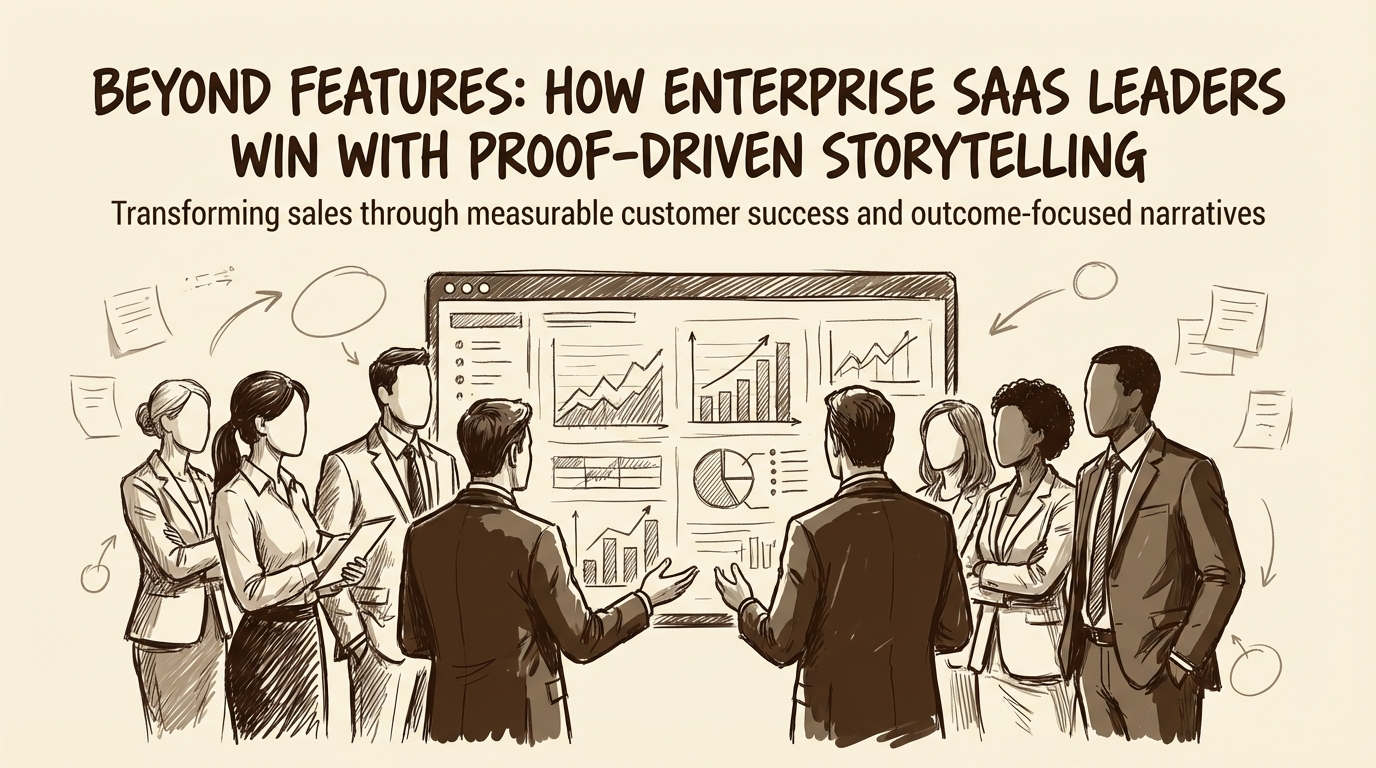
In enterprise SaaS sales, features alone no longer win deals. Buyers are saturated with product pitches, feature matrices, and generic collateral. What they respond to now is proof—clear, credible evidence that your solution delivers measurable business impact. The brands winning in 2026 are those mastering the art of storytelling with quantifiable outcomes, turning customer success into their most powerful sales communication asset.

The Shift From Features to Outcome-Driven Narratives
For years, SaaS companies built their sales strategies around product capabilities. We told prospects what our software does, highlighted technical features, and listed integrations. But enterprise buying has evolved. Today, customer-led narratives consistently outperform feature-based messaging, especially when they showcase real-world outcomes, implementation journeys, and clear business impact. As noted in Flippa, customer-led storytelling and multi-channel orchestration now beat feature-led, single-channel strategies across B2B SaaS.
This shift reflects a deeper truth about enterprise decision-making. When a CFO, CTO, or operations leader evaluates a SaaS platform, they are not asking, "What does this product do?" Instead, they want to know, "What will this do for our business? What results have similar companies achieved? How much risk are we taking on?" These questions can only be answered convincingly through concrete proof, not optimistic promises.
The implication for sales professionals is profound. Your role evolves from product advocate to trusted advisor—someone who uses case studies, benchmarks, and quantified outcomes to help prospects visualize their own success. This is consultative selling at its best, grounded in the language of results rather than the language of features.
Why Data-Driven Storytelling Works in Complex Sales Cycles
Enterprise sales cycles are long, political, and complex. Multiple stakeholders with different incentives must align around a single purchasing decision. In this environment, objection handling becomes exponentially harder when your proof points are theoretical.
Consider the typical objections:
- "How do we know this will actually work for our use case?"
- "What is the real ROI, and how long until we see it?"
- "How disruptive will implementation be to our operations?"
- "What if adoption is slow or teams resist change?"
These are legitimate business questions. Generic reassurance and feature recaps will not move the deal forward. But a well-crafted story about a peer company in their industry achieving a 140% increase in qualified lead generation or a 40% reduction in onboarding time? That changes the conversation entirely.
When you combine storytelling with proof, the narrative becomes the vehicle and the data becomes the engine. You are not just telling a compelling story about transformation—you are backing it up with measurable evidence from similar organizations.
In 2026, the brands that stand out will be those that take trusted data and deliver personalised, human-centred narratives around it. Research from Broad Vision Marketing underscores this trend: turning data into stories and tailoring them to individual buyers is now a defining characteristic of top-performing SaaS go-to-market teams.

Real-World Proof: How Leading Enterprise SaaS Companies Execute This Strategy
The most effective enterprise SaaS companies are not inventing a new discipline; they are updating timeless consultative selling principles with modern data, channels, and creative storytelling.
Take Mailchimp’s famous "Clustomer" campaign. Instead of leading with a laundry list of AI features, Mailchimp dramatized the core customer problem: undifferentiated mass audiences and generic messaging. The campaign then showed how Mailchimp unlocks personalization at scale—visually demonstrating audience clustering, AI-powered segmentation, and behavior-based triggers in action. According to DigitalDefynd Education, this narrative-plus-proof approach translated into measurable gains in engagement and marketing efficiency.
Similarly, Acora, an IT services provider, did not just claim it was better than competitors like Accenture and Atos. It reframed the entire category by challenging the industry’s reliance on Service Level Agreements (SLAs) and championing Experience Level Agreements (XLAs) that prioritize end-user satisfaction. The results were tangible: a 140% surge in search volume for Acora and more than double the share of category searches—evidence that bold narrative positioning, backed by proof, can reshape how buyers perceive an entire market.
These examples share a critical thread: storytelling rooted in real customer challenges and quantifiable results. They move beyond slogans to demonstrate impact.
Three Essential Strategies for Implementing Storytelling With Proof
1. Develop Industry-Specific Case Studies That Ladder Up to Business Outcomes
Generic customer success stories are no longer enough. Create deep, targeted case studies organized by:
- Industry vertical (e.g., fintech, healthcare, manufacturing)
- Company size (SMB, mid-market, enterprise)
- Core business challenge (churn, pipeline quality, support costs, compliance risk)
For each case study, capture precise metrics such as:
- Percentage increase in efficiency or productivity
- Time saved in key workflows or processes
- Incremental revenue generated or pipeline created
- Reduction in operational costs or error rates
- Improvements in NPS, CSAT, or employee engagement
Then organize these stories by the objections you hear most often. When a prospect says, "We are not sure this will work in our environment," you can immediately present a story from a similar company with similar complexity and constraints.
2. Master Benchmarking and Comparative Positioning
Enterprise buyers want context. They want to know how they stack up against peers and what “good” looks like. Create benchmark reports that show average performance metrics across your customer base, segmented by industry, company size, or maturity level.
In sales conversations, this allows you to say, "The average company in your sector using our platform achieves X, while top performers reach Y." That simple framing both validates your solution and inspires ambitious targets. Case libraries like those highlighted by Triple Dart show how outcome-focused benchmarks—such as 500% traffic growth or surging qualified leads—can directly address skepticism and make SEO and demand generation investments feel concrete.
3. Build Proof Into Every Stage of the Sales Cycle
Do not reserve proof for late-stage negotiations. Weave it through the entire journey:
- Discovery: Share 1–2 concise examples that mirror the prospect’s context, focusing on challenges and outcomes, not just features.
- Demos: Align your product walkthrough with specific metrics you have helped similar customers achieve.
- Proposals: Include a tailored mini-case study and projected outcome ranges, with assumptions clearly stated.
- Implementation planning: Use real rollout timelines, adoption curves, and change-management tactics from previous customers.
- Renewals and expansion: Re-surface the original business case, then quantify how far you have come against those initial goals.
Proof becomes a continuous thread rather than a last-minute rescue tactic.
The Technical Side: Making Proof Discoverable and Actionable
Storytelling with proof is not just a marketing exercise; it is an operational capability. Leading enterprise SaaS teams in 2026 treat proof as a system, not a collection of PDFs. They:
- Embed case summaries in the CRM so reps can filter stories by industry, persona, and challenge during live calls.
- Create reusable slide libraries with pre-approved benchmarks, visualized metrics, and succinct customer quotes.
- Develop interactive ROI and TCO calculators that let prospects plug in their own data and model potential impact.
- Train sales teams to reference data conversationally—using proof as a consultative tool, not a defensive reaction.
The goal is seamless integration. When a prospect raises a concern, you do not rifle through folders or Slack threads. You immediately cite a specific benchmark, case study, or outcome that directly addresses their worry. That is what consultative selling looks like when anchored in proof.

Objection Handling Through the Lens of Proven Outcomes
Most objection handling in enterprise sales falls flat because it leans on opinion rather than evidence. Storytelling with proof reframes the entire dynamic. Consider how this works in practice:
Objection: "We are not sure this will deliver ROI in our specific context."
Response: "That is a valid concern. We worked with a company in your industry with similar scale and complexity that had the same hesitation. In their first 12 months, they reduced onboarding time by 32% and increased qualified opportunities by 47%. Let me show you how they approached rollout and what drove those numbers."
Objection: "Implementation will be too disruptive to our operations."
Response: "Many of our customers started in the same place. Here are three implementation examples—with different operational constraints—showing phased rollouts, parallel running, and change management tactics. You will see actual timelines, adoption curves, and where the early wins came from."
Objection: "How do we know your support team can handle our volume?"
Response: "That is critical, especially at your scale. We support organizations that process 5–10x your current volume. Across that segment, our median first-response time is X minutes and our resolution rate is Y% within 24 hours. I can also share a short story from a customer who scaled from your current level to double in 18 months without compromising SLAs."
Each response is grounded in verifiable proof, easing anxiety and shifting the conversation from risk to opportunity.
The Competitive Advantage of Proof-Based Relationship Selling
In relationship-driven enterprise sales, trust is the ultimate differentiator. Relationships are built on credibility, reliability, and demonstrated competence over time. When you arm yourself with quantified outcomes, benchmarks, and customer success stories, you are not just pitching—you are advising.
This distinction matters in multi-month or multi-year cycles, where influence extends far beyond the initial meeting. The sales professional who can consistently reference hard data, cite relevant customer examples, and blend proof into every interaction becomes an internal champion’s strongest ally.
Leading SaaS brands like Apple, Canva, Notion, Zoom, and Shopify have shown that narrative excellence is now a must-have, not a nice-to-have, in modern GTM strategies. As outlined in Better Marketing, these brands win by pairing clear, emotionally resonant stories with tangible proof of value in the real world.
Building Your Proof Infrastructure
If you are serious about making storytelling with proof a competitive edge in enterprise SaaS, you need deliberate infrastructure, not ad-hoc anecdotes. That includes:
- Systematic outcome documentation: Capture baseline metrics, interventions, and post-implementation results for every significant customer.
- Structured libraries: Organize stories and metrics by industry, persona, use case, and objection type.
- Quantification as a default: Train teams to ask, "How can we measure this?" at every customer milestone.
- Storycraft training: Help reps, CSMs, and marketers translate raw data into clear, concise narratives that foreground the customer, not the product.
- Feedback loops: Regularly review which proof points actually move deals forward and refine assets accordingly.
The SaaS companies winning in 2026 do not stumble into strong proof—they intentionally measure, curate, and productize their customer outcomes.
Your Next Chapter: From Features to Proof
The future of enterprise SaaS sales belongs to professionals who understand that features do not close deals—proof does. When you master the art of storytelling with quantified outcomes, you elevate yourself from salesperson to strategic partner. Buyers stop seeing you as someone trying to win a contract and start seeing you as someone invested in their long-term success.
The conversation in 2026 is no longer about what your product does. It is about what your product does for companies like theirs—measured in revenue, efficiency, risk reduction, and experience. It is about:
- Case studies that mirror their specific challenges and context.
- Benchmarks that reveal where they stand today and what is possible tomorrow.
- Proven implementation paths that de-risk change and build internal confidence.
This is where consultative selling meets data-driven rigor. This is where relationship building is supercharged by quantifiable proof. And this is where your enterprise SaaS sales strategy becomes not just effective, but genuinely transformational for your buyers.
To operationalize this approach, consider how you will capture, centralize, and surface your own customer success data. Tools such as Mindreader software can help you organize, analyze, and leverage outcome data at scale—fueling every sales conversation with the proof your buyers need to make confident, high-stakes decisions.