
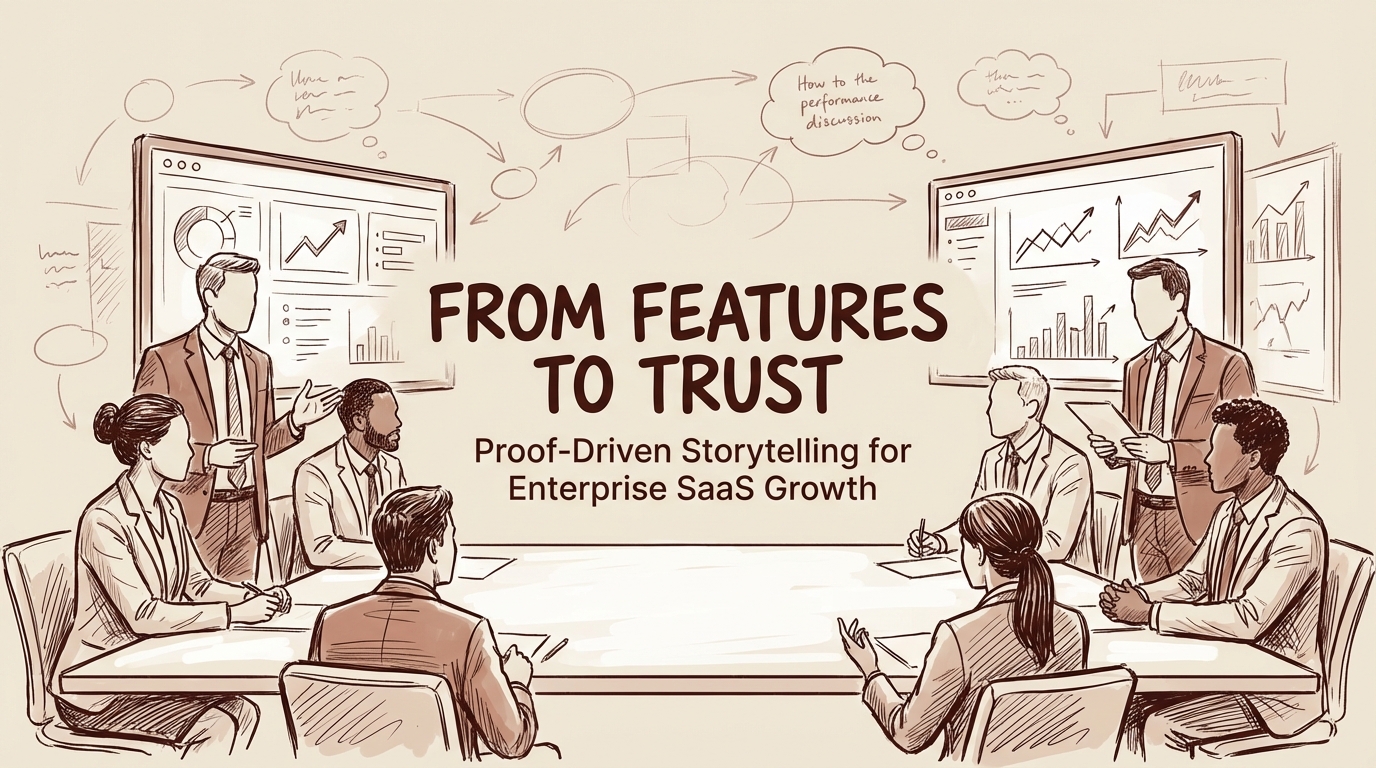
Enterprise SaaS buyers are drowning in promises. Every vendor claims they will transform operations, reduce costs, and accelerate growth. What separates winning companies from the noise is a fundamental shift: moving from abstract claims to concrete, quantified proof wrapped in compelling, relevant narratives.
Today’s enterprise decision-makers demand evidence before committing to six- or seven-figure deals. They want to see real-world outcomes, measurable business results, and stories of companies like theirs achieving tangible impact. Storytelling with proof—anchored by case studies, benchmarks, and quantified outcomes—has become a defining trend in enterprise sales, marketing, and relationship selling.

The Trust Gap in Enterprise SaaS
Enterprise buyers are skeptical by design. A single software decision can affect thousands of employees, reshape workflows, and influence annual revenue. The execution risk is high, and careers are on the line. As a result, buyers lean heavily on evidence-based content to reduce uncertainty throughout their buying journey.
According to The Gutenberg, 73% of B2B marketers consider case studies one of the most effective content types for building credibility and driving conversions. That is not a coincidence. Case studies act as proof that a solution delivers measurable business outcomes. For enterprise technology and SaaS buyers, this validation addresses the fundamental fear underlying every major purchase: “Will this actually work for us?”
The most sophisticated enterprise sales teams understand that consultative selling today means bringing proof into every conversation. Rather than leading with features or generic benefits, they lead with evidence. They position themselves as partners who have solved similar challenges for comparable organizations—and they quantify exactly what success looked like.
Why Quantified Outcomes Matter More Than Ever
Vague benefits are no longer persuasive. When a prospect hears, “Our solution improves efficiency,” they tune out. When they hear, “Our platform helped a Fortune 500 retailer increase customer retention by 27% and sales by 18% within six months,” they lean in.
This shift mirrors a deeper change in how enterprise technology is evaluated. Vendors are increasingly adopting outcome-based business models, where their fees are tied to specific, measurable results. Research highlighted by Correct Context indicates that 30% of enterprise SaaS solutions will incorporate outcome-based components by 2025—a trend that fundamentally changes the game.
When vendors tie their economics to customer outcomes, they make a powerful statement: “We believe in our product enough to bet on it.” For sales professionals engaged in relationship selling, this creates a strategic advantage. It gives you permission—and ammunition—to shift conversations away from feature comparisons and toward impact quantification.
Your role becomes demonstrating, with proof, that you understand the specific business challenges your prospect faces and that you have a verified track record of solving them. Proof is no longer a “nice to have”—it is the currency of trust.

Building a Proof Strategy: Three Essential Elements
Effective proof-driven selling rests on three integrated components that transform a simple success story into a persuasive, enterprise-ready asset.
1. Clear Business Context
The strongest case studies begin by articulating a specific, relatable business problem. Instead of, “Company X needed better data visibility,” a more compelling framing is, “A Fortune 500 retailer was losing millions annually due to siloed data that prevented real-time customer insights.”
This level of specificity makes the story resonate. When your prospect recognizes their own challenge reflected in your case study, they become emotionally and intellectually invested in the outcome. In consultative selling, this moment of recognition is when trust begins to build.
2. Solution Transparency
Next, explain not just what you did, but why it mattered and what made your approach distinct. This is where objection handling often happens naturally. If a prospect worries about integration complexity, a case study that demonstrates a seamless implementation—with a short, defined timeline and minimal IT disruption—reduces that concern without confrontation.
The proof speaks for itself. When you can reference a similar company that shared the same concern and still achieved rapid, successful adoption, you handle objections through narrative rather than debate.
3. Quantifiable Results
The numbers are non-negotiable. “Improved customer retention” is vague. “Customer retention increased by 27%” is powerful. Precision creates credibility.
Strengthen this further with third-party validation, internal dashboards, or client testimonials that add additional credibility layers. When you cite measurable outcomes, you are no longer asking the prospect to trust your promise—you are showing them what has already been achieved in the real world.
The Modern Case Study as a Core Sales Communication Tool
Traditional sales communication often follows a predictable pattern: features, benefits, call to action. Modern enterprise SaaS communication follows a different arc: business challenge, implementation narrative, quantified impact, client voice.
Leading SaaS companies model this well. A CRM vendor might highlight how an industrial manufacturer increased sales productivity by 22% by consolidating customer data. A product-led SaaS company might demonstrate how a financial services firm reduced onboarding time by 50% through workflow automation and better in-app guidance, echoing the data-driven storytelling approaches described by Broad Vision Marketing.
The most persuasive case studies integrate the client’s voice directly. A satisfied customer saying, “Switching to this solution helped us streamline operations and unlock new revenue,” adds authenticity that no product sheet can match. When you are in sales communication mode, these quotes become anchors that transform abstract claims into human validation.
From Content to Conversation: Making Proof Conversational
The power of proof extends far beyond static PDFs or landing pages. Today’s most effective enterprise sales teams weave proof into live conversations.
- They reference relevant benchmarks during discovery calls.
- They share specific customer outcomes when concerns arise.
- They use quantified results as evidence in pricing and procurement negotiations.
This consultative approach recognizes that enterprise buyers are information-hungry but time-constrained. They want evidence, but they want it curated and contextualized.
A single customized case study that speaks directly to a prospect’s industry, company size, and challenge is worth more than ten generic success stories. To achieve this, your sales team should maintain a “proof library” organized by vertical, segment, and use case. When a prospect raises a concern about implementation risk, you do not recite features—you surface a relevant case study showing how a similar organization mitigated that exact risk and what timeline they experienced.
When objection handling arises around ROI justification, you bring forward quantified benchmarks that show realistic payback periods and expansion potential for comparable customers.
Building Trust Through Benchmark Transparency
Beyond individual case studies, leading enterprise SaaS companies leverage anonymized benchmarks as high-impact proof. Instead of vaguely claiming their solution “outperforms competitors,” they publish data showing how their customers perform against industry standards and peer groups.
This approach serves multiple functions in relationship selling:
- It signals transparency and confidence. You are not hiding behind slogans; you are putting real numbers in front of buyers.
- It creates a decision framework. Prospects can quickly understand whether their current performance is lagging, average, or leading—and what the upside could look like.
- It reframes the conversation. Instead of debating whether your solution “works,” you discuss where the prospect sits today, where they want to be, and what closing that gap would mean financially and operationally.
This is consultative selling at its most sophisticated: helping buyers see themselves in the data and co-defining what success should look like.

Making Proof Real: Practical Implementation Tips
- Organize case studies by selling motion: Create distinct proof assets for different buyer personas and use cases. A cost-savings story resonates more with a CFO, while a speed-to-market narrative is more compelling for a COO or product leader. In consultative selling, matching the right proof to the right stakeholder is essential and signals that you understand their unique priorities.
- Quantify the path, not just the destination: Show how outcomes were achieved, not only the final numbers. “Activation rate improved from 45% to 68% in 90 days” tells a story of momentum. “Customer onboarding time was reduced by 50% through automation and standardized workflows” provides a blueprint for replication, similar to the practical examples documented by Directive Consulting.
- Update and refresh proof regularly: An outdated case study erodes credibility. Maintain a steady pipeline of new stories that reflect current market conditions, technologies, and buyer expectations. Fresh proof signals that you are actively solving today’s problems, not just showcasing yesterday’s wins.
The Relationship Selling Advantage
In relationship selling, trust compounds over time. Early-stage proof—case studies, benchmarks, testimonials—establishes credibility. But sustained relationships are built through the ongoing delivery and communication of quantified value.
High-performing enterprise SaaS organizations understand this. They do not use proof only to close deals; they use it to set expectations for long-term partnership. Post-sale, they continue to share benchmarks, highlight new use cases, and surface adjacent success stories that inspire expansion.
This turns proof into a shared language of value. Success plans are grounded in metrics. Quarterly business reviews focus on realized and future outcomes. Both sides can see, in black and white, whether the partnership is delivering.
The Future of Proof-Driven Sales
As enterprise SaaS matures, proof-driven selling will only intensify. Outcome-based pricing models are expanding. Buyer expectations for transparency are rising. The ability to show not just capability, but proven impact, has shifted from competitive edge to baseline requirement.
For sales professionals and revenue leaders, the path forward is clear:
- Invest in building a structured, searchable proof library.
- Train your team to lead with evidence instead of feature lists.
- Organize proof by buyer challenge, persona, and industry.
- Embed case studies, benchmarks, and quantified outcomes into every key sales interaction.
The organizations winning in enterprise SaaS today are those that have fully embraced storytelling with proof. In a market flooded with vendor claims, authentic evidence—rooted in real customer outcomes—remains the most powerful sales tool available.
This is more than a sales tactic; it is a philosophy that treats enterprise buyers as rational decision-makers who deserve clarity, transparency, and proof that you can deliver real business value. In true consultative selling, this approach elevates the salesperson from vendor to trusted advisor—someone who brings not just solutions, but validated proof that those solutions work.
As you refine your sales communication strategy, consider how proof-driven storytelling can elevate every conversation. Tools like Mindreader software can amplify these efforts by giving your sales team real-time access to relevant case studies, benchmarks, and quantified outcomes at every critical moment—enabling truly evidence-backed selling that builds trust and closes complex enterprise deals.