The Rise of Consultative Selling in the Self-Service Buyer Era
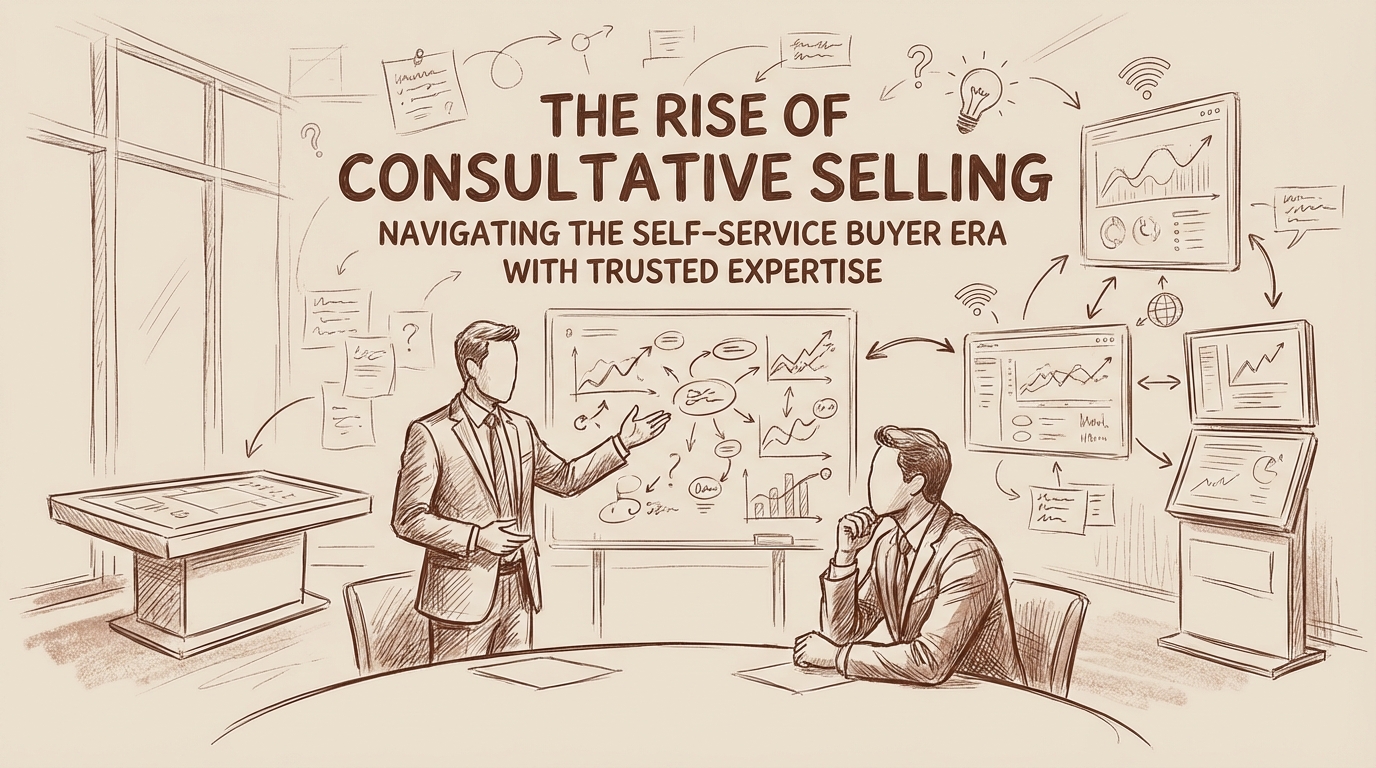
In 2026, buyers arrive at sales conversations armed with more knowledge than ever before, often completing up to 80% of their research independently before speaking to a salesperson. This self-serve reality is fundamentally reshaping the sales landscape. To win, high-ticket sales professionals must move beyond product pitches into deep consultative selling, where every interaction builds trust, delivers tailored strategic value, and strengthens long-term relationships.

Understanding the Dominant Trend: Self-Service Buyers and the Death of Product Education
Today's sales ecosystem is defined by the self-service buyer revolution. Buyers research, evaluate, and compare vendors on their own, arriving at sales conversations with a clear view of available solutions, competitors, pricing, and organizational fit. As highlighted in sales trend research from monday.com Sales Trends 2026, more than 70% of the B2B buying journey now happens before a buyer engages a sales team.
This shift renders traditional product education almost obsolete. Buyers no longer need salespeople to walk through basic features they have already dissected via websites, review platforms, and peer communities. Instead, the value now lies in consultative selling—helping buyers interpret what they have learned, prioritize initiatives, and design a path to measurable outcomes.
Sales professionals must step into a strategic consulting role, providing industry context, outcome-focused advice, and implementation expertise that self-research cannot replicate. Modern buyers want guidance on change management, ROI realization, and business model implications. When done well, consultative selling elevates sales communication from transactional to transformational.
Why Consultative Selling Is the #1 Trend for High-Ticket Relationship Selling
Consultative selling tops the list of 2026 sales trends because it directly addresses buyer skepticism and rising expectations. With buyers more informed and more selective, generic outreach fails. AI-driven tools and content have raised the bar for personalization and insight, making templated pitches feel shallow and interchangeable.
According to insights from MTD Sales Training Future of Selling 2026, the most successful sales organizations are leaning heavily into expertise, trust, and advisory-led conversations. By diagnosing root problems, quantifying impact, and mapping solutions to outcomes, consultative sellers earn the right to influence high-stakes decisions.
Data-backed consultative approaches often see significantly higher win rates in complex, high-ticket deals. Relationship selling thrives in this context, extending beyond the initial transaction to long-term strategic partnerships. Sales professionals who master this model anticipate evolving needs, provide continuous value, and measure success by customer outcomes, renewal, and expansion revenue—not just closed-won deals.
AI plays a powerful support role here. As noted in research from Salesforce Top Sales Trends 2026, AI increasingly handles administrative tasks, surface insights, and recommend actions, freeing human sellers to focus on high-value conversations centered on trust, judgment, and nuanced advisory.

Key Statistics Highlighting the Urgency of This Shift
The data paints a clear picture of urgency. By 2026, roughly 70–75% of B2B buyers report completing most of their buying journey without active sales involvement, meaning sellers are invited in only at critical decision points. Organizations that prioritize consultative selling, strategic relationship building, and outcomes-based success reporting are seeing measurable advantages: faster sales cycles, higher win rates, and stronger customer lifetime value.
These organizations often implement unified revenue models that align marketing, sales, and customer success teams around shared outcomes and account health, a trend reinforced by research from Global Performance Group 26 Sales Trends. When everyone is measured on customer impact instead of isolated departmental metrics, consultative behaviors are naturally rewarded.
The result is a stark divide. Teams still relying on product-centric pitches and feature dumps are increasingly outmaneuvered by those who master objection handling through deep business advisory. The latter use buyer concerns as springboards to demonstrate expertise, refine the business case, and strengthen the partnership.
Mastering Sales Communication in a Consultative World
Effective sales communication in 2026 emphasizes conversations over presentations. Winning sellers do less telling and more asking—probing for context, priorities, constraints, and risk tolerance. The goal is to co-create a pathway from the buyer's current state to their desired future state.
Objection handling evolves in this environment as well. Rather than treating objections as barriers to be overcome, consultative sellers view them as invitations to clarify, educate, and align. They respond with empathy, test their understanding with follow-up questions, and tie responses back to agreed outcomes. This approach reduces defensiveness and reinforces trust.
For high-ticket sales, this happens across multiple channels: virtual meetings, in-person sessions, and asynchronous interactions such as recorded demos and shared digital workspaces. Hybrid selling environments are now the norm. As discussed in Badger Maps Sales Trends 2026, top sellers blend marketing and sales skills to orchestrate streamlined, high-impact buyer journeys that feel cohesive across every touchpoint.
Digital sales rooms and collaborative workspaces centralize deal communication, documents, and decision criteria. Engagement signals—who views what, for how long, and when—feed into forecasting models that predict deal health. AI quietly captures data in the background, populating CRMs and surfacing next-best actions. Human sellers remain front and center, but now operate as strategic advisors supported by powerful technology.
3 Practical Tips to Implement Consultative Selling Today
To thrive in this consultative ecosystem, you do not need to overhaul your entire sales motion overnight. Instead, start by upgrading the quality of your conversations using these three practical strategies.
1. Focus on Outcomes First
Begin every interaction by mapping the buyer's current reality to their desired future results. Ask questions such as:
- What outcomes are you under pressure to deliver this quarter or this year?
- Which metrics matter most to your leadership team, and how are they trending today?
- What constraints—budget, bandwidth, risk tolerance—could slow progress?
Once you have this context, align your solution explicitly to their strategic objectives. Replace feature-heavy demos with scenario-based conversations that show how your offering de-risks decisions, unlocks value, and accelerates time-to-impact.
2. Leverage AI for Precision Personalization
Use AI tools to analyze buyer data—firmographics, technographics, engagement patterns, and content consumption—to craft outreach that speaks directly to each account's priorities. Intelligent recommendations can help you tailor messaging by persona, industry, and buying stage, ensuring that every touch feels relevant and considered.
This type of personalization, highlighted across multiple 2026 sales trend analyses, positions you as a consultative partner rather than a generic vendor. When prospects feel truly understood from the first touch, they are more willing to share candid details about their internal dynamics and constraints, which further sharpens your advisory role.
3. Practice Advanced Objection Handling
Upgrade your objection handling by treating every concern as a doorway to deeper discovery. When a buyer raises an objection, resist the urge to respond immediately with a rebuttal. Instead:
- Clarify the concern by asking follow-up questions to uncover the real root issue.
- Reframe objections around desired outcomes, demonstrating how the right approach mitigates risk or increases returns.
- Illustrate your points with relevant case studies and stories that mirror the buyer's situation.
- Co-create implementation and success plans that address their specific risks and constraints.
This approach turns skeptics into collaborators and, ultimately, advocates. You are no longer "handling" objections; you are partnering with the buyer to build a solution that will stand up to internal scrutiny.

Building Strategic Partnerships for Long-Term Success
Consultative selling is the gateway to enduring strategic partnerships. In 2026, success metrics are no longer limited to quarterly bookings. High-performing teams track expansion revenue, churn prevention, product adoption, and relationship health alongside deal size.
Unified data platforms give everyone a shared view of account status: marketing sees which campaigns influence revenue, sales sees product usage and stakeholder engagement, and customer success spots opportunities for proactive support. This cross-functional alignment encourages ongoing value creation instead of one-off wins.
High-ticket deals, in particular, demand this depth. Buyers in complex, multi-stakeholder environments want a partner who will continue to guide optimization, adoption, and innovation long after the ink is dry. Sellers who invest in understanding their customers' evolving business models become embedded advisors rather than replaceable suppliers.
Overcoming Challenges in the Consultative Shift
Transitioning to a fully consultative model is not without friction. Teams rooted in traditional selling often resist moving from instinct to data-driven decision-making. Siloed departments make it difficult to present a unified, strategic front to the buyer. Legacy tools and rigid processes can slow adoption of more collaborative ways of working.
To overcome these challenges, invest in targeted sales training for micro-skills like business acumen, financial storytelling, change management, and AI collaboration. Modern CRMs and revenue platforms should enable flexible workflows, easy data sharing, and clear visibility into account health. Hybrid roles that blend sales and marketing capabilities—an emerging trend documented across multiple 2026 sales forecasts—help streamline funnels and shorten sales cycles, especially in high-ticket environments.
Objection handling remains a critical lever during this transformation. Use it not only with external buyers, but also internally with stakeholders who are wary of new tools or processes. Share market data, customer wins, and competitive insights that illustrate why consultative, AI-augmented selling is no longer optional.
Embracing the Future: Your Call to Action
As the 2026 sales landscape continues to evolve, one reality is clear: the greatest salespeople will not merely sell products—they will unlock possibilities. They will translate information into insight, options into strategy, and transactions into durable partnerships.
You already possess the core skills. Now is the time to refine them with consultative precision. Start by redesigning your discovery conversations around outcomes, leaning on AI for intelligent personalization, and treating every objection as a chance to deepen trust. Then, reinforce these behaviors with tools that decode buyer intent and streamline collaboration.
Integrating platforms like Mindreader software into your process can accelerate this shift by revealing real-time buyer signals, supercharging your objection handling, and amplifying your ability to build unbreakable, high-value relationships. In an era where buyers can research any product on their own, the differentiator is not what you sell—it is how you help customers think, decide, and succeed.