
Ever heard of a color personality test? It's a surprisingly straightforward way of connecting your preferences for certain colors to your deeper personality traits, how you communicate, and what drives your decisions. The idea is simple: our gut attraction to specific hues is subconsciously tied to our inner nature, offering a quick lens to better understand ourselves and others.
Unlocking Insights with the Color Personality Test
Imagine having a cheat sheet that gives you a glimpse into a client's mindset before you even start your pitch. That's exactly what a color personality test can feel like in a practical sense. It’s like a ‘communication compass,’ where each color guides you toward the most effective way to navigate a conversation and build genuine rapport.
This isn’t just about someone’s favorite shade of paint. The concept is built on the observation that our affinity for certain colors can reveal key aspects of who we are. For anyone in sales, this offers an immediate and powerful edge, allowing you to tailor your message so it resonates on a far more intuitive level. While they aren't rigid scientific instruments, these frameworks are grounded in observable patterns linking personality to color choice.
The Four Primary Archetypes
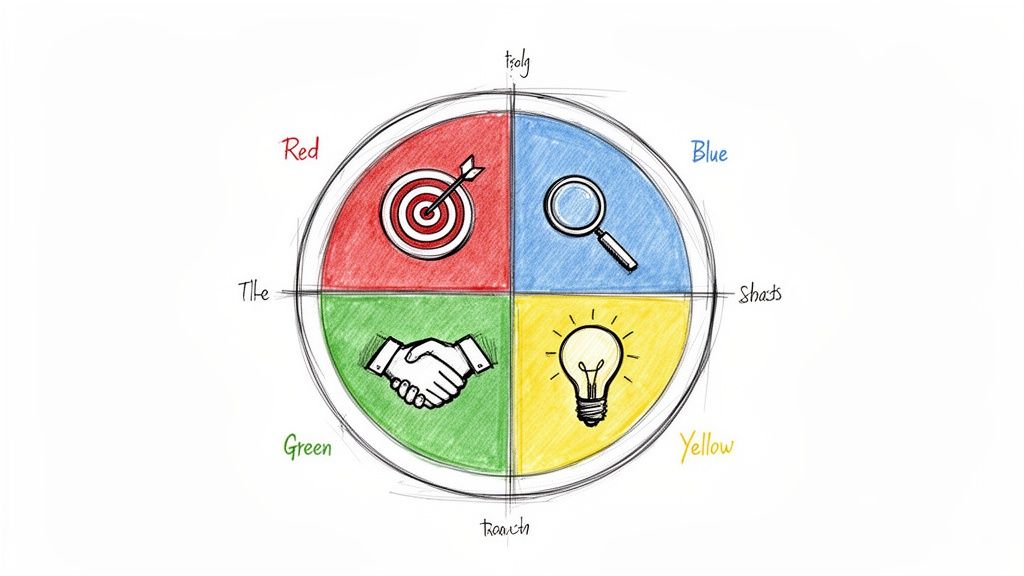
Most color-based models boil personality down to four main archetypes. This simplicity makes the system easy to remember and apply on the fly, especially in fast-paced business scenarios. You'll find different systems use slightly different names, but the core traits are remarkably consistent across the board.
Here’s a quick look at the core four:
- Red: These are the decisive, goal-oriented leaders who value efficiency and get straight to the point.
- Blue: This group represents the analytical, data-driven thinkers who appreciate logic, details, and precision.
- Green: Think collaborative, relationship-focused supporters who prioritise harmony, trust, and consensus.
- Yellow: These are the innovative, expressive creatives motivated by big ideas, enthusiasm, and new possibilities.
Understanding these foundational categories lets you quickly adapt your approach. And this is more than just anecdotal—research consistently finds real connections between personality and color.
A fascinating 2022 study in Seoul looked into these links with 854 individuals. The findings were clear: those high in Extraversion overwhelmingly preferred vibrant reds and oranges. Meanwhile, individuals high in Agreeableness gravitated toward calming blues and greens, reporting 28% higher preference rates for these shades. It really highlights just how deeply our color preferences are wired into our communication styles.
Four Core Color Archetypes at a Glance
To make it even clearer, here's a simple breakdown of how these archetypes typically show up in a professional setting. Think of this table as your quick-reference guide.
| Color Archetype | Dominant Personality Trait | Communication Style | Decision-Making Driver |
|---|---|---|---|
| Red | Decisive & Goal-Oriented | Direct & To-the-Point | Results & Efficiency |
| Blue | Analytical & Detail-Oriented | Factual & Logical | Data & Proof |
| Green | Supportive & Harmonious | Collaborative & Calm | Trust & Relationships |
| Yellow | Enthusiastic & Expressive | Visionary & Inspiring | Ideas & Innovation |
Recognising these patterns can give you a massive advantage when trying to connect with a potential client or colleague.
A Framework for Better Communication
At its heart, a color personality test is a tool for building empathy. It helps you anticipate how someone might receive information, what they truly value in a discussion, and what could cause unnecessary friction.
By identifying a prospect’s likely archetype—whether they’re a direct Red or a supportive Green—you can adjust your pitch to meet their psychological needs right from the start.
This simple framework helps you move beyond a one-size-fits-all sales script and embrace a more adaptive, human-centric approach. While these insights are incredibly valuable, it’s important to remember they offer a starting point, not a complete picture. For a deeper look at how these assessments stack up against other methods, you might find our guide on the role of https://themindreader.ai/blog-insights/static-personality-tests in sales helpful.
Ultimately, this approach allows you to open conversations with greater awareness and build stronger, more authentic client relationships from the very first interaction.
The Psychology Behind Color and Personality
The real value of a color personality test in sales isn't just a quirky gimmick; it's grounded in the deep, psychological ties between colors and how we think and act. These connections aren't random. They’re a blend of hardwired evolutionary responses and the cultural meanings we've learned over a lifetime.
Think about it from a survival perspective. For our ancestors, colors were critical signals. A bright red could mean danger, like fire, but it could also mean a life-saving ripe berry. This primal wiring is still with us, which is why red often triggers feelings of alertness or decisiveness—a handy insight when you’re trying to understand someone’s personality.
Cultural Layers and Learned Meanings
On top of that biological foundation, culture adds rich, complex layers of meaning. In many Western cultures, white is the color of weddings and purity. In parts of Asia, it's traditionally the color of mourning. These learned associations are powerful, shaping how we see the world and how our color preferences reflect who we are in a social context.
A color personality test taps into both of these streams. It looks at preferences that might point to innate traits (like being drawn to stimulating, warm colors) while also considering the symbolic meanings that subtly guide our communication styles and motivations.
Scientific Links Between Traits and Hues
Modern research is increasingly providing solid evidence for these connections, moving them beyond simple observation into statistically significant findings. Study after study shows correlations between core personality traits and specific color affinities, giving real credibility to the frameworks these tests use.
This chart shows a cluster analysis from a 2022 study. It identified five distinct personality groups, each with its own unique color signature.
The analysis reveals clear patterns. Extroverts, for instance, tend to prefer vibrant reds and oranges, while more agreeable individuals often gravitate towards calming blues and greens. This gives statistical weight to the idea that our color choices are far from random—they’re a reflection of our underlying psychological makeup.
Further research backs this up. A detailed study of Singaporean college students found profound, personality-driven differences in their clothing color choices. The data showed that extroverted students preferred blues by 31%, while those with more neurotic tendencies leaned towards red and purple at 27% higher rates. Introverts? They favoured yellow-greens 24% more. The study confirmed that personality was a key predictor, validating the core idea behind color-based assessments.
The key takeaway is that color personality tests are not rigid diagnostic tools designed to label people. Instead, they are powerful guides for developing empathy, building rapport, and understanding communication preferences on a more intuitive level.
Ultimately, the psychology behind these tests is all about pattern recognition. To see how this works in a practical sense, it’s worth exploring how specific color choices can influence perception, like learning about the best colors to wear for professional headshots. By understanding the 'why' behind someone's affinity for a certain color group, sales professionals gain a valuable reference point for adapting their messaging and building stronger connections. It’s about using these insights wisely to foster better, more human interactions.
Decoding the Four Main Color Personalities
While color personality frameworks can seem complex, most boil down to four primary archetypes. Getting to know these core profiles is a bit like learning the basic grammar of a new language—once you’ve got the fundamentals down, you can start communicating far more effectively.
Let’s translate these abstract color archetypes into the real-world business personas you meet every day. Each one is driven by a unique core motivation that shapes how they talk, what they value, and ultimately, what makes them say “yes.” Spotting these patterns is the key to adapting your approach and building momentum from the very first handshake.
This diagram shows how our perceptions of color are shaped by both primal evolutionary responses and learned cultural associations.
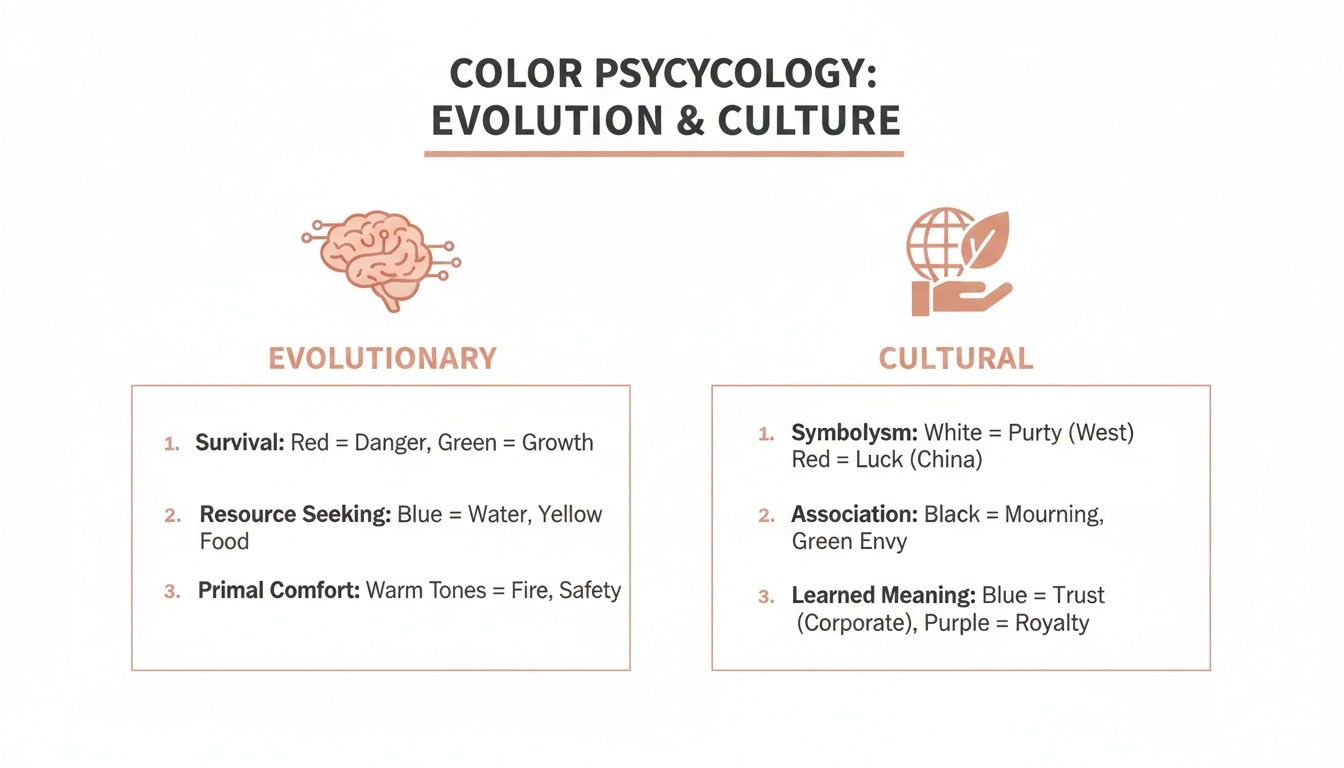
This dual influence is precisely why a color personality test can be so insightful; it taps into both deep-seated psychological triggers and the shared meanings we assign to colors as a society.
The Direct Red Personality
First up is the "Red" personality—the decisive, goal-focused leader who’s motivated by results and control. They see the world in terms of objectives, efficiency, and getting things done. When you’re in a room with a Red, they expect you to get straight to the point.
Their internal monologue is always asking, "What's the bottom line?" Wasting their time with fluffy conversation or rambling details is the fastest way to lose them. They value a clear ROI, quick decisions, and concrete outcomes. To earn their trust, you need to project confidence and focus squarely on how your solution helps them win.
Communicating with a Red:
- Do: Be direct, stick to the facts, and frame everything around results and efficiency.
- Don't: Be vague, overly emotional, or take too long to get to your main point.
The Analytical Blue Personality
Then you have the "Blue" personality, the quintessential analytical and data-driven thinker. Motivated by logic and accuracy, Blues need to understand every last detail before they even consider making a decision. For them, the value is in the facts, the evidence, and a well-thought-out process.
When you're pitching to a Blue, bring your data. And then bring some more. They are naturally skeptical and will poke holes in your claims, so come armed with case studies, statistics, and a logical, step-by-step presentation. Building trust with a Blue means proving you've done your homework and demonstrating true expertise. They appreciate precision and will absolutely notice if you haven’t.
Key Insight: Blues aren't trying to be difficult when they ask a dozen questions. They're simply processing information in the methodical way that makes them feel secure. Your patience and thoroughness are your greatest assets in building a solid foundation of trust with them.
The Supportive Green Personality
Next, meet the "Green" personality. They are the relationship-focused consensus-builders of the world. Motivated by harmony and security, Greens place trust, empathy, and genuine connection above all else. They are incredible listeners and naturally work to make sure everyone in the room feels heard and included.
To connect with a Green, you have to build authentic personal rapport. A hard-sell, high-pressure approach will make them shut down immediately. Instead, practice active listening, show you genuinely care about their team's well-being, and provide plenty of reassurance. This isn't just theory; research shows how personality traits link to color associations. For instance, a study of 3,170 respondents found that females scoring 12% higher on Neuroticism preferred soothing greens and blues 22% more than males. This suggests a 'Healer' or Green archetype's preference for calming colors can give a sales rep valuable cues on pacing and tone.
Communicating with a Green:
- Do: Be patient, listen more than you talk, and focus on building a real personal connection.
- Don't: Be pushy, dismiss their feelings, or create a stressful, high-pressure environment.
The Expressive Yellow Personality
Finally, there's the "Yellow" personality—the expressive, big-picture visionary. Motivated by fun, social recognition, and excitement, they are enthusiastic idea-generators who thrive on exploring new possibilities. Anything innovative and forward-thinking will grab their attention.
When you're engaging a Yellow, match their energy and bring the inspiration. They're far less interested in the tiny details and much more captivated by the future vision. Focus on the big ideas, share exciting success stories, and paint a picture of how your solution is new and groundbreaking. To build trust with a Yellow, you need to share their enthusiasm and show that you appreciate their creative spark.
For a deeper look at tailoring your sales approach, check out our guide on selling to the four sales personality types.
Communicating with Different Color Archetypes
Knowing the theory is one thing, but putting it into practice is what really counts. Here’s a quick-glance table to help you adapt your communication strategy on the fly when you're preparing for your next meeting.
| Color Archetype | How to Open a Meeting | Key Selling Point to Emphasize | Common Objections and How to Handle |
|---|---|---|---|
| Red | "Thanks for your time. Let's get right to it. The main outcome we can deliver for you is..." | Bottom-line results: How it increases profit, saves time, or beats the competition. | "This is too slow." Show them the fastest path to ROI and highlight efficiency gains. |
| Blue | "I've prepared an agenda and brought the data you requested to walk you through our process." | Proof and Logic: Case studies, data, security features, and a clear implementation plan. | "I need more data." Willingly provide it. See their questions as buying signals, not obstacles. |
| Green | "How has your team been finding the current situation? I'd love to hear your perspective first." | Team harmony and support: How it reduces risk, improves collaboration, and offers reassurance. | "This seems disruptive." Emphasise support, training, and how you'll ensure a smooth, risk-free transition for everyone. |
| Yellow | "I'm really excited to show you something innovative that I think will capture your team's imagination." | The big picture and vision: How it's new, creative, and will earn them recognition. | "I'm bored by the details." Keep the focus on the exciting vision and delegate the granular details to their team. |
Think of this table not as a rigid script, but as a compass. It's designed to help you orient your messaging to resonate more deeply, build trust faster, and ultimately, make your conversations more productive.
Putting Color Insights Into Your Sales Process
Knowing the theory behind a color personality test is one thing, but translating that into action is where you’ll start seeing real results. This is all about moving from simply understanding the archetypes to weaving those insights into every part of your sales cycle. And it starts long before you ever jump on a call.
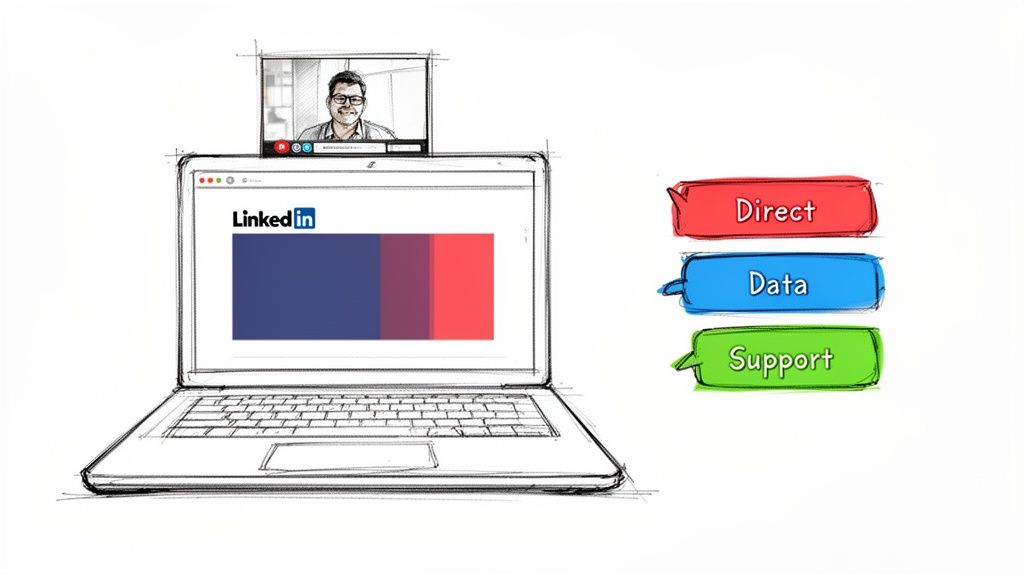
Your pre-call research is the perfect place to begin. As you’re looking through a prospect's LinkedIn profile, notice the colors they use in their banner or headshot. A stark, minimalist design with bold reds or blacks could be a clue you're dealing with a 'Red' personality. That's your signal to prepare a direct, no-fluff opening that gets straight to the results.
On the other hand, if their profile is full of warm, earthy tones, you might be looking at a 'Green' who would respond much better to a personal, relationship-first approach. These little clues are your first data points, helping you build an early hypothesis about their style before you’ve even said hello.
Adapting During the First Interaction
Once you’re in a meeting—virtual or face-to-face—your powers of observation are your biggest advantage. Listen closely to the words your prospect chooses. Are they all about the big-picture vision and future possibilities ('Yellow')? Or are they immediately drilling down into specific data points and timelines ('Blue')?
Even their virtual background can offer a hint. A custom background flashing their company's ambitious mission statement feels very 'Yellow', while a tidy, perfectly organised bookshelf could point to a 'Blue' personality. Use these real-time observations to subtly adjust your own tone and pacing, mirroring their style to build that all-important subconscious rapport.
The goal isn't to become a carbon copy of them. It's about adapting your communication so they feel truly heard and understood. When you speak their language, you build the trust needed to move any deal forward—fast.
This kind of responsive adaptation shows you're paying attention to them as a person, not just as a business problem to be solved.
Customising Your Communication and Follow-Up
This is where applying color insights gets really powerful. A generic, one-size-fits-all pitch deck or follow-up email is a massive missed opportunity to connect on a much deeper level.
Think about how you can tailor your approach based on what you’ve learned:
- For the Red Personality: Keep emails brutally short. Use bullet points that scream "outcomes" and attach a crisp, one-page executive summary. Your pitch deck should lead with the bottom-line ROI.
- For the Blue Personality: Your follow-up needs to be packed with detail. Think data sheets, technical case studies, and a clear project plan. Your presentation has to be logical, sequential, and overflowing with evidence.
- For the Green Personality: Send a warm, personalised email that references a personal connection you made during the call. Your materials should shine a spotlight on team benefits, ongoing support, and testimonials from happy, real-life clients.
- For the Yellow Personality: Follow up with an energetic summary of the big, exciting ideas you discussed. Your pitch deck should be visually stunning, focusing on the future vision and innovative potential of your solution.
At the end of the day, understanding the psychology driving your buyers is the bedrock of effective selling. Other powerful frameworks and psychology-based sales methodologies are built on similar principles of guiding interactions more effectively. By subtly customising your approach, you’re not just selling; you’re showing empathy. That’s how you make your message resonate, turning smart insights into stronger connections and measurable business results.
Using Color Insights Ethically and Effectively
Getting your hands on insights from a color personality test is a bit like being given a superpower for connection. But with that power comes a serious responsibility: you have to use it ethically. The golden rule is simple. Treat these insights as a way to build bridges, not to put people in boxes. Trust is always built on authenticity, not assumptions.
Stereotyping a client based on their supposed color is the fastest way to shatter that trust. Assuming a direct ‘Red’ personality doesn’t give a damn about their team, for example, is a rookie mistake. People are always, always more complicated than any single framework can ever capture.
Fostering Connection Over Manipulation
The real point of using personality insights is to adapt your communication style so the other person feels comfortable and truly heard. It’s all about adjusting your approach to build a genuine connection, not to manipulate someone into a sale. This is the heart of modern, trust-based selling—it’s about enhancing the human interaction, not gaming it.
When you get this right, you’re not trying to trick someone into a decision. You’re showing empathy by speaking their language. For an analytical 'Blue', this means giving them the data they need to feel confident. For a supportive 'Green', it means creating a safe, collaborative space for discussion.
Use personality insights to open a conversation, not to end one.
This mindset is everything. It keeps the focus squarely on mutual understanding and respect, which is the only real foundation for a lasting professional relationship.
A Guide for Authentic Engagement
At the end of the day, a color personality test is just a tool to help you listen and observe better. It’s a prompt to pay closer attention to the verbal and non-verbal cues people are already giving you, helping you respond more thoughtfully. This is worlds away from just sticking to a rigid script.
Think of it like having the right key for a specific lock. You aren’t changing the lock itself; you’re just using the correct tool to open it smoothly and without force.
Of course, understanding the limits of these models is also key. To learn more, check out our article on the challenges in using AI for personality typing. When you use these insights to serve, not to pigeonhole, you elevate every single interaction.
Common Questions About Color Personality Tests
Even after getting a handle on the four archetypes, you probably still have some questions floating around. That’s perfectly normal. Let's tackle some of the most common ones that pop up when sales professionals first bump into color personality tests.
Getting these cleared up is the first step to using these ideas with confidence—and doing it in a way that’s both effective and ethical.
Are Color Personality Tests Scientifically Valid?
Let's be clear: a color personality test isn't a "hard science" tool that can predict the future with perfect accuracy. However, the core ideas behind it are well-supported by psychological research. Countless studies have found real correlations between foundational personality traits (like extroversion) and preferences for certain colors (like warm, energetic hues).
Think of it less as a definitive diagnosis and more as a way to make an educated guess about someone's communication style. It gives you a powerful starting point for building rapport, which you can then fine-tune through a real, human conversation. It’s a guide, not a gospel.
How Can I Find Out My Own Color Personality?
There are plenty of free quizzes online that can give you a general sense of your own color personality. They usually ask about your preferences and how you like to work. These are a great way to start building a bit of self-awareness.
But for a more focused, sales-specific application, professional tools go deeper. They analyse multiple data points to assign a practical archetype. This gives you much more actionable advice on how to play to your natural communication strengths and understand how others might see you.
Can Someone's Favorite Color Change?
Absolutely. A person’s favorite color can—and often does—shift over time. It can change with new life experiences, a shift in mood, or even just exposure to different cultures. It's a completely natural part of how we grow.
However, the core personality traits these tests aim to measure tend to be much more stable once we reach adulthood. So while someone’s favorite color might change from blue to green, both colors often sit within a similar psychological space (think calm, harmonious, steady). The underlying archetype usually stays put even if the surface-level preference evolves.
The real insight here is that the test is measuring the why behind the preference, not just the preference itself. That underlying motivation is far more consistent than the color they pick today.
Is Using Color Psychology in Sales Manipulative?
This is a critical question, and the answer comes down to one thing: your intent.
When you use these insights to thoughtfully adapt to a client's communication style, you’re practising a powerful form of empathy. It’s about making the conversation more comfortable and effective for them, not about tricking them into saying yes.
For instance, presenting a logical, data-heavy case to an analytical 'Blue' archetype isn’t manipulation; it’s just clear communication in their preferred language. Manipulation is when you use these insights to deceive, pressure, or exploit someone. The ethical approach focuses on building genuine trust and rapport, which is the foundation of any strong, long-term business relationship.
Mindreader helps you apply these insights ethically and effectively, turning guesswork into a clear strategy. Discover how our AI can help you understand your clients' communication styles in seconds, so you can build trust and close more deals. Learn more at https://www.themindreader.ai.