The Ultimate Guide to the Cognitive Functions Test in Sales
When you hear someone mention a "cognitive functions test," what comes to mind? For many, it conjures up images of a single, formal exam. But the term is a bit of a catch-all, covering two completely different kinds of tools. One is a clinical evaluation a doctor would use to check for medical issues, and the other is a personality-style inventory designed to map out how someone prefers to think.
Decoding the Cognitive Functions Test
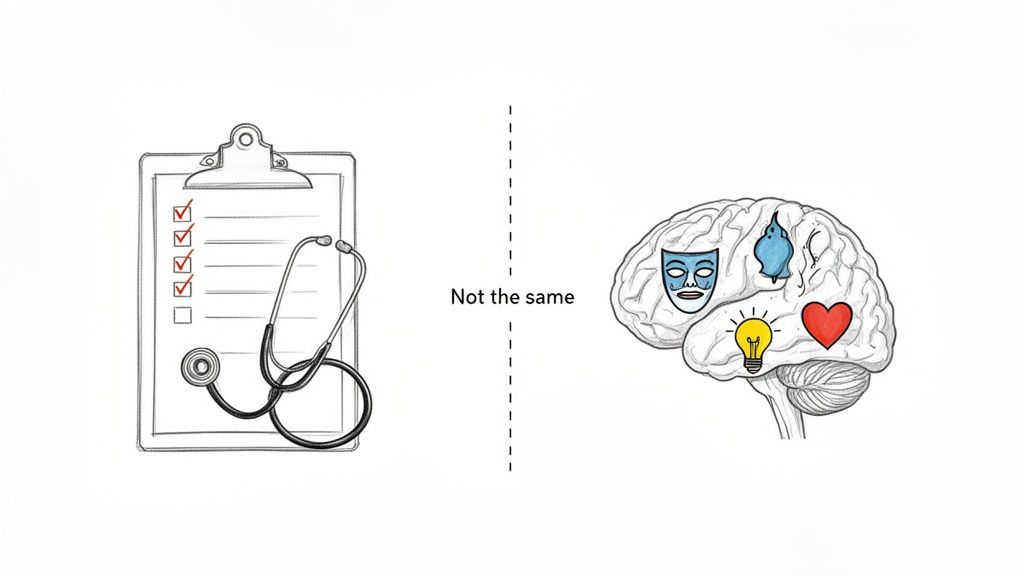
The first and most important step is getting this distinction right. Lumping these two assessments together is like confusing a car engine diagnostic with a brochure detailing its features. Both give you information about the car, but they answer completely different questions.
For sales professionals, understanding this nuance isn't just academic—it's the key to using these insights ethically and effectively.
Clinical Versus Personality Assessments
On one side of the coin, you have clinical neurocognitive screens. These are serious medical tools used by doctors, neurologists, and psychologists to spot signs of cognitive decline, brain injury, or neurological disorders. They measure core brain functions like memory, attention, and processing speed. The goal here is purely diagnostic: find out if something is wrong.
On the other side are personality-style inventories, often based on frameworks like Carl Jung’s cognitive functions. These are not medical tests. They don't measure intelligence or diagnose impairments. Instead, they offer a blueprint of an individual's preferred mental shortcuts for taking in information and making decisions.
To help clarify this, here’s a quick breakdown:
Two Types of Cognitive Tests at a Glance
| Attribute | Clinical Cognitive Screens | Personality-Style Inventories |
|---|---|---|
| Primary Purpose | Diagnose medical impairments, injury, or decline. | Identify preferred thinking and decision-making styles. |
| What It Measures | Brain ability and performance (e.g., memory, speed). | Mental preferences and habits (e.g., logic vs. feeling). |
| Who Uses It | Doctors, neurologists, clinical psychologists. | Individuals, coaches, HR professionals, sales teams. |
| Context of Use | Medical settings for health assessment. | Personal development, team building, communication strategy. |
| Example Question | "Repeat this sequence of numbers backward." | "When making a decision, are you more likely to rely on logic or on how it impacts people?" |
This table makes the contrast pretty clear. One is about fixing a problem, the other is about understanding a preference.
The core difference is purpose. Clinical tests diagnose medical issues, measuring ability and impairment. Personality inventories identify preferred thinking styles, mapping mental preferences and habits.
For sales teams, this separation is everything. The focus is always, without exception, on the personality-style inventories. The objective isn’t to play armchair psychologist with a prospect. It’s about understanding their communication style to build genuine rapport and frame your message in a way that resonates.
It's a shift from a one-size-fits-all pitch to a conversation tailored to how they naturally see the world. This leads to clearer communication and, ultimately, stronger relationships. As we dig deeper, you'll see what a modern cognitive function test for sales entails and how it’s built for this specific purpose.
Getting this foundation right prevents the misuse of sensitive information. It correctly frames cognitive insights as a tool for empathy and connection, not for amateur diagnosis. When sales teams respect these boundaries, they can responsibly use powerful psychological frameworks to become better communicators.
Understanding Clinical Neurocognitive Assessments
While personality-style inventories give us a map of preferred thinking styles, it's vital to know where they stop and their clinical cousins begin. Think of clinical neurocognitive assessments as a specialised 'mental health check-up' for the brain, used exclusively by healthcare professionals.
These are absolutely not personality quizzes. They are standardised, evidence-based evaluations designed to measure core brain functions with scientific precision. Their purpose isn't to uncover preferences but to spot potential cognitive decline or impairment from injury, illness, or age-related conditions.
What Do Clinical Assessments Actually Measure?
Unlike personality frameworks that explore how someone likes to think, a clinical cognitive functions test evaluates how well they can think. Healthcare providers use these tools to get objective data on specific cognitive domains.
The process often involves a series of structured tasks and questions designed to establish a baseline or detect changes in crucial mental abilities.
Commonly measured functions include:
- Memory: Checking both short-term recall (like remembering a list of words) and long-term memory.
- Attention and Concentration: Sizing up the ability to focus on a task, shut out distractions, and maintain that focus.
- Language Skills: Testing comprehension, fluency, and the ability to name objects or put thoughts into words.
- Executive Functions: Measuring higher-level skills like problem-solving, planning, and making decisions.
The results from these tests are sensitive, protected health information. The entire field is built on a scientific foundation, which is why a clear grasp of implementing evidence-based practice is non-negotiable for the practitioners who use them.
Why This Matters for Sales Professionals
So, why should a sales professional care about medical tests they'll never use? It all comes down to context and empathy. This is especially true if you work in sectors with an older demographic, like wealth management or luxury real estate.
An aging client who seems "difficult" or "indecisive" might not be either of those things. They could be experiencing subtle cognitive shifts that make processing complex information more of a challenge. Recognising this possibility—without ever playing doctor—allows you to adapt your entire approach.
Understanding the context of clinical cognitive health allows a sales professional to shift from persuasion to partnership. It's about creating a communication environment that is supportive, clear, and patient, which builds immense trust.
This awareness can turn a potentially frustrating interaction into a golden opportunity. Instead of pushing for a quick decision, you might slow down, bring in more visuals, or break a long meeting into shorter sessions. This isn't about exploiting a weakness; it’s about showing genuine respect and accommodating your client’s needs.
A Look at Regional Cognitive Health Trends
The need for this kind of awareness is backed by some eye-opening health data. For instance, recent studies using tools like the Mini-Mental State Examination (MMSE) and Hasegawa's Dementia Scale-Revised (HDS-R) are revealing different rates of cognitive impairment across Southeast Asia. In one rural area, HDS-R scores suggested that 29.9% of participants showed signs of cognitive impairment. This research, which also points to a higher prevalence in places like Malaysia compared to South/Central Asia, suggests a significant slice of the population may be dealing with cognitive challenges. You can dive into the full research on these regional cognitive health findings to see the detailed data.
For a salesperson in Singapore, this isn't just an abstract statistic; it's a powerful insight. It strengthens the business case for empathy and adaptability. Your prospect’s hesitation might stem from something much deeper than simple sales resistance. By understanding this broader health landscape, you can approach every client interaction with more patience and strategic foresight. This knowledge doesn't change what you sell, but it absolutely changes how you sell, turning potential roadblocks into bridges for stronger, more trusting relationships.
Mapping Personality with Jungian Functions
Alright, let's leave the clinical world of neurocognitive screens behind and get into the kind of cognitive functions test that’s actually useful—and powerful—for sales professionals. These frameworks don't measure intelligence or hunt for impairments. Instead, they’re all about mapping a person’s preferred ways of seeing and interacting with the world, based on the psychological theories of Carl Jung.
Think of it like being right-handed or left-handed. You can use both hands, of course, but one just feels more natural. It’s more efficient and requires way less conscious thought. A Jungian-based test simply aims to figure out which mental "hand" you—or your prospect—naturally favour.
It’s about revealing the cognitive tools someone instinctively reaches for when they need to gather information or make a decision. This isn’t about ability; it's purely about preference and habit.
The Core Function Pairs
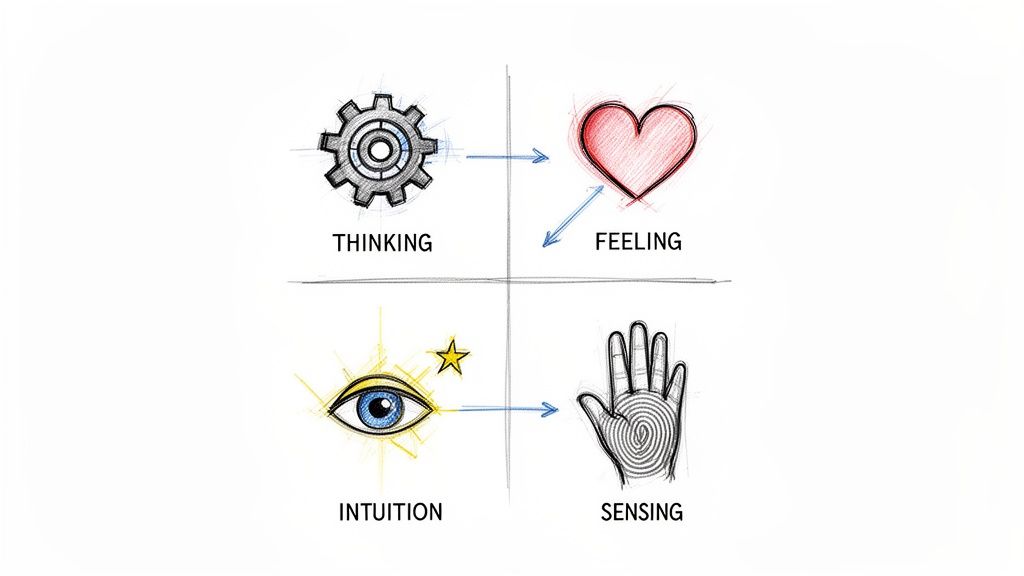
At the heart of this whole system are pairs of opposing functions. Picture them as two ends of a spectrum for how we process information. Getting a handle on these pairs is the first real step in turning abstract psychology into practical sales tactics.
The two main pairs are:
- Perceiving Functions (How we take in information): This is all about how we prefer to absorb data from the world. Do we zoom in on the concrete facts, or are we drawn to the abstract patterns?
- Judging Functions (How we make decisions): Once we have the information, this is about how we prefer to evaluate it and land on a conclusion. Do we lean on objective logic or on human-centred values?
By spotting where a prospect lands on these spectrums, you can start tuning your communication to their natural wavelength. Suddenly, your message becomes clearer, more relevant, and a lot more persuasive.
Sensing vs Intuition: How We Perceive Reality
The first pair, Sensing (S) and Intuition (N), is all about information gathering. It’s the very lens through which we view reality.
Someone with a Sensing preference is grounded in the here and now. They trust what’s tangible, real, and observable through their five senses. They live for practical details, proven facts, and clear, step-by-step processes.
In contrast, a person with an Intuition preference is focused on the big picture. They’re wired to see patterns, possibilities, and what’s coming down the road. They get a buzz from connecting abstract ideas and are far more comfortable with theoretical concepts than with granular details.
A Sensing prospect wants to know what is. They’ll ask for case studies, product specs, and a detailed implementation plan. An Intuitive prospect wants to know what could be. They’ll light up when you talk about future trends, strategic vision, and innovative potential.
Thinking vs Feeling: How We Make Decisions
The second critical pair, Thinking (T) and Feeling (F), steers our decision-making. After we’ve gathered all that information, how do we sort through it to make a choice?
A prospect with a Thinking preference makes decisions using objective logic, principles, and impersonal criteria. They want to be impartial and are driven by data, efficiency, and a solid return on investment (ROI). Their go-to question is, "Does this make logical sense?"
On the other side, a prospect with a Feeling preference bases their decisions on personal values, empathy, and the impact on people. They prioritise harmony, trust, and the quality of the relationship. Their main question is, "How will this affect everyone involved?"
Understanding this split is huge for building rapport. If you want to dive deeper into how these different preferences play out in relationships, a good MBTI compatibility chart can offer some fascinating insights into how different types tend to interact.
Here's a quick side-by-side comparison.
| Aspect | Thinking (T) Prospect | Feeling (F) Prospect |
|---|---|---|
| Primary Driver | Logic, efficiency, and objective truth. | Values, harmony, and human impact. |
| Key Questions | "What's the ROI?" "Show me the data." | "Who will this affect?" "How does your team support clients?" |
| Persuasive Language | Factual, direct, analytical, focused on results. | Warm, personal, focused on shared values and trust. |
| Objections | Based on logical flaws or insufficient data. | Based on concerns about team buy-in or relationship risk. |
When you learn to spot the clues—the questions they ask, the language they use—you can finally move beyond a one-size-fits-all sales pitch. You can start having conversations that speak directly to what your client genuinely values, making every single interaction more meaningful and a whole lot more effective.
Turning Psychological Theory into Sales Intelligence
Understanding the theory behind cognitive functions is a great start, but it leaves sales professionals with a massive question: How do you actually use these insights without asking a prospect to fill out a questionnaire?
The answer lies in modern tools that bridge the gap between abstract psychological theory and practical, in-the-moment sales action. This is where systems like Mindreader’s Human Intelligence System (HIS) come into play. Instead of relying on self-reported data, these AI-driven platforms analyse observable communication cues to build a reliable profile of a prospect’s thinking style. It’s a shift from guesswork to genuine, actionable intelligence.
From Theory to Actionable Archetypes
The real magic of this technology is in its translation. It takes dense concepts from frameworks like the Jungian cognitive functions test and converts them into practical, sales-focused archetypes. This is the crucial difference that makes the insights immediately useful in a high-stakes B2B environment.
For instance, Mindreader profiles individuals into four core archetypes designed specifically for sales interactions:
- The Knight: Direct, decisive, and focused on results and efficiency.
- The Explorer: Innovative, big-picture oriented, and driven by future possibilities.
- The Healer: Relationship-focused, empathetic, and concerned with team harmony.
- The Wizard: Analytical, data-driven, and motivated by logic and proven facts.
This leap from a vague personality type to a concrete sales archetype changes everything. You’re no longer just guessing that a client has a 'Thinking' preference. The system flags them as a 'Wizard' and, more importantly, tells you exactly what to do with that information.
The goal isn’t to slap labels on people but to get a practical roadmap for communication. An archetype gives you a clear starting point for how to pace your meeting, structure your pitch, and frame your value proposition in a way that truly connects.
This delivers an immediate, tangible competitive advantage. Suddenly, you have specific talking points, email templates, and meeting strategies tailored to that individual. To analyse conversations at this level, many teams find that dedicated sales call transcription services are invaluable for capturing the raw client insights needed for this type of profiling.
Adapting to Subtle Cognitive Cues
This level of insight becomes especially powerful when dealing with diverse client bases, including those in older demographics where subtle cognitive shifts can influence communication. Recent data shows just how important this is for sales leaders. A 2025 study in Southeast Asia on the Vascular Cognitive Assessment Tool (VCAT) found that 42.2% of its 524 participants had vascular mild cognitive impairment (VMCI).
For sales teams in Singapore's luxury markets, this prevalence signals a real opportunity to serve clients better. Prospects experiencing subtle cognitive shifts are more likely to ghost on complex pitches that move too quickly. You can discover more about these findings on cognitive health and their implications.
Mindreader's AI, by analysing communication cues for archetypes, gives sales reps the playbooks they need to adapt on the fly. It might suggest pacing a meeting slower, using more visuals for a 'Knight' who values directness but may struggle with dense data, or breaking down complex terms for a 'Healer' who prioritises clarity and understanding.
This proactive adaptation turns what could be a communication barrier into a moment to build trust, demonstrating empathy and a deep understanding of the client’s needs. By translating these cognitive stats into revenue momentum, teams can connect more effectively and close deals that might otherwise have been lost.
Using Communication Insights Responsibly and Ethically
When you gain a window into a prospect's thinking style, you’ve got a massive advantage. But with that power comes a serious responsibility. These tools are meant to build genuine rapport and foster connection, not to manipulate people or exploit what you think are their weaknesses. The second you cross that line, trust is gone, and the whole point is lost.
Bringing this kind of technology into your workflow demands a mature, ethical mindset. It’s all about creating a better, more respectful sales experience for everyone. Without clear guardrails, teams can easily slip into misusing personality data, which leads to lazy stereotyping and ultimately damages the very relationships you’re trying to build.
Remember, the goal is always adaptation, not manipulation.
The Tailor Analogy: Building Trust, Not Boxes
Picture a master tailor crafting a bespoke suit. What’s the first thing they do? They take meticulous measurements. This isn’t an invasion of privacy; it’s a crucial step to create a garment that fits perfectly, making the client look and feel fantastic. The tailor uses these insights to adapt the fabric and cut to the client's unique shape.
Using communication insights is exactly the same. The information you gather—whether from a cognitive functions test or a modern AI analysis—has one job: to help you tailor your communication so it fits the client just right. It lets you frame information in a way that feels natural and clear to them, making the conversation comfortable and productive from the start.
The ethical use of communication insights is about adapting your approach to fit the client, not trying to force the client into a box. It's a service designed to enhance their experience and build genuine trust.
This approach shows you respect the client as an individual. It proves you’ve done your homework and care enough to speak their language, which is the bedrock of any solid business relationship.
Avoiding Stereotypes and Misuse
The biggest trap with any personality framework is the temptation to stereotype. Slapping a "Wizard" or "Healer" label on a prospect and making rigid assumptions is a surefire way to fail. These archetypes are not definitive labels; they are guideposts for communication.
Here are the core principles to keep you on the right track:
- Insights Guide, They Don't Dictate: Treat a personality profile as a starting point. It informs your strategy, but you must always listen and adapt to the real person in front of you. People are complex and rarely fit neatly into one category.
- Focus on Adaptation, Not Exploitation: The aim is to adjust your language, pacing, and the way you present arguments to create clarity and connection. It is never about finding a "weakness" to leverage for a quick win.
- Maintain Privacy and Confidentiality: Insights into someone’s communication style are sensitive. Treat this information with the same high level of care you would any other confidential client data.
Building this ethical foundation isn't just about staying compliant; it's about fostering a sustainable sales culture built on respect. For any team looking to bring these powerful tools on board, striking the right balance is everything. We take a deeper dive into this in our article on AI in sales and marketing: balancing power with responsibility. By empowering your team to use these insights with confidence and integrity, you’ll build stronger client relationships and drive much better results in the long run.
Putting Client Insights into Your Sales Workflow
Theory is great, but in sales, it's the results that count. The real magic of understanding different client mindsets happens when you weave those insights into your daily grind. This is where you move from abstract concepts to a practical workflow that actually builds momentum and closes deals.
Think of it this way: using a tool like Mindreader lets you stop guessing and start connecting with real precision. This isn't about adding another complicated step to your day. It’s about making every single touchpoint—from that first cold email to the final handshake—smarter and more impactful. When integrated into your CRM, these psychological insights start turning into measurable ROI.
The process is simpler than it sounds. It boils down to a powerful three-step loop.
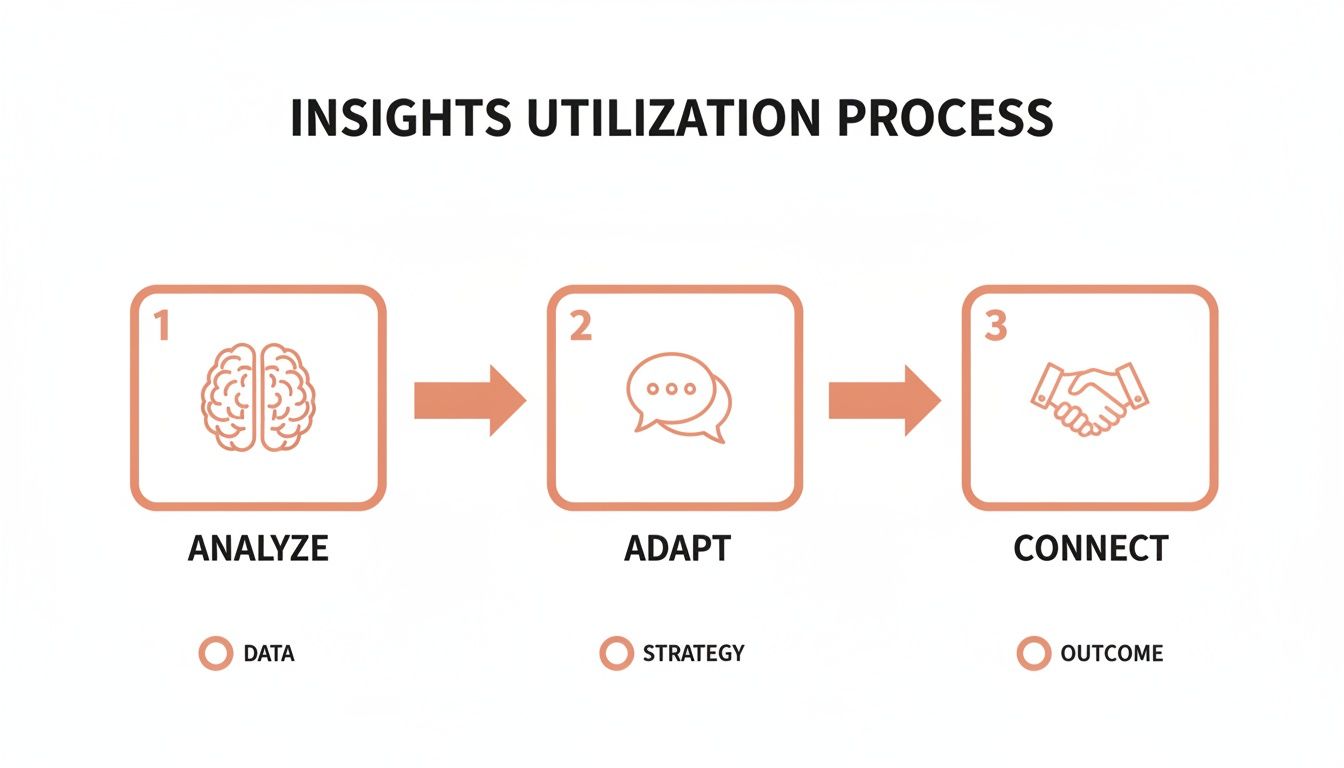
This flow is all about a continuous cycle: you first Analyse who your client is, then Adapt your messaging to match them, and finally, you Connect in a way that feels authentic and builds trust.
Prepping for a First Call with a Knight
Let’s get practical. Imagine you’re about to jump on your first call with a new prospect. Mindreader’s analysis flags them as a ‘Knight’ archetype. What does this tell you? Knights are direct, decisive, and laser-focused on results. The biggest mistake you can make is wasting their time with fluffy small talk.
Your preparation needs to reflect this right away:
- The Agenda: Ditch the long-winded intros. Make your agenda tight, punchy, and action-oriented. Lead with the outcome, not the process.
- The Opener: Instead of a generic "How's your week going?", try something more direct. "Thanks for making time. I know you're busy, so I want to jump right into how we can help you achieve [their specific goal]."
- The Pacing: Keep the conversation moving. A Knight appreciates efficiency and will mentally check out of a slow, meandering pitch.
By adapting your approach from the first second, you’re showing respect for their time and communication style. That alone builds instant credibility.
Navigating Objections from an Explorer
Okay, different scenario. You're in a product demo with a prospect identified as an ‘Explorer’. This archetype is all about innovation, big-picture ideas, and what the future could look like. During the demo, they hit you with an objection: "I'm not sure how this fits into our long-term vision."
A generic, feature-focused response will fall flat. But armed with archetype insights, you can pivot:
- Validate Their Mindset: Start by agreeing. "That's a fantastic point. Thinking long-term is absolutely crucial, and that's exactly where this platform really comes into its own."
- Connect to Future Possibilities: Don’t just talk about what your tool does now. Talk about where the industry is headed. "Many leaders in your space are moving towards [a future trend], and our solution is designed to put you ahead of that curve, not just help you keep up."
- Frame It as an Opportunity: Turn their objection into a reason to buy. "This isn't just about solving today's problem; it’s about giving you the agility to pioneer new strategies three or even five years from now."
This approach doesn't just counter the objection—it validates their visionary thinking and reframes your solution as the key to their future success. It’s a smart, data-informed communication strategy that boosts engagement and builds serious deal momentum.
This kind of adaptive communication is also crucial when dealing with older clients. A 2020 study in Laos, for example, revealed that a startling 49.3% of adults aged 60 and over showed signs of cognitive impairment, with women being more affected. For reps in Singapore's financial or real estate sectors, this isn't just an abstract statistic. Using archetypes to simplify your messaging for a ‘Healer’ or get straight to the point with a ‘Knight’ can be the difference between a confused client ghosting you and a conversation that builds deep, lasting trust. You can read the full research on cognitive health in older adults to better understand just how important this is.
Frequently Asked Questions
When you start digging into cognitive assessments and how they apply to sales, a lot of questions pop up. Let's tackle some of the most common ones we hear.
Is a Cognitive Functions Test the Same as an IQ Test?
Not at all. Think of it this way: an IQ test is like measuring a car's engine horsepower. It's designed to gauge raw intellectual ability and reasoning skills, giving you a score at the end.
A personality-style cognitive functions test, on the other hand, is like finding out what kind of car you're driving. It’s not about how powerful the engine is, but how you think—your preferred routes, your natural driving habits, and the communication styles you naturally lean into. It’s about the how, not the how much.
Can I Use These Insights to Profile Any Client?
While understanding communication styles is a massive advantage in any conversation, it's a tool that demands to be used responsibly. Modern systems are built for professional B2B interactions where the goal is to create clarity and build genuine rapport, not to play armchair psychologist.
The aim is always to adapt your own communication to connect better with a client, not to slap a label on them or shove them into a box. Ethical use is all about making the conversation more effective and respectful for everyone involved.
How Does This Differ from Standard MBTI or DISC Tests?
They might come from a similar family tree, but their real-world application is miles apart. Traditional tests like MBTI or DISC hinge on self-reported questionnaires. The problem? People’s answers can be subjective and often don't reflect how they actually behave under the pressure of a high-stakes sales call.
AI-driven systems today are a different breed entirely. Instead of asking for opinions, they analyse objective communication signals in real-time. But the biggest difference is that they provide sales-specific, actionable playbooks—not just a four-letter type. They translate the insight directly into what you should say and do next to move the deal forward, making them infinitely more practical in a sales workflow.
Ready to stop guessing and start connecting with precision? Mindreader’s Human Intelligence System gives you the actionable insights to understand how your clients think and tailor your approach for maximum impact. Discover how you can increase reply rates and build unstoppable deal momentum. Learn more at TheMindreader.ai.